Nose in a book

Reviews and other ramblings

  • Home
  • Reviews archive
    • Book reviews
    • TV reviews
    • Theatre reviews
  • TBR
  • Challenges
    • The Classics Club
    • 2014 Popular-Science Reading Challenge
    • Cookery challenge
    • The Gilmore Girls Reading Challenge
    • 2013 TBR Pile Challenge
    • 2013 Translation Challenge
    • Crime and Punishment read-a-long
  • About
    • Cookie legal stuff

Category: Reviews

Life wraps metaphors up in little bows

February 7, 2013February 4, 2013 2 Comments

Brain on Fire: My Month of Madness
by Susannah Cahalan

At the start of this year I made a vague promise to myself not to buy any new books or request any advance copies from publishers, and within two weeks I had failed on both counts. The first was a hopeless case anyway, but I really thought I’d manage the second. Until, that is, I read about this book in the Penguin Press Newsletter and absolutely had to read it.

Susannah Cahalan is a reporter for the New York Post, one of those annoyingly talented people who got her break as a journalist before she even left high school, but when she was 24 she suddenly descended into mental health hell. Her symptoms escalate quickly from lack of concentration and paranoia to mania and seizures, to the point where she has to be hospitalised, a time that she cannot actually remember so she has had to piece it together from doctors’ notes, interviews with family and friends, hospital video and her intermittent journal entries.

Cahalan’s journalism training serves her well. She tells her story with a fluid, gripping style, while doing a good job of explaining the medical facts. She comes across as intelligent and likeable, as well as remaining confused by her illness and how it has changed her life. To an extent, you can tell that she is a tabloid journalist, as she is both easy to read and prone to a few too many soap-opera/cliffhanger-style statements, but she doesn’t shy from the more complicated side of trying to understand her illness.

“Sometimes, just when we need them, life wraps metaphors up in little bows for us. When you think all is lost, the things you need the most return unexpectedly.”

It is a frightening story. Cahalan has no history of mental illness and yet is diagnosed in quick succession with bipolar disorder, alcoholic withdrawal, schizoaffective disorder and then psychosis but all attempts to find a medical explanation for her catatonic state initially fail. Her family is desperate to keep her out of the psychiatric ward and it is their tenacity, plus a little luck/good timing that finally gets the ball rolling toward diagnosis, treatment and recovery.

“It had cost $1 million to treat me, a number that boggles the mind. Luckily, at the time I was a full-time employee at the Post, and my insurance covered most of the exorbitant price tag…Unfortunately, there’s often not the same safety net in place for those with lifelong psychiatric conditions.”

I hesitate to compare my health problems with Cahalan’s, obviously our situations are totally different, but there were definitely moments I could empathise with. “I began keeping to-do lists…including insignificant things like ‘walk to town’ or ‘read the papers’ so I could experience the satisfaction of crossing them off.” I do that all the time. I hate to not do something useful every day, but fatigue and brain fog can make that tough. And Cahalan’s final diagnosis is an autoimmune disease, as mine is, so we have both had to figure out how to react to the idea that our own bodies are attacking us. Plus of course an autoimmune disease never really goes away. While Cahalan is currently in complete remission, she will always be waiting for the next flare up, always wondering if a sudden fit of jealousy or deja vu is genuine or a symptom.

It’s a very insightful, moving book. I was a little frustrated by the repetition of the question of whether she was the same person as before. I get that she felt she lost herself for a few months, that people who saw her during that time barely recognised her, and therefore getting her sense of self back was hugely important. But of course it will have changed her. Even if she is 100% medically recovered she has been through a huge experience. She was young, outgoing and driven and then she had breakdowns at work, lost interest in the world, accused her nearest and dearest of horrible things – of course that would change a person, at the very least as a huge knock to the confidence.

But minor quibbles aside this is a well written, brutally honest account of a life that falls apart and has to be painstakingly rebuilt. Plus it’s an important reminder that a person experiencing a manic or psychotic episode isn’t just crazy or even possessed, they’re a human being whose brain is sick, or as Cahalan’s doctor explains it, whose brain is on fire.

Published February 2013 by Penguin Books.

Source: This book was kindly sent to me by the publisher in return for an honest review.
Kate Gardner Reviews

Literature informs, instructs, it prepares you for life

February 1, 2013

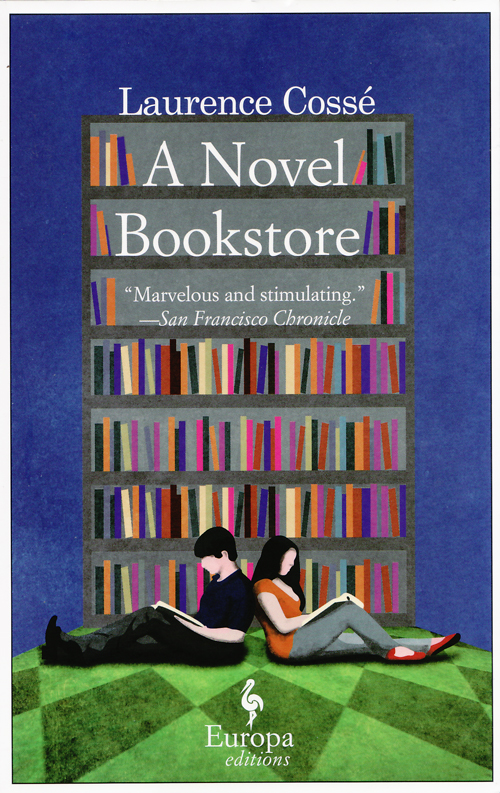
A Novel Bookstore

A Novel Bookstore
by Laurence Cossé
translated from French by Alison Anderson

Have you ever dreamed of opening a bookshop? Have you ever planned what it would be like, how it would be different from all those other bookshops? I can’t decide whether this book would encourage or discourage such an ambition but there’s definitely some wish-fulfilment going on.

The novel opens with a series of attacks on seemingly unconnected people. I don’t want to reveal too much, but the link is The Good Novel, a Paris bookshop opened by rich booklover Francesca and idealistic bookseller Ivan. They discover that they share the same dream of a bookshop that sells only great novels, and pour everything into making their dream a reality, but their shop strikes a nerve in French cultural circles and comes under increasingly severe attacks.

“If I spent my money restoring a Roman viaduct or any other masterwork of our heritage, everyone would think it was a very worthy cause. What we are doing is no different. We are investing our time and money to support and enrich our literary heritage, which is being threatened by forgetfulness and indifference, not to mention disarray in taste. Our cause is undeniable.”

I found that I couldn’t grasp the tone at first. And then just as I was getting the hang of it, there was an odd switch from crime drama to the idealistic story of setting up the dream bookshop. But it’s a surprisingly enjoyable read considering all the action is in the first three chapters.

At the core of the book is the debate between high and low culture. Francesca and Ivan have pinned their hopes on high culture: their choice of “great” novels is primarily classic or overlooked literary works. They opt out of the bestseller lists and new releases, which isn’t the most effective business model and isn’t entirely popular with publishers and other bookshops – it does admittedly smack of snobbery – but of course it’s the authors whose books aren’t chosen for sale at The Good Novel who express the most anger.

“The essential problem raised by the notion of literary value is that this value changes with time. A work that might have been hailed by its contemporaries seems trivial a hundred years later, perhaps even thirty years later. Inversely, another work that was judged unpleasant or uninteresting may now be praised to the skies.”

Personally, I’m torn which side I’m on. Not that I condone the attacks on The Good Novel. And I love heartfelt book recommendations, such as are at the core of Ivan’s bookselling style. But I think getting people reading is always a good thing, and those easy reads and bestsellers – they’re a big part of that process.

“Literature is a source of pleasure, he said, it is one of the rare inexhaustible joys in life, but it’s not only that. It must not be disassociated from reality…There are grown-ups who will say no, that literature is not life, that novels teach you nothing. They are wrong. Literature informs, instructs, it prepares you for life.”

This book is jam-packed with references to “great” books and you could make a very long recommended reading list from it, though how many of them would be available in English translation I don’t know. The other thing it has going for it is a sub-plot that’s a sweet realistic romance. I kept expecting darker things around the corner but this novel’s beauty is its simplicity.

“He had no more imaginary space, nowhere he could escape to, no more expectations, all he could do was make himself available to the present moment, to what was immeasurable, the terrible profusion of moments that make up a day.”

Au bon roman published 2009 by Editions Gallimard, Paris.
Translation published 2010 by Europa Editions.

Source: Won in a giveaway from Savidge Reads.

Challenges: This counts towards the 2013 TBR Pile Challenge.

Kate Gardner Reviews

Nightmares sneak out into the daylight

January 28, 2013July 9, 2015 2 Comments

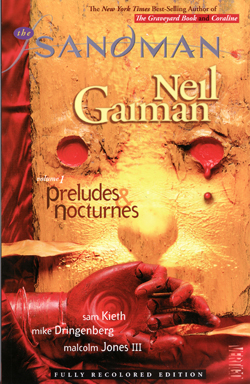
The Sandman

The Sandman Vol. 1 Preludes & Nocturnes
by Neil Gaiman (writer), Sam Keith, Mike Dringenberg and Malcolm Jones III (artists)

I have been told so many times that I should read The Sandman that I just assumed it would be wonderful. It’s Neil Gaiman, it’s a highly acclaimed comic-book series, it’s about dreams and nightmares – it sounded perfect. And it is pretty good, but I think my expectations were too high.

This is the first of 12 volumes, republishing the full original run of The Sandman. The artwork is beautiful in a dark, gothic style. The concept is fascinating and open-ended. Quite simply, the Sandman is the lord of the world of dreams, both good and bad. He can move in and out of the real world, magical realms and dreams themselves.

This volume has a clear complete storyline – in 1916 a magic circle tries to summon Death and instead gets the Sandman, whom they imprison for many decades. This has a terrible effect on the world – with no-one controlling the dream world, some people go mad, others just stay asleep for years. The Sandman must escape and regain control, but it won’t be an easy task.

“Daniel Bustamonte returns to his best dream. But this time the clouds are flimsy, frail, less real. And then the clouds aren’t there at all. Too scared to sleep, he sobs to keep himself awake until dawn.”

“Stefan’s case is new to the doctors. They thought they’d seen every form of shellshock. How long can a boy go without sleeping? When do the nightmares sneak out into the daylight? The morphine is proving useless. It’s sad.”

“Unity Kinkaid finds it harder and harder to stay awake. She now sleeps for almost 20 hours a day. She used to dream; to shift in her sleep, muttering and sighing, locked in half-remembered fantasies. Now she lies unmoving, breath shallow and silent, lost to the world. Unity sleeps.”

I liked the concept, I liked the story and the artwork, I like that it’s dark (even a bit grisly in places) but…I’m not sure exactly what was wrong but it didn’t grab me. The stuff about the world going mad without the Sandman was brilliant but over a little too quickly, I felt a lot more could have been made of it. And there was surprisingly little of the dream world depicted, but I’m sure that’s still to come. Only, I’m not all that bothered about reading the remaining volumes.

Maybe I was in the wrong mood. Maybe I should treat it as much as a work of art as a work of fiction. I’m not sure. I had half a plan to try The Books of Magic next. Perhaps I should lower my expectations first?

First published as The Sandman issues 1–8, 1988–1989, by DC Comics.
This edition published 2010 by Vertigo, DC Comics.

Source: I bought this from my local comic-book shop.

Kate Gardner Reviews

A parody of the writer

January 23, 2013 4 Comments

Aunt Julia and the Scriptwriter
by Mario Vargas Llosa
translated from Spanish by Helen R Lane

This was a book group choice and typically the meeting happened during the nasty cold snap we have had and I decided not to brave the freezing rain to attend. I did however have a brief Twitter chat about the book. Not quite the same but fun!

I knew pretty much nothing going into this book. I didn’t even read the blurb so the format came as a surprise. It’s the semi-autobiographical story (I learned that from Twitter; the copy of the book I had gave no indication) of Mario, a young man juggling a law degree, working full-time for a radio station in Lima, writing short stories and developing a relationship with an older woman (the Aunt Julia of the title, who is not strictly his aunt, but is always known as such). He largely manages this juggling act by never going to university and frequently skiving from his job, none of which seems to bother anyone nearly as much as him dating a 32-year-old divorcee.

(Incidentally this made me, having recently turned 32, feel pretty old. Not that I would dream of dating an 18-year-old, in fact that seems icky, but I do object to being considered old!)

Mario’s story is alternated with the radio serials written by Pedro Camacho, the scriptwriter of the title. This isn’t made clear though, so the first time the story switched I was a bit thrown, especially when it descended into melodrama. Camacho himself is an enigmatic character, with a mysterious background and very high-strung artistic temperament, not to mention some unusual working methods. And his radio serials are a huge hit:

“When I asked them why they liked soap operas more than books, they protested: what nonsense, there was no comparison, books were culture and radio serials mere claptrap to help pass the time. But the truth of the matter was that they lived with their ears glued to the radio and that I’d never seen a one of them open a book.”

Despite the element of auto fiction, there are some clear literary allusions at work. The radio serials are ridiculous but Mario’s real life becomes as crazy and farcical as the radio scripts had been to begin with. And there are various types of writing for a living explored. Camacho writes his radio soaps at formidable speed, churning out ten different storylines. Mario and his assistant rewrite news stories for radio. Mario writes short stories that are never published (usually based on real-life stories he has been told, in a bit of symmetry with the origin of this novel) and he dreams about moving to Paris to live in a writer’s garret. Despite being snide about the radio serials he admires Camacho’s dedication to his art:

“How could he be, at one and the same time, a parody of the writer and the only person in Peru who, by virtue of the time he devoted to his craft and the works he produced, was worthy of that name? Were all those politicians, attorneys, professors who went by the names of poets, novelists, dramatists really writers, simply because, during brief parentheses in lives in which four fifths of their time was spent at activities having nothing to do with literature, they had produced one slim volume of verses or one niggardly collection of stories? Why should those persons who used literature as an ornament or a pretext have any more right to be considered real writers than Pedro Camacho, who lived only to write?”

I found the main character a little frustrating, as 18-year-olds are wont to be, and would have preferred to learn more about Aunt Julia and the scriptwriter, who both remain a little mysterious. In fact, the overall style is detached enough that I didn’t greatly care how things turned out, though I was entertained enough to keep reading,

There are a few other themes covered. Obviously, love, though it’s always love of an overblown teenage/soap opera kind. There is nothing moving or romantic about any of the love stories in this novel. Another is memory. Mario is telling his story from later in life, giving a lot of detail about some days that you could argue the average person just wouldn’t remember. And there’s a character who starts having memory problems, but they’re not dealt with particularly sensitively. Instead they’re the source of comedy, which I found uncomfortable.

That wasn’t the only uncomfortable subject for me. The book includes racism, sexism and religious bigotry and, while they’re not passed off as acceptable views, they are used for humorous value. When I went back and read the blurb on the back of my copy it calls this a “comic novel” and I would argue that it is neither, though it has elements of both.

I found this a very slow read but at no point was it a struggle, I always felt I was enjoying it, so I would probably read Llosa again. What potentially interests me more, though, is that Julia Urquida, the “Aunt Julia” of the title, wrote her own memoir of her relationship with Llosa called What Little Vargas Didn’t Say. It sounds brilliantly bitter from that title!

La tia Julia y el escribidor published 1977. English translation first published in the USA in 1982 by Farrar, Strauss and Giroux.

Source: Bought secondhand via Abe Books.

Challenges: This counts towards the 2013 Translation Challenge.

See also: Mario Vargas Llosa discusses Aunt Julia and the Scriptwriter on World Book Club.

Kate Gardner Reviews

Man is many things, but he is not rational

January 15, 2013January 23, 2013 2 Comments

The Picture of Dorian Gray
by Oscar Wilde

I have had this sat on my shelves for ages because, even though I’ve watched and loved a few of Wilde’s plays and have fond memories of his children’s stories, something in me said this is old and “classic”, therefore it will be hard. It was not a hard read at all, it was a thoroughly enjoyable one.

I would say that everyone already knows the storyline, but I was surprised to discover how vague my understanding of it was before I started reading. So I will summarise. At the start of the novel, Dorian Gray is young, beautiful, charming and innocent, and is serving as a muse to painter Basil Hallward, who is a little obsessed with him and has just painted his masterpiece, a portrait of Dorian. Dorian remarks that he wishes the painting might grow old while he stays young and beautiful and…well, it happens, but more slowly and darkly than I had expected.

“Hour by hour, and week by week, the thing upon the canvas was growing old…The cheeks would become hollow or flaccid. Yellow crow’s feet would creep round the fading eyes and make them horrible. The hair would lose its brightness, the mouth would gape or droop, would be foolish or gross, as the mouths of old men are. There would be the wrinkled throat, the cold, blue-veined hands, the twisted body.”

Dorian, when he realises what is happening, slowly becomes quite bad. Is this the influence of life in general? The circumstance of being able to look fresh and beautiful no matter how guilty he feels? Is it how Dorian’s nature was always fated to develop? Or is it all the influence of Lord Henry Wotton, a friend he was introduced to by Basil on that fateful day when the portrait was finished? Lord Henry is a fun character, talking largely in aphorisms and painting himself as morally repugnant, but the key seems to be that he doesn’t mean half of what he says, whereas Dorian takes it all to heart.

” ‘I adore simple pleasures,’ said Lord Henry. ‘They are the last refuge of the complex. But I don’t like scenes, except on the stage…I wonder who it was defined man as a rational animal. It was the most premature definition ever given. Man is many things, but he is not rational. I am glad he is not, after all.’ “

This book is so very quotable. Even skipping the slightly trite aphoristic preface (which I have seen quoted from many times), the language is full of both delightfully Wildean phrases but also exquisite descriptions:

“There was a silence. The evening darkened in the room. Noiselessly, and with silver feet, the shadows crept in from the garden. The colours faded wearily out of things.”

The characters are interesting. I didn’t feel I ever got to know any of them well, but they are certainly varied and in some cases fascinatingly complex. Even those characters that might have been verging on caricature are described so well it hardly matters.

“The exaggerated folly of the threat, the passionate gesture that accompanied it, the mad melodramatic words, made life seem more vivid to her. She was familiar with the atmosphere. She breathed more freely, and…would have liked to have continued the scene on the same emotional scale, but he cut her short. Trunks had to be carried down, and mufflers looked for. The lodging house drudge bustled in and out. There was the bargaining with the cabman. The moment was lost in vulgar details.”

Nothing is straightforward and not all of the mysteries of the story are resolved. Which was sometimes frustrating – exactly what are the rumours circulating about Dorian? I can imagine, but I want to know! I suppose that’s one of the moments to remember that this was written in the 19th century – it rarely if ever feels that old.

First published in the July 1890 issue of Lippincott’s Monthly Magazine. Revised and published as a book in 1891 by Ward, Lock and Company.

Source: I have a chunky Complete Works of Oscar Wilde that I have owned for more than 10 years. I think I bought it for myself. Probably.

Challenges: This counts towards the Rory Gilmore Reading Challenge.

Kate Gardner Reviews

Don’t be so tough early in the morning

January 8, 2013January 25, 2013 1 Comment

To Have and Have Not
by Ernest Hemingway

I have been slowly working my way through a box set of Hemingway. At times completely brilliant, at others it was overblown, racist and inconsistent in style. I can see why it divides people.

The main character is Harry Morgan, a poor man who lives in the Florida Keys with his wife and daughters and, at the start of the book, makes a living in Cuba taking tourists out sea fishing in his boat. But with the depression starting to bite, a rich tourist doesn’t pay a large bill and Harry is forced to accept one of the more questionable business deals he repeatedly gets offered, marking the beginning of his slow decline into crime.

The structure is a little odd, switching between points of view, introducing detailed minor characters who sometimes have a role in the main story but often don’t. The tone and style is initially a lot like Raymond Chandler and it retains a touch of that throughout, though it does get both more real and more political.

“You know how it is there early in the morning in Havana with the bums still asleep against the walls of the buildings, before even the ice wagons come by with ice for the bars?…
‘Listen,’ I told him. ‘Don’t be so tough early in the morning. I’m sure you’ve cut plenty people’s throats. I haven’t even had my coffee yet.’
‘So you’re sure I’ve cut people’s throats?’
‘No,’ I said. ‘And I don’t give a damn. Can’t you do business without getting angry?’ “

There are some nasty characters in this book and Harry certainly isn’t blameless in his descent. He makes some bad choices, but he also has bad luck thrust upon him. The switches in point of view can be very revealing. For instance, Harry is genuinely in love and lust with his wife still but when another character describes her it’s a very unflattering picture that is painted, with a total lack of understanding for how the Morgans’ relationship might work.

Which is a theme, actually – assumptions about other people being proved wrong when the narrative switches to their perspective. There are some surprisingly modern touches, such as the smug misogynist painted as a fool. But Harry’s racism certainly isn’t modern. I can’t remember the last time I read the n*** word so many times in one sitting and it bothered me, but it wasn’t just casual terminology. Harry talks about various coloured people in demeaning stereotypes, painting them as less than human, and no amount of historical leniency can make me okay with that.

Hemingway does show some real knowledge of boating and fishing, with detailed descriptions of bringing a boat in to harbour or chasing down a marlin. Neither is my thing at all but even those sections kept me engrossed, which suggests they were written pretty well.

I’ll continue reading through my Hemingway box set but so far The Old Man and the Sea is still the high point for me.

First published 1937 by Charles Scribner’s Sons.

Source: Secondhand, I think from a book swap.

Challenges: This counts towards the Rory Gilmore Reading Challenge.

Kate Gardner Reviews

Christmas reads in brief

January 1, 2013January 1, 2013 1 Comment

As I may have mentioned once or thrice, most of our spare time lately has been spent chivvying builders/cleaning up after builders/redecorating. While I have managed to squeeze in some reading, I think I’m going to skip writing full reviews for this holiday and get back in the swing next week. That’s a good way to start the new year, right?

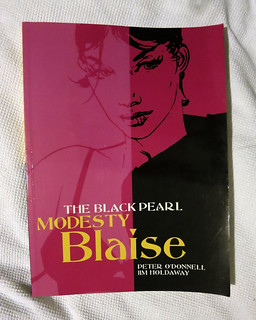
Modesty Blaise: the Black Pearl

Modesty Blaise: the Black Pearl
by Peter O’Donnell (story) and Jim Holdaway (art)

Modesty Blaise: the Green-Eyed Monster
by Peter O’Donnell (story) and Enric Badia Romero (art)

I punctuated my holiday with two volumes of the long-running comic strip about the very British super-capable heroine Modesty Blaise. As I’ve written about her before, there is little new to say. O’Donnell puts her in a variety of locations and intrigues but tries not to make his stories Bond-like, so although she has a good friend high up in the British secret service, she is not a spy. She is a gun for hire, but most of the time she finds her own work, happening, like a young sexy martial-arts-trained Miss Marple, upon crimes and capers wherever she goes. Some stories impressed me with their nuanced political intrigue but then there was the occasional racism that reminded me that this was popular culture in the 1960s and 1970s.

First published in the London Evening Standard and the Glasgow Evening Citizen 1966–1971.
These collections published 2004 and 2005 by Titan Books.

The Clothes They Stood Up In
by Alan Bennett

This tiny book is a novella about a middle-aged couple whose fancy flat is burgled while they’re out at the opera. Everything has been taken, even the carpets, light fittings, toilet rolls and telephones. It’s almost a farce, with the well-to-do middle class slowly picked apart as they try to navigate public telephones and immigrant-run corner shops. Bennett is of course spot-on with his observations and had me laughing out loud from page one. But it’s also moving, sad even, to see how unhappy marriage can be and how far apart people who live together and love one another can become. Highly recommended.

First published in the London Review of Books in 1996. This edition published in 1998 by Profile Books.

Wild Girls: the Love Life of Natalie Barney and Romaine Brooks
by Diana Souhami

On the back of the excellent Mitfords book I thought I’d try another biography. Unfortunately, this one was not as good. It felt a little rushed although perhaps they were really only interesting by virtue of the circles they moved in? Barney was a poet and Brooks an artist. Barney surrounded herself by the elite of Paris culture, particularly the gay section of that crowd, and had affairs with everyone (or rather every woman who would have her). Brooks started out in this crowd but became a recluse. Souhami tells of the wonderful long life of Barney versus the painful slow decline of Brooks and it’s sad but I never felt I had got to know either of them. Extracts from their passionate love letters are repetitive and overblown. Souhami’s intensive research has led to strange chaotic annotations/references in several different formats, which were near impossible to navigate when I actually wanted to. Interesting, but felt like it could have been more than it was.

First published in 2004 by Weidenfeld & Nicolson

So that’s what I read over the holidays. What about you?

Kate Gardner Reviews

There must have been some extraordinary quality

December 23, 2012 4 Comments

The Mitford Girls
by Mary S Lovell

The Mitfords weren’t really on my reading radar until I started book blogging (almost three years ago) and suddenly they were everywhere. After trying to read a volume of Nancy’s letters and failing to see the charm everyone else seemed to have found, I decided it might help to know more about the family and by a stroke of luck, spotted this biography in a charity shop. It worked, in that I am now completely smitten with the Mitfords.

This book is clearly extensively researched – there are 80 pages of notes, index and bibliography at the back – but it manages not to read as a dry product of research, as biographies sometimes can. This is partly due to Lovell’s clear affection for the family, though she only briefly spoke to, rather than knowing intimately, four of the sisters and recounts those meetings very honestly in her introduction. In fact, she does an excellent job of bringing to life her large cast who were largely dead or elderly at the time of writing. Of course, it doesn’t hurt that the Mitfords were such a very interesting bunch of people.

For those who don’t know, the “Mitford Girls” of the title are the sisters Nancy, Pamela, Diana, Unity, Jessica and Deborah, of whom only the youngest, Deborah, is still alive. For much of the 20th century they were household names, for various reasons. Nancy was a bestselling writer, author of many greatly admired biographies as well as novels including The Pursuit of Love that were heavily based on her own family. Diana married Oswald Mosley, leader of the British Union of Fascists, and was a staunch supporter of his political ideals despite decades of hatred from the British public. Unity went even further and became friends with Hitler, in fact was obsessively in love with him and tried to kill herself when Britain declared war in 1939, resulting in brain damage. Jessica was a card-carrying Communist, worked for the civil rights movement in the USA and became such an accomplished journalist that she lectured at universities including Yale and Harvard. Even the less-featured-in-the-headlines Pamela and Deborah lived the kind of lives most of us would find hard to imagine, born as they were the daughters of a Baron, hobnobbing with the great and good of Society, including John Betjeman (family friend), Evelyn Waugh (good friend of Nancy), Winston Churchill (their cousin by marriage), the Kennedys (related by marriage to Deborah) and Harold MacMillan (also related by marriage to Deborah), to name but a few.

I think, because the details were new to me, it was Unity’s story that I found most shocking:

“There must have been some extraordinary quality in Unity that not only attracted Hitler’s attention but caused him to establish a deeper relationship by continued invitations… Unity chatted to Hitler as she would to any member of her family, unselfconsciously bright, always seeking to amuse, entertain or impress. No-one else in his life dared to treat him in the casual manner that Unity adopted.”

Lovell’s job was not, I suppose, an easy one as so very much had previously been published about the family, often directly contradictory. As you might imagine from the differing political affiliations, there were some serious fallings out between members of the family and the combination of sisterly cattiness and a public profile that allowed them to publish their views on any subject in print meant that Lovell did have some work to do establishing the facts. However, sometimes I found this point pressed a little too hard, especially in the earlier sections where I, as a relative newcomer to the story, did not have any preconceptions and therefore got a little bit bored of being told what I had apparently got wrong. Lovell also had a lot of material to wade through, as no less than four of the sisters had written memoirs; they were all prolific letter writers and kept diaries; and being such high-profile figures, many biographies and documentaries of some or all of the family exist.

Despite the title, Lovell also writes quite a lot about the girls’ parents, Sydney and David, and the one brother, Tom. Tom, I suspect, would make a great subject for a biography of his own and does take a bit of a back seat here, though he was clearly universally adored.

My main criticism of this book (and bear in mind here that I thoroughly enjoyed it) would be that Lovell does seem to defend Diana and Unity’s political beliefs but remains critical of Jessica’s Communism (despite stating in her introduction that she would not take a political side). This was also the stance of the parents – Sydney in particular greatly admired Hitler, even after the war – and perhaps it is just that Lovell’s reportage of the opinions of family and friends seemed one-sided because their opinions were heavily sided against Jessica. In fact, on reading this I have come to admire Jessica most of all, as she was instrumental in early civil rights activism in the USA and spent her life bringing to light and campaigning against injustice. As she wrote of her youthful political awakening in Hons and Rebels:

“The discovery of other people’s reality – more than fifty million in England alone! – is one you can grasp from time to time, only to find it eluding you again, its vastness proving too much for you to handle. You discover suffering – not just your own suffering, which you know is largely of your own making, nor the childhood suffering over Black Beauty, David Copperfield or Blake’s Little Chimney Sweep – but you catch disturbing, vivid glimpses of the real meaning of poverty, hunger, cold cruelty.”

In fact most of the passages I marked in the book were about Jessica or noting something that annoyed me: Lovell’s adoption of some of the upper class language (“on non-speakers”, eurgh), her insistence on using nicknames throughout, her repeated use of the phrase “at the height of her beauty”. Except for this one passage, which illustrates the warmth and joy the sisters seemed to be filled with:

“For Nancy, Paris increasingly became the beau idéal of life. She found there an elegance, glitter, warmth and freedom that were lacking in London. One could be uninhibited there without drawing clucks of disapproval, ‘I have often danced all down the Champs Élysées,’ she wrote to Tom, ‘and no-one notices, they are so used to that sort of thing…Oh, I am so excited.’ “

And that’s what makes this a good read. The Mitfords were/are such wonderful characters. I foresee a lot more of them in my reading future!

First published by Little, Brown and Co in 2001.

Kate Gardner Reviews

He doesn’t have the sense of a billy goat

December 14, 2012December 14, 2012

Fried Green Tomatoes at the Whistle Stop Cafe
by Fannie Flagg

This was a book club pick and I thought somehow that it would be light and fluffy and girly, possibly because that’s how I remember the film (though on rewatching the film this week I discovered it’s not really those things either). It’s certainly an easy, enjoyable read, but it covers a lot of issues without labouring the point and has some very interesting things to say.

In the 1980s middle-aged Alabama housewife Evelyn Couch is visiting a nursing home and gets talking to a resident there, Mrs Ninny Threadgoode. Ninny is old and a little forgetful but also charming and immediately launches into stories about her early life in a small town called Whistle Stop. At the heart of these stories are Idgie and Ruth, the two women who ran the Whistle Stop Cafe from 1929 until it closed. However, inbetween there are snippets about other characters from the town and their lives, all told with a wonderful sense of humour.

“This skinny little man, so black he was a deep royal blue, had caused a lot of trouble for the opposite sex. One gal drank a can of floor wax and topped it off with a cup of Clorox, trying to separate herself from the same world he was in. When she survived, claiming that the liquids had ruined her complexion for life, he became continually uneasy after dark, because she had snuck up behind him more than once and cracked him in the head with a purseful of rocks.”

And at that level it all sounds a bit twee. But this book covers racist violence, domestic abuse, homosexuality, prostitution, extreme poverty and death, which is some pretty dark stuff for a story that’s so nice and chirpy on the surface. I know some at book group felt that this meant none of the themes were really explored, but were just thrown in there, and certainly the only subjects really talked about are female empowerment and death.

But then one of the running themes in this book is not talking about important things. Idgie and Ruth are a couple, which you would think was a big no-no in a small southern US town in the 1930s, but the whole town seems to know and just accept the situation. I wondered if this was because they all consider Idgie an honorary man. She certainly not only joins in with but often takes lead in hunting, fishing, gambling, drinking and the other manly pursuits of the town. But she’s far from being the only strong woman in town.

“Cleo, Idgie’s brother, was concerned…
‘Idgie, I’m telling you, you don’t need to feed every [hobo] that shows up at your door. You’ve got a business to run here. Julian…says he thinks you’d let Ruth and the baby go without to feed those bums.’
…’What does Julian know? He’d starve to death himself if Opal didn’t have the beauty shop. What are you listening to him for? He doesn’t have the sense of a billy goat.’
Cleo couldn’t disagree with her on that point.”

Each chapter takes a different source or viewpoint, so there’s Evelyn’s daily life, Ninny’s reminiscences, the Whistle Stop newsletter and other newspaper articles, and occasionally a plain old omniscient narrator. There’s also lots of jumping back and forth in time, which was confusing at first because there seemed to be sections that were unrelated, but by the end it all ties together. And also, in the end there is no single character who knows everything that the reader does, which I quite liked.

Generally, I found what could have been a heavy-handed moral tale a much more subtle look at life in the southern US. The one unsubtle message was about strong women. Really, it’s Evelyn’s story, and she is discovering through Ninny’s stories how unhappy she is with her life, downtrodden and ignored by her husband.

“After the boy at the supermarket had called her those names, Evelyn Couch had felt violated. Raped by words. Stripped of everything. She had…always been terrified of displeasing men…She had spent her life tiptoeing around them like someone lifting her skirt stepping through a cow pasture.”

As someone at book club pointed out, at the novel’s heart is the power of storytelling. Ninny’s stories have to be good for us to believe they would have such a profound effect on Evelyn. And it is all a rollicking good yarn, with a running theme of tall tales.

I seem to be saying this of every other book at the moment, but I think I would get a lot out of re-reading this.

First published 1987 by Random House.

Kate Gardner Reviews

It is the ideas and stories that count

December 9, 2012 4 Comments

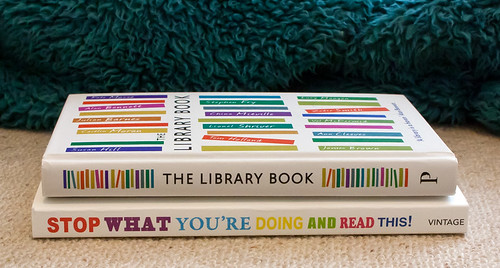
Stop What You’re Doing and Read This!
by various authors

Slightly meanly, I think, the publisher has not credited anyone as the editor of this collection of essays on the topic of reading. Even the introduction is simply signed “Vintage Books, 2011”. I bought this book on a whim at the same time as The Library Book, as they were both pretty and colourful and contained essays by interesting people.

Foyles haul

I think it’s probably not surprising, then, that my reaction to this book is very similar to my reaction to The Library Book. Hit and miss. But perhaps to more of an extreme in this case. The hits had me nodding my head furiously, while the misses in some cases had me furious.

I like that the 10 essays are not only written by big names. They include novelists, poets, publishers, journalists, academics and the founder of a charity, the Reader Organisation. And the wide topic allowed them to take very different angles. Blake Morrison writes intelligently and profoundly about the pleasures and benefits of reading, including why poetry matters:

“It takes courage to own up to dark thoughts and dangerous feelings. But poetry – the most intimate yet public of forums – is the ideal place. Ted Hughes is one writer who recognised this. Writing, he said, was about facing up to what we were too scared to face – about saying what we would prefer not to say, but desperately need to share.”

This illustrates what my favourite of these essays do well – they quote widely, creating a whole reading list for me within their few pages of eloquent argument. Carmen Callil writes interestingly about books in her life and how being a woman in a man’s world led her to found Virago. She shows a great, warm love for books. Tim Parks, in contrast, goes negative. He generalises the average westerner as someone who either doesn’t read or only reads the latest big title:

“If we read fast, superficially, for plot, to get through, so as to congratulate ourselves…we’re not only missing out on certain pleasures, we’re actually putting ourselves at risk, leaving ourselves open to messages and attitudes we haven’t weighed up…”

Not only is this quite ungenerous, not to say judgemental, but I also think it’s wrong. Different books have different effects on us and who is he or I to tell someone that they shouldn’t read a certain book because we didn’t get anything from it? Thankfully Mark Haddon says entirely the opposite:

“This, I think, does a disservice both to readers and to the books themselves…because it’s not true. Visit a prison library and you’ll meet good people whose lives have been saved by potboilers, and psychopaths reading Jane Austen.”

But Haddon also writes intuitively about the act of reading itself:

“Stop reading right now. Look around you…The sense of being inside looking out, of seeing a world that belongs to everyone, but is nevertheless yours alone. It is this uncrossable gulf between me and not-me, between my private experiences and yours, which lies at the heart of being human and which no other medium can touch, and this border is where the novel lives and moves and has its being.”

And then Jeanette Winterson went and ruined it by returning to Parks’ snobbery and turning it up to 11. She goes from praising the King James Bible and Shakespeare to:

“We live under 24/7 saturation bombing from an enervated mass media and a bogus manufactured popular culture. If you don’t read you will likely be watching telly, or on the computer, or listening to fake music from puppet-show bands…The consequences of homogenised mass culture plus the failure of our education system and our contempt for books and art (it’s either entertainment or elitist, never vital and democratic), mean that not reading cuts off the possibility of private thinking, or of a trained mind, or of a sense of self not dependent on external factors…Attention Deficit Disorder is not a disease; it is a consequence of not reading.”

What?!! There is so much wrong with these statements. That last sentence…whooah! Has she ever expounded her theory to a doctor or ADHD specialist? I’d be interested to hear their response! I mean, I think reading is important and rewarding, but that really is taking it too far. And as for her comments on modern pop culture, well that’s her own personal taste and to extrapolate from her dislike to such disparagement is unkind and even ignorant. Music can transport me, make my heart race and my emotions surge – and I don’t mean classical music here, I mean rock, folk, dance and pop music. Not every song, or course, but plenty that I am sure Winterson would turn her nose up at. And let’s not forget that Shakespeare was the pop culture of his day.

I think in general it is a stubborn clinging to the past that frustrated me. A few of the essayists write about how the physical printed book is intrinsically better than ebooks, and how new technology and mass media threaten today’s youth and therefore the entire world. Personal preference is one thing, but I think we have to face up to the fact that we live in an age of transition and be positive about the possibilities the future offers. The final essay by Maryanne Wolf and Mirit Barzillai addresses this well:

“The Greek transition from an oral culture to a literacy-based culture provides a valuable analogue…Socrates argued that the seeming permanence of the printed word would delude the young into thinking they had accessed the essence of some aspect of knowledge, rather than simply decoded it…Will [today’s] young people immersed in technological innovation become adept at prioritising, sorting and critically evaluating information, adapting different types of reading styles based upon their purpose…Will the flexibility of digital text actually enhance the reading experience for many readers, propelling them into a deeper engagement with text, or will such enhancements serve as further distraction?”

I accept that my own preference for reading novels in hard copy is a product of my life to date, but I didn’t exactly dislike my brief dalliances with a borrowed Kindle and I absorb most of my journalistic writing via computer these days. I think a love of music, film, TV, comedy and theatre complements my love of reading, rather than detracting from it (though I won’t deny that they are all competing for my time). I think reading is important, valuable and worth encouraging in others but it is not about to disappear. As Callil says in her essay:

“The human race has been telling stories, and trying to record them on papyrus, on manuscripts, on stones, since the beginning of time. Whether we read on the printed page or on a machine is beside the point. It is the ideas and stories that count.”

Published 2011 by Vintage.

Kate Gardner Reviews

Posts pagination

1 … 50 51 52 … 72

Archives

RSS feed: Nose in a book Nose in a book

  • Non-Fiction November 2026
  • Book review: The House of Doors by Tan Twan Eng
  • Book review: Taiwan Travelogue by Yáng Shuāng-zǐ

Me on the internets

  • @kate_in_a_book@mas.to (Mastodon)
  • Flickr/noseinabook
  • Instagram/kate_in_a_book
  • StoryGraph/kate_in_a_book

Categories

  • Blog
  • Reviews
  • Uncategorized
  • © Copyright Kate Gardner. All rights reserved.
Proudly powered by WordPress | Theme: Dream by vsFish.