Nose in a book

Reviews and other ramblings

  • Home
  • Reviews archive
    • Book reviews
    • TV reviews
    • Theatre reviews
  • TBR
  • Challenges
    • The Classics Club
    • 2014 Popular-Science Reading Challenge
    • Cookery challenge
    • The Gilmore Girls Reading Challenge
    • 2013 TBR Pile Challenge
    • 2013 Translation Challenge
    • Crime and Punishment read-a-long
  • About
    • Cookie legal stuff

Category: Reviews

And we got back to work

December 5, 2012

The Restraint of Beasts
by Magnus Mills

I was sent this book by an old friend in a book swap and I can see why he chose it. It’s a comedy of a pretty niche sort and I think you’d have to know someone well to confidently recommend this to them. I was amused, so thanks Matt.

Mills takes a very simple story of everyday working class life, with all the drudgery and repetition that real life entails, and injects a few bizarre moments and a lot of black humour. Tam and Richie are Scottish fencers working under the supervision of the unnamed narrator, who must cajole and harass them into doing their job. Early in the novel, their employer sends them away from rural Scotland to equally rural west England to erect specialist fences for a grumpy farmer. The three main characters must share a small, dilapidated caravan and all they have to look forward to, aside from going home to Scotland when the job is finished, is their nightly visit to the local pub. When they come across local fencers the Hall Brothers, they think they have inadvertently trodden on toes and are in trouble for it, but the tale turns out to be much stranger than that.

Or does it? At the end I had quite a few unanswered questions. There are a number of things said that seem to be evasions or euphemisms that are not explained. Everything is sinister and suspect. A talk from the boss will be built up to as a climactic event, while the real big drama just happens with a shrug. The humour is understated and dark.

“Tam slowly advanced on the sheep, chisel raised like a dagger, getting within a few yards of the animal. Then suddenly he sprang forward.
‘Tam, no!’ I yelled.
The sheep instantly bolted, and Tam fell forward onto the ground…
‘What are you doing?’ I said.
‘I was just seeing if I could catch it, that’s all,’ he replied.
‘Why?’
‘In case we have to eat them.’
‘Why should we have to do that?’
‘Well, there’s fuck all else, is there?’ He looked desperate…
I made Tam promise not to kill, or practise killing, any sheep, and we got back to work.”

Tam and Richie are harmlessly useless. Work-shy and thoughtless to the point of stupidity, they spend all their money (and more, in the form of loans from the narrator) on beer and cigarettes. But they’re sweet in their reliance on one another and they’re happy enough with what they have. When persuaded to work they are good at their job and often it’s easy to sympathise with their reluctance to work – when it’s cold and raining and they just want to be finished and home for Christmas, for instance.

I’m not sure if a point is being made or if it’s just intended to be funny but there are a lot of conversations in the novel where a manager gives an impossible order or wilfully misunderstands an employee. The story is certainly firmly on the side of the main three characters – the working men. It doesn’t try to make big statements about society or the state of Britain but you could argue that this one small example does illustrate issues such as employment rights, debt and heavy drinking.

I did find the tone and subject disorienting at first. Mills worked as a fencer for years and has included a lot of detail about the job in his prose. And the tone is so very dry that it took me a while to pick up on the irony at work. But a chapter or so in it clicked for me and I found myself grinning through the rest of the book.

Published 1998 by Flamingo, an imprint of HarperCollins.
Shortlisted for the Booker Prize and the Whitbread First Novel Award. Winner of the McKitterick Prize in 1999.
Kate Gardner Reviews

To define happiness, its one clean note

November 26, 2012

Seducing Ingrid Bergman
by Chris Greenhalgh

When I spotted this title in the Penguin Press Newsletter it wasn’t so much Bergman’s name that attracted me – though she was a great actress and some of her films are deservedly classics – but that of the other half of this brief affair – war photographer Robert Capa. Photography interests me as a hobby and as an art form and I was interested to see how that would be handled within a novel about one of the medium’s legendary names.

It’s a great story that has all the right ingredients for becoming a great film, but it didn’t immediately click for me. Despite a dramatic, well judged opening that contrasts Capa parachuting into enemy territory and being shot at in March 1945 with Bergman receiving an Oscar in a glittering ceremony in Hollywood, I found myself noticing the writing, tutting at all the similes that would have served better as metaphors and the slightly obvious parallels drawn with photography wherever possible:

“…involuntarily she repeats the way Pia had wrinkled her nose, closing both eyes at the same time as though taking a photograph.”

However, I think perhaps I just took a while to get over the fact that these were real people and that I had been expecting something that felt a bit more like historical fiction or even biography. Because this is solidly a novel, ascribing thoughts and fears and feelings to its characters and even using first person for about half of the narrative (always as Capa). And as I gradually got pulled into the story I began to thoroughly enjoy it and even to pick out well written passages:

“We watch as the light rises, giving the world shadows. The grey shapes of the trees on the boulevards hold their breath for the heat of day. And behind the buildings the sun comes up with its liquid edges.”

The bulk of the story is set in Paris, where Bergman is sent to entertain troops and Capa is based in-between assignments. Greenhalgh does a good job of describing Paris, primarily in a romantic light but with the occasional touch of realism, such as very funny observation about a high class cafe having a hole-in-the-floor toilet, and Capa imagining all the fancy ladies in their high heels squatting over the filth and being impressed by them emerging looking flawless.

I must admit, and this may be largely my own cynicism, that I found the early descriptions of the affair saccharine to an annoying degree:

“I don’t know whether it’s the music or Ingrid sitting there, her spoon poised over her ice cream, but everything merges at this moment – the leaves, the sunlight, the scent of vanilla, the street with its sliced shadows – and if I had to define happiness, its one clean note, well, this is the closest I’ve come to it.”

For me, it was everything else in their lives that captivated me, for instance when Capa had flashbacks to wartime and was terrified and yet would profess later that day a desire to get back to work, meaning another war. Or descriptions of Bergman making films I know and love, such as Notorious.

Perhaps I would have been better off reading biographies of these people and an anonymous love story, but the one advantage this novel does have is that you know from the start (or at least I did) how it ends, you know that this was not the only love either person experienced in their lives, nor even the most dramatic one, and yet while it lasted it was all those things and more, because that’s how life and love are. And I do now want to go back to Capa’s photographs and Bergman’s films, which is after all their legacy, not who they loved.

This book was kindly sent to me by the publisher in return for an honest review.

Published November 2012 by Penguin Books.

Kate Gardner Reviews

She believed in the worst and knew herself to be imagining the best

November 23, 2012 5 Comments

Saplings
by Noel Streatfeild

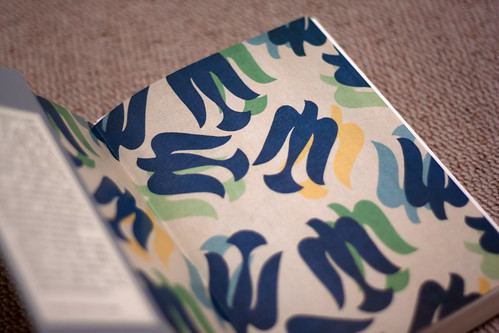
This is one of those books that I wished didn’t have to end, though in a way I was glad that it did because it’s the tale of a downward spiral. It’s also a beautiful book physically, being my first (finally!) read from Persephone Books.

End paper gorgeousness

Streatfeild is famous for her children’s books, especially Ballet Shoes, but she also wrote books for adults, though they never sold as well. This may possibly be the pick of the bunch but Saplings is so wonderfully good that I am saddened it’s the only one of Streatfeild’s novels for adults currently in print.

It’s a clever, sharply observed book about children, family and war. The Wiltshires are a happy, comfortable middle-class family, with two parents, four children, a nanny and a governess, a home in London and holidays to the seaside. But from the first pages the potential cracks are there. The adults are worrying about the inevitability of war and whether London is a safe place for children. The father Alex worries that war will take him away from his family. The mother Lena worries that she will have to go with the children when all she wants is to be at Alex’s side. The baby of the family, four-year-old Tuesday, frets because the adults are clearly worried, while 11-year-old Laurel mixes together war-time fears with more mundane worries about school:

“She believed in the worst and knew herself to be imagining the best. As a shield she made loud fun of all war precautions…It didn’t matter being the plain one at home, people were used to it. If only she had managed to be super at something, then she could have gone to the Abbey School carrying her ability like a screen.”

The story follows the family from summer 1939 until summer 1944, such a short time but of course one of huge change for Britain as a whole. Streatfeild never tries to extrapolate the wider changes going on, she simply illustrates them through the Wiltshires and their extended family and friends. Things do not just suddenly fall apart, the descent from happiness is gradual. Some of it is unavoidable – evacuating the children to their grandparents’ house and then to boarding school, for their own safety. But a lot of what happens is far more subtle. Things aren’t said that should be, expressions are misunderstood, situations are mishandled. It is a heartbreaking study of avoidable unhappiness. And I thought this passage a very good description of a panic attack:

“He saw the attacks as if they had shape. Huge, black and soft, ready to fall on him…First he felt a tenseness in his diaphragm, which got steadily worse til he was hard in front, as if he were made of wood. Then he had a sinking sensation. The people around him were still there but on a different level, beyond reach…he had to get away alone and let the attack reach its climax. Then everything swam before his eyes, his heart beat quicker and quicker, there was thumping in his ears…”

The prose in insightful rather than poetic but once I realised that the slightly irritating idyll of family life at the start of the story was both part-facade and about to break apart anyway, I was carried along by the momentum of the story. Streatfeild does not keep surprises or mysteries up her sleeve, the narration is open in a way the Wiltshire family never can be. If anything this lesson may be repeated a little too often, but it is such a realistic one, touching on both the stoicism of wartime and the very English habit of keeping one’s emotions to oneself. She does allow herself a few characters who know the children well enough, or are just observant enough, to see what other adults don’t, but the wartime setting keeps these saviours away for long periods.

And without wishing to give anything away, everything is not alright in the end. Bad things have happened and those who are in a good or safe place know that it may not last. This was, after all, published while the war was still going on, and after several years of “It’ll all be over by Christmas,” optimism had faded, even when things were finally going well for the Allies. But also, the two oldest children, Laurel and Tony, have grown up over the course of the story and are 16 and almost 15 at the novel’s close, so they are seeing the world differently in more ways than one.

This is a story full of heart, and completely on the children’s side. Even the best of the adult characters gets thing wrong from the children’s perspective, and Streatfeild shows how a thoughtless word or imagined slight can lead to months of real misery. I wanted so badly for things to suddenly be all good, but of course life isn’t like that.

I chose this book after reading Liz’s review and it was bought for me by my very loveliest friend H who took me on a special trip to Persephone Books a few months ago. Thanks to both of them!

First published 1945 by Collins.
Published by Persephone Books in 2000.

Kate Gardner Reviews

Time is supposed to measure history, isn’t it?

November 15, 2012 1 Comment

The Sense of an Ending
by Julian Barnes

This book has left me puzzled. I was happily reading it, enjoying the slow, thoughtful prose, and then the last page happened and I thought, “What?!” Is that a standard sign of a Booker prize winner? Or is it just my standard reaction to Julian Barnes?

It’s a little difficult to discuss this book without giving too much away. It’s so short, only 150 pages, and is one of those books where you could say very little happens, or that a lot happens. Which is fine. The language is beautiful, measured and philosophical.

Briefly, narrator Tony Webster is retired, divorced, but generally happy with his ordinary life. Then something happens (and we don’t find out what until halfway through) to remind him of his childhood friend Adrian. Adrian was always the brilliant, serious, passionate one and Tony muses on the lost passions of youth, love, friendship, life and death. There’s a lot of musing.

“The history that happens underneath our noses ought to be the clearest, and yet it’s the most deliquescent. We live in time, it bounds us and defines us, and time is supposed to measure history, isn’t it? But if we can’t understand time, can’t grasp its mysteries of pace and progress, what chance do we have with history – even our own small, personal, largely undocumented piece of it?”

Through flashback, Tony revisits his childhood and early adulthood. During the story he is led to question his memory, not just of events but of other people’s experiences of the same events. Which isn’t exactly original, but it’s done reasonably well.

“I must stress that this is my reading now of what happened then. Or rather, my memory now of my reading then of what was happening at the time.”

The storyline annoyed me but the writing was provocative, intellectually stimulating. I’m glad I read it but I’m not sure I rate it as highly as other Booker winners I’ve read. I know a few people have said that it’s a book that demands re-reading so perhaps I should do that to see if I missed something?

“It ought to be obvious to us that time doesn’t act as a fixative, rather as a solvent. But it’s not convenient – it’s not useful – to believe this; it doesn’t help us get on with our lives; so we ignore it.”

Published 2011 by Jonathan Cape.
Winner of the Man Booker Prize 2011.

Kate Gardner Reviews

Each of us has only a quantum of compassion

November 8, 2012 2 Comments

Tinker, Tailor, Soldier, Spy
by John le Carré

Audiobook read by Michael Jayston

Many years ago I was sent a free copy of this novel (I think as a welcome gift to one of those book-buying clubs; I loved those when I was a teenager with my first part-time job) and I turned my nose up at it. It sat for years on the bookshelf and is probably still there at my Dad’s house faded and unread. Then when the film came out last year one of the newspapers offered the audiobook free to its readers, so I downloaded the mp3s and finally got round to listening to it over the past few weeks.

I have discovered more about me and audiobooks, I suspect, than I have about the book itself. Because it turns out I’m not great at listening to audiobooks, especially not during my commute (when I usually listen to podcasts). My mind wanders; I don’t always have a free hand to turn up the volume when the traffic noise drowns out the narrator; if I see someone I know I get chatting and fumble over hitting pause. I had more success listening to it at home while doing housework or, my favourite discovery, while having a bath (so much better than getting a nice book wet!). But even when giving it my full attention without distracting background noise, I still struggled a little. I think I just don’t take in information as well audibly as I do when I read it. I missed being able to flick back through the pages to check a name or other detail. I missed marking quotes I liked. Which was a real shame because there were some gems in here. I cribbed these off Goodreads:

“’I have a theory which I suspect is rather immoral,’ Smiley went on, more lightly. ‘Each of us has only a quantum of compassion. That if we lavish our concern on every stray cat, we never get to the centre of things.’”

“The more identities a man has, the more they express the person they conceal.”

For those who haven’t read the book/seen the film/watched the TV show, this novel follows George Smiley, a spy who was forced into early retirement from MI6, as he is persuaded to help former colleagues track down a mole within the British ranks. Le Carré really brings alive the day-to-day existence of a spy, often humdrum, occasionally explosively exciting, always suspicious. I loved the language of Le Carré spycraft – how MI6 is “the circus” because it is (fictionally) located at Cambridge Circus in London; how babysitter, caretaker, janitor and mother are all euphemisms for jobs within the circus (there are others too that I missed; see this list for more); and terms I remembered from the brilliant children’s book I had of spycraft, which I think was a forerunner of the Usborne Spy’s Guidebook.

The story is heavily political, with real ambiguity about whether any of what any of the spies is doing is of use to their country, or humanity at large. There’s a lot of men talking in rooms, as I believe Mark Kermode said of the film, and what action there is is in flashback. There are two main narrative threads – the main one following Smiley and an occasional one following a former spy called Jim Prideaux, who is now working as a schoolmaster at a boarding school in Somerset and has developed a sweet facsimile of a spymaster–apprentice relationship with one of the boys there. The latter thread was more immediately accessible and has made me interested in Le Carré’s earlier novel A Murder of Quality, which sees Smiley investigate a murder at a boarding school. (Incidentally, I hadn’t realised this wasn’t the first Smiley novel and now hope I can read the earlier ones without plot points having been spoiled for me.)

Michael Jayston’s narration was spot-on and it was only a small surprise to discover that he played a main role in the 1979 TV series. I loved his voice for Smiley, a quiet, almost bored, quickly forgettable tone perfectly in keeping with Le Carré’s description.

I wish I could properly assess Le Carré’s writing but, aside from knowing that there were many brilliant phrases that stood out for me, I don’t think listening to the words allows me to be sure of my reaction the way reading them would.

First published 1974 by Hodder & Stoughton.

Kate Gardner Reviews

We invent memories without thinking

November 5, 2012 2 Comments

Before I Go to Sleep
by S J Watson

I think this may be one of those books that is best not analysed. While reading it I thoroughly enjoyed the ride, was gripped even, but since putting it down I have been picking it apart.

The story is that of Christine who has an unusual form of amnesia whereby she is only able to retain new memories until she falls asleep, so each morning she wakes up not knowing where she is or who the man lying next to her is. Every day this man must explain that he is her husband Ben and that she is 47 years old, not in her early 20s as she feels. The novel begins with her meeting a doctor who gives her a journal he says she has been keeping. On the first page is written “Don’t trust Ben”. And so begins a rollercoaster ride of paranoia and uncertainty.

“The bedroom is strange. Unfamiliar. I don’t know where I am, how I came to be here. I don’t know how I’m going to get home.”

The writing is simple, effective and without flourish. I did not mark any notable quotes while reading but I didn’t cringe at anything either. It’s a thriller that does its job and does not try to be any more than that. Which is fair enough. And I was hooked while it lasted.

“We’re constantly changing facts, rewriting history to make things easier, to make them fit in with our preferred version of events. We do it automatically. We invent memories. Without thinking. If we tell ourselves something happened often enough we start to believe it, and then we can actually remember it.”

But when it ended I began spotting plot holes, mostly relating to the ending, so I won’t discuss them. One failing is that the majority of the book is supposed to be Christine’s journal, but it doesn’t read like a journal at all. Another failing is, I suppose, a product of the amnesia plot device: Christine has no real character and all the people she meets essentially seem the same to her – friendly-seeming but potentially lying and therefore slightly creepy.

There are some criticisms I have heard from elsewhere that I don’t agree with. While the form of Christine’s amnesia seems too good to be true for a thriller writer, it is actually based on real-life cases (the author’s bio says rather vaguely that he worked for the NHS). And a few people said they guessed the end and were therefore disappointed. While the ending was one possibility that occurred to me early on, it wasn’t the only one. I probably won’t re-read this, but it was a good read at the time.

Published 2011 by Doubleday, an imprint of Transworld.

Kate Gardner Reviews

Life is only worth living because we hope it will get better

October 31, 2012 4 Comments

Swimming Home
by Deborah Levy

I had heard quite mixed reviews of this novel but it was on the staff picks shelf at the very lovely Mr B’s Emporium of Reading Delights in Bath so I took a chance. I can see why it has divided people. As the blurb says, “it wears its darkness lightly”.

The set-up is that familiar one of the middle-class English family holidaying in a villa on the French Riviera when a stranger intrudes. Or is it? There are clues throughout that things are not what they seem and to the last page I was not sure if all or any of the events recounted had actually happened.

“He leaned his head out of the window and felt the cold mountain air sting his lips…They knew the past lived in rocks and trees and they knew desire made them awkward, mad, mysterious, messed up…He asked her again to please, please, please drive him safely home to his wife and daughter.
“‘Yes,’ she said. ‘Life is only worth living because we hope it will get better and we’ll all get home safely.'”

What it appears to be is the story of famous poet Joe Jacobs and his absent war correspondent wife Isabel, whose marriage is breaking down. But there’s also their teenage daughter Nina, childlike for her 14 years but trying to be one of the adults. And there’s family friends Laura and Mitchell, a couple who run a boutique shop in London and who never seem comfortable in this holiday setting. And then there’s Kitty Finch, the stranger who turns up floating naked in their outdoor swimming pool, unembarrassed by her nakedness or the apparent mix-up that has brought her there.

There are some plot threads that seem so inevitable that Levy has put their conclusions on the first page to save the reader wondering. Yes, we do have a philandering husband and a beautiful, strange young woman thrown in his path. Yes, we do have characters dealing with depression and thoughts of death. And if you take it all at face value then you might say that what happens is no more than the sum of these parts. But I think that the writing demands more of its reader.

There are two obfuscating themes: identity and fiction. Joe, we learn early on, is Jozef to his wife, JHJ to his readers. Everyone lies or withholds information or tells different versions of the truth. Not only is Joe a poet, but Kitty is an aspiring writer eager for his opinion of her work, and then later in a section told from Nina’s perspective there are short poems thrown into the narrative as if she, too, is a poet, an inventor of fictions. Characters seem to repeat each other’s words or actions as if the novel is being rewritten even as you read it.

“No one dared say they minded, because the war correspondent was controlling them all. Like she had the final word or was daring them to contradict her. The truth was her husband had the final word because he wrote words and then he put full stops at the end of them.”

Add to all this that two characters have a history of depression and related illnesses and a third character is constantly stoned, and you have yourself a thoroughly unreliable narrative. What seems like a quick, easy, fluid read becomes so much more than the sum of its parts.

Published 2011 by And Other Stories.
Shortlisted for the Man Booker Prize 2012.

Kate Gardner Reviews

Beyond the edge of infinity

October 30, 2012October 30, 2012 2 Comments

Ringworld
by Larry Niven

My education in the greats of science fiction continues at the behest of Tim. In this case we’d been having a conversation about hard SF, which is not something I’ve dipped into much, and I’m beginning to think that’s for the best.

It’s not that I struggled to grasp the science concepts, as I did with, say, Asimov’s The Gods Themselves. But this book had so much going on with so many different strands of ideas coming together (or not) in relatively few pages that there wasn’t really room left for those little details and little moments that develop characters and relationships between them.

The story begins with the 200th birthday of (human) Louis Wu. While celebrating his birthday in a fun, innovative manner, he is intercepted by an alien who is putting together a space voyage and wants Louis to be part of it. Louis is eternally restless (and has been taking youth drugs for most of his life so his age is not an issue, in fact his experience is vital) and the alien makes the offer very attractive with the promise of new technology for humankind.

The full crew of four are the first alien, Nessus, of the puppeteers, another alien, Speaker To Animals, of the kzin, Louis and another human, 20-year-old Teela Brown. Louis is puzzled by this last selection as Teela not only has no relevant experience but she also shows no initial curiosity for travel. But Nessus has his reasons. The puppeteers are a highly advanced, apparently cowardly species. The kzin are fearsome, aggressive creatures who have fought (and lost) a war with humankind and are now gradually learning to live peaceably as neighbours.

So much thought has gone into every detail of this book. Niven has chosen to have these aliens not be humanoid in appearance, but to share enough of humans’ basic needs (air, water, etc) to be able to exist in the same atmospheric conditions. Each species has its general characteristics, but the individuals in the story have their own quirks and exceptions. There’s a sense of fun and humour running through it all that prevents the huge ideas from feeling too serious or unwieldy.

“Louis Wu the man ached. If his body didn’t begin adjusting soon, his joints would freeze him in sitting position and he’d never move again. Furthermore, his food bricks were beginning to taste like—bricks…But Louis Wu the tourist was being royally entertained.”

The object of the mission is to investigate something the puppeteers have seen in far-off space, the Ringworld of the title. There is a lot of discussion in the early part of the book about population growth and running out of space, so it comes as no surprise that the Ringworld is a massive engineered world, essentially choosing the perfect distance from the right kind of sun and making a planet in a ring all around that orbit. It is unfathomably huge and Niven puts in some really good descriptions of the crew trying to get their heads around its size, and mostly failing.

“The Ringworld was obtrusively an artifact, a made thing. You couldn’t forget it, not for an instant; for the handle rose overhead, huge and blue and checkered, from beyond the edge of infinity. Small wonder Nessus had been unable to face it. He was too afraid—and too realistic.”

But this isn’t just a story about four people in space and giant ideas. It’s also an adventure story, a study of how strangers cope when thrown together for a long time, with arguments both petty and genuine threatening their survival as much as circumstances do. And there’s a lot more SF ideas thrown into the mix that I can’t discuss here because they come up later in the novel, sometimes in interesting plot twists that turn everything up to that point on its head.

So it’s a great novel for discussion and I can see why people revere it and refer back to it. But there were some things that annoyed me. Louis seems to be only interested in women for sex. When there is a suggestion that one of the aliens has a mate of the same gender, Louis is startled by it. I would hope a 200-year-old was not so easily shocked as that! And although Teela is in no way an insignificant character, or helpless, she is as much an idea as a person. She’s a bit one-note and, while she does develop through the novel, it’s the idea that’s being developed, not her personality.

I’m sure the ideas will stay with me but the language…not so much.

First published 1970 by Ballantine Books.
Winner of the Hugo, Locus, Ditmar and Nebula awards.

Kate Gardner Reviews

Light bleeds in among the cracks

October 26, 2012 1 Comment

The Yiddish Policemen’s Union
by Michael Chabon

I found this book hard to read and I’m finding it hard to write about, but I don’t want to give the wrong idea. It’s hard in a brilliant, literary way. And it’s sort-of SF. Which I took a while to twig to.

In a big Jewish settlement in Alaska (that should have been my first clue that something was askew), detective Meyer Landsman is called in to the scene of a murder in the very same seedy hotel that he lives in. The dead man was a junkie who played chess – and that’s all anyone seems to know. Landsman’s lifelong love–hate relationship with chess has him intrigued by the case but he is almost immediately told to drop it by his boss, who is also his ex-wife. She is tidying up loose ends before administration of the Sitka district is handed back to the USA, as the Jews’ 50-year lease on the land is about to end.

“She puts a hand to his mouth. She has not touched him in three years. It probably would be too much to say that he feels the darkness lift at the touch of her fingertips against his lips. But it shivers, and light bleeds in among the cracks.”

There is so much going on this novel and it’s all wrapped up in gorgeous language, a combination of the purple prose of, say, Raymond Chandler, and Yiddish. Yes, Yiddish, which I am not so learned in, I must admit. And there’s also a fair selection of outright obscure words (a “hortatory cigarette”, anyone?). Which makes for brilliant quotes (I have marked so many pages in this book) but does not allow a quick read.

“Until this minute Landsman didn’t realize what he and every noz in the District, and the Russian shtarkers and small-time wiseguys, and the FBI and the IRS and the ATF, were up against…You could lead men with a pair of eyes like that. You could send them to the lips of whatever abyss you chose.”

Landsman of course does not drop the case and drags in his partner for good measure, a half-Native-American, half-Jew called Berko Shemets. Which gives Chabon the opportunity to discuss the effect a sudden mass-immigration of Jews immediately following the Second World War might have had on the local Alaskan population, not to mention on US politics in general. Social history, race, religion and culture are central to the story. The Jews are split between the averagely devout, the really devout, or “black hats”, and the…lapsed.

Unsurprisingly, Landsman is the latter. He is your typical detective – divorced, family all dead, a drunk, without faith, obsessive about his work and he chain smokes. He loves his friend Berko but is not above using him badly. He also (and/or perhaps Chabon) has a wry sense of humour.

“Landsman watches the progress of Elijah the Prophet and plans his own death. This is a fourth strategy he has evolved to cheer himself when he’s going down the drain. But of course he has to be careful not to overdo it.”

Despite the familiar trappings of a typical whodunit, with an action-packed story and a variety of bad guys who are linked in various ways, this is not a rip-roaring read because it is just too complex for that. I found it hard to follow and I am honestly sure if this was deliberate or if it was me struggling with the language. There are definitely facts held back, not fully explained until later. And the characters, while being realistically unstraightforward, are kept at a distance, because we effectively experience the story from Landsman’s perspective and he is almost perpetually drunk, so it’s tough to get to know even him.

“Men tend to cry, in Landsman’s experience, when they have been living for a long time with a sense of rightness and safety, and then they realize that all along, just under their boots, lay the abyss. That is part of the policeman’s job, to jerk back the pretty carpet that covers over the deep jagged hole in the floor.”

This novel is to some extent an intellectual exercise. There’s more than one “What if” scenario being played out, but there’s also a lot of general information about Jewish tradition, history and culture, some of which I felt I was expected to already know, to recognise from page one and be at home with. Add to that all the chess discussion and there was a fair bit of this book passing me by. But I kept going, because though I found it tough, I also found it beautiful, in a rough and dirty sort of way.

“The reporters have tumbled their way through the black hats…they haul out the questions they have brought. They unpocket them like stones and throw them all at once. They vandalize the woman with questions.”

First published in Great Britain by Fourth Estate in 2007.
Winner of the Hugo and Nebula awards in 2008.

Kate Gardner Reviews

For shame you must compose yourself and stay very quiet

October 16, 2012October 20, 2012 2 Comments

Hateship, Friendship, Courtship, Loveship, Marriage
by Alice Munro

This collection of short stories was picked by my book group. The title gives a clue to its overarching themes and I had an inkling that Munro was well known for her short stories, but otherwise I didn’t know what to expect. I have an idea that she is a bit of a national treasure in Canada so apologies for my cluelessness.

The stories all deal with relationships, of all kinds – couples, siblings, extended family, friends, acquaintances; even the brief relationships established with strangers under certain circumstances. There is nothing fantastical, or showy, or even hugely eventful (though things do happen that with another writer at the helm could be dramatic, or melodramatic). Munro’s style is quiet, understated, acutely observed but not in the biting, sarcastic manner of many a younger writer. She is generous to her characters, reserving judgement even as she reveals their flaws.

All of which sounds like this could be a light, fluffy read, but it most definitely is not. There is a slightly melancholic air about the stories, a sense of disappointment and disenchantment. Lovers cheat and/or break up, people get sick, people die, people lose touch. But it’s not all downbeat. There are small pleasures, small hopes, moments of pure love:

“Her heart had been dry, and she had considered it might always be so. And now such a warm commotion, such busy love.”

Every story stands up to scrutiny; in fact they are almost certainly improved by it. At book club we all had different favourites and all enthused about each other’s choices. We did all have reservations about the first story, from which the collection takes its title. While clever and interesting, it did not have the everyday feel of the other stories. It starts with a woman arranging to ship furniture across Canada, then tells us who she is and why she is doing it, then continues her story, but it skips perspective several times, zooming in on a character for a few pages at a time. At 54 pages it is the longest story in the book and possibly the most experimental. It certainly intrigued me but also frustrated me, which was actually a reaction I had a few times.

It is almost certainly a good thing to find yourself shouting (on the inside) at a character for their actions – it shows both that you have been drawn into the story and that you find the character believable – how else could you presume to think they would act in a certain way? And Munro definitely populates her stories with believable people. She deftly, in just a few lines, tells you what you need to know and yet sometimes the whole story will be a gradual revealing of a person’s character:

“She looked both frail and hardy, like a daisy on a long stalk.”

Brilliantly, you could just as easily argue that little or nothing happens in these stories, or that too much happens. Those mundane details of everyday life that Munro picks out can seem so inconsequential, yet at the same time you realise that the characters’ concerns are often the same as your own so-called disasters. It is difficult balancing guilt at having moved away from family and the need to build your own independent life and it is galling when someone plays on your guilt.

This is one of many examples where Munro seems to take a side, only to give sympathetic ear to the other side of the debate later on, often in another story. To balance the unwanted family guest, there’s a very sick man who could really do with his family making the effort to visit. That, incidentally, comes in the final and for me most emotionally engaging story, “The bear came over the mountain”.

I am beginning to realise how very much there is to say about these stories and that I already want to re-read some of them. At first I was not impressed and even on immediately finishing the book I felt that it had all been a bit old-fashioned, too much about marriage with most of the wives staying at home and having babies. But the more I reflect the more I see how well Munro has captured the realities of a certain kind of life that is familiar to most of us in the western world. None of her characters is hugely rich or desperately poor. Those who face hardship have support. These are the most middling of ordinary lives, and that is why they ring so true and say so much:

“And yet – an excitement. The unspeakable excitement you feel when a galloping disaster promises to release you from all responsibility for your own life. Then for shame you must compose yourself and stay very quiet.”

Published 2001 by Alfred A Knopf in the US, Chatto & Windus in the UK.

Kate Gardner Reviews

Posts pagination

1 … 51 52 53 … 72

Archives

RSS feed: Nose in a book Nose in a book

  • Non-Fiction November 2026
  • Book review: The House of Doors by Tan Twan Eng
  • Book review: Taiwan Travelogue by Yáng Shuāng-zǐ

Me on the internets

  • @kate_in_a_book@mas.to (Mastodon)
  • Flickr/noseinabook
  • Instagram/kate_in_a_book
  • StoryGraph/kate_in_a_book

Categories

  • Blog
  • Reviews
  • Uncategorized
  • © Copyright Kate Gardner. All rights reserved.
Proudly powered by WordPress | Theme: Dream by vsFish.