Book review: Taiwan Travelogue by Yáng Shuāng-zǐ
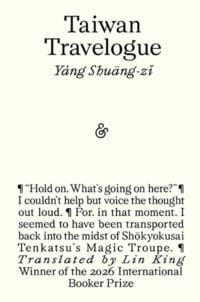 Since its English translation was first published in 2024, Taiwan Travelogue by Yáng Shuāng-zǐ has generated a lot of positive buzz in bookish circles. Lin King’s translation from Taiwanese Mandarin won the 2024 National Book Award for Translated Literature and the 2026 International Booker Prize. On top of all that, this book was recommended by Leah of Bristol’s Very Small Bookshop.
So I was disappointed to find that I didn’t love this novel. But it did grow on me, and the translation is undoubtedly astonishing.
Taiwan Travelogue is a complex layered study of language, colonial occupation and queer love. We are told this is a long-lost manuscript by Japanese novelist Aoyama Chizuko, translated into Chinese multiple times and now tidied up and released in full for the first time. The story is supposedly auto fiction based on Chizuko’s travel diary from 1938. Nested inside multiple forewords and afterwords is a first-person narrative, all with footnotes from both the fictional translator into Chinese and the real translator into English.
In 1938 Chizuko is invited by Taiwan’s tourist board to spend a year travelling Taiwan, publishing regular columns about her travels. She is assigned a young local woman, Tshian-ho̍h, as translator and travel assistant.
“A young woman. Pinkish cheeks. Dimples when she smiled. Eyes that glittered with sunlight. The sudden swelling in my chest made me choke on a lungful of air.”
Taiwan was then under Japanese occupation, which affects everything about this story. At work Tshian-ho̍h uses the Japanese name Chizuru. But Chizuko feels this is too close to her own name so she quickly nicknames her assistant Chi-chan – a very familiar term to use for a woman she’s just met. Similarly, every Taiwanese placename is referred to by its Japanese name.
Chizuko has a parental or kindly aunt attitude to Taiwan. She wants to experience “real” Taiwan and is irritated by the more obviously prejudiced attitudes of the colonial officials she meets. But she herself is surprised by the modernity of the island, and is often condescending or thoughtless in her comments.
From the start, Chizuko is more interested in Taiwanese food than its tourist sites. In her early weeks she’s disappointed to be repeatedly “treated” to Japanese food despite her requests for local delicacies. It’s Tshian-ho̍h’s willingness to evade these official feasts and source the food Chizuko really wants that establishes their relationship. Chizuko sees a new friend, someone she wants to get closer to and share food with. Tshian-ho̍h sees a coloniser who thinks she is open-minded but has rarely asked her a personal question, or questioned the colonisation itself.
Add to this that they are effectively employer and employee, and it becomes clear that these two women can never be true equals. Which means that despite what they say to each other, they can never have a real friendship – or more.
Chizuko has a ravenous appetite, one that Tshian-ho̍h teases her for, while also feeding it. The narrative is at first a series of similar accounts of travel to a new town, a potted history of that town, followed by describing the large quantity of food the two women eat. Which I found a little slow and repetitive, even when the food sounded delicious.
“I’d heard that, though India was widely considered the birthplace of curry, there was in fact no dish called curry there. It was an umbrella term that English colonisers had coined to refer to all Indian dishes that used a large number of spices…so-called curry was brought from India to England; then, after Commodore Perry forced Japan to end its era of isolation, it was imported to Japan under the misnomer of yōshoku, Western food, and from there made its way to another colony: Taiwan…Chi-chan filled the dining table with curry dishes…None of it was strictly yōshoku, and of course it wasn’t Indian cuisine or Qing-style Shina cooking, either. This was, quite simply, Taiwanese food.”
Gradually, the undercurrents of the narrative bubbled up enough for me to enjoy the subtext. Chizuko’s appetite is an apparently harmless desire that nevertheless uncomfortably parallels Japan’s attitude toward the island.
I knew little about this time period in Taiwan, or honestly much at all of Taiwan’s history. Japanese occupation of the island lasted from 1895 to 1945, when it was placed under China’s control. The island has many Indigenous groups, but contact with China from the 13th century onward led to Han Chinese being the largest ethnic group. It was also partially colonised by the Dutch and the Spanish, before Hoklo and Hakka immigrants arrived from China from the 17th century onwards.
Yáng gives us all this through the medium of Tshian-ho̍h who is in turn trying to explain Taiwan to Chizuko. We never see any violent oppression from the Japanese colonisers, but there are quiet reminders that Taiwan did not choose to be ruled by Japan. We are left to fill in ourselves what violence might have led to this apparently peaceful outpost of empire.
The queer love story is subtle, as befits the concept of a novel written in the 1950s based on events in the 1930s. It is mostly a tale of longing, of shared looks without being sure of shared understanding. The afterwords fill in some of the blanks so that we’re not left wondering.
I really do think this novel is a great achievement and I strongly suspect it would benefit from a reread. So unusually I’m going to hold onto it even though I didn’t love it. Because maybe second time around, I will.
臺灣漫遊錄 /Táiwān Mànyóu Lù first published in Mandarin Chinese in 2020 by SpringHill Publishing.
This translation first published in 2024 by Graywolf Press.
First published in the UK in 2026 by And Other Stories.
One Comments