Non-Fiction November 2026
It’s a while since I’ve joined a book blogging challenge. I have less free time than when I started this blog in 2010. And the blogging world is much more fragmented. But I spotted the hashtag #NonFictionNovember on social media and it intrigued me.
National Non-Fiction November is an annual event run by the UK’s Federation of Children’s Book Groups. The idea is to celebrate young readers who have a passion for information and facts, and teach children how to use non-fiction books to find information. Which I can definitely get behind. But I am not a young person, nor a teacher or parent, so why am I getting involved?
Well, book bloggers have taken up the Non-Fiction November mantle. Each week this month, a different blog posted a discussion prompt on the theme of non-fiction. Due to my aforementioned lack of time, I’m going to deal with all four in one post.
Week one: Heather of Based on a True Story asks “What non-fiction we have read in the past year? What were your favourites? Did you find yourself reading a particular category of non-fiction most often?”
In the past year I’ve read 15 non-fiction titles, out of 85 books total. So it’s not a major genre for me. They’ve been a mix of memoir, biography, essays, science, history and other subjects. I do enjoy a good memoir and read them as quickly as a novel. Most other non-fiction I find slower to get through but I often love a deep dive on a niche topic. Tim introduced me to Australian author Helen Garner, who is a great essayist. But my top non-fiction read this year was Normally Weird and Weirdly Normal: My Adventures in Neurodiversity by Robin Ince. This has aspects of memoir but is mostly a study of neurodiversity, both from a scientific perspective and a series of interviews of people with autism and/or ADHD. I’ve seen Ince speak live twice this year and he is brilliant every time.
Week two: Frances of Volatile Rune asks us to “choose a book that reflects a journey”.
For this my mind immediately went to Felicity Cloake’s three books about cycling around different countries exploring their food. In particular her first, One More Croissant for the Road which really triggered in me a desire to go on long cycling adventures. As I admitted to Cloake last year during her Peach Street to Lobster Lane book tour, I haven’t achieved a proper touring cycling holiday…yet. But cycling has been part of most of mine and Tim’s holidays since 2019, so a cycle tour seems like a natural progression. I think mostly what’s holding us back is the planning.
Week three: Liz of Adventures in Reading, Running and Working from Home invites us to “pair up a non-fiction book with a fiction title”.
The first pairing that occurs to me is Antarctic-related. All the White Spaces by Ally Wilkes was one of my top reads in 2022. It’s a novel about a fictional voyage to Antarctica in 1920 in which everything goes wrong. It’s super creepy and atmospheric in the most brilliant way, and clearly inspired by real-life voyages to Antarctica of that era. My favourite of which is The Worst Journey in the World by Apsley Cherry-Garrard.
Another pairing I’d suggest are both by Christopher Isherwood. His memoir Christopher and His Kind revisits events that he fictionalised in his novel Goodbye to Berlin (and others). It’s really interesting to hear from the horse’s mouth what he made up because it created better drama, and what he made up to protect himself.
Week four: Deb of Readerbuzz asks what non-fiction titles you added to your TBR this month.
Non-fiction titles added to my wishlist this month include Story of a Murder by Hallie Rubenhold and My Cantopop Nights by Emma-Lee Moss. I will admit those were both inspired by podcasts I follow. The only non-fiction I’ve actually bought, and added to my physical TBR, is The Argonauts by Maggie Nelson – which has been recommended by just about everyone and I’m pretty excited to read it.
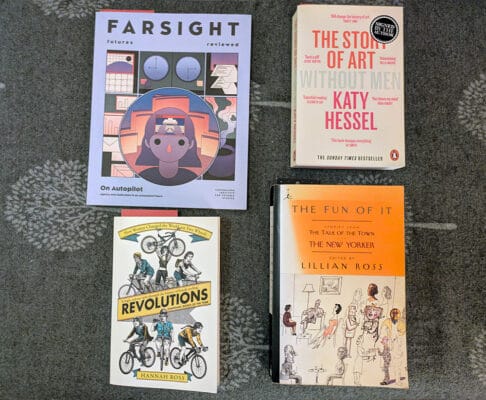
Most importantly: what non-fiction have I been reading this month? Well, I am currently in the middle of no fewer than four non-fiction titles. That might be too many. But they’re all good.
The Story of Art Without Men by Katy Hessel was a present from my brother. It’s art history, solely looking at women artists. I’ve never read a whole book on art history before, but I do love art galleries so I’ve absorbed a lot in bits and pieces. This is very much a book to dip into for a few pages at a time, so for a while now it’s accompanied my breakfasts. I’ve just read a couple of pages about the late great Yayoi Kusama, whose work I have seen in several cities and always enjoyed.
Revolutions: How Women Changed the World on Two Wheels by Hannah Ross is the easiest read of the bunch. It’s about women cyclists, from the very earliest days in the 19th century to the present day. There’s so much fascinating history and sociology tied to bikes. The last section I read covered suffragettes, World War II resistance, and women in current-day Iran, Afghanistan and Saudi Arabia. I’m loving this, as Tim (who bought it for me) knew I would.
The Fun of It: Stories from Talk of the Town edited by Lillian Ross is a New Yorker anthology published in 2001. Talk of the Town is the closest thing the New Yorker has to a gossip column, with short articles about unusual residents of the city, famous visitors, sometimes an event. This book comes with an interesting story. I bought it secondhand from The Strand bookstore in New York in 2007. When I finally started reading it a few weeks ago, I discovered a letter tucked inside. It was from the New Yorker to the agent of Joseph Mitchell, and attached was a cheque for the republication of one of Mitchell’s columns in this anthology. Now, Mitchell died in 1997. His contribution to this volume was first published in 1938. So it wasn’t a big cheque, and it stopped being valid 25 years ago. But I still felt some responsibility to do…something. So I e-mailed the agent with a photo of the letter and an explanation of where I found it. I haven’t had a reply.
It’s not technically a book, but I am also reading issue no.18 of Farsight, a magazine published by the Copenhagen Institute for Future Studies. It’s 96 pages of essays about how automation might affect the future of humanity. I bought it to read on the train journey home from Denmark this summer. It’s well written, attractively laid out and illustrated, but I found it a bit too serious and put it aside until a couple of weeks ago.
So I’m alternating non-fiction about art, cycling, celebrated New Yorkers and robotics/AI. Is it wrong that I’m seriously considering throwing some cosy crime fiction into the mix?
Leave a Reply