Nose in a book

Reviews and other ramblings

  • Home
  • Reviews archive
    • Book reviews
    • TV reviews
    • Theatre reviews
  • TBR
  • Challenges
    • The Classics Club
    • 2014 Popular-Science Reading Challenge
    • Cookery challenge
    • The Gilmore Girls Reading Challenge
    • 2013 TBR Pile Challenge
    • 2013 Translation Challenge
    • Crime and Punishment read-a-long
  • About
    • Cookie legal stuff

Category: Reviews

I do not see him in the mirror but feel him

May 1, 2012May 1, 2012

Anatomy of a Disappearance
by Hisham Matar

This short, quick read effectively covers a devastating subject: the loss of a parent. And somehow it manages to be about everything else as well: love, family, identity, growing up and lust.

It is this last that the book might seem to be centred around. The story is narrated by Nuri who is 14 when his father mysteriously disappears, never to be found. Born in Paris, raised in Cairo, Nuri’s family are outsiders, Arabs, from an unnamed other country suffering military dictatorship. Nuri’s father was a government adviser to their king so they are now effectively in exile. After the death of Nuri’s mother when he is 10, the father and son struggle to communicate until one summer they meet Mona, a half-British half-Egyptian beauty aged exactly between them. Father and son both fall in lust but of course it is the father she responds to and marries while 12-year-old Nuri is in torment.

Nuri, like most teenage boys, struggles desperately with his lustful feelings, which are complicated by Mona’s flirtatious behaviour with him and then, later, his father’s absence. Though there are so many other things going on in his life that he could fixate on (boarding school in England; his so-called mother country; his struggle to make friends), in this narrative at least it is Mona who takes centre stage for most of the story. It is only when he gets older that he straightens out his priorities and makes an attempt to look for his father and make a life for himself.

The story is simply told, with what might believably be a young man’s voice recalling his childhood and teenage years and their raw pain. Though the setting moves all over the world, nowhere is strongly evoked except his own mind. While it was beautifully, sparsely done, I couldn’t help but wish for something that had gone deeper. Perhaps follow the adult searches a little and the politics that that might dredge up. But that would be a very different book.

My only other difficulty with this book was that Nuri’s family is so extremely well off, that outside his family, life is made very easy for him. We never see him get a job or struggle for something to do in holidays from his boarding school when he does not feel comfortable staying with Mona. I know this might be petty but I might have sympathised a little more if he was scraping together the funds to go to Switzerland to search for his father.

Not naming the “mother country” is, I would guess, an attempt to distance the fictional story from the author’s true life experience. Matar’s family fled their native Libya to Egypt following political persecution and when he was 20 his father was kidnapped. For many years Matar did not know whether his father was alive or dead. All that must, of course, have informed his writing but in Nuri he has created a believable separate character from himself.

I think I would say I was not as bowled over by this as by Matar’s debut novel In the Country of Men but I would still rank him as an excellent writer to keep an eye on.

First published 2011 by Viking.
Kate Gardner Reviews

The silence that anaesthetises shame

April 26, 2012 4 Comments

The Light Between Oceans
by M L Stedman

This is a beautifully written account of people facing terrible circumstances and decisions. It didn’t move me the way I thought it would (or should) but it got me thinking about love, in all its forms. I can see why this debut novel has already attracted a lot of interest.

The story is set in Western Australia in the 1920s, primarily on a tiny island far off the coast occupied only by the lighthouse keeper and his family. After serving in World War I, Tom is looking for a quiet, useful life when he signs up to “the lights”. He expects to live out his days alone and has accepted that when, on shore leave in the small town of Partageuse, he meets Isabel. She is young, sparkling, headstrong and quick to fall in love.

Izzy has to persuade Tom that she can deal with the life on the island. Shore leave is every three years, with the only other contact with people being a quarterly supply boat. In emergencies a signal can be sent out but otherwise they are quite alone with the lighthouse, cottage, vegetable patch, chickens and goats, at the forefront of every weather front and surrounded by the tempestuous meeting point of two oceans. It is a tough life but Izzy seems up to the task.

The novel begins with the pivotal event before going back to fill in all these details. One day a boat washes up on the island containing a dead body and a crying baby. Izzy has just lost her third child in stillbirth and is out of her mind with grief. The baby appears like a gift from God. But they can’t possibly keep it and not report it, can they?

The story explores grief, truth, lies and choices, sometimes slightly too obviously but at other times very effectively: “History is that which is agreed upon by mutual consent. That’s how life goes on – protected by the silence that anaesthetises shame.”

It’s a hugely emotional story quietly told. I actually thought it was written by a man until I read Stedman’s bio because it is largely viewed from Tom’s perspective. He is stoic, dependable and brave – essentially a good man – where Izzy is impetuous, subject to mood swings and bears grudges. Perhaps this perspective prevented the story from becoming melodramatic or schmaltzy, which is some achievement considering the subject matter, but it also distanced me enough from events that I was not moved by things that I think should have moved me. I should have cried reading this story, or at least come close, but I did not. In fact at times I found it too slow, though it picked up a lot in the third act.

The characters are very well created and I was eager to know what would happen to them. I liked how Tom turned to his duty, becoming more efficient, more clean and tidy, when life got hard. But the best part was the setting. The descriptions of the sea and the weather are stunning: “There are times when the ocean is not the ocean – not blue, not even water, but some violent explosion of energy and danger”. Beautiful.

This book was sent to me by the publisher in return for an honest review.

Published 26 April 2012 by Doubleday, an imprint of Transworld Books.

Kate Gardner Reviews

Hunting for metaphors which might convey something

April 24, 2012June 17, 2012 2 Comments

The Alexandria Quartet
Book 4: Clea
by Lawrence Durrell

And so at last I have finished the quartet. Was it a fitting end, full of vagueness and mystery? Did the poetic unreliable narrator return, both as a narrator and to Alexandria itself?

The Alexandria Quartet

Well, the answer to question two (both parts) is yes but to question one…I’d hazard no. The series began, in Justine, with a lot of vagueness, events in uncertain order and a lot was left unsaid. As the Quartet proceeded, the narrative got clearer and clearer until this book, even though it is once again narrated by Darley, who was previously so unreliable, was perfectly straightforward and linear. I mean, there were memories and extracts from old letters, but they were clearly signposted as such. To be honest I found this disappointing, though it was good to get closure on all the characters and storylines at last.

Which is not to say that the writing in this book is less good than it has been previously. In fact, I have bookmarked more quotable passages than ever. But as a story it didn’t grip me. Which is odd because there was a lot going on in this book. Darley has been called back to Alexandria from his Greek island to return the child he has been looking after to her true father. World War II has finally got under way and Alexandria has not escaped unscathed. Mountolive (the British Ambassador to Egypt) finds Darley a job in the censorship department of the War Office, which is a perfect statement on his narrative. No mention is made of Darley ever having been expected to fight, despite his being a British citizen of, I assumed, good health and young age, but I don’t know what the situation was for ex-pats.

And so, until the end of the war and a short time afterward, Darley catches up with the lives of his old friends, makes sure the girl settles in with her new parents and discovers more details about his previous stay in Alexandria that once again force him to re-evaluate the truth. Clea is, as ever, everyone’s friend and confidante, and a cheery one at that, so through her we hear the little anecdotes that people really do tell about their friends, particularly those who have died. She is a good influence on Darley, encouraging him to not just face the truth but actively seek it. When one friend asks Darley how his writing is going, he replies:

“It has stopped…I somehow can’t match the truth to the illusions which are necessary to art without the gap showing…”

The picture of a city at war is hauntingly real. A lot of the time, Alexandria is on the outskirts of the war, the place where soldiers come on leave from the desert frontlines, but it is for a short time bombarded and the harbour is full of warships rather than pleasure boats.

“How had things changed? It was not danger, then, but a less easily analysable quality which made the notion of war distinctive; a sensation of some change in the specific gravity of things. It was as if the oxygen content of the air we breathed were being steadily, invisibly reduced day by day…”

One thing I found a little strange was that one longish chapter takes the form of an essay written by (Darley’s former flatmate) Pursewarden years earlier after a series of conversations with Darley about literature. It is eloquent and interesting and so, so quotable (“Words being what they are, people being what they are, perhaps it would be better always to say the opposite of what one means”) but it perhaps went on a little long and broke up the story more than necessary for its purpose: making Darley realise he had misjudged Pursewarden.

Despite the apparent changes in Darley, perhaps he is still unreliable, because he still manages to fool himself and he repeatedly declares that he is done with writing yet he narrates as if he is writing it down:

“I am hunting for metaphors which might convey something of the piercing happiness too seldom granted to those who love; but words, which were first invented against despair, are too crude to mirror the properties of something so profoundly at peace with itself…”

And lest all the revelations and clarifications of this book fool us into thinking we are here learning the absolute final truth about these characters, we have this pearl from the wise old doctor Balthazar:

“When one casts around the fields of so-called knowledge which we have partially opened up one is conscious that there may well be whole areas of darkness which may belong to the Paracelsian regions—the submerged part of the iceberg of knowledge.”

So on the whole it was a fitting end to the Quartet. It made me laugh, it made me sad. It has a surprisingly modern attitude to sex, love and homosexuality (though the characters do not necessarily have modern attitudes) and I can now go and have a look at the last discussion of the Guardian Reading Group without having the story spoiled for me!

First published 1960 by Faber & Faber.

N.B. It’s too late now to join in the Guardian Reading Group discussion about this book but you can still listen to the Guardian Books podcast about Lawrence Durrell at 100. It discusses and quotes heavily from The Alexandria Quartet and is well worth checking out.

See also: my reviews of
Book 1: Justine
Book 2: Balthazar
Book 3: Mountolive

Kate Gardner Reviews

Each man has his own interpretation

April 20, 2012June 17, 2012 4 Comments

The Alexandria Quartet
Book 3: Mountolive
by Lawrence Durrell

Well, I had an inclination that book three would get political and I was certainly proved right, but it also had some other big differences from the two books that precede it. I can’t decide whether I was thrown by this or drawn deeper in than ever.

The Alexandria Quartet

Where the first two books are narrated by an initially un-named first person and set entirely in Alexandria over an approximately two-year time period (plus the occasional jump forward to the time of writing, which seems to be only shortly later), Mountolive is a more traditional third-person narrative, following the titular David Mountolive from his youthful first visit to Egypt, through his illustrious (and well travelled) career with the British Diplomatic Service until he is finally posted back to Egypt as British Ambassador, the position in which he had occasionally popped up in Balthazar.

This takes up the first 100 pages or so, about a third of the novel, but it is essential background to understanding the man and his actions. Despite his limited appearances previously, Mountolive is key to the story we have already heard twice. In true Durrell style we learn of goings-on that were hinted at but never revealed in Justine or Balthazar and all the old characters are intricately tied up in machinations that are at times surprising, at times make complete sense of what before had been blurry.

In some ways this reads like a detective novel, with Mountolive the stoic investigator, a career man who was once passionate and romantic even, but is now middle aged and enjoying the power and status of his new job. The suspect is Nessim, the rich banker who has always seemed suspect and shadowy but now we learn what he is suspected of. And it is of course different things by different people. Indeed, is he even really deserving of suspicion or is he merely a puppet for some other player? Perhaps his wife, the beautiful and seductive Justine. Or his brother, the disfigured and hard-working Narouz. Or his mother, the strong and proud Leila.

Limiting the story (for the most part) to these two men, and switching to the third person, makes this in some ways a more straightforward read than the previous two books. Which is helpful when you are called upon to understand some complex political manoeuvrings. But there are moments when the narrative directly contradicts something previously learned and it becomes blurry again; which version is to be believed? Is this narration actually omniscient or is this narrator better at hiding?

Balthazar at one point says, “Truth naked and unashamed. That’s a splendid phrase. But we always see her as she seems, never as she is. Each man has his own interpretation.”

The language is evocative as ever – “The desert was like a dry kiss, a flutter of eyelashes against the mind” – and even the psychological exploration has not disappeared, such as in this exchange:

“If only we did not have to keep acting a part, Justine.”
“Ah, Nessim! Then I should not know who I was.”

So, will Clea wrap everything up nicely or throw it all back into confusion? I can’t wait to find out.

First published 1958 by Faber and Faber.

See also: my reviews of
Book 1: Justine
Book 2: Balthazar
Book 4: Clea

Kate Gardner Reviews

To imagine is not necessarily to invent

April 16, 2012June 17, 2012 4 Comments

The Alexandria Quartet
Book 2: Balthazar
by Lawrence Durrell

Rather than continuing where the previous book, Justine left off, this is instead a revisit to the same time period by the same narrator after he has learned more information. Except it’s not even just that.

The Alexandria Quartet

The assertions and assumptions of the previous book are thoroughly shaken and the narrator proved without doubt unreliable by his own words and other people’s. Balthazar, the wise old doctor and leader of a Cabal in Alexandria, has read the narrator’s Justine manuscript and annotated it heavily, resulting in the document referred to as the Interlinear. He has included information he knew the narrator to be unaware of and remonstrations where he thinks the narrator has misrepresented a person or event. He knows that some of this, indeed much of it, will be painful for the narrator to learn of.

Despite the strange set-up, this novel is actually more straightforward than Justine, though I don’t know if it would make any sense without having read Justine shortly beforehand. The majority is made up of Balthazar’s lengthy annotations, with the narration linking or commenting on or reconstructing in-between. As before, time is not entirely linear, but events are a little more clear and a lot of hints are sown for the next book to come (I think politics and spywork may be coming slowly to the fore), as well as the occasional explanation of a puzzling detail in book one.

Because so much is in Balthazar’s voice, there is a little less musing on the beauty and life of the city, but that just makes the passages more noticeably beautiful when they come:

“The city, inhabited by these memories of mine…isolated on a slate promontory over the sea, backed only by the moonstone mirror of Mareotis, the salt lake, and its further forevers of ragged desert (now dusted softly by the spring winds into satin dunes, patternless and beautiful as cloudscapes)…”

What there is more of is confusion between the story itself and the books and manuscripts written by various characters. By this point there are, I think, four fictional authors?

Balthazar writes, “To imagine is not necessarily to invent, nor dares one make a claim for omniscience in interpreting people’s actions. One assumes they have grown out of their feelings as leaves grow out of a branch. But can one work backwards, deducing one from the other? Perhaps a writer could if he were sufficiently brave to cement these apparent gaps in our understanding with interpretations of his own…” And later, “Truth is not what is uttered in full consciousness. It is always what ‘just slips out’…”

Our narrator gets a couple of nicknames in this volume including the heavily sarcastic-sounding “Wise One”, surely an ironic comment on his inability to see the truth. Or is that the problem at all? Does he in fact understand exactly what is going on and just exclude certain details from his account? At this point I think either could be true. Possibly a bit of each.

At the end of Justine I was a little uncertain about how this story could continue for three more books, whereas now I already see plenty to fill two more books, let alone any new plot threads that might emerge. I guess this may mean it gets a bit more action-based and less cerebral. World War II does seem to be creeping closer (“rumblings in Europe” are mentioned periodically) and our narrator is a young male British citizen. I look forward to seeing whether any of my guesswork is proved right.

First published 1958 by Faber & Faber.

See also: my reviews of
Book 1: Justine
Book 3: Mountolive
Book 4: Clea

Kate Gardner Reviews

A medium as unstable as words

April 12, 2012June 17, 2012 7 Comments

The Alexandria Quartet
Book 1: Justine
by Lawrence Durrell

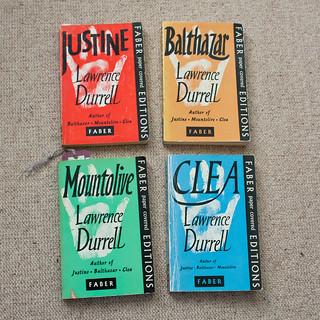
I had sort-of vaguely heard of the Quartet and then a couple of years ago I stumbled across these beautiful old Faber editions in Bristol’s excellent Beware of the Leopard book shop.

The Alexandria Quartet

Except they only had two of the four books. By chance, a few weeks later I found a matching third in another secondhand book shop. But no sign of a fourth. Cut forward almost two years to Tim buying me the the fourth book from Abe Books and I could finally start reading! By coincidence, 2012 would have been the year Durrell turned 100 years old so the Guardian Reading Group chose The Alexandria Quartet as its book for March (these days it is published as a single chunky volume), and through that I was able to garner some insights from people much cleverer than me as I went along.

Which helped. Because this is not a straightforward book. It is a pensive, thoughtful musing upon events an unknown time ago, in an unclear order, narrated by an unnamed narrator. The language is beautiful, evocative, poetic even. The true main character is the Egyptian city of Alexandria, at a guess in the 1930s, and Durrell lovingly brings to life the streets and waterways of this exotic mishmash of cultures. The people of the book are the city’s rich and educated few, so they come from all over the world and various walks of life.

The narration is jumbled throughout, but particularly so at the start. For several pages it skips from thought to thought, without explanation. Various names are mentioned but no-one properly introduced. Early on the narrator quotes the line “It is idle to go over all this in a medium as unstable as words” and later says “(I am inventing only the words.)”

And it continues like this, but with some of those thoughts being a memory, so that details are slowly filled in. Very slowly. It took me most of the book to figure out what its story is, and even then I feel a real pull to get started on the next book in the quartet to clarify some of the many details left partly obscured.

To give some idea of the story, the narrator was in a relationship with Melissa, an exotic dancer in a nightclub with frail health, but fell for Justine, the great Alexandrian socialite whose reputation for beauty and sexual intrigue goes before her, and who is married to the rich, powerful banker Nessim. The narrator and Justine embark on an affair, despite the narrator claiming to love Melissa absolutely and to be afraid of Nessim. From the start it is clear that things did not end well and the narration gradually gathers momentum as it builds towards the conclusion of this part of the story.

But the point isn’t the story. The point is the exquisite language. On the Guardian threads there was talk of the whole thing being more about psychoanalysis than characters in a story and perhaps if you know more than me about psychoanalysis that may be the case, but I loved all the characters and, unusually for me, was not bothered by the slowness of the emerging story. I was entranced by the words.

“Far-off events, transformed by memory, acquire a burnished brilliance because they are seen in isolation, divorced from the details of before and after, the fibres and wrappings of time. The actors, too, suffer a transformation; they sink slowly deeper and deeper into the ocean of memory like weighted bodies, finding at every level a new assessment, a new evaluation in the human heart.”

The narrator pulls his tale together from a number of sources, including his own journals, a novel written before he arrived in Alexandria about many of his friends there, and three of Justine’s diaries, which he has been given. He frequently quotes from these, even substituting names in the novel with those of his friends. So he is undoubtedly unreliable, and I am sure the subsequent books will contain multiple about-turns that will force me to re-evaluate what I have learned, or think I have learned, so far. I can’t wait.

First published 1957 by Faber & Faber.

See also: my reviews of
Book 2: Balthazar
Book 3: Mountolive
Book 4: Clea

Kate Gardner Reviews

Veils, shimmering like curtains

April 9, 2012April 14, 2012

Ariel
by Sylvia Plath

A still life for Easter

This was Plath’s final volume of poetry, published two years after her death, and I could not separate the knowledge of what shortly followed these writings from the words themselves. It was not an easy read.

Death is everywhere in these poems. I got shivers down my spine on almost every page. Yet these are not obvious musings on death but rather word collages. For the most part the poems are constructed of a series of images, with no clear story or scene, but there are a few exceptions. “Gulliver” describes Swift’s character in the scene in Lilliput when he is tied to the ground:

“You there on your back,
Eyes to the sky.
The spider-men have caught you,”

“Daddy” explores her feelings about her father, a complex relationship despite his death early in her life (“I was ten when they buried you”). And “Wintering” is actually the last part of a series of four poems about her new-found vocation of beekeeping:

“Now they ball in a mass,
Black
Mind against all that white.”

But these are exceptions in-between the darker poems (and even those were not entirely free from comment on death). Her depression is ever present:

“I am terrified by this dark thing
That sleeps in me;
All day I feel its soft, feathery turnings, its malignity.” [from “Elm”]

She refers to her previous suicide attempt many times over, making it clear her only regret about it is that she didn’t succeed:

“After all I am alive only by accident.
I would have killed myself gladly that time any possible way.
Now there are these veils, shimmering like curtains” [from “A birthday present”]

But the poem that moved me most was “Years”, where Plath’s pain and anger seem to be at their peak:

“O God, I am not like you
In your vacuous black,
Stars stuck all over, bright stupid confetti.
Eternity bores me,
I never wanted it.”

First published 1965 by Faber & Faber.

Kate Gardner Reviews

You’re gonna get screwed but good in this town

April 6, 2012April 28, 2012

Tales of the City
by Armistead Maupin

After hearing this book praised left, right and centre since I started book blogging I figured I had to give it a go. And what a joy it is!

This is the first in what has turned out to be a very long-running series about a large cast of characters in San Francisco. In this book (I don’t know if this is true of any of the rest) the focus is on a boarding house on Russian Hill run by the inimitable Anna Madrigal (who grows her own weed and claims to have been raised in a whorehouse), and in particular her tenant Mary Ann Singleton. Mary Ann has newly arrived in the city from Cleveland and her sweet naivety is in for a shock. Or several shocks.

According to something I heard on Radio 4 (I think it was on A Good Read) the editors of the San Francisco Chronicle, in which this started life as a serial, kept a tally of straight versus gay sex scenes because there was a concern about it being “too gay”. Which tells you a little about the book. It is outrageous and wickedly funny but also intelligent and insightful. The characters lean very slightly into the larger-than-life category but they are not stereotypical or predictable. It really is an achievement that so much silliness can be so lovable.

There are dozens of storylines at work, only a couple of which are wrapped up by the end of the novel. The characters are introduced separately but their lives quickly overlap to the point where I was hard-pressed to remember who knew who from where. I’ll just have to read it again!

The extra character is, of course, the city of San Francisco. Maupin lovingly describes its streets and views and bars and people with all the little details of someone who calls it home. It is very much a tale of 1978, with an undercurrent of the politics and social nuances of the time. I was (perhaps naively) surprised by how much of the “pretentious” of middle-class life today (organic food, over-earnest attempts to appear not racist or homophobic, caring about global warming) was considered pretentious back then too. It is satirical but somehow firmly on the side of the people it satirises. Both prudish innocent (Mary Ann) and sexaholic (most everyone else) are celebrated in their own way.

I can see why it has been called a literary soap opera and it is indeed both those things. It isn’t literary in floweriness but rather in insight and cleverly spare language that gives you just enough, while finding room for some fantastic little jokes with words and meanings. So that’s six more books to add to the wishlist then, I guess!

First published in 1978 in the San Francisco Chronicle.
Published in book form in 1980 by Corgi Books.

Kate Gardner Reviews

Life might have been totally different

April 3, 2012April 28, 2012 3 Comments

1Q84
by Haruki Murakami

It’s my own fault. I was really excited about this book. I built it up in my head. I believed the “magnum opus” hype. I was bound to be let down.

1Q84

I really like Murakami. He’s not my favourite writer but I have loved some of his books and really liked several more, so the prospect of a three-volume masterpiece by him sounded wonderful. Unfortunately it turned out to be my least favourite of his works so far. In fact, at times it had me angry enough to want to throw the book across the room and I nearly gave up on it multiple times. But I soldiered on because this is after all Murakami and there is an intriguing storyline that is not wrapped up until the last page. And I had to know.

So that’s it’s great strength: the story. It’s a very Murakami story, an idea that starts gradually, slowly forming, giving you room to guess what’s going on. It’s weird in a surreal sort of way but it has an internal logic that allows you to see the directions it might go in.

Because it takes most of book 1 (300+ pages) for the basic concept to become clear, I don’t want to say too much about what happens. The chapters alternate between the stories of Tengo and Aomame. Tengo is part-time teacher, part-time writer, who allows himself to be persuaded by an editor friend to rewrite someone else’s entry in a creative writing competition, a story called Air Chrysalis. The situation goes from a bit unethical to downright dangerous when it turns out that there is a lot more to Air Chrysalis than meets the eye.

Aomame is a fitness instructor and also an assassin. But not the ruthless kind who will kill anyone for the right price. She has just one client and kills one particular breed of very bad men. So what links her to Tengo? Well, that would be saying too much, but from the start it is clear that they have a lot in common. They are both about 30 years old, living in Tokyo, with no strong emotional ties to anyone. They have almost clinical attitudes to their sex lives. They are particular about cleanliness and eating well. And because they would clearly get on well, it was wonderful slowly learning about how they were linked, seeing their stories draw together. But.

For one thing, I think 1Q84 is far longer than it needs to be. Murakami has a reputation as a sparse writer but here there is lots of repetition, lots of restating facts – a lot of bulk could have been shed. After the initial teasing out of a detail or plot point it then gets overstated and too obvious. This was to the detriment of the more surreal, magical elements because it made them seem at times clumsy and over-thought.

But I also had issues with some of the major themes in the book. First up: sex. I have no problem with sex scenes, but here I frequently got the feeling that typical male fantasies were being depicted for no good reason. Aomame is straight and at one point turns down an offer of sex with a woman, yet Murakami has her linger on the memory of a teenage lesbian dalliance with a close friend more than once. For no reason that I could fathom, when she remembers two good female friends from her past she thinks about their breasts. And not in a jealous way but in a sexual way. It’s very strange.

Then there’s the parents thing. There are no good parent–child relationships in this book. Tengo is horribly self-centred in his attitude to his father. Both Tengo and Aomame chose to move out from their parents at the earliest possible opportunity, but neither describes anything particularly terrible to explain why. Aomame’s parents were religious, Tengo’s father a distant workaholic, and perhaps with some further details those would have indeed been in some way abusive situations, but for all the very many words, I was never able to see what had been so wrong with either childhood.

Which brings us to the last problem: religion. Oh my word does Murakami have an axe to grind here. I should point out that I am an atheist, I am no fan of organised religion and recognise that it has been the source of a lot of bad stuff. But it has its positive side too and in most cases is probably best described as benign. 1Q84 gives no stock to such nuances. ALL RELIGION BAD could sum its attitude up. Basically, you have a cult that somehow grew out of a non-religious hippy commune and became a child-raping place of evil. And all other religious sects, churches or organisations mentioned are spoken of as if they are just as bad. As if they all brainwash, make children miserable, expect unreasonable things of their followers. Some of the statements I read made me slam the book shut and shout out angrily. At one point there was so much of this nonsense I didn’t know how I could possibly read on, but thankfully the narrative moved past it. (Although this is also a problem because I felt it was very ambiguous whether the nasty child-rape situation had been resolved or not.)

It started well and it ended well. The anger I felt in book 2 never resurfaced, although the boredom with some of the “waiting” sections did. I kept on reading because I wanted to know more, but I could not honestly say I enjoyed the read. This was translated by Murakami regulars Jay Rubin and Philip Gabriel so the style should have been familiar but it genuinely felt poorly edited in places and there were no moments when the writing stood out as beautiful or moving. Tengo and Aomame were typical Murakami characters in that they felt real but at a distance, slightly cold fish, so I could never be in their shoes truly living the story.

It saddens me that I cannot recommend this book and am even a little bit put off reading Murakami at all for a while. But I know other people have loved it so remember this is just my opinion. Others are available.

First published in Japanese in 2009 and 2010 by Shinchosa Publishing.
This translation published 2011 by Harvill Secker.

See also: discussions on Tony’s Reading List and In Spring it is the Dawn

Kate Gardner Reviews

The power of a great title

March 27, 2012March 21, 2012

Clash of Civilizations Over an Elevator in Piazza Vittorio
by Amara Lakhous
translated from Italian by Ann Goldstein

This book is clever, funny, insightful, serious and lighthearted all at once. I bought it on the back of a glowing review I read somewhere (possibly Eva of A Striped Armchair? Sorry I’m not sure on that) and am so glad that I discovered both an excellent book and a very interesting new publisher to me.

This book blends together a tried and tested format with a very modern story and characters. It’s a murder mystery, with alternate chapters made up of diary entries by the now missing – and therefore prime suspect – Amedeo, and the chapters in-between each narrated by a different character involved in the story.

They all live in an apartment building on Piazza Vittorio in Rome managed by the redoubtable Benedetta, or “the Neapolitan”. In fact, the residents come from all over – elsewhere in Italy, in Europe and the whole world. Immigration, racism and racial stereotypes are the central theme here. This one building is home to people from different parts of society, including a university professor, a travel agent, a cafe owner, a film student and an unemployed former chef. Each has their own view of the world and their own limits on what they observe or question.

The humour is evident right from the start, with Iranian immigrant Parviz despairing at his inability to hold down a job, convinced that he keeps getting fired because he doesn’t like pizza; despairing at the concierge Benedetta’s persistent use of a word he thinks (wrongly) is a swear word; despairing at the police repeatedly arresting him for feeding the pigeons, which he cannot comprehend being a crime. It is clear that this is a series of misunderstandings, largely based on his almost non-existent Italian. But he is not being mocked. Rather, Lakhous is pointing out how easy it is for people to choose anger and resentment rather than try to understand and be understood.

And the misunderstandings continue, get worse even, among people who do (or can) speak the same language but fail to listen to each other. Or prefer to believe their own prejudices and stereotypes rather the evidence before them. This can lead to some horrifying assumptions, but the humour – often revolving around the apartment’s elevator, which is central to many a row between residents – keeps the tone from getting too serious.

This is a short, fun read that has a lot to say and does it supremely elegantly. I will be on the lookout for more from this author and this publisher.

First published as Scontro di civiltà per un ascensore a piazza Vittorio in 2006 by Edizioni.
This translation published 2008 by Europa Editions.

Kate Gardner Reviews

Posts pagination

1 … 55 56 57 … 72

Archives

RSS feed: Nose in a book Nose in a book

  • Non-Fiction November 2026
  • Book review: The House of Doors by Tan Twan Eng
  • Book review: Taiwan Travelogue by Yáng Shuāng-zǐ

Me on the internets

  • @kate_in_a_book@mas.to (Mastodon)
  • Flickr/noseinabook
  • Instagram/kate_in_a_book
  • StoryGraph/kate_in_a_book

Categories

  • Blog
  • Reviews
  • Uncategorized
  • © Copyright Kate Gardner. All rights reserved.
Proudly powered by WordPress | Theme: Dream by vsFish.