Nose in a book

Reviews and other ramblings

  • Home
  • Reviews archive
    • Book reviews
    • TV reviews
    • Theatre reviews
  • TBR
  • Challenges
    • The Classics Club
    • 2014 Popular-Science Reading Challenge
    • Cookery challenge
    • The Gilmore Girls Reading Challenge
    • 2013 TBR Pile Challenge
    • 2013 Translation Challenge
    • Crime and Punishment read-a-long
  • About
    • Cookie legal stuff

Category: Reviews

Retinas oxidized in the ether
June 24, 2012April 27, 2015 2 Comments

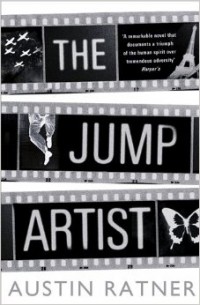
the jump artistThe Jump Artist
by Austin Ratner

Although I knew that this novel was based on a true story, it was only in the last few pages that I realised I knew a little of its subject, Philippe Halsman, and his famous photographs. Which was perhaps for the best, because it meant that the story was new to me. But I don’t think it would matter if you already knew the story, because the writing is by far good enough to keep you enraptured.

The story begins with Philippe and his father on a walking holiday in the Austrian Alps in 1928. By the end of the day Philippe has been accused of murder and his subsequent trial and retrial reverberate throughout the world’s press. Halsman was a Latvian Jew, an intense, brooding, depressive man in a bewildering world of anti-Semites. Great thinkers of the day, including Albert Einstein, Thomas Mann and Sigmund Freud spoke up on his behalf and he later became a celebrity photographer, but the murder and the imprisonment could never be struck from Halsman’s memory.

Ratner has done an excellent job of combining extensive research, with extracts from diaries, newspapers and other first-hand sources throughout the text, and yet he has still created a living breathing character in Halsman. He is not even a sympathetic character, at least not at first, though considering the seemingly hopeless situation you can forgive him for the flights of crazy. He self-harms, invents methods of self-punishment including starvation, and disappears into his own dark dark world of death and guilt and shame. Extracts from Halsman’s letters from prison reveal his slightly scary intensity and Ratner captures this in his own prose:

“When he’d seen Winged Victory on the Daru staircase at the Louvre, Papa and Mama and Liouba had had to leave him behind to go see the Persian friezes. He’d soaked up the pleasure of it in his eyes for more than an hour, and when he looked at his face in the mirror at the hotel, his eyes were wrecked with burst vessels.”

Despite this dark central character, and indeed the dark times covered, from 1920s Austria to 1930s Paris and the great exodus of 1940, this book didn’t depress me. In fact, the one time I cried it was at a beautiful moment of humanity. I was so engrossed that I powered straight through in just a couple of sittings, and then wished that I had lingered over it, savoured the often exquisite language:

“They’d been up at 5:30 that very morning and vaulted up the Schönbichlerhorn into its frigid airless winds, had their retinas oxidized in the ether, and their hands seared on the snow and the flint rocks, hot as sunburned metal. They had broken themselves on the mountain and been baptized there above the timber line at the top of the world, where the river of air meets the river of fire.”

In later chapters, I loved the descriptions of Halsman taking photographs and could often picture the finished result from Ratner’s description. From tentative beginnings, Halsman finally finds confidence and artistry in photography and Ratner evokes a believably troubled but brilliant man.

I am not sure why, after this was published to great acclaim in the US in 2009, it took three years to find a UK publisher, but I am really glad that it now has.

This book was kindly sent to me by the publisher in return for an honest review.

First published in the USA in 2009 by Bellevue Literary Press.
Winner of the 2010 Sami Rohr Prize for Jewish Literature.
Published in Great Britain in 2012 by Viking, an imprint of Penguin Books.
Kate Gardner Reviews

Crossing the Rubicon

June 19, 2012September 27, 2015 3 Comments

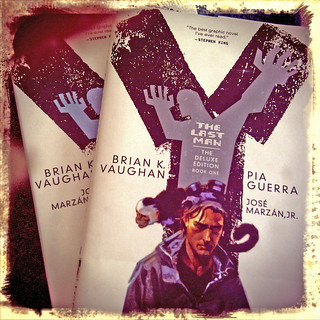
Y: the Last Man
The complete series
by Brian K Vaughan and Pia Guerra

This is a series of comic books that Tim really really wanted me to read so I told him I would if he would help me write the review afterward. Here is our joint effort.

Y: the Last Man begins with all humans and animals with a Y chromosome dying at the same instant, apart from 20-something-year-old Yorick and his monkey Ampersand. Yorick suddenly goes from being just some ambitionless and jobless guy to having everyone after him, as the potential key to the whole situation. But do all women want or even need men to come back?

First, a quick taste of the dialogue:

“[You’ve] crossed the fucking Rubicon.”
“The what?”
“Shut up.”
“I’m serious. What is that? ‘Crossing the Rubicon’?”
“It’s just a saying, all right? Means you’ve passed the point of no return—that you’re fucked.”
“But why does it mean that? What’s a Rubicon?”
“Jesus Christ! You just executed a human being, and all you—”
“You don’t know, do you?”
“—”

Y: the Last Man

Kate: You really wanted me to read this series. Why in particular?

Tim: It’s a very well written, touching, non-superhero comic book based on a strong SF trope. I am still trying to be your guide in SF and comics. Plus, y’know, literature plays a large part. And I know you love literature. What did you think of the literary allusions?

K: You had told me there would be literary references so I think I was expecting more than there was. But it’s actually done well, quite subtly, and I think it’s very true that an ardent reader would place a lot of value on finding people he could talk to about books, even in the middle of global disaster.

T: Also, the art is beautiful, I love the graphical themes that tie the issues/books together.

K: For science fiction, there’s not much science. It’s mostly about the impact on society of a major humanity-changing event.

T: True. SF that doesn’t dwell too much on the “plumbing” of the event can be very good SF. The beauty of this one is the way that Brian K Vaughan toys with characters (and the reader) having different theories for what caused the plague, all in different levels of mysticism/science. I often like this in stories, and that kind of uncertainty can really lend itself to some great storytelling. Take Bladerunner, or Total Recall, or Forever War, or I Am Legend, or Gateway, or Drowned World or… okay, there are a lot of titles that use the uncertainty and not-explaining attitude to SF. Is uncertainty in the heart of a plot an SF thing, or a general good lit thing?

K: It’s not just SF. It’s also not always good (but it often is).

Although our main characters keep facing violence and aggression, the all-female society does pull itself together and get stuff working over time. A comment is made that if the situation were reversed men would have been way more warlike and disorganised in reaction. In fact, a lot of women react with hatred for men and determination that women are better off.

T: Yep. You know, every English teacher I ever had was a feminist.

Several women are shown or implied to have become lesbian or start self-identifying as male as a result of the plague. Is this a cis-hetero/masculine fantasy or an offensive assumption? It is important to note that many other women do NOT.

K: I don’t think it’s handled in a male-fantasy way, whatever that would be. I think it’s realistic that some women would be open to it immediately while others would gradually turn to it from a lack of the alternative and others would resolutely refuse. It could have been discussed more but that’s a BIG conversation.

T: And it’s interesting that the one woman in the book who was already lesbian becomes, basically, celibate.

K: The main character is a man. Is this actually quite a masculine book with an idealised view of women?

T: Do you mean masculine or male chauvinist? I think you need Yorick as a contrast to the assumed macho male, and to evoke reactions (to him being male) from all the other (female) characters they meet. It would have been very easy to have him exist in the story just as a foil or a mirror. What’s impressive is that he is a character with depth without being macho or heroic.

K: Agreed. If anything Yorick is happy when he sees communities figuring shit out and would prefer to blend into the background and let women get on with it.

Though it eventually opens out, a large part (indeed all of the early stuff) of the story is set in the US, with a classic cross-country road trip. Would it have been too conceptual to see more of the world from the start?

T: I don’t know. I think it was important to concentrate on one thread of plot to begin with, allowing some measure of claustrophobia. It’s important because with the death of half of society, communications failed. The point is that the characters we follow don’t know what’s happening in their own city (to start with), and it gradually opens out as communications and society open out. I thought it was a well used device.

K: One observation I made early on was that the cities were falling apart, essentially war zones, while small towns were making it work. Is that realism or idealism?

T: I think it’s realism. There’s a bunch of reasons for it, though. Firstly, you start off in the domesticated east coast, and head west, towards the frontier, “can do” spirit. But I think, more importantly, (as seen in Make Room, Make Room or Caves of Steel) cities don’t exist in a vacuum, they rely on technology – that in this case failed (the power plants blew up, etc) – and a constant stream of food and supplies into the city (transport also broke down). The people living in more rural areas were not only more self-sufficient and practical to start with, they already had handy generators and the ability to grow/catch food. Cities cannot exist without civilization (I checked. I tried playing a whole game of Civ without building a city and it didn’t get anywhere).

Thank you Tim for the discussion and indeed the original recommendation. It is an excellent series.

Originally published 2002–2008 by DC Comics.
Deluxe editions published 2008–2011 by Vertigo.

Kate Gardner Reviews

The places to which your blood is anchored

June 12, 2012 3 Comments

The Tiger’s Wife
by Téa Obreht

I am trying not to let my jealousy of young, beautiful, successful Téa Obreht colour my feelings about this book because she is undeniably talented and deserving too. This novel felt original and inventive by using traditional folktale-type storytelling.

How do you describe what this book is about? It’s about the civil war that broke up Yugoslavia; it’s about love in its many forms; it’s about the affection we bestow on objects, animals or even people who can never return it; it’s about how superstitions and folk stories are created and why they are important. But it begins and keeps on coming back to the death of a beloved grandfather.

The narrator, Natalia, is a doctor who is travelling to an orphanage across the newly formed border to deliver vital vaccines and other medical care when she receives news of her grandfather’s death. This story is already complicated by odd details and family secrets, and then when she arrives at the orphanage she finds another complicated situation awaits, tied up in distrust and superstition and national identity. Obreht weaves into this story not one but effectively three further plots: Natalia’s relationship with her grandfather, the story her grandfather told her of the Deathless Man, and the story she pieced together after his death of the Tiger’s Wife.

At first, the “facts” within the novel versus the fictions seem clear, but as the novel progresses they are increasingly wound up together until they cannot be separated. The main recurring theme is the tiger. During Natalia’s grandfather’s childhood, a tiger escapes from the zoo in the big city and comes into his village, triggering local legend for generations to come and consolidating the boy’s love of The Jungle Book, a copy of which he carries with him for the rest of his life. Natalia’s earliest memories are of going to the zoo every week with her grandfather and his particular love of the tiger there, and later his distress for the tiger during the zoo’s war-enforced closure. Obreht describes scenes from the tiger’s point of view and yet never once anthropomorphises him.

The writing is lyrical without being longwinded. In fact, a lot is packed in and it was a long way into the book that I realised just how much it was about the war that broke up Yugoslavia. In a way, this is dealt with in an underhand way because the country is never named. Natalia’s home is just the City and all the other placenames given are fictitious. But between Obreht’s background and the details that are given, it seems likely that the setting is the Balkans. The City of two rivers that is untouched by years of civil war until a sudden onslaught of bombing might easily be Belgrade. I don’t know if the names are withheld out of sensitivity for which side of the new borders the characters are from, or if this is just another element of mystique adding to the fable quality of the story. Certainly, when the narrative delves into the histories of characters they seem to match up with the history of the Balkans, with invasions from Turks and Germans, and there is an interesting discussion of people who have only just become one nation, with one identity, coming to terms with its dissolution.

“When your fight has purpose—to free you from something, to interfere on behalf of an innocent—it has a hope of finality. When the fight is about unravelling—when it is about your name, the places to which your blood is anchored, the attachment of your name to some landmark or event—there is nothing but hate, and the long, slow progression of people who feed on it and are fed by it, meticulously, by the ones who come before them. Then the fight is endless, and comes in waves and waves, but always retains its capacity to surprise those who hope against it.”

Obreht does a good job of combining a modern feeling in the first-person narrator, who is real and rounded, and an old-fashioned round-the-fire storytelling vibe. My only gripe would be that toward the end I started to feel that there were too many stories at once. Every notable character within each story gets a full backstory and I started to notice that details overlap or repeat, which I am sure has significance but was too many levels for me. But maybe that just means that it will reward re-reading.

First published in 2011 by Weidenfeld & Nicolson.
Winner of the Orange Prize for Fiction 2011.

Kate Gardner Reviews

Let our life stories become tragic art

June 5, 2012 3 Comments

Snow Flower and the Secret Fan
by Lisa See

This is the kind of book I went through a phase of reading several years ago – Asian country, female narrator, historical setting (often during a civil war) and generally following the daily life of poor(ish) folk. So I have some comparison. This one stood up well in terms of teaching me new stuff but less well as regards quality of story. Sadly.

Lily is born in 1830 to a modest farming family in the Chinese province of Hunan. As second daughter she has little worth and is just another mouth to feed until the Matchmaker delivers surprising news: if her feet are bound properly, she will have perfect feet, which will secure her both a good marriage (which her family will benefit from) and a laotong – a lifelong best friend (other girls must leave their childhood friends behind when they marry). But secrets, reversals of fortune and an attempted peasant rebellion all threaten both her happiness and her friendship.

The book is narrated by Lily, from her earliest memories aged five or so, and from the age of seven she is largely confined to the “women’s chamber” and discouraged from paying attention to the world of men, so we hear little about the history or politics of the time, but there is still plenty to tell. See did a lot of research into nu shu, the secret women’s writing, and frames her story around it, but she also details the horrors of foot binding, the rituals of daily life and special occasions to the point that I frequently felt I was learning a lesson rather than reading a story. It’s a fascinating lesson, and after years of research I understand why she wanted to use what she could, but it might have been nice to have a little more, I don’t know, insight?

Perhaps I wasn’t helped by my dislike of Lily. She and her laotong Snow Flower are matched at the age of seven, visit one another often and write to each other in-between, so they appear to be extremely close. Yet they almost always stick to formalised language that allows for misunderstandings and misinterpretations that cause them both pain and suffering:

“My writing is soaked with the tears of my heart,
An invisible rebellion that no man can see.
Let our life stories become tragic art.
Oh, Mama, oh, sisters, hear me, hear me.”

I can accept that their writing might have remained this rigid but in person too? They are often alone together – after they are married, when they visit they share a bed with each other and banish husbands to another room – so how come they never speak naturally even then? The insinuation of Lily’s narrative is that she insisted on this formality and in that way caused all the ensuing problems. But really?

Maybe I am struggling with suspension of disbelief. I’m not saying it’s a bad book. I was very interested and entertained but I did not feel absorbed.

First published 2006 by Bloomsbury Publishing.

Kate Gardner Reviews

A person could die trying to love him

May 31, 2012 2 Comments

Mr Fox
by Helen Oyeyemi

This is a strange and beautiful book. It has disjuncts that cannot be explained but somehow the whole works anyway.

St John Fox is a writer in New York City with a sweet, devoted wife in Daphne and a spirited muse in Mary Foxe, who is no less of a threat to Mrs Fox because her husband made her up. After, all that makes Mary his perfect woman.

Mary accuses St John of killing her off in one of his stories and so begins their game. His short stories are interspersed into the narrative, often starring Mary and/or himself. But the reality, after all, includes an imaginary woman, so is that just one of Mr Fox’s stories too?

Through St John’s imagination Mary can switch from wickedly playful to sweet and timid: from “Abominable Mr Fox, Contemptible Mr Fox, Nefarious Mr Fox,” to “But what can I do for Jonas? Last summer I spent almost an hour blowing dandelions off their stems towards him, so that he had a chance to wish for everything he wanted. He was very polite about it, but it can’t have meant much to him. Jonas thinks about eternity and other things that make wishes seem tiny and silly.”

The stories are disconnected by place (Europe, Asia, Africa) but also time. Mr Fox appears to be living and writing in the 1930s but some of the integrated stories (possibly all?) appear to be set in the present. Not the 2010s as someone in the 1930s might have imagined it, but as it really is. There are also some stories that appear to have no link at all to Mr Fox and his two women, aside from the fact that he is trying to write a love story with a happy ending (at which he continually fails).

These sound like problems or accusations, but they are somehow not. I loved this book. It is magical and inventive and surprising. Oyeyemi’s language is wonderful; simply phrased but with such imagination.

“She looked into his eyes – they were like a famine. Seeing them sent hurt and light through her. His eyes kept asking, asking, and she knew that a person could die trying to love him.”

A real treat.

Published 2011 by Picador.

Kate Gardner Reviews

What idiocy, to be racing into this story and its labyrinths

May 29, 2012 1 Comment

Enduring Love
by Ian McEwan

This is a story of love in all its forms, and both how painful and how uplifting that love can be. It also manages to be a compelling thriller, beginning with an event that sets wheels in motion for a series of misfortunes, building up to a dramatic climax.

Clarissa and Joe are happy, utterly in love after many years together. While at a picnic, they unwittingly become part of a terrible accident. At first it seems that the rest of the book will be them coming to terms with tragedy. But it quickly turns out to be something else, or at least, as the narrator, Joe keeps insisting that something else is going on, but Clarissa and the police don’t believe him. Is this a classic case of the unreliable narrator? Or is there a genuine terror stalking Joe and Clarissa, ready to erupt at any time?

For a start, Joe is easily lost in daydreams or work-related thoughts from the reality at hand. From the first page he is challenging his own memory. Did it happen the way he describes? He knows certain details conflict with other witness accounts gathered by the police and Clarissa’s memory. He says, “I’m holding back, delaying the information. I’m lingering in the prior moment because it was a time when other outcomes were still possible.”

Joe is a freelance science writer, a successful one, but also a man who feels that he made a mistake leaving research behind, so he is not entirely happy with where he is. He loves Clarissa unreservedly but she is unable to have children, which has always been a huge source of pain for them both. It’s a set-up that allows pure happiness to fall apart very quickly.

Through a psychological thriller framework, McEwan examines relationship love, parental love, religious love (though only at the extreme end), the love shared in friendship, sibling love (quite briefly) and obsessive love. It also examines a few forms of psychological instability, from the uncertainties of grief through to a far more troubling example.

McEwan writes well and keeps the possibilities open as he carries us along to the climax. In true thriller style, the augurs are all there that something is coming, but as a literary novel you know that the actual ending may be a more mundane realisation of truth.

I didn’t greatly like Joe. He is a bit dismissive of Clarissa, even condescending at times. While he has acquired tidbits of knowledge from far outside his original physics training, he seems to assume Clarissa’s only interests are her scholarly work on Keats, and children. I’m not sure if this is a failing of the character or of McEwan. Certainly, neither of the other female characters comes off well from Joe’s descriptions either. One is a widow too distracted by her loss to pay attention to her children, the other essentially a bimbo. I hope the problem is Joe’s.

Interestingly, although this all sounds plot-driven, despite having watched the film made of this book a few years back, I could not remember where it was going. Perhaps that’s just my memory, or the film was somehow incoherent, but perhaps it is because this book is sneakily about the writing after all: “What idiocy, to be racing into this story and its labyrinths, sprinting away from our happiness.”

First published 1997 by Jonathan Cape.

Kate Gardner Reviews

I may break a few rules

May 17, 2012April 28, 2016

The Big Sleep
by Raymond Chandler

The first book in the Philip Marlowe series (though not the first I’ve read) this blackly funny story of the darker side of LA confirmed my love for Chandler and his purple prose. I read it for book club, which led to a hilariously highbrow conversation about what has never aspired to be more than pulp fiction. But it’s good pulp fiction.

The plot is…complicated. I was beginning to think I had missed something towards the end and then Marlowe explains the whole thing to another character, which I suspect his publisher made him put in there. The story begins with the private detective being hired by dying millionaire Sternwood to deal with a pesky blackmailer. It seems straightforward but one bad guy leads to another and Sternwood’s two daughters are both troublesome, turning it all into one big knot of murder and intrigue.

Marlowe himself is an intriguing character. He’s a good guy and has a strong moral code that he imposes on himself, yet he delights in pissing off the police or letting people believe that he’s up to no good. And he’s not above kissing a girl and then discarding her. He’s clever, but not so clever that he’s pieced it all together from the start. He gives the impression of a devil-may-care attitude but looking closely at his actions you realise he actually cares very much. As he explains to Sternwood, “I do my best to protect you and I may break a few rules, but I break them in your favour.”

Chandler’s LA is of course marvellously seedy. Even the rich Sternwood girls are caught up with gangsters and crooks, from the petty to the top of the pile. It is his (and by extension Marlowe’s) understanding of the criminal world, and how several seemingly distinct cases are tied up together by the associations between people, that makes the book brilliant and confusing.

And it’s funny. Marlowe’s narration is full of sharp observations and ironic humour. I love lines like “You have to keep your teeth clamped around Hollywood to keep from chewing on stray blondes.” The language in general is gorgeously overblown, which is a style some members of my book club found offputting. But I can’t help adoring a book that sets a scene: “I got down there about nine, under a hard high October moon that lost itself in the top layers of a beach fog.”

For a book written in the 1930s, there is an interesting attitude towards homosexuality. Marlowe uses language that would be considered homophobic today but elsewhere he appears open-minded about such things. When joking about his impending death, he says “Don’t scatter my ashes over the blue Pacific. I like the worms better. Did you know that worms are of both sexes and that any worm can love any other worm?”

I think I preferred Farewell My Lovely, but this was still a great read and I fully intend to read the rest of the series.

First published 1939 by Alfred A Knopf.

Kate Gardner Reviews

This place will lend you books for free

May 15, 2012 2 Comments

The Library Book
edited by Rebecca Gray

This collection of essays, musings and stories about public libraries has been compiled in support of the Reading Agency‘s library programmes. Which is definitely a cause I can get behind. They are all big names, from Zadie Smith to Alan Bennett to Susan Hill to Stephen Fry, but sadly the levels of enthusiasm and quality are a little variable.

I think part of the problem is that several of the essays cover the same ground: memories of the writer’s first library followed by a vociferous attack on the idea of closing any of them. Some writers are more practical, looking at how libraries and librarians can change with the times. Seth Godin makes a good case for the necessity of the librarian as gatekeeper of information. Bella Bathurst talks about libraries as places where people can mix, can make connections, can interact, whoever they are.

Other writers use fiction, including a very nice extract from China Miéville’s novel Un Lun Dun (though I can’t help think that’s cheating, when everyone else seems to have written their contribution specially). And I like that not all of the writers are novelists. There are also several journalists and, my personal favourite, Nicky Wire, whose piece is titled “If you tolerate this…” and discusses (among other things) the background behind that great Manic Street Preachers lyric “Libraries gave us power”.

This book is certainly a conversation-starter. Though my position on public libraries was never in dispute, I have learned more about the potential arguments against spending public money on them and gained many weapons in the arsenal against such attacks.

I love libraries. To me, these days, they share much in common with bookshops, in that I’m stepping into a room crammed full of books and I get to take some home with me. But then these days I can afford to buy enough books to keep up with how much I read. When I was a child I read so, so much more (and admittedly the books were smaller, generally) and neither I nor my parents could have afforded that without the local library. But libraries are about more than just reading. They are community centres. They are public access to the internet. They are free access to information. They are equal access to culture. They are great.

Published 2012 by Profile Books.

Kate Gardner Reviews

What might have happened

May 11, 2012

The Uses of Enchantment
by Heidi Julavits

Once again this is a book I read about on a book blog and liked the sound of but can no longer where it was I read about it. I must come up with a better system! But more to the point, was I right that it was my sort of book? Well, yes and no.

I have never studied psychology or psychoanalysis, nor have I any strong interest in it, but it seems to crop up so often in my reading that I’m beginning to think I should take a course or something. This book picks apart the psyche so thoroughly there is no clear line between the “real” of the story and the imagined. Which is the whole point. I think. That and something about teenage girls and sexuality.

Mary disappeared for a few weeks when she was 16 years old. At first she said she could not remember what happened, though she thinks that she had been kidnapped and sexually abused. Months later, following analysis, she agreed with her psychologist that she had made it all up, and subsequently became a minor local celebrity. Years later she returns to the family home in a Boston suburb for her mother’s funeral and finally faces up to the family tensions that she has been hiding from. But which version of the past is true? Does she even know herself?

If her psychologist is right, Mary is precociously bright, though she has managed to hide it from everyone else. Woven into her changing stories are details from Freud’s Dora, from the case of Bettina Spencer – another girl from her prep school who disappeared under similar circumstances years earlier – and witches condemned to death in nearby Salem. She certainly has issues related to her distant, Puritanical mother and her own sexual urges, but is she in control of what she is doing in response to those issues? Is this all, as she claims at one point, a highly original method of completing a school assignment on Dora?

The story is told in three threads – the present day, starting with Mary’s mother’s funeral, the notes of her first psychologist, Dr Hammer, and a series of chapters titled “What might have happened”. Details from one thread crop up again in another in a way that doesn’t make sense unless at least one of these threads isn’t the whole truth.

It’s a fascinating premise and told well enough to keep me reading hungrily, but there was something awry. The language made me disengage at times. Julavits is one of those writers who use a lot of unusual words. Perhaps they are the most precisely correct word but using a word that is not in common usage will make most readers stumble, I think. There was also a slightly troubling treatment of teenage girls who claim sexual abuse and psychologists who help them – not exactly mockery or disbelief, but a definite hint that teenage girls will lie about such things given the chance and adults should know better than to believe them. But perhaps I have misinterpreted on that point. Perhaps it is more of a statement about uptight New England rich white people and their attitudes to sex. Certainly Mary says more than once that her mother wants desperately for her to be proved a liar because she would rather have a liar for a daughter than a rape victim.

I think maybe my difficulty with truly enjoying this book is that it touches on some big issues but, for all its deep knowledge of psychoanalysis, it doesn’t feel like it really truly explored those issues. All I feel I have explored is the human (and in particular the teenage girl’s) capacity to imagine.

There were some touches that I loved. Speech marks were only used in the present day sections of the book, and not in all of those. Was that a clue to what was real? There are some objects discovered early on in the present day narrative that seem significant but do not get their reveal until near the end of the book, and it took me a moment to notice the key difference between the two versions of the objects. If trustworthy, this difference is a clue to the truth. Or to part of the truth.

First published 2006 by Anchor Books.

Kate Gardner Reviews

Memories that approached, invading my body

May 8, 2012 4 Comments

The Seamstress
by María Dueñas
translated by Daniel Hahn

This novel (which is titled The Time In Between in some countries) is one of those where a lot happens later in the book and I am torn about how much to reveal. I don’t think the story hinges on these plot points, but I have a general policy to not give away plot details. So I’ll do my best but…

I think the key to my impression of this book was hidden away in the author’s note at the end. I can see why it was saved until after all of the story has been revealed, but it made me see everything in a different light and half makes me want to re-read the book with the new knowledge that I have. What Dueñas has done is to take a historical story that she wanted to tell, with huge real events and important real people, but shown through the prism of a fictional minor character.

That character is Sira, born in Madrid to a single mother who works hard as a seamstress. Sira is all set to follow in her mother’s footsteps, or perhaps learn to type and become a lowly civil servant, when a man storms into her life and changes everything.

The story is set in the 1930s and 1940s, through the Spanish Civil War and the beginnings of World War II. In Spain, Morocco and Spain again, Sira’s fortunes rise and rise, but as she mixes with richer folk she learns about the politics of her country and is driven to do what she can to help it at this worst of times. She enjoys more than a little luck, with many a kind stranger giving her a helping hand along her way, but she is a likeable enough character. In fact, she is a very strong woman, single for most of the book and independently making her way.

Sira narrates the story in no-nonsense fashion, with few embellishments and few asides. What she describes is believably what would catch the eye of a dressmaker born to a poorer life than the one she later enjoys. She describes the poise and confidence of the rich, the cut and quality of clothes, the size and elegance of rooms or furnishings. Despite essentially following one career on a successful trajectory, Sira thinks of each new stage in her life as a reinvention, requiring changes to her personality as well as her back story. She makes a point of teaching herself how to act above her station – how to stand, how to speak, how to socialise.

At 600+ pages it’s quite a long book, and there were times in the middle when my attention strayed. It felt to me that the whole point of the book was the final section, in Madrid when Franco’s government is teetering towards full collaboration with the Nazis, and that all of the rest had been build-up. It certainly changes pace there, becoming a thriller with a poised, confident female heroine. But perhaps it wouldn’t have worked so well without the full knowledge of how Sira became that woman.

Another slight negative for me, and of course I don’t know if this is Dueñas or the translation, was that there were many times when what could have been a subtle point was overstated, sometimes clumsily even. But I should also say that in general I thought the translation was excellent, dealing very effectively with characters speaking multiple languages to one another.

This book has stayed with me in the days since finishing it and has definitely made me curious to learn more about the Spanish Civil War. And it’s made me want to go to Morocco, but I kinda already wanted to do that!

This book was sent to me by the publisher in return for an honest review.

Published May 2012 by Viking, an imprint of Penguin Books.

Kate Gardner Reviews

Posts pagination

1 … 54 55 56 … 72

Archives

RSS feed: Nose in a book Nose in a book

  • Non-Fiction November 2026
  • Book review: The House of Doors by Tan Twan Eng
  • Book review: Taiwan Travelogue by Yáng Shuāng-zǐ

Me on the internets

  • @kate_in_a_book@mas.to (Mastodon)
  • Flickr/noseinabook
  • Instagram/kate_in_a_book
  • StoryGraph/kate_in_a_book

Categories

  • Blog
  • Reviews
  • Uncategorized
  • © Copyright Kate Gardner. All rights reserved.
Proudly powered by WordPress | Theme: Dream by vsFish.