Nose in a book

Reviews and other ramblings

  • Home
  • Reviews archive
    • Book reviews
    • TV reviews
    • Theatre reviews
  • TBR
  • Challenges
    • The Classics Club
    • 2014 Popular-Science Reading Challenge
    • Cookery challenge
    • The Gilmore Girls Reading Challenge
    • 2013 TBR Pile Challenge
    • 2013 Translation Challenge
    • Crime and Punishment read-a-long
  • About
    • Cookie legal stuff

Author: Kate Gardner

I live in Bristol and I like to read books and share what I thought about them here. I read mostly general or literary fiction, with pretty much every genre making an appearance from time to time. I love to receive comments, whether you've read the same books or not!

Bookish things in the post

December 19, 2012December 21, 2012 6 Comments

Life has been hectic for me lately, so I haven’t been paying the blog enough attention, but I’ve had a few bookish arrivals in the post that I thought I might share.

The Book Bloggers Holiday Card Exchange is a very lovely idea run by Courtney and Judith. When I got post from France I was initially confused who it could be from, but when I saw this lovely card inside it twigged:

Card from the Book Bloggers Holiday Card Exchange

My exchange partner was Beth and I love my French card and the very friendly bookish message written inside it, so thank you Beth.

I also received this very exciting book from And Other Stories:
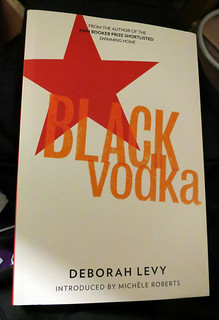
First book on subscription from & Other Stories

And Other Stories is a small publisher that works on a subscription model. They publish six new books per year, often translations into English. Subscribers get their names printed in a numbered first edition of each book they subscribe to. I was very excited to read my name in this book! And as a bonus they included a few copies of this poem, which I have stuck to our fridge:
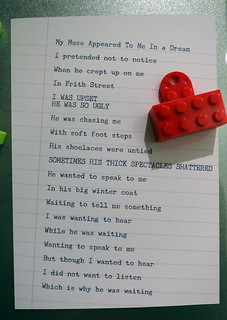
Lovely poem from & Other Stories

Have you had any good post lately?

Kate Gardner Blog

He doesn’t have the sense of a billy goat

December 14, 2012December 14, 2012

Fried Green Tomatoes at the Whistle Stop Cafe
by Fannie Flagg

This was a book club pick and I thought somehow that it would be light and fluffy and girly, possibly because that’s how I remember the film (though on rewatching the film this week I discovered it’s not really those things either). It’s certainly an easy, enjoyable read, but it covers a lot of issues without labouring the point and has some very interesting things to say.

In the 1980s middle-aged Alabama housewife Evelyn Couch is visiting a nursing home and gets talking to a resident there, Mrs Ninny Threadgoode. Ninny is old and a little forgetful but also charming and immediately launches into stories about her early life in a small town called Whistle Stop. At the heart of these stories are Idgie and Ruth, the two women who ran the Whistle Stop Cafe from 1929 until it closed. However, inbetween there are snippets about other characters from the town and their lives, all told with a wonderful sense of humour.

“This skinny little man, so black he was a deep royal blue, had caused a lot of trouble for the opposite sex. One gal drank a can of floor wax and topped it off with a cup of Clorox, trying to separate herself from the same world he was in. When she survived, claiming that the liquids had ruined her complexion for life, he became continually uneasy after dark, because she had snuck up behind him more than once and cracked him in the head with a purseful of rocks.”

And at that level it all sounds a bit twee. But this book covers racist violence, domestic abuse, homosexuality, prostitution, extreme poverty and death, which is some pretty dark stuff for a story that’s so nice and chirpy on the surface. I know some at book group felt that this meant none of the themes were really explored, but were just thrown in there, and certainly the only subjects really talked about are female empowerment and death.

But then one of the running themes in this book is not talking about important things. Idgie and Ruth are a couple, which you would think was a big no-no in a small southern US town in the 1930s, but the whole town seems to know and just accept the situation. I wondered if this was because they all consider Idgie an honorary man. She certainly not only joins in with but often takes lead in hunting, fishing, gambling, drinking and the other manly pursuits of the town. But she’s far from being the only strong woman in town.

“Cleo, Idgie’s brother, was concerned…
‘Idgie, I’m telling you, you don’t need to feed every [hobo] that shows up at your door. You’ve got a business to run here. Julian…says he thinks you’d let Ruth and the baby go without to feed those bums.’
…’What does Julian know? He’d starve to death himself if Opal didn’t have the beauty shop. What are you listening to him for? He doesn’t have the sense of a billy goat.’
Cleo couldn’t disagree with her on that point.”

Each chapter takes a different source or viewpoint, so there’s Evelyn’s daily life, Ninny’s reminiscences, the Whistle Stop newsletter and other newspaper articles, and occasionally a plain old omniscient narrator. There’s also lots of jumping back and forth in time, which was confusing at first because there seemed to be sections that were unrelated, but by the end it all ties together. And also, in the end there is no single character who knows everything that the reader does, which I quite liked.

Generally, I found what could have been a heavy-handed moral tale a much more subtle look at life in the southern US. The one unsubtle message was about strong women. Really, it’s Evelyn’s story, and she is discovering through Ninny’s stories how unhappy she is with her life, downtrodden and ignored by her husband.

“After the boy at the supermarket had called her those names, Evelyn Couch had felt violated. Raped by words. Stripped of everything. She had…always been terrified of displeasing men…She had spent her life tiptoeing around them like someone lifting her skirt stepping through a cow pasture.”

As someone at book club pointed out, at the novel’s heart is the power of storytelling. Ninny’s stories have to be good for us to believe they would have such a profound effect on Evelyn. And it is all a rollicking good yarn, with a running theme of tall tales.

I seem to be saying this of every other book at the moment, but I think I would get a lot out of re-reading this.

First published 1987 by Random House.

Kate Gardner Reviews

It is the ideas and stories that count

December 9, 2012 4 Comments

Stop What You’re Doing and Read This!
by various authors

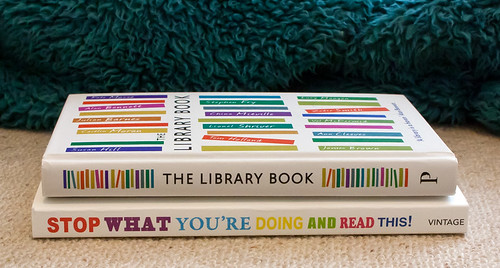
Slightly meanly, I think, the publisher has not credited anyone as the editor of this collection of essays on the topic of reading. Even the introduction is simply signed “Vintage Books, 2011”. I bought this book on a whim at the same time as The Library Book, as they were both pretty and colourful and contained essays by interesting people.

Foyles haul

I think it’s probably not surprising, then, that my reaction to this book is very similar to my reaction to The Library Book. Hit and miss. But perhaps to more of an extreme in this case. The hits had me nodding my head furiously, while the misses in some cases had me furious.

I like that the 10 essays are not only written by big names. They include novelists, poets, publishers, journalists, academics and the founder of a charity, the Reader Organisation. And the wide topic allowed them to take very different angles. Blake Morrison writes intelligently and profoundly about the pleasures and benefits of reading, including why poetry matters:

“It takes courage to own up to dark thoughts and dangerous feelings. But poetry – the most intimate yet public of forums – is the ideal place. Ted Hughes is one writer who recognised this. Writing, he said, was about facing up to what we were too scared to face – about saying what we would prefer not to say, but desperately need to share.”

This illustrates what my favourite of these essays do well – they quote widely, creating a whole reading list for me within their few pages of eloquent argument. Carmen Callil writes interestingly about books in her life and how being a woman in a man’s world led her to found Virago. She shows a great, warm love for books. Tim Parks, in contrast, goes negative. He generalises the average westerner as someone who either doesn’t read or only reads the latest big title:

“If we read fast, superficially, for plot, to get through, so as to congratulate ourselves…we’re not only missing out on certain pleasures, we’re actually putting ourselves at risk, leaving ourselves open to messages and attitudes we haven’t weighed up…”

Not only is this quite ungenerous, not to say judgemental, but I also think it’s wrong. Different books have different effects on us and who is he or I to tell someone that they shouldn’t read a certain book because we didn’t get anything from it? Thankfully Mark Haddon says entirely the opposite:

“This, I think, does a disservice both to readers and to the books themselves…because it’s not true. Visit a prison library and you’ll meet good people whose lives have been saved by potboilers, and psychopaths reading Jane Austen.”

But Haddon also writes intuitively about the act of reading itself:

“Stop reading right now. Look around you…The sense of being inside looking out, of seeing a world that belongs to everyone, but is nevertheless yours alone. It is this uncrossable gulf between me and not-me, between my private experiences and yours, which lies at the heart of being human and which no other medium can touch, and this border is where the novel lives and moves and has its being.”

And then Jeanette Winterson went and ruined it by returning to Parks’ snobbery and turning it up to 11. She goes from praising the King James Bible and Shakespeare to:

“We live under 24/7 saturation bombing from an enervated mass media and a bogus manufactured popular culture. If you don’t read you will likely be watching telly, or on the computer, or listening to fake music from puppet-show bands…The consequences of homogenised mass culture plus the failure of our education system and our contempt for books and art (it’s either entertainment or elitist, never vital and democratic), mean that not reading cuts off the possibility of private thinking, or of a trained mind, or of a sense of self not dependent on external factors…Attention Deficit Disorder is not a disease; it is a consequence of not reading.”

What?!! There is so much wrong with these statements. That last sentence…whooah! Has she ever expounded her theory to a doctor or ADHD specialist? I’d be interested to hear their response! I mean, I think reading is important and rewarding, but that really is taking it too far. And as for her comments on modern pop culture, well that’s her own personal taste and to extrapolate from her dislike to such disparagement is unkind and even ignorant. Music can transport me, make my heart race and my emotions surge – and I don’t mean classical music here, I mean rock, folk, dance and pop music. Not every song, or course, but plenty that I am sure Winterson would turn her nose up at. And let’s not forget that Shakespeare was the pop culture of his day.

I think in general it is a stubborn clinging to the past that frustrated me. A few of the essayists write about how the physical printed book is intrinsically better than ebooks, and how new technology and mass media threaten today’s youth and therefore the entire world. Personal preference is one thing, but I think we have to face up to the fact that we live in an age of transition and be positive about the possibilities the future offers. The final essay by Maryanne Wolf and Mirit Barzillai addresses this well:

“The Greek transition from an oral culture to a literacy-based culture provides a valuable analogue…Socrates argued that the seeming permanence of the printed word would delude the young into thinking they had accessed the essence of some aspect of knowledge, rather than simply decoded it…Will [today’s] young people immersed in technological innovation become adept at prioritising, sorting and critically evaluating information, adapting different types of reading styles based upon their purpose…Will the flexibility of digital text actually enhance the reading experience for many readers, propelling them into a deeper engagement with text, or will such enhancements serve as further distraction?”

I accept that my own preference for reading novels in hard copy is a product of my life to date, but I didn’t exactly dislike my brief dalliances with a borrowed Kindle and I absorb most of my journalistic writing via computer these days. I think a love of music, film, TV, comedy and theatre complements my love of reading, rather than detracting from it (though I won’t deny that they are all competing for my time). I think reading is important, valuable and worth encouraging in others but it is not about to disappear. As Callil says in her essay:

“The human race has been telling stories, and trying to record them on papyrus, on manuscripts, on stones, since the beginning of time. Whether we read on the printed page or on a machine is beside the point. It is the ideas and stories that count.”

Published 2011 by Vintage.

Kate Gardner Reviews

And we got back to work

December 5, 2012

The Restraint of Beasts
by Magnus Mills

I was sent this book by an old friend in a book swap and I can see why he chose it. It’s a comedy of a pretty niche sort and I think you’d have to know someone well to confidently recommend this to them. I was amused, so thanks Matt.

Mills takes a very simple story of everyday working class life, with all the drudgery and repetition that real life entails, and injects a few bizarre moments and a lot of black humour. Tam and Richie are Scottish fencers working under the supervision of the unnamed narrator, who must cajole and harass them into doing their job. Early in the novel, their employer sends them away from rural Scotland to equally rural west England to erect specialist fences for a grumpy farmer. The three main characters must share a small, dilapidated caravan and all they have to look forward to, aside from going home to Scotland when the job is finished, is their nightly visit to the local pub. When they come across local fencers the Hall Brothers, they think they have inadvertently trodden on toes and are in trouble for it, but the tale turns out to be much stranger than that.

Or does it? At the end I had quite a few unanswered questions. There are a number of things said that seem to be evasions or euphemisms that are not explained. Everything is sinister and suspect. A talk from the boss will be built up to as a climactic event, while the real big drama just happens with a shrug. The humour is understated and dark.

“Tam slowly advanced on the sheep, chisel raised like a dagger, getting within a few yards of the animal. Then suddenly he sprang forward.
‘Tam, no!’ I yelled.
The sheep instantly bolted, and Tam fell forward onto the ground…
‘What are you doing?’ I said.
‘I was just seeing if I could catch it, that’s all,’ he replied.
‘Why?’
‘In case we have to eat them.’
‘Why should we have to do that?’
‘Well, there’s fuck all else, is there?’ He looked desperate…
I made Tam promise not to kill, or practise killing, any sheep, and we got back to work.”

Tam and Richie are harmlessly useless. Work-shy and thoughtless to the point of stupidity, they spend all their money (and more, in the form of loans from the narrator) on beer and cigarettes. But they’re sweet in their reliance on one another and they’re happy enough with what they have. When persuaded to work they are good at their job and often it’s easy to sympathise with their reluctance to work – when it’s cold and raining and they just want to be finished and home for Christmas, for instance.

I’m not sure if a point is being made or if it’s just intended to be funny but there are a lot of conversations in the novel where a manager gives an impossible order or wilfully misunderstands an employee. The story is certainly firmly on the side of the main three characters – the working men. It doesn’t try to make big statements about society or the state of Britain but you could argue that this one small example does illustrate issues such as employment rights, debt and heavy drinking.

I did find the tone and subject disorienting at first. Mills worked as a fencer for years and has included a lot of detail about the job in his prose. And the tone is so very dry that it took me a while to pick up on the irony at work. But a chapter or so in it clicked for me and I found myself grinning through the rest of the book.

Published 1998 by Flamingo, an imprint of HarperCollins.
Shortlisted for the Booker Prize and the Whitbread First Novel Award. Winner of the McKitterick Prize in 1999.

Kate Gardner Reviews

Goodbye Holly dog

December 1, 2012 5 Comments

Holly 1997–2012

Holly

I will always love you, Holly dog.

Kate Gardner Blog

To define happiness, its one clean note

November 26, 2012

Seducing Ingrid Bergman
by Chris Greenhalgh

When I spotted this title in the Penguin Press Newsletter it wasn’t so much Bergman’s name that attracted me – though she was a great actress and some of her films are deservedly classics – but that of the other half of this brief affair – war photographer Robert Capa. Photography interests me as a hobby and as an art form and I was interested to see how that would be handled within a novel about one of the medium’s legendary names.

It’s a great story that has all the right ingredients for becoming a great film, but it didn’t immediately click for me. Despite a dramatic, well judged opening that contrasts Capa parachuting into enemy territory and being shot at in March 1945 with Bergman receiving an Oscar in a glittering ceremony in Hollywood, I found myself noticing the writing, tutting at all the similes that would have served better as metaphors and the slightly obvious parallels drawn with photography wherever possible:

“…involuntarily she repeats the way Pia had wrinkled her nose, closing both eyes at the same time as though taking a photograph.”

However, I think perhaps I just took a while to get over the fact that these were real people and that I had been expecting something that felt a bit more like historical fiction or even biography. Because this is solidly a novel, ascribing thoughts and fears and feelings to its characters and even using first person for about half of the narrative (always as Capa). And as I gradually got pulled into the story I began to thoroughly enjoy it and even to pick out well written passages:

“We watch as the light rises, giving the world shadows. The grey shapes of the trees on the boulevards hold their breath for the heat of day. And behind the buildings the sun comes up with its liquid edges.”

The bulk of the story is set in Paris, where Bergman is sent to entertain troops and Capa is based in-between assignments. Greenhalgh does a good job of describing Paris, primarily in a romantic light but with the occasional touch of realism, such as very funny observation about a high class cafe having a hole-in-the-floor toilet, and Capa imagining all the fancy ladies in their high heels squatting over the filth and being impressed by them emerging looking flawless.

I must admit, and this may be largely my own cynicism, that I found the early descriptions of the affair saccharine to an annoying degree:

“I don’t know whether it’s the music or Ingrid sitting there, her spoon poised over her ice cream, but everything merges at this moment – the leaves, the sunlight, the scent of vanilla, the street with its sliced shadows – and if I had to define happiness, its one clean note, well, this is the closest I’ve come to it.”

For me, it was everything else in their lives that captivated me, for instance when Capa had flashbacks to wartime and was terrified and yet would profess later that day a desire to get back to work, meaning another war. Or descriptions of Bergman making films I know and love, such as Notorious.

Perhaps I would have been better off reading biographies of these people and an anonymous love story, but the one advantage this novel does have is that you know from the start (or at least I did) how it ends, you know that this was not the only love either person experienced in their lives, nor even the most dramatic one, and yet while it lasted it was all those things and more, because that’s how life and love are. And I do now want to go back to Capa’s photographs and Bergman’s films, which is after all their legacy, not who they loved.

This book was kindly sent to me by the publisher in return for an honest review.

Published November 2012 by Penguin Books.

Kate Gardner Reviews

She believed in the worst and knew herself to be imagining the best

November 23, 2012 5 Comments

Saplings
by Noel Streatfeild

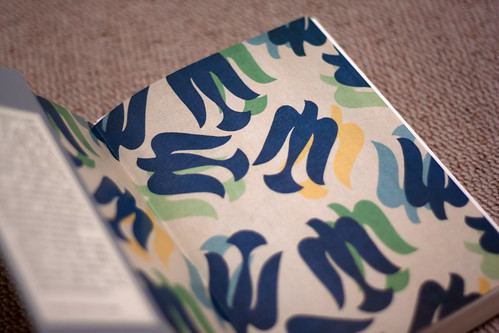
This is one of those books that I wished didn’t have to end, though in a way I was glad that it did because it’s the tale of a downward spiral. It’s also a beautiful book physically, being my first (finally!) read from Persephone Books.

End paper gorgeousness

Streatfeild is famous for her children’s books, especially Ballet Shoes, but she also wrote books for adults, though they never sold as well. This may possibly be the pick of the bunch but Saplings is so wonderfully good that I am saddened it’s the only one of Streatfeild’s novels for adults currently in print.

It’s a clever, sharply observed book about children, family and war. The Wiltshires are a happy, comfortable middle-class family, with two parents, four children, a nanny and a governess, a home in London and holidays to the seaside. But from the first pages the potential cracks are there. The adults are worrying about the inevitability of war and whether London is a safe place for children. The father Alex worries that war will take him away from his family. The mother Lena worries that she will have to go with the children when all she wants is to be at Alex’s side. The baby of the family, four-year-old Tuesday, frets because the adults are clearly worried, while 11-year-old Laurel mixes together war-time fears with more mundane worries about school:

“She believed in the worst and knew herself to be imagining the best. As a shield she made loud fun of all war precautions…It didn’t matter being the plain one at home, people were used to it. If only she had managed to be super at something, then she could have gone to the Abbey School carrying her ability like a screen.”

The story follows the family from summer 1939 until summer 1944, such a short time but of course one of huge change for Britain as a whole. Streatfeild never tries to extrapolate the wider changes going on, she simply illustrates them through the Wiltshires and their extended family and friends. Things do not just suddenly fall apart, the descent from happiness is gradual. Some of it is unavoidable – evacuating the children to their grandparents’ house and then to boarding school, for their own safety. But a lot of what happens is far more subtle. Things aren’t said that should be, expressions are misunderstood, situations are mishandled. It is a heartbreaking study of avoidable unhappiness. And I thought this passage a very good description of a panic attack:

“He saw the attacks as if they had shape. Huge, black and soft, ready to fall on him…First he felt a tenseness in his diaphragm, which got steadily worse til he was hard in front, as if he were made of wood. Then he had a sinking sensation. The people around him were still there but on a different level, beyond reach…he had to get away alone and let the attack reach its climax. Then everything swam before his eyes, his heart beat quicker and quicker, there was thumping in his ears…”

The prose in insightful rather than poetic but once I realised that the slightly irritating idyll of family life at the start of the story was both part-facade and about to break apart anyway, I was carried along by the momentum of the story. Streatfeild does not keep surprises or mysteries up her sleeve, the narration is open in a way the Wiltshire family never can be. If anything this lesson may be repeated a little too often, but it is such a realistic one, touching on both the stoicism of wartime and the very English habit of keeping one’s emotions to oneself. She does allow herself a few characters who know the children well enough, or are just observant enough, to see what other adults don’t, but the wartime setting keeps these saviours away for long periods.

And without wishing to give anything away, everything is not alright in the end. Bad things have happened and those who are in a good or safe place know that it may not last. This was, after all, published while the war was still going on, and after several years of “It’ll all be over by Christmas,” optimism had faded, even when things were finally going well for the Allies. But also, the two oldest children, Laurel and Tony, have grown up over the course of the story and are 16 and almost 15 at the novel’s close, so they are seeing the world differently in more ways than one.

This is a story full of heart, and completely on the children’s side. Even the best of the adult characters gets thing wrong from the children’s perspective, and Streatfeild shows how a thoughtless word or imagined slight can lead to months of real misery. I wanted so badly for things to suddenly be all good, but of course life isn’t like that.

I chose this book after reading Liz’s review and it was bought for me by my very loveliest friend H who took me on a special trip to Persephone Books a few months ago. Thanks to both of them!

First published 1945 by Collins.
Published by Persephone Books in 2000.

Kate Gardner Reviews

Sunday Salon: Do you re-read?

November 18, 2012 16 Comments

The Sunday Salon

Re-reading is one of those subjects that comes up every now and again and every time I say wish I did, I just never get round to it. But that’s a rubbish excuse. I mean, if I don’t re-read, then what’s the point of my beautiful library (except as a repository for the ever-expanding TBR)? I have friends who re-read all the time, who return to certain books over and over again, and I can definitely see the appeal.

I was listening to an old episode of Books on the Nightstand in which Ann and Michael discussed how they don’t re-read and I recognised some of their excuses: too many new books – both in terms of the excitement of new books and the pressure to keep up – but also the fear that a book that was a perfect read the first time round won’t live up to the memory of it on re-reading. But I must also admit that blogging is another reason I don’t do it. Because it’s a lot harder to review a book on a re-read. Or at least, it can be.

For instance, I just read The Hitch Hiker’s Guide to the Galaxy for, I think, the third time. Not only have I read it before, and all of its sequels, and watched the TV series and the film (though sadly never heard the radio show) but it’s also become a firm part of our culture, from the Babel Fish online translation tool to our local secondhand bookshop Beware of the Leopard to everyone’s favourite number being 42. There’s even a Towel Day every year to celebrate the work of the late Douglas Adams. This weekend, while going round our neighbourhood arts trail (here’s my post about the 2010 trail) I spotted that the sign next to the Norwegian waffle window included a joke about Slartibartfast, which made me grin like a loon.

How do you review a book like that? It’s not far off when I read a book for book group and on my way to the meeting I’m desperately trying to think of something more clever to say than “I liked it”. But then, The Hitch Hiker’s Guide to the Galaxy is exceptional, surely. Not every book I want to re-read is going to be quite so…well, brilliant.

Of course, when I was a child and even as a teenager I re-read all the time. My copy of Carbonel by Barbara Sleigh is in pieces I read it so often, and I’m frankly amazed my other most-read favourites The Wickedest Witch in the World by Beverley Nichols and The Ghosts of Motley Hall by Richard Carpenter (yes yes, I loved a book based on a TV series) didn’t end up in the same state. I think I did buy new copies of a couple of Roald Dahl books that were getting tatty. But then I hit 16 or so and stopped re-reading as often. And the books I have re-read as an adult – most of which were for book groups – I have still only read two or three times, as compared with the at least 50 times I must have read the three titles listed above.

Of course, I do have less free time now. And I do challenge myself more (sometimes, at least) with my reading choices. And I am aware of the limited time I have versus all of the beautiful books out there that I have yet to read. But still, it is both comforting and rewarding to re-read and once again I conclude that I should do it more.

What about you? Do you re-read?

Kate Gardner Blog

Time is supposed to measure history, isn’t it?

November 15, 2012 1 Comment

The Sense of an Ending
by Julian Barnes

This book has left me puzzled. I was happily reading it, enjoying the slow, thoughtful prose, and then the last page happened and I thought, “What?!” Is that a standard sign of a Booker prize winner? Or is it just my standard reaction to Julian Barnes?

It’s a little difficult to discuss this book without giving too much away. It’s so short, only 150 pages, and is one of those books where you could say very little happens, or that a lot happens. Which is fine. The language is beautiful, measured and philosophical.

Briefly, narrator Tony Webster is retired, divorced, but generally happy with his ordinary life. Then something happens (and we don’t find out what until halfway through) to remind him of his childhood friend Adrian. Adrian was always the brilliant, serious, passionate one and Tony muses on the lost passions of youth, love, friendship, life and death. There’s a lot of musing.

“The history that happens underneath our noses ought to be the clearest, and yet it’s the most deliquescent. We live in time, it bounds us and defines us, and time is supposed to measure history, isn’t it? But if we can’t understand time, can’t grasp its mysteries of pace and progress, what chance do we have with history – even our own small, personal, largely undocumented piece of it?”

Through flashback, Tony revisits his childhood and early adulthood. During the story he is led to question his memory, not just of events but of other people’s experiences of the same events. Which isn’t exactly original, but it’s done reasonably well.

“I must stress that this is my reading now of what happened then. Or rather, my memory now of my reading then of what was happening at the time.”

The storyline annoyed me but the writing was provocative, intellectually stimulating. I’m glad I read it but I’m not sure I rate it as highly as other Booker winners I’ve read. I know a few people have said that it’s a book that demands re-reading so perhaps I should do that to see if I missed something?

“It ought to be obvious to us that time doesn’t act as a fixative, rather as a solvent. But it’s not convenient – it’s not useful – to believe this; it doesn’t help us get on with our lives; so we ignore it.”

Published 2011 by Jonathan Cape.
Winner of the Man Booker Prize 2011.

Kate Gardner Reviews

Autumn days

November 13, 2012

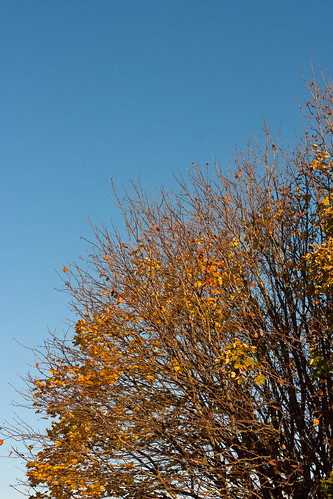
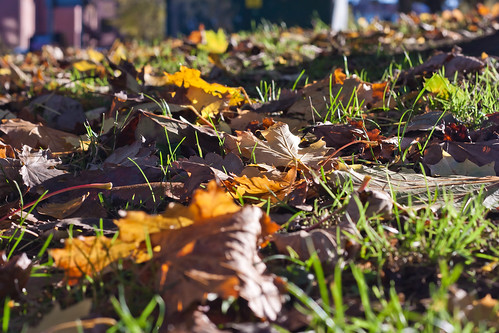
I love this time of year – late autumn/early winter. Crisp cold air and clear blue skies. Or mist and rain and wind howling down the chimneys. I blame The Secret Garden – that line about the wind wuthering always was my favourite.

Autumnal

Untitled

Untitled

Kate Gardner Blog

Posts pagination

1 … 92 93 94 … 126

Archives

RSS feed: Nose in a book Nose in a book

  • Non-Fiction November 2026
  • Book review: The House of Doors by Tan Twan Eng
  • Book review: Taiwan Travelogue by Yáng Shuāng-zǐ

Me on the internets

  • @kate_in_a_book@mas.to (Mastodon)
  • Flickr/noseinabook
  • Instagram/kate_in_a_book
  • StoryGraph/kate_in_a_book

Categories

  • Blog
  • Reviews
  • Uncategorized
  • © Copyright Kate Gardner. All rights reserved.
Proudly powered by WordPress | Theme: Dream by vsFish.