Nose in a book

Reviews and other ramblings

  • Home
  • Reviews archive
    • Book reviews
    • TV reviews
    • Theatre reviews
  • TBR
  • Challenges
    • The Classics Club
    • 2014 Popular-Science Reading Challenge
    • Cookery challenge
    • The Gilmore Girls Reading Challenge
    • 2013 TBR Pile Challenge
    • 2013 Translation Challenge
    • Crime and Punishment read-a-long
  • About
    • Cookie legal stuff

Author: Kate Gardner

I live in Bristol and I like to read books and share what I thought about them here. I read mostly general or literary fiction, with pretty much every genre making an appearance from time to time. I love to receive comments, whether you've read the same books or not!

Featured today on Savidge Reads: me

January 17, 2013 1 Comment

Just a quick post to say that if you want to learn a little about me and my books, take a look over at Simon’s blog Savidge Reads where I’m today’s featured blogger in his series Other People’s Bookshelves.

I can also recommend checking out the rest of the series, because who doesn’t like having a nosy of other people’s bookshelves?

Kate Gardner Blog

Man is many things, but he is not rational

January 15, 2013January 23, 2013 2 Comments

The Picture of Dorian Gray
by Oscar Wilde

I have had this sat on my shelves for ages because, even though I’ve watched and loved a few of Wilde’s plays and have fond memories of his children’s stories, something in me said this is old and “classic”, therefore it will be hard. It was not a hard read at all, it was a thoroughly enjoyable one.

I would say that everyone already knows the storyline, but I was surprised to discover how vague my understanding of it was before I started reading. So I will summarise. At the start of the novel, Dorian Gray is young, beautiful, charming and innocent, and is serving as a muse to painter Basil Hallward, who is a little obsessed with him and has just painted his masterpiece, a portrait of Dorian. Dorian remarks that he wishes the painting might grow old while he stays young and beautiful and…well, it happens, but more slowly and darkly than I had expected.

“Hour by hour, and week by week, the thing upon the canvas was growing old…The cheeks would become hollow or flaccid. Yellow crow’s feet would creep round the fading eyes and make them horrible. The hair would lose its brightness, the mouth would gape or droop, would be foolish or gross, as the mouths of old men are. There would be the wrinkled throat, the cold, blue-veined hands, the twisted body.”

Dorian, when he realises what is happening, slowly becomes quite bad. Is this the influence of life in general? The circumstance of being able to look fresh and beautiful no matter how guilty he feels? Is it how Dorian’s nature was always fated to develop? Or is it all the influence of Lord Henry Wotton, a friend he was introduced to by Basil on that fateful day when the portrait was finished? Lord Henry is a fun character, talking largely in aphorisms and painting himself as morally repugnant, but the key seems to be that he doesn’t mean half of what he says, whereas Dorian takes it all to heart.

” ‘I adore simple pleasures,’ said Lord Henry. ‘They are the last refuge of the complex. But I don’t like scenes, except on the stage…I wonder who it was defined man as a rational animal. It was the most premature definition ever given. Man is many things, but he is not rational. I am glad he is not, after all.’ “

This book is so very quotable. Even skipping the slightly trite aphoristic preface (which I have seen quoted from many times), the language is full of both delightfully Wildean phrases but also exquisite descriptions:

“There was a silence. The evening darkened in the room. Noiselessly, and with silver feet, the shadows crept in from the garden. The colours faded wearily out of things.”

The characters are interesting. I didn’t feel I ever got to know any of them well, but they are certainly varied and in some cases fascinatingly complex. Even those characters that might have been verging on caricature are described so well it hardly matters.

“The exaggerated folly of the threat, the passionate gesture that accompanied it, the mad melodramatic words, made life seem more vivid to her. She was familiar with the atmosphere. She breathed more freely, and…would have liked to have continued the scene on the same emotional scale, but he cut her short. Trunks had to be carried down, and mufflers looked for. The lodging house drudge bustled in and out. There was the bargaining with the cabman. The moment was lost in vulgar details.”

Nothing is straightforward and not all of the mysteries of the story are resolved. Which was sometimes frustrating – exactly what are the rumours circulating about Dorian? I can imagine, but I want to know! I suppose that’s one of the moments to remember that this was written in the 19th century – it rarely if ever feels that old.

First published in the July 1890 issue of Lippincott’s Monthly Magazine. Revised and published as a book in 1891 by Ward, Lock and Company.

Source: I have a chunky Complete Works of Oscar Wilde that I have owned for more than 10 years. I think I bought it for myself. Probably.

Challenges: This counts towards the Rory Gilmore Reading Challenge.

Kate Gardner Reviews

Sunday Salon: Keeping track

January 13, 2013January 13, 2013 6 Comments

The Sunday Salon

I spotted an open invite recently to complete a survey about book blogging and it highlighted something that had already begun to concern me – I don’t keep track of where my books come from.

I would guess that the majority (or at least a large proportion) of my books were given to me as presents but if the giver didn’t write a note on the inside cover (which they rarely do), I have no record of this and when I come to read the book a year or more later I have invariably forgotten whose kind present it was. This is sad both in terms of me being able to show full appreciation and in terms of the lost memory.

So I have decided to tackle this in two ways. One, all new books added to the TBR shelves get a little note written in them about where they came from. And all my reviews this year will include a mention of the source of the book.

If I can, that is. Where I have happened to blog about book buying I should have a reminder of when I bought books for myself, so with a little bit of memory power more recent additions should be easy to identify, but what about those books that have sat unread for four, five or more years? I’ll have to get delving through all the old photographs of birthdays and Christmases to see what I can deduce!

Do you keep note of where your books came from? Do you write anything in the books themselves? What about when you’re the one giving books as presents?

Kate Gardner Blog

Challenges and read-a-longs and read-a-thons, oh my

January 11, 2013January 19, 2013 8 Comments

I have decided that this is the year when I am going to make more of an effort to join in all of those group activities going on in the book blogging world. I haven’t been much of a joiner to date, but I’ve already spotted several great looking challenges/events that I want to get stuck into. So here’s my list of fun…so far.

2013 Translation Challenge hosted by Ellie of Curiosity Killed the Bookworm

The aim is simply to read one book that is translated into English from another language per month, every month. Seeing as how I had recently concluded that I am a bit rubbish at reading translations, this is the ideal challenge for me, and I have already started reading my first translated book of 2013: Aunt Julia and the Scriptwriter by Mario Vargas Llosa. There is an optional additional challenge to read 12 books translated from 12 different languages. That might be tough, but I won’t say no just yet.

read-a-long-plain-001

Crime and Punishment read-a-long hosted by Wallace of Unputdownables

The thing is, I tried reading this in December and those first 80 pages dragged, I hated the main character, it was all predictably depressing and I decided life was just too stressful at that time to make myself read something that got me down. But I do still really want to read it and it just happens that this read-a-long is scheduled for February and March, which seems like the only way I’m likely to tackle it again any time soon. Also, it’ll count towards the translation challenge! And the Rory Gilmore Reading Challenge (see below).

The Rory Gilmore Reading Challenge

I actually posted about this ginormous ongoing challenge (not unlike the Boxall’s 1001 Books You Must Read Before You Die list) last July, but failed to read anything from it until last week. I think a sensible aim would be 12 books this year. At which rate it will take me 20+ years to complete, but that’s not really the point of giant long lists like this, is it?

2013tbrpilechall

2013 TBR Pile Challenge hosted by Roof Beam Reader

This is almost cheating, as I’d already decided the TBR was too unwieldy for me to be allowed to buy new books until I made a dent in it, but this challenge is specifically about digging out those older books that have sat on the TBR for far too long. And I have to post a list of the books I aim to read, so here goes:

1. A Novel Bookstore by Laurence Cossé
2. Breakfast of Champions by Kurt Vonnegut
3. The Confessions of Max Tivoli by Andrew Sean Greer
4. Immortality by Milan Kundera
5. Other Colours by Orhan Pamuk
6. Chasm: a Weekend by Dorothea Tanning
7. On the Road by Jack Kerouac
8. A Paper House by Mark Thompson
9. The White Tiger by Aravind Adiga
10. Dan Yack by Blaise Cendrars
11. The Stories of English by David Crystal
12. The Heart of the Matter by Graham Greene

Alternates
1. The Prince by Niccolo Macchiavelli
2. Disgrace by J M Coetzee

Bloggiesta

And the rest

I will also be joining in at least one Bloggiesta, giveaway and read-a-thon, so let me know if there’s any coming up. I also have an idea for a little challenge for myself involving all those rarely opened cookery books in our kitchen, but more on that another time. Do you do challenges etc? Which ones caught your eye this year?

UPDATE: I’ve created a new challenges page here.

Kate Gardner Blog

Don’t be so tough early in the morning

January 8, 2013January 25, 2013 1 Comment

To Have and Have Not
by Ernest Hemingway

I have been slowly working my way through a box set of Hemingway. At times completely brilliant, at others it was overblown, racist and inconsistent in style. I can see why it divides people.

The main character is Harry Morgan, a poor man who lives in the Florida Keys with his wife and daughters and, at the start of the book, makes a living in Cuba taking tourists out sea fishing in his boat. But with the depression starting to bite, a rich tourist doesn’t pay a large bill and Harry is forced to accept one of the more questionable business deals he repeatedly gets offered, marking the beginning of his slow decline into crime.

The structure is a little odd, switching between points of view, introducing detailed minor characters who sometimes have a role in the main story but often don’t. The tone and style is initially a lot like Raymond Chandler and it retains a touch of that throughout, though it does get both more real and more political.

“You know how it is there early in the morning in Havana with the bums still asleep against the walls of the buildings, before even the ice wagons come by with ice for the bars?…
‘Listen,’ I told him. ‘Don’t be so tough early in the morning. I’m sure you’ve cut plenty people’s throats. I haven’t even had my coffee yet.’
‘So you’re sure I’ve cut people’s throats?’
‘No,’ I said. ‘And I don’t give a damn. Can’t you do business without getting angry?’ “

There are some nasty characters in this book and Harry certainly isn’t blameless in his descent. He makes some bad choices, but he also has bad luck thrust upon him. The switches in point of view can be very revealing. For instance, Harry is genuinely in love and lust with his wife still but when another character describes her it’s a very unflattering picture that is painted, with a total lack of understanding for how the Morgans’ relationship might work.

Which is a theme, actually – assumptions about other people being proved wrong when the narrative switches to their perspective. There are some surprisingly modern touches, such as the smug misogynist painted as a fool. But Harry’s racism certainly isn’t modern. I can’t remember the last time I read the n*** word so many times in one sitting and it bothered me, but it wasn’t just casual terminology. Harry talks about various coloured people in demeaning stereotypes, painting them as less than human, and no amount of historical leniency can make me okay with that.

Hemingway does show some real knowledge of boating and fishing, with detailed descriptions of bringing a boat in to harbour or chasing down a marlin. Neither is my thing at all but even those sections kept me engrossed, which suggests they were written pretty well.

I’ll continue reading through my Hemingway box set but so far The Old Man and the Sea is still the high point for me.

First published 1937 by Charles Scribner’s Sons.

Source: Secondhand, I think from a book swap.

Challenges: This counts towards the Rory Gilmore Reading Challenge.

Kate Gardner Reviews

Sunday Salon: New year, new books

January 6, 2013January 6, 2013 11 Comments

The Sunday Salon

Every year when my family asks what I want for Christmas and my birthday (they’re pretty close together) I give them a wishlist that is 90% books and every time I have to reassure them that yes, books really really are what I want. You’d think they’d learn. Thankfully, they know me well enough to buy me said books, in addition to a few useful things.

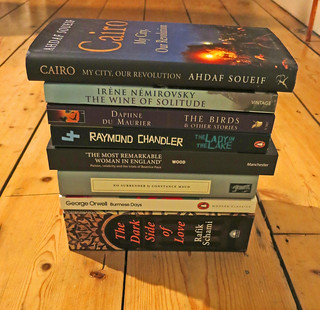
Even though I already own 120 or so unread books and a couple of thousand read books that I have kept because I want to re-read them some day, it makes me super happy to see this stack of new books.

Christmas books

If you can’t quite read those spines, the books are:

Cairo: My City, Our Revolution by Ahdaf Soueif
The Wine of Solitude by Irène Némirovsky
The Birds and other stories by Daphne du Maurier
The Lady in the Lake by Raymond Chandler
The Most Remarkable Woman in England by John Carter Wood
No Surrender by Constance Maud (that’s the pretty Persephone edition)
Burmese Days by George Orwell
The Dark Side of Love by Rafik Schami

And despite already having all of those lovely new books, I tripped and bought a book yesterday – the first trade paperback volume of Sandman by Neil Gaiman (and if I like it there’s 11 further volumes to buy!) – while Tim was picking up his latest comics and earlier this week I ordered a book from Abe Books to complete my collection of the Claudine series by Colette. Can I help wanting to give a loving home to all the books?

Oh, and I also received a belated Christmas card via the Book Bloggers Holiday Card Exchange. This one is from Vasilly and came in a very pretty shiny envelope and contains a great quote about reading.

Card exchange prettiness

Yay, I love Christmas and birthdays! Just eleven and a half months to go to the next time. Did you get any great books lately?

Kate Gardner Blog

Christmas reads in brief

January 1, 2013January 1, 2013 1 Comment

As I may have mentioned once or thrice, most of our spare time lately has been spent chivvying builders/cleaning up after builders/redecorating. While I have managed to squeeze in some reading, I think I’m going to skip writing full reviews for this holiday and get back in the swing next week. That’s a good way to start the new year, right?

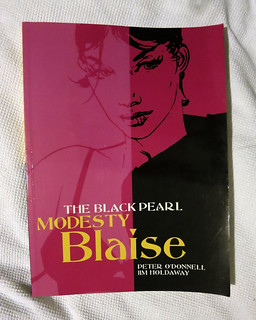
Modesty Blaise: the Black Pearl

Modesty Blaise: the Black Pearl
by Peter O’Donnell (story) and Jim Holdaway (art)

Modesty Blaise: the Green-Eyed Monster
by Peter O’Donnell (story) and Enric Badia Romero (art)

I punctuated my holiday with two volumes of the long-running comic strip about the very British super-capable heroine Modesty Blaise. As I’ve written about her before, there is little new to say. O’Donnell puts her in a variety of locations and intrigues but tries not to make his stories Bond-like, so although she has a good friend high up in the British secret service, she is not a spy. She is a gun for hire, but most of the time she finds her own work, happening, like a young sexy martial-arts-trained Miss Marple, upon crimes and capers wherever she goes. Some stories impressed me with their nuanced political intrigue but then there was the occasional racism that reminded me that this was popular culture in the 1960s and 1970s.

First published in the London Evening Standard and the Glasgow Evening Citizen 1966–1971.
These collections published 2004 and 2005 by Titan Books.

The Clothes They Stood Up In
by Alan Bennett

This tiny book is a novella about a middle-aged couple whose fancy flat is burgled while they’re out at the opera. Everything has been taken, even the carpets, light fittings, toilet rolls and telephones. It’s almost a farce, with the well-to-do middle class slowly picked apart as they try to navigate public telephones and immigrant-run corner shops. Bennett is of course spot-on with his observations and had me laughing out loud from page one. But it’s also moving, sad even, to see how unhappy marriage can be and how far apart people who live together and love one another can become. Highly recommended.

First published in the London Review of Books in 1996. This edition published in 1998 by Profile Books.

Wild Girls: the Love Life of Natalie Barney and Romaine Brooks
by Diana Souhami

On the back of the excellent Mitfords book I thought I’d try another biography. Unfortunately, this one was not as good. It felt a little rushed although perhaps they were really only interesting by virtue of the circles they moved in? Barney was a poet and Brooks an artist. Barney surrounded herself by the elite of Paris culture, particularly the gay section of that crowd, and had affairs with everyone (or rather every woman who would have her). Brooks started out in this crowd but became a recluse. Souhami tells of the wonderful long life of Barney versus the painful slow decline of Brooks and it’s sad but I never felt I had got to know either of them. Extracts from their passionate love letters are repetitive and overblown. Souhami’s intensive research has led to strange chaotic annotations/references in several different formats, which were near impossible to navigate when I actually wanted to. Interesting, but felt like it could have been more than it was.

First published in 2004 by Weidenfeld & Nicolson

So that’s what I read over the holidays. What about you?

Kate Gardner Reviews

Now the year is over

December 31, 2012January 11, 2013 5 Comments

This year, for the first time, I kept some statistics on the books I read. I didn’t go out of my way to read differently, I just recorded what I felt were the key details, with a view to looking at them at the end of the year. Well, here we are. So what have I learned?

Of my 78 books read in 2012, 12 were non-fiction, 3 poetry and 63 fiction. 32 were written by women, 41 by men and 5 had multiple authors covering both genders, so that’s not a bad split. Only 7 were translated, which is pretty poor. And only 15 of the authors were non-UK, non-US. I think I should work on that.

So will I read differently in 2013? I’d like to try but the TBR is getting unwieldy so my first priority is to stop buying books for a while! And I still have to add the generous pile of Christmas books to the TBR, which will make it even longer…

A merry Christmas indeed

And now it’s time to do some painting before I can bring in the New Year with some of that Christmas wine. Happy New Year everyone! Do you have any reading resolutions?

EDIT
I’ve just been poring over my spreadsheet again, as I am wont to do, and spotted that while my reading wasn’t as international as I would have liked, I did read something written by at least one author from every continent, and every continent was represented as a setting as well. However, that’s counting America as one continent. If you split it into north and south, then South America is a big glaring omission from my 2012 reads. Good thing I already have a Peruvian book lined up for January!

Kate Gardner Blog

Merry Christmas

December 24, 2012

Merry Christmas

Have a wonderful holiday, everyone. x

Kate Gardner Blog

There must have been some extraordinary quality

December 23, 2012 4 Comments

The Mitford Girls
by Mary S Lovell

The Mitfords weren’t really on my reading radar until I started book blogging (almost three years ago) and suddenly they were everywhere. After trying to read a volume of Nancy’s letters and failing to see the charm everyone else seemed to have found, I decided it might help to know more about the family and by a stroke of luck, spotted this biography in a charity shop. It worked, in that I am now completely smitten with the Mitfords.

This book is clearly extensively researched – there are 80 pages of notes, index and bibliography at the back – but it manages not to read as a dry product of research, as biographies sometimes can. This is partly due to Lovell’s clear affection for the family, though she only briefly spoke to, rather than knowing intimately, four of the sisters and recounts those meetings very honestly in her introduction. In fact, she does an excellent job of bringing to life her large cast who were largely dead or elderly at the time of writing. Of course, it doesn’t hurt that the Mitfords were such a very interesting bunch of people.

For those who don’t know, the “Mitford Girls” of the title are the sisters Nancy, Pamela, Diana, Unity, Jessica and Deborah, of whom only the youngest, Deborah, is still alive. For much of the 20th century they were household names, for various reasons. Nancy was a bestselling writer, author of many greatly admired biographies as well as novels including The Pursuit of Love that were heavily based on her own family. Diana married Oswald Mosley, leader of the British Union of Fascists, and was a staunch supporter of his political ideals despite decades of hatred from the British public. Unity went even further and became friends with Hitler, in fact was obsessively in love with him and tried to kill herself when Britain declared war in 1939, resulting in brain damage. Jessica was a card-carrying Communist, worked for the civil rights movement in the USA and became such an accomplished journalist that she lectured at universities including Yale and Harvard. Even the less-featured-in-the-headlines Pamela and Deborah lived the kind of lives most of us would find hard to imagine, born as they were the daughters of a Baron, hobnobbing with the great and good of Society, including John Betjeman (family friend), Evelyn Waugh (good friend of Nancy), Winston Churchill (their cousin by marriage), the Kennedys (related by marriage to Deborah) and Harold MacMillan (also related by marriage to Deborah), to name but a few.

I think, because the details were new to me, it was Unity’s story that I found most shocking:

“There must have been some extraordinary quality in Unity that not only attracted Hitler’s attention but caused him to establish a deeper relationship by continued invitations… Unity chatted to Hitler as she would to any member of her family, unselfconsciously bright, always seeking to amuse, entertain or impress. No-one else in his life dared to treat him in the casual manner that Unity adopted.”

Lovell’s job was not, I suppose, an easy one as so very much had previously been published about the family, often directly contradictory. As you might imagine from the differing political affiliations, there were some serious fallings out between members of the family and the combination of sisterly cattiness and a public profile that allowed them to publish their views on any subject in print meant that Lovell did have some work to do establishing the facts. However, sometimes I found this point pressed a little too hard, especially in the earlier sections where I, as a relative newcomer to the story, did not have any preconceptions and therefore got a little bit bored of being told what I had apparently got wrong. Lovell also had a lot of material to wade through, as no less than four of the sisters had written memoirs; they were all prolific letter writers and kept diaries; and being such high-profile figures, many biographies and documentaries of some or all of the family exist.

Despite the title, Lovell also writes quite a lot about the girls’ parents, Sydney and David, and the one brother, Tom. Tom, I suspect, would make a great subject for a biography of his own and does take a bit of a back seat here, though he was clearly universally adored.

My main criticism of this book (and bear in mind here that I thoroughly enjoyed it) would be that Lovell does seem to defend Diana and Unity’s political beliefs but remains critical of Jessica’s Communism (despite stating in her introduction that she would not take a political side). This was also the stance of the parents – Sydney in particular greatly admired Hitler, even after the war – and perhaps it is just that Lovell’s reportage of the opinions of family and friends seemed one-sided because their opinions were heavily sided against Jessica. In fact, on reading this I have come to admire Jessica most of all, as she was instrumental in early civil rights activism in the USA and spent her life bringing to light and campaigning against injustice. As she wrote of her youthful political awakening in Hons and Rebels:

“The discovery of other people’s reality – more than fifty million in England alone! – is one you can grasp from time to time, only to find it eluding you again, its vastness proving too much for you to handle. You discover suffering – not just your own suffering, which you know is largely of your own making, nor the childhood suffering over Black Beauty, David Copperfield or Blake’s Little Chimney Sweep – but you catch disturbing, vivid glimpses of the real meaning of poverty, hunger, cold cruelty.”

In fact most of the passages I marked in the book were about Jessica or noting something that annoyed me: Lovell’s adoption of some of the upper class language (“on non-speakers”, eurgh), her insistence on using nicknames throughout, her repeated use of the phrase “at the height of her beauty”. Except for this one passage, which illustrates the warmth and joy the sisters seemed to be filled with:

“For Nancy, Paris increasingly became the beau idéal of life. She found there an elegance, glitter, warmth and freedom that were lacking in London. One could be uninhibited there without drawing clucks of disapproval, ‘I have often danced all down the Champs Élysées,’ she wrote to Tom, ‘and no-one notices, they are so used to that sort of thing…Oh, I am so excited.’ “

And that’s what makes this a good read. The Mitfords were/are such wonderful characters. I foresee a lot more of them in my reading future!

First published by Little, Brown and Co in 2001.

Kate Gardner Reviews

Posts pagination

1 … 91 92 93 … 126

Archives

RSS feed: Nose in a book Nose in a book

  • Non-Fiction November 2026
  • Book review: The House of Doors by Tan Twan Eng
  • Book review: Taiwan Travelogue by Yáng Shuāng-zǐ

Me on the internets

  • @kate_in_a_book@mas.to (Mastodon)
  • Flickr/noseinabook
  • Instagram/kate_in_a_book
  • StoryGraph/kate_in_a_book

Categories

  • Blog
  • Reviews
  • Uncategorized
  • © Copyright Kate Gardner. All rights reserved.
Proudly powered by WordPress | Theme: Dream by vsFish.