Looking down

Reviews and other ramblings
The Help
by Kathryn Stockett
Audiobook narrated by Jenna Lamia, Bahni Turpin, Octavia Spencer and Cassandra Campbell
A few weeks ago the Guardian offered readers this audiobook as a free download via Audible. Well, I couldn’t say no to that, could I? This book was even on my wishlist. Perfect.
This is the first audiobook I’ve listened to in years and it’s a very different experience from reading, so I still can’t say for sure whether I would have enjoyed reading this book. Probably, but I can’t be certain. However, I loved the audiobook. It’s a gripping story, with lots of wonderful characters and the narrators did a fantastic job of bringing it to life. Really, this felt more like a radio play than a read, but it was more immersive and captivating than any radio play I can remember.
The story is narrated by three characters, plus there is one chapter told in third person, and those are the four voice actors. Each narrates their own chapters in full, putting on different voices for the different people they talk about, so you hear some characters voiced three or even four different ways. It sounds confusing but it isn’t really.
The story is set in Jackson, Mississippi in the early 1960s. White women throw themselves into the busy schedule of society events, setting up their unmarried friends with suitable partners and having babies, while their coloured maids raise those babies, clean their houses and cook their meals. No-one questions this state of things or tries to change it, even while the rest of the USA is discovering civil rights, but beneath the surface, tensions are high between the communities. Nasty things happen to anyone who steps out of line, and the line is narrow.
Narrator number one is Aibileen, maid to Elizabeth Leefolt, a vacuous woman whose eagerness to please centre of society and “League” president Hilly Holbrook makes her an increasingly difficult and even dangerous employer. Narrator number two is Minnie, another maid, who near the start of the book is fired by Hilly Holbrook on behalf of her aged mother and must find another job while Hilly is spreading lies all over town about her. Narrator number three is Eugenia “Skeeter” Phelan, an old schoolfriend of Elizabeth and Hilly and the only one to make it through college – the others left to get married. She is a slightly awkward woman, convinced by her mother’s constant sniping that she is too tall, too plain and too lacking in taste to ever attract a man. So instead she lives with her parents and sticks to her routine of League events and tennis at the country club, keen to be a part of it all.
At the start of the book Elizabeth and Skeeter seem quite similar – nice enough, thrown by Hilly’s nasty comments about black people but pretty clueless about the world really. But a combination of things make their paths diverge. Skeeter is intelligent while Elizabeth is dumb, but Elizabeth is a central member of society by being married and a mother, while Skeeter, by being single and resisting attempts to change that, is held at arms’ length from society. When Skeeter pitches article ideas to a New York publisher and touches on civil rights, she is only raising the topics she thinks the publisher wants to hear about. But then she starts to look around her and find out what is actually going on, and is shocked into taking sides.
The three narrators are warm, funny, wonderful characters – at least, once they get to have their own say they are. But there’s also a large cast of further characters running the whole gamut from scheming and vindictive, complacent and therefore complicit, genuinely good but afraid to stand out from the crowd, and many others inbetween. There’s a violent husband, a loving husband, an absent husband. There’s white outsiders besides Skeeter. All are fully fleshed out and real (though that may be due to good acting as much as good writing).
I thought I knew the facts about civil rights, about the divisions and the violence and the politics, but this book brought to life what it must have really been like, the genuine life-threatening danger of being different, just 50 years ago in a so-called civilised country. It’s terrifying but it’s also wonderful to see how brave people could be, had to be, in the face of awfulness. And yet, in spite of the huge, dark issues, this is a warm, uplifting book.
When I first downloaded the audiobook I didn’t know how I would find time to listen to over 17 hours of it. That’s a lot of time. But I downloaded the Audible app so I could listen on my phone and it has been my companion for two weeks – walking to work, doing housework, taking the train – all to the soundtrack of Mississippi accents drawing me into a world that I was genuinely sad to leave behind.
The film rights were snapped up pretty quickly and I believe The Help (film) has already been released in the US, while in the UK we have to wait until October. I’m intrigued but so much will have to be cut. Hmm.
Book first published 2009.
UPDATE: There has been some controversy surrounding this book and a great discussion has started over on Amy Reads and Wolfs Howl, who are also running a related reading project. Very illuminating.
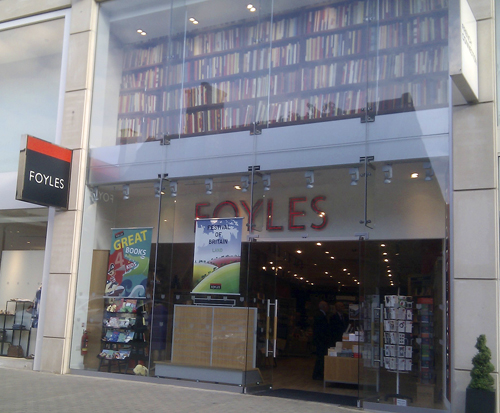
As bookshop chains go, Foyles retains the respect of booklovers by being a darn good bookshop. The Foyles in Bristol’s Quakers Friars was the first in the chain outside of London but I’m sure it won’t be the last.
I first came across Foyles when I was a magazine intern in London and I discovered this incredible series of talks run by Foyles. They have an author event almost every night. The only other bookshop I’ve known to equal it is Topping & Co in Bath.
The new Bristol Foyles store feels spacious and yet full of books. There is a fair selection of related paraphernalia – notebooks, diaries, games, postcards – but these are so well chosen, not to mention well designed, that I’ll forgive them using up floorspace that could have gone to books.
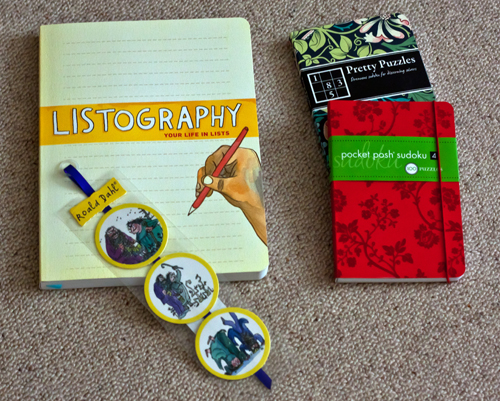
This is not the place to go to get the latest celebrity autobiography or 3 for 2 chicklit. The “top ten” and “staff picks” bookcases showcase mostly literary fiction, including a few titles I’d never heard of. There is a surprisingly large cookery section, including a display of the new Penguin Great Food series. In fact, there was a certain emphasis on this current trend for beautiful books, which I am all in favour of. I picked up a few pretty tidbits for forthcoming birthdays in addition to some books for me.
I’d still like to see more independent bookshops out there but I do think Foyles is a welcome addition to Bristol.
Foyles, 6 Quakers Friars, Cabot Circus, Bristol, BS1 3BU
The Diary of a Nobody
by George and Weedon Grossmith
I first heard of this book a few years back when the BBC dramatised it as a mini-series. The way it was scripted was essentially reading the whole book aloud, so you might say I had read the book before, but it was still funny second time around.
The book was originally a series in Punch magazine, complete with comic illustrations. It is what it says on the tin: the diary of a middle class man living in a London suburb, which he hopes, after his death, will provide some small comfort to his wife and son and perhaps even be published. Even after more than 100 years it remains fresh and funny and accessible.
I have no idea if this was the first comic “diary” to be published but I can certainly see its influence on, for example, Sue Townsend’s Adrian Mole series. The everyday life of Charles Pooter is pretty mundane and he is not even the most likeable character, but his observations and preoccupations are funny and cleverly observed. Pooter is a city clerk and a complete snob, though he has no aspiration to be fashionable or even original. Aside from a few minor bumps on the way he takes the sensible, non-adventurous route and frets that his grown son Lupin is more daring.
A lot of the comedy comes from the writers cleverly using Pooter’s own po-faced words to poke fun at him. He is a largely old-fashioned man, fretting over colourful language in the presence of ladies when clearly he is the only one offended on most occasions. He has a fondness for writing letters of complaint, whether to the laundry or a friend, and this has a tendency to go wrong for him.
Unlike Adrian Mole, though Pooter’s antics occasionally land him in hot water, for the most part he gets by very well. He has a loving wife, forgiving friends and an appreciative boss. In return Pooter speaks highly of all those people, particularly his wife Carrie. He does, however, jump to pre-emptively judge anyone else he meets and is often obliged to change his mind.
This was a book club read and it went down well. It was interesting that all us Brits felt a certain affection for Pooter while the non-Brit in the group didn’t (though she did enjoy the book). Apparently we have a national fondness for the underdog. What we did all agree was that Pooter seems to attract people who take advantage of him, and while he may be a bit of a fool, the rest of the characters are little better.
First published in Punch in 1888–1889. First published in book form in 1892.

Random.org has done its thing and the winners of my UK & EU Summer Hop giveaway are…
Rupture by Simon Lelic goes to The Girl.
The Little Stranger by Sarah Waters goes to LizC.
Congrats to you both. I’ll drop you an e-mail to sort posting. Shout if you don’t get the e-mail by the end of the week.
Thanks again to Donna and Jessica of Book Passion for Life and Jodie of Books for Company for organising this blog hop. And thank you to everyone who entered. Sorry you couldn’t all win!
A Tale Etched in Blood and Hard Black Pencil
by Christopher Brookmyre
This book took a while to grow on me. I was a little disappointed from the start to realise that it wasn’t part of the Jack Parlabane series, and its structure was at first an irritation, before I realised how vital it was to the storyline, and how clever.
Martin is a successful lawyer to the rich and famous. He gets a phonecall one night from an old schoolfriend asking him to go back to Braeside where another old schoolfriend has been arrested for the murder of…you got it, yet another former classmate. And another classmate’s dad. And another classmate is in a coma, while yet another is the policewoman leading the investigation. The scene is set for a lot of memory dredging, facing up to childhood prejudices and crime-solving.
The narrative skips between current day – beginning with two crooks trying to dispose of the bodies – and school days, tackled year by year. Hidden behind the Glasgow dialogue and ever-changing nicknames is all the complexity of childhood – the complicated tangle of loyalties that are constantly switching, the importance placed on certain games and certain moments, the favours given and the mistreatments that were never forgotten.
There’s a lot of very believable childishness here: the changing slangwords; the fear of recrimination from saying, doing or reacting in a non-uniform way; the moments of innocent naivety followed by awful realisation. It’s not exactly how I remember primary school. We weren’t all swearing in every sentence from the start as Brookmyre’s class seems to be. And the rough talk and violent threats started later to my knowledge, but then I wasn’t a boy and all that was the boys’ domain, after all. With girls it’s all about the bitching and the name-calling and the cliques and I most certainly remember that.
In fact, though I struggled with it a little at first, mostly due to the dialogue, the school stuff was far more clever and subtle and well-written than the adult part of the book. As adults, the same characters seem to be either remarkably well adjusted or in a complete mess and in need of a life lesson. Which they duly receive. Okay, it’s not quite that simplistic but there is a certain tendency for old friends to declare “I told you so”. But the adult part does have the murder mystery, which slowly unravels into a much more complicated picture than it initially appears.
Though it has its moments, this book isn’t as funny as previous Brookmyre novels that I’ve read. It’s not bleak and heavy either, and at a push I might call it black comedy, but the genuine comic moments are few and far between. There also isn’t a single main character with the charm and presence of Brookmyre regular Jack Parlabane, but by the end of the book he has fleshed out almost a whole classful of rounded, believable individuals, which is no small achievement.
I would say this isn’t quite as fun and light a read as other Brookmyre books, but it still served me well on my beach holiday.
First published 2006 by Little, Brown.
Two Tales and Eight Tomorrows
by Harry Harrison
Having noticed that my last two book club reads were a tad heavy on the religion front, Tim recommended that I read the Harry Harrison short story “The streets of Ashkelon” and dug it out for me. It happened to be the first story in this collection and I enjoyed it so much I carried on reading the rest of the book.
This was my first experience of Harry Harrison (I think) and I was impressed. Each story has a unique, often complex sci-fi setting but the tales told are very human, accessible and warm. The details of space transport or alien beings are given but not lingered over, except where they are a plot point.
I liked every story but I can see why the blurb on the back cover picks out two in particular. “The streets of Ashkelon” looks at a peaceful, literal-minded alien race who have no concept of gods or religion, until man intervenes. It is an awful and thought-provoking parable. “I always do what teddy says” is just as chilling as that title suggests. Every child has a teddy bear that is programmed by the government to teach children everything from manners to morals. Which is clever but terrifying and, of course, though the idea behind it is to create a better world, there is the potential for a frightening level of manipulation.
My other favourites were “Captain Bedlam” – in which the precise details of space travel are kept a closely guarded secret from the public and space pilot Captain Jonathon Bork feels a complete fraud but can never tell anyone why – and “Rescue operation”, in which an alien falls into the ocean near the coast of a very rural Yugoslav village and visiting astrophysicist Dr Kukovic must cope with narrow-minded fear and lack of provisions in his attempt to keep the alien alive.
There was a certain tendency toward military characters, but that is really my only qualm about these stories and I look forward to reading more from Tim’s vast Harry Harrison collection.
This anthology first published 1965 by Victor Gollancz.
A publication history of each story can be found on Harrison’s website.
** This competition is now closed. Winners are announced here. **
It’s giveaway time again! As part of the UK & EU Summer Hop, organised by Donna and Jessica of Book Passion for Life and Jodie of Books for Company, I am giving away these two books:

So, if you fancy winning a copy of Rupture by Simon Lelic (which I reviewed here) or The Little Stranger by Sarah Waters (which I reviewed here) then all you have to do is leave a comment saying which book you’d prefer, if you have a preference.
This competition is open to UK and EU residents only and it’s open until midnight on 8 August, so that’s a whole week to check out all the other great giveaways taking place in this blog hop (listed below)! I will randomly select two winners next week.
Wish Her Safe at Home
by Stephen Benatar
This book surprised me. It had been on my wishlist for a long time but when I saw it at the library and recognised it from this discussion, the only detail I remembered was that it’s set in Bristol. Which seemed as good a reason as any to pick it up. But sadly, Bristol is not the focus of the book; really it could be set anywhere. Thankfully, the book has other things going for it.
It’s the story of Rachel, a middle-aged spinster living a dreary life in London until, out of the blue, she inherits a house in Bristol. On a whim she decides to move into it, giving up her job and abandoning her flatmate for a suddenly impassioned restoration project. As the book goes on it becomes clear that Rachel’s newfound giddy happiness and occasional sudden lows signal increasing mental instability.
It’s very cleverly done. The story is narrated by Rachel and at first you accept the complete change of attitude, her newfound confidence and ability to make friends. But the hints get stronger; the version of events changes from one telling to the next, and you start to question everything – not just whether it happened the way she first described, but whether it happened at all.
Conversely, I liked Rachel more as the book went on. Initially I found her a bit of a cold fish, possibly on the autism spectrum if her awkward encounters with strangers were anything to go by, but then she would reveal an awareness of being distant, possibly deliberately, that didn’t fit with that assessment. But later on, Rachel tries so hard to be happy and good and charming that when you see the cracks you feel bad for her, or at least I did.
One of the forms of Rachel’s mania is a tendency to quote or, more often, sing snatches from classic books, films or plays. She displays great knowledge on this score and often lost me (as indeed she would lose her audience, when she had one) as she jumped from one character to another. But through these quotes she sometimes expressed a truth that she couldn’t in her own words:
“‘I’ll tell you what I want. Magic! Yes, yes, magic! I try to give that to people. I misrepresent things to them. I don’t tell the truth. I tell what ought to be the truth. And if that is sinful, then let me be damned for it!'”
[From Tennessee Williams’ A Streetcar Named Desire]
In the end , this is a very moving account of mania from a time (1981) when people weren’t so familiar with terms like bipolar disorder and manic depression as we are now. I wonder if Benatar was a little ahead of his time, because this book deserves to have become far better known. I think this would make a fantastic book club read – there’s so much to discuss that I can’t raise here without revealing too much of the plot.
The edition I read (a 2007 reprint) includes an excellent introduction by the eminent John Carey, an illuminating essay that is far more insightful about this book than I could be. But I would still recommend you save that for after reading the book itself – let yourself enjoy the guessing game before you unravel it.
First published 1982 by Bodley Head. Reissued by the New York Review of Books.
SEE ALSO: review by Stuck in a book
Starter for Ten
by David Nicholls
I am deliberately not looking at my review of One Day just yet, but I suspect I have similar things to say. This book is funny, nostalgic and cringeingly true to life. Not as moving or romantic as One Day but definitely close in style.
Now, I made the mistake of watching the film before reading the book. I try not to do that if I can and this is a classic example of why. Even though it’s a few years since I watched the film, through at least the first half of the book I unfailingly pictured and heard James McAvoy in the lead role rather than conjuring up my own version. And the other distraction for me was also partly the film’s fault. The book is set in an unnamed English university city but the film was definitely Bristol, so I kept searching the text for clues as to whether it was a specific, unnamed (even slightly disguised) city or a genuine made-up mishmash. I’m still not sure (though if it is Bristol then there are definitely some errant details).
But enough of that. The book follows Brian’s first year at university, in 1985. He’s working class mixing with the middle classes and very very aware of it. He’s also a bit of a tosser (and he knows that and he means well, so he’s likeable most of the time). He’s read a lot and absorbed a lot of facts, and hasn’t yet grasped that this doesn’t necessarily make him clever or wise or discerning. He’s grappling with typical 18/19-year-old issues such as acne and relationships and making new friends and how (or if) you keep old friends when your life has changed and theirs haven’t; all while figuring out that university is supposed to be about getting an education. So he goes and complicates it all from the start by applying to be on the University Challenge team.
These days I can’t imagine a fresher getting a look-in at “The Challenge” but perhaps it was less popular in the 1980s? Or maybe this university advertised really poorly? Either way, both Brian and super attractive (and aware of it) first-year Alice get accepted and so begins a series of – mostly excruciatingly embarrassing – attempts by Brian to seduce Alice. Which he does while simultaneously ignoring the very lovely and far more suited to him Rebecca.
Brian has sentimental reasons for applying to be on University Challenge – most of his remaining memories of his dead father are of the two of them watching it on telly together. His grief is dealt with very well, I thought. Brian doesn’t dwell on it and has reached the stage where he tells people before they say something they might later regret, but he does occasionally cry still. He is very conflicted about how other people react and I think this was one of things that made me feel warmest toward him.
I enjoyed this book, and laughed out loud at times, but I have reservations. The main one being that, never having been a teenage boy myself, I found it very hard to read about Brian’s more disgusting/selfish side (does the boy ever wash?) and not be completely put off. I also must admit that it doesn’t feel particularly original. It relies heavily on the nostalgia factor and to some extent that did work for me (who ever thought we’d be waxing nostalgic over Woolworths?) but…I’m not sure it’s enough.
First published 2003 by Hodder & Staughton