Nose in a book

Reviews and other ramblings

  • Home
  • Reviews archive
    • Book reviews
    • TV reviews
    • Theatre reviews
  • TBR
  • Challenges
    • The Classics Club
    • 2014 Popular-Science Reading Challenge
    • Cookery challenge
    • The Gilmore Girls Reading Challenge
    • 2013 TBR Pile Challenge
    • 2013 Translation Challenge
    • Crime and Punishment read-a-long
  • About
    • Cookie legal stuff

Author: Kate Gardner

I live in Bristol and I like to read books and share what I thought about them here. I read mostly general or literary fiction, with pretty much every genre making an appearance from time to time. I love to receive comments, whether you've read the same books or not!

Future terrors

September 14, 2011March 12, 2012 2 Comments

The Handmaid’s Tale
by Margaret Atwood

My immediate reaction on finishing this book was “Oh wow” (in fact, I think I tweeted exactly that). I am so grateful to my book club for getting me to read it and suspect it will be a book to come back to, time and again.

This is an amazing, intense, important story that is also gripping and immensely readable. Atwood cleverly dripfeeds information about what exactly is going on, which makes it a little difficult to describe without any plot spoilers, and because of this I’m extra glad I was able to have a book club discussion about it.

The book’s title and the Bible quote at the start of it (Genesis 30:1–3) make reasonably clear at least one element of the story, even if the details are only slowly filled in. The society in which this book is set, the Republic of Gilead, designates certain women as handmaids and their sole purpose is to bear children. A handmaid is assigned to a married couple who have been unable, for whatever reason, to have children themselves. The handmaid is stripped of her former name and must wear a uniform that immediately identifies her role and hides her body and face, as well as obscuring her view of the world. It is a curiously old-fashioned situation in what appears to be a near-future North American setting. But it is of course far more complicated than just this and has its reasons for being as it is.

One other thing that is clear from the start is that there is a great fear of the state, via hidden spies or cameras or just loyal citizens willing to speak up about any trangressions of the many rules. One of these rules is that handmaids may not read or write at all, a rule so strictly enforced that the heroine obsesses over one written word that she sees every day. This society places a lot of emphasis on role and status, with the privileged as well as the less so immediately marked out by their clothing. It is a terrifying vision of a totalitarian state (and not just because of the reading and writing thing) partly because as you trace the steps that were taken to create it, it is conceivable that it or something similar could happen. As the narrator says in a prayer:

“If they have to die, let it be fast. You might even provide a Heaven for them. We need You for that. Hell we can make for ourselves.”

But it’s not at all a difficult or even challenging read because its narrator is so engaging and real. The handmaid of the title never reveals her former name, but between documenting her life as a handmaid she reminisces about life before and through that we learn about the background of the current regime as well as about her. It is her job, as a handmaid, to be a vessel and no more and as a narrator she is also a vessel for revealing an exercise in science fiction, but she is also an ordinary, relatable human facing extraordinary circumstances (to us, anyway). She vacillates between embarrassment of and admiration for her mother. She is trying desperately to survive, no matter what it takes, and yet contemplates methods of suicide. She has a fondness for flowers and word games.

Though by no means a comedy, there is a certain wit to Atwood’s writing. Even in the loneliest moments when the world is cold, a small detail seen or heard or remembered will be warm, familiar even.

****Spoiler warning – you might want to skip this paragraph if you’ve not read the book ****

This book was first published in 1985 and to an extent it reveals the fears and preoccupations of its time. Gilead might be described as a fundamentalist state, making it a crime to follow any other than the state religion. The world has suffered as a result of chemicals in the water supply and nuclear reactor meltdowns. There has been an AIDS epidemic and there have been riots over abortion. The same book written now might choose slightly different background events than these, though they are all, of course, still relevant.

****End of spoiler****

At book club we discussed how this future vision is not only possible but could almost be said to be happening in certain strict Islamic states. Indeed, in the decade before this book’s publication Iran suddenly went from being a modern, egalitarian place to a totalitarian, fundamentalist country with women suddenly driven out of higher education and most jobs, suddenly forced to dress and behave differently.

“Women” really is the key word. Though not militantly so, this is a feminist text. It is the story of men either choosing to or being complicit in the subjugation of women. Because we see the world through the handmaid’s eyes, we never really learn much about the lives of men in the Republic of Gilead, but from what we do see their lives are not nearly so bad as for women.

This is not the first Atwood I have read but it is probably the best. It definitely makes me want to read more of her work, particularly any that fall into the speculative/science fiction category.

First published by McClelland and Stewart in 1985.
Winner of the 1985 Governor General’s Award and the 1987 Arthur C. Clarke Award. Nominated for the 1986 Nebula Award, the 1986 Booker Prize and the 1987 Prometheus Award.

See also: review by Connie at The Blue Bookcase.
Kate Gardner Reviews

Give it up

September 12, 2011 15 Comments

When you are first diagnosed with a chronic illness it seems as though you are constantly having to give things up. Good things. Fun things. Chronic illnesses don’t tend to be a death sentence but they often appear to be a boredom sentence. It can take years of living with the disease to work out that you don’t need to live like a monk after all and I have often wished that doctors would try harder to get this message across.

For instance, when I was at university I was diagnosed with irritable bowel syndrome (the first of my chronic ailments). My GP told me to give up alcohol (as a hard partying, hard drinking student, that was bad enough), plus coffee, spicy food, tomato skin and dairy. Just like that. He did say there might be other irritants but didn’t advise how to identify them. Now maybe I was just unlucky. I’m sure other doctors out there have the sense to advise a detox diet followed by reintroducing possible irritants one at a time. I worked it out for myself, but with no advice to follow I did rather a bad job of it. I didn’t keep a food diary, didn’t try to add small amounts of foods and then larger amounts. I just cut things out and then started eating them again and guessed at whether my IBS pains were being caused by a food item or the stress of university.

After many years of trial and error I have now worked out that I didn’t need to cut anything out entirely, I just need to limit my intake of certain things, particularly stress. And the most effective change to my life that reduced stress? Being diagnosed with lupus. Odd how life works, huh?

Of course, lupus brought its own limitations on fun. Never having any energy means rarely doing anything on a week night. Near-constant headaches, joint pains and brain fog mean I often feel antisocial and struggle to make conversation with people I don’t know very well. Avoiding the sun in summer puts me in the opposite mindset of everyone else. I often have to cancel plans, which close friends and family accept (and I love them for that) but it makes it hard to go to gigs or the theatre, stuff that needs to be booked months in advance.

So when I was first ill with lupus, I stopped doing everything, near enough. I became good friends with the TV and the DVD collection. I took everything more slowly, moving house so that I could walk to work and the doctor and the train station. I was bored a lot of the time, but I wasn’t stressed.

Until, that is, I got fed up with being bored. I hadn’t expected to ever be one of those people whose life is work, TV, bed, but that’s who I’d become. I didn’t go out like I’d used to, didn’t take any of the evening classes I’d planned to, even gave up writing, my favourite hobby since I was six years old. Something had to give.

My first saving grace was photography, as I’ve talked about here before. I’d had a camera almost my whole life but it wasn’t until Tim bought us a good digital camera that I really discovered the creative possibilities and found that I wanted to learn all about F numbers and exposure settings and all sorts of things. Here was a hobby that I could do as much or as little of as my diseases allowed me to. It got me out of the house and going for walks. It gave me something to talk to new people about, when the brain fog allowed.

My second saviour? Really good food. I have always loved my food, even if as a vegetarian with IBS I seem like a horribly picky eater. But I discovered that I didn’t mind cutting back on foods that I love, like cheese and ice cream, if I found the absolute best form of that food. I mean, no-one gorges themselves on white truffles or caviar; you’re meant to have very small amounts of it and savour it for days afterwards. That’s how I treat coffee, or chocolate, or alcohol (most of the time). I spread these pleasures out over my week, so it doesn’t feel as though I’m missing out at all.

I’m sure there are people who would look at my life and call it dull. I don’t get drunk (often), or stay up late, or join the latest extracurricular fad. And I do get frustrated with it all sometimes, but I have learned to take life slowly and appreciate the small things and I suspect that makes me happier with my lot than many a “healthy” person out there.

Kate Gardner Blog

What larks, eh?

September 8, 2011March 11, 2012 1 Comment

Stiff Upper Lip, Jeeves
by P G Wodehouse

It’s perhaps surprising that I had never picked up a Wodehouse before, and I’m glad I’ve finally indulged. This is one of the later titles in the canon but I already knew the characters and storylines from the TV series so I figured it made no difference. Maybe one day I’ll read them all in order.

Bertie Wooster and his valet Jeeves are such well established characters that I’m not sure I need to describe them but I’ll give a quick sketch for the unfamiliar. Wodehouse wrote short stories and novels about these characters over an almost 60-year period but all are set at an unnamed time that appears to be between the two world wars. Bertie is a loveable idiot, an idle English gentleman who has a wide circle of friends and gets into endless scrapes. Jeeves cleverly and subtly (for the most part) extricates Bertie from said scrapes and generally puts the world to rights.

The story is narrated by Bertie, which is where much of the humour lies. Though he can be dim-witted, he is a lover of words and often drops in slightly ridiculous overblown literary references, though he generally has to confirm the line with Jeeves. He seems to have no fear of looking foolish, but quite happily wades in to any situation and does, says and wears whatever he likes (though Jeeves does exert some control over his wardrobe).

This novel refers back a lot to previous episodes but the salient facts are repeated so that isn’t a problem. The main story is that Bertie is persuaded to visit Totleigh Towers – a stately home in Gloucestershire – to fix a rupture in the relationship of his friends Madeline Bassett and Gussie Fink-Nottle. (Yes, the names are brilliant, though occasionally confusing because Bertie calls them all by nicknames such as Stinker and Stiffy.) It sounds like a selfless task but in truth Bertie’s primary motivation is that due to a previous misunderstanding he has promised to marry Madeline if things don’t work out with Gussie; only he really doesn’t want to marry Madeline.

As ever, Totleigh Towers is awash with visitors plus of course its owner, Sir Watkyn Bassett, who is a strong contender for Person Who Hates Bertie Wooster The Most. Mix in a few questionable favours that are bound to get Bertie in trouble and an attempt to lure Jeeves away to a new employer and the scene is set for all sorts of fun.

And fun it really is. While Bertie can be – as his friends and acquaintances frequently observe – an ass, he is well meaning and endlessly accommodating, not to mention frightfully chipper (as he himself might say). There is a certain degree of rose-tinted nostalgia about it all and we sadly learn next to nothing about Jeeves besides his impeccable professionalism, but let’s face it, this was never intended to be social realism. Wodehouse is amiably mocking not only Wooster but also all of his social circle, and yet there is also a clear yearning for those days when life was this simple. I would like to see if that tone is something that crept in over time (it seems likely) so I will just have to buy some of the earlier titles. What a hardship!

First published in 1963 by Herbert Jenkins Ltd.

Kate Gardner Reviews

Something new every time

September 6, 2011

We like to go to the zoo. Specifically, Bristol Zoo, which just happens to be our local one. Handy that. It’s a particularly good one in terms of conservation and breeding programmes and all that. The enclosures are big enough and full of enough foliage and whatnot that the animals can pretty effectively hide from view, which some of them do more often than not (no aye ayes for us on the last 2 or 3 visits) but somehow we still managed to take almost 1000 photos there at the weekend. Yup. 1000. Of which I have so far identified about 20 good ones.

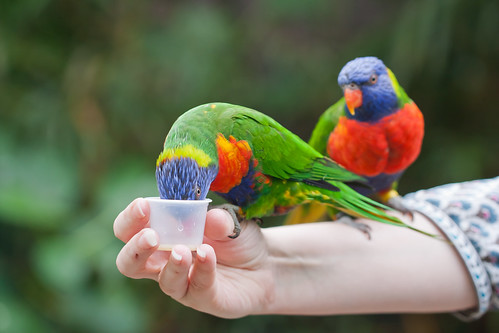
While we like to think we know our zoo pretty well and can find our way around and show visitors hidden treats, there is always something new to see/do/learn. This time we saw lion cubs, learned about gorillas and fed lorikeets. Which was all very cool.

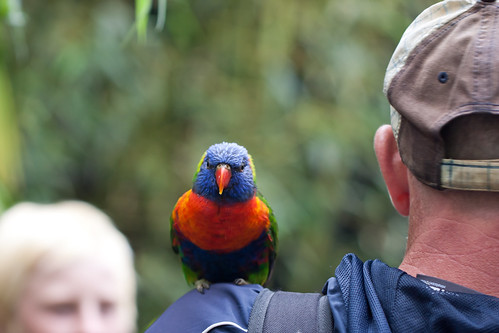
The lorikeets know that visitors are bringing them food so they land all over you, eager to be closest when you reveal the pot of nectar. It’s a bizarre feeling, birds’ feet on your bare arm. The keeper shooed off the bird that landed on my Mum’s head. Sadly I didn’t get a photo of that because we foolishly all fed the birds at the same time. So my photos are of complete strangers feeding the lorikeets.

They are very pretty and reasonably gentle if slightly frantic birds. My best photos of the day were taken in the Bug House but I figured they might freak some of my readers out, seeing as it freaked me out a little editing them. Zooming in on a locust’s head to check if the eye or the mouth is in focus – it’s making the hairs rise on the back of my neck just thinking about it!

I’m gradually adding the selected photographic highlights to my Flickr photostream so if you’re interested and ready to be slightly unnerved by/speed quickly past the insect macros, take a peek.

Kate Gardner Blog

The fun of the fair

September 4, 2011March 11, 2012 2 Comments

Nights at the Circus
by Angela Carter

This is one of those modern classics that keeps popping up in discussions on Radio 4, with nothing but praise directed its way, so I thought it was about time I gave it a go.

It is a beautiful, crazy book. Right from the start, Carter keeps us guessing: is anyone telling the truth? Is this the part fantasy/fairy tale that it seems to be or is it a story about some rather clever, even fantastic, people in “real” life?

The story switches between three narrators, sometimes third person, sometimes first, but always appearing to be one of their perspectives. First there’s Jack Walser, an American investigative journalist who, at the start of the novel, is in London to interview a woman who he thinks must be pulling some kind of trick on the British public. That woman is our second narrator, Sophie Fevvers, a six foot plus blonde with wings – yes, wings – who takes advantage of this strange growth by performing as a trapeze artist. She gladly tells Walser her story, or a version of it, with help from her rather less welcoming foster mother Lizzie, who seems to have tricks up her sleeve, has a way with words that belies her coarse cockney accent and is our third narrator/perspective.

Walser quickly falls for Fevvers, as she prefers to be known, to the extent that he signs himself up to join the circus that she is about to go on tour with; and so begins a cacophony of adventure and misadventure.

The story is set in 1899 so the circus is that old-fashioned kind that combined freak show, performing animals, and heavy superstition and tradition. This sometimes got hard to stomach. I have in my time campaigned for circuses to be animal-free and, frankly, this novel offers strong evidence in that campaign’s favour. However, it’s all part of the surreal menagerie that now includes Fevvers – part woman, part swan. And the chimps are completely brilliant.

Carter toys with her readers throughout, mixing reality with lore and perception so that it is never clear what the characters believe to be true and what actually is true:

“[They] did not live alone. There was a bear, a black one, not yet a year old, still almost a cub. This bear was part pet, part familiar; he was both a real, furry and beloved bear and, at the same time, a transcendental kind of meta-bear, a minor deity and also a partial ancestor because the forest-dwellers extended considerable procreational generosity towards the other species of the woods and there were bears in plenty on the male side of the tribal line.”

For all its rollicking, good humoured, wonderfully written storytelling, it did take me a while to get through this book. Mostly I think that was the language. This isn’t simple, accessible language. This is complex, crafted, allusion-heavy prose, with borrowings from the folklore and mythology of several European countries. I thought it was magnificent, but there was no rushing through it.

I also – and I hate to admit that this made a difference – took a while to warm to any of the main characters. Fevvers and Lizzie deliberately keep themselves at a distance, though they can talk for hours on end (and do so), so you’re always aware that they’re holding something back, even without the big mystery of Fevvers’ wings. And Walser starts out as a pure journalist, not letting his own character or history get anywhere near the story that he is unravelling, so it is a long time before his personality begins to show through.

In all, this is a magical, funny, adventure-filled read encompassing all sorts of colourful outsiders – prostitutes, freaks, clowns, murderers and more besides. The story travels from London to Siberia and evocatively captures each location as well as the daily lives of its huge cast of characters. Carter created something extraordinary here and I will definitely have to read more of her work.

First published 1984.
Winner of the James Tait Black Memorial Prize.

Kate Gardner Reviews

Non-fiction in fiction’s guise

September 1, 2011March 11, 2012 1 Comment

War is Boring
story by David Axe, artwork by Matt Bors

I am starting to acquire a collection of this “graphic novel style journalism” and I’m really liking it thus far. If anyone has any recommendations for more titles, let me know!

That said, this is not my favourite of the bunch. It’s a slim volume by war correspondent Axe and flits quickly through Chad, Iraq, Lebanon, East Timor, Afghanistan and Somalia, with really only a few short scenes in each place. Which is the point of the book but still not what I was expecting. I suppose I was hoping for a little more background behind each war; in fact I say “more” but in some cases we learn no more than “it’s a war zone”.

But I’m being unfair. Axe’s actual journalism about all these places was published elsewhere. This is not that. This book is about the effect of war on him, on his way of seeing the world. Or perhaps it’s not about war itself but solely about him and the type of person he is. You see, from the start his maxim is “War is boring, peace is much worse” and despite coming perilously close to bullets, explosions, rockets and deadly knives, this view of things doesn’t change.

While he calls himself a war junkie, Axe doesn’t seem to get a thrill from war, it’s just that a direct attempt on his life is the only thing that makes him feel alive. I can’t really understand that but then I’ve never experienced it; I suspect my whole world view would change.

I do empathise with Axe’s aim, which is to bring world conflicts and the people affected by them to wider attention. He genuinely cares and is deeply upset by what he sees when he travels to these places. His website, warisboring.com is part webcomic, part blog from the warzones that he continues to travel to and, with all the space of the internet, it seems to get deeper into the minutiae of each conflict visited, or even just Axe’s experience of each. There are photographs of soldiers in action and straight journalistic accounts alongside the panels of the comic and this combination works better, for me, than the comic alone.

As with previous examples of this genre, the artwork is excellent – detailed and illuminating without showing a lot of graphic violence. And the depiction of Axe himself is self-deprecating and self-aware and more likeable than not. Maybe he has since struck a better balance in life, but the book ends with a frighteningly bleak statement about the awfulness of humanity and the senselessness of violence that made me want to tell him to go see some beautiful things in-between wars – but then, I’m an optimist.

First published August 2010 by Penguin Books.

Kate Gardner Reviews

Job done

August 29, 2011August 29, 2011 11 Comments

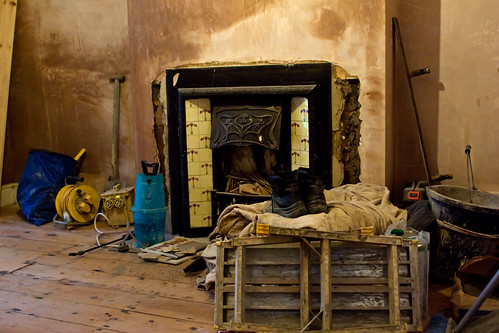
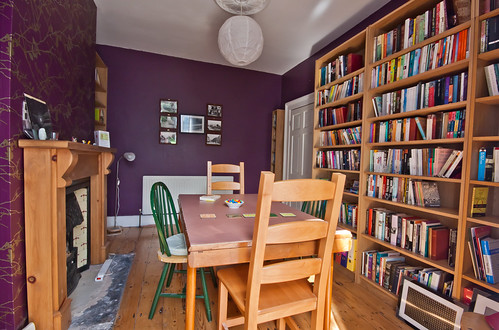
Last year we had builders in to do various jobs and for longer than I was entirely happy about our dining room looked like this:

The builders' ready room

At new year, with the builders finally gone and the room freshly plastered, we were ready to start redecorating. We picked out colours,

And it begins

braved putting up wallpaper,

Progress

(Tim worked speedy fast for me)

Fast work

and started constructing my library.

Shelves up

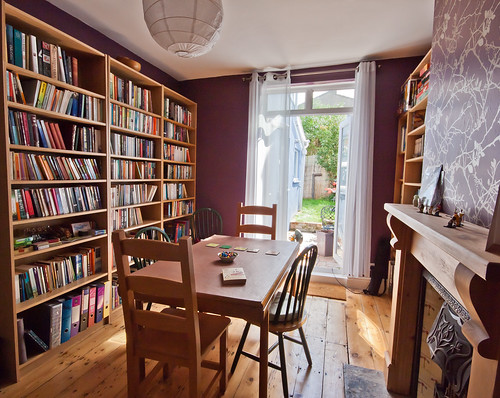
In fact, a few months back we were mostly done and I blogged about my almost-finished library here. However, there were a few bits and pieces still to do. Between my sister’s wedding, my lupus flares and us generally wanting to have a life outside of DIY, it’s taken us a while, but today I can finally declare the library finished! And isn’t it beautiful?

Set

Detail

Kate Gardner Blog

Another vague drifty one

August 28, 2011May 9, 2015

Saving Agnes
by Rachel Cusk

I picked this up while in the US on holiday. I had read and enjoyed Cusk’s second novel The Temporary, which it turns out has rather a lot in common with this title. Possibly too much.

Agnes Day (which is a great name for a heroine) is drifting. She doesn’t really care about her job, feels distant from her (somehow still active) love life and even her friends. She lives with two former schoolmates in a house that is on the brink of being condemned, thanks to a large crack in the wall. This crack acts as a literal (and slightly over-obvious) representation of Agnes’s inner life.

Agnes is one of those heroines who frets about everything, is convinced everyone else is normal while she is abnormal and reminisces fondly about her teenage years when she came close to suicide because at least she was more decisive back then. I did not warm to her. Which is perhaps odd because I’m an over-thinker myself, but I like to think I’m also practical and Agnes is certainly not that. She seems to expect some magical change to just happen to her life, rather than going out and making it happen. She’s also one of those annoying people who take up causes without really learning about them. Even when challenged about this she doesn’t recognise her own failure to engage. And she’s self-absorbed, taking some serious jolts to notice the people around her.

There is an art to creating such a vague, drifting character. For much of the novel Agnes talks about her current relationship and her previous one interchangeably, so that it can be unclear which one is the subject, though what does gradually becomes clear is that Agnes’s attitude to relationships is unorthodox.

Cusk is…wordy. Her prose is beautiful but obscured by long, convoluted sentences:

“Agnes lay in bed waiting for the telephone to ring, believing as she did that the former event would precipitate the latter. Her faith, though gritty, was, she knew, ill-founded, attempting as it did to harness the perversity of the universe and make consistency where there was essentially none. By taking upon herself the task of second-guessing ill-fortune, she was in fact violating the creed of her anti-faith, which, if its principles were to be understood, would presumably visit her only at her own inconvenience…” [This goes on for two full pages before we learn whether or not the phone rings.]

I remember liking The Temporary but with very similar reservations – it also is about a disaffected woman in her 20s drifting, hating London (there is no love for the setting here) and being generally self-absorbed. However, the writing is good and Agnes is completely realistic (lesser characters aren’t quite fully realised but this is actually a believable portrayal of Agnes’s picture of the world).

First published 1993 by Macmillan.
Winner of the Whitbread First Novel Award 1993.

Kate Gardner Reviews

Strangely weird or weirdly strange

August 24, 2011March 11, 2012

Blind Willow, Sleeping Woman
by Haruki Murakami
translated from Japanese by Philip Gabriel and Jay Rubin

This is another of those books that I kept in my work drawer for months on end to read in the occasional lunch break, meaning that by the time I came to the end of it I’d forgotten the first half. Thankfully it’s short stories, so that’s not a huge problem, but it is a drawback in writing this review.

This wasn’t my favourite Murakami to date. Though it’s not unusual for a Murakami story to be more of a character sketch with no clear storyline, several of these stories felt a bit…nothing. There were also some beautiful, wonderfully weird stories, to be clear.

The impression I got from the introduction was that this is a compilation of Murakami’s earliest published writing and certainly there is no overarching theme or even the same translator throughout. There is, however, a certain pattern to his work. He takes an ordinary Japanese person and explores an event or relationship of significance to their life. Occasionally a story tries to tell a whole lifetime but that felt too stretched. A number of times he introduces the story third-hand, as if this is about a friend of a friend, like that adds some kind of authenticity. I found this a little weak, detracting from the power that opening lines can have; should have. In one story he tries to explain himself:

“I think things took place pretty much as set out…though I might have forgotten some of the details, I distinctly recall the general tone. When you listen to somebody’s story and then try to reproduce it in writing, the tone’s the main thing. Get the tone right and you have a true story on your hands. Maybe some of the facts aren’t quite correct, but that doesn’t matter…Turn this around, and you could say there are stories that are factually accurate yet aren’t true at all.”

Which might make for an interesting essay but as an interjection in the middle of a story, for me it just drags me out of the story’s world, interrupts the imaginative process of reading.

But as I said, there were some good stories here and lots of good writing. Two stories centre around how a person’s name is their identity, which was interesting. In “Nausea 1979” a man gets a phonecall every evening where an anonymous voice just says his name then hangs up. This has such a profound effect on him, physically and emotionally, that he begins to wonder if he has a psychiatric illness, but the university hospital turns him away. The police also aren’t interested: “there are two kinds of crime the police won’t bother with: crank calls and stolen bicycles” (which certainly rings true to me). Throughout the story the main character is unnamed but the narrator is addressed as Mr Murakami.

In the second story about names, “The Shinagawa monkey”, a woman keeps forgetting her own name. She has no other memory trouble but the name thing becomes such a problem that even having a bracelet made with her name on it doesn’t resolve the problem and she turns to a councillor with unusual methods. This woman is named and we learn a lot about her life and her past as she struggles to understand what is happening.

The other theme that comes up time and again – throughout Murakami’s work, not just here – is music, specifically jazz. He often meditates on the pleasure of finding that rare vinyl recording of a certain combination of musicians, or the reasons why this performance of a certain song is better than that one. If a Murakami character is into music it is invariably jazz, as if there is no other kind.

This is not a wide study of Japanese society. The characters are middle class with good jobs (or savings to live off if they lose their job) or are students at university. When they marry, the women often stop working to keep house for their husbands. And I was a little disappointed that the one time there was a gay character, this was made a big fuss of.

Perhaps I would have enjoyed this more if my reading had been less disjointed. Or perhaps my reading would have been less disjointed if I’d been enjoying it more.

Most of these stories had been previously published in periodicals, including Harpers and McSweeney’s.
This collection first published 2006 by Harvill Secker.

Kate Gardner Reviews

Something missing

August 22, 2011March 11, 2012

Trance of Insignificance
by Jennifer Rainville

This book was sent to me by the author after a short e-mail exchange during which she intrigued me with her title and synopsis. It sounded like a smart, modern romance that would make an easy but satisfying summer read. It certainly had all the right components, but for me it didn’t quite hit the spot.

Rainville has created a main character with a lot in common with herself. Jules Duvil, like her creator, worked as a political aide in Washington and then as a TV journalist in New York City before becoming a media adviser and writing a novel, which is about to be released at the start of this book. This lends a weight of authority to the passages set in newsrooms and I was a little sorry that there wasn’t any detail about Jules’ time in Washington, because I’d have loved to learn more about that.

The book cuts back and forward in time, mostly to three periods: Jules’ problematic childhood on the rougher side of Boston; her relationship 10 years ago with local celebrity news anchor Jack who is a known womaniser and yet is jealous of Jules’ every move; and the present day, in which Jules is trying to make things work with the far more staid and predictable ad exec Noah, who comes from money and believes in doing things in a certain way. It is clear that neither man is good for Jules; both of them want to change her, but they also love her deeply.

For me, the novel started on a bit of a bum note. In an early chapter we hear about Jules’ first day as a lowly production assistant for a big New York news station and that day just happened to be 11 September 2001. It’s a bold decision to take and gives Rainville the chance to quickly explain a lot about how TV news works while relating it to a news story that we all remember vividly. However, she doesn’t write much about the effect of 9/11 outside the news room – the state the city was in, the change that was suddenly and irrevocably wrought. I know she is trying to make a point about news journalists being bloodthirsty enough to not think about the human side of tragedy, but surely that was too big and awful an event for that to be true? Maybe I’m wrong.

I didn’t warm to Jules. Though we gradually learn from the flashbacks why she is a little cold and label-obsessed, I was annoyed by the need to detail every one of Jules’ outfits, including accessories – all designer. I wasn’t convinced that a single woman living alone in New York and struggling to make it as a journalist would honestly be able to afford such extravagant outfits, not coming from a poor background. Maybe she earned a small fortune during her couple of years in Washington? But that seems unlikely. It’s more believable in the present-day sections, when she’s become a successful self-employed media adviser and it would have been interesting to see a contrast from perhaps her envy of other women’s clothing in 2001 to having a designer-filled wardrobe in 2011.

Jules’ rough upbringing wasn’t, sadly, entirely convincing. Rainville drops in a lot of family trauma and some scenes are frank and shocking, but they didn’t feel fully fleshed out. They were often very brief – just a page or two – and could have done with expanding, perhaps even softening with some warmer or even just mundane memories.

This is Rainville’s first novel and it’s self-published, neither of which is necessarily a bad thing, but in this case it shows. Though Rainville has some talent, she would have benefited enormously from a professional publishing house to give her some guidance and edit the text line by line. The copy editing is poor, though that may have particularly stood out for me because it’s how I make my living. But more than that, there are some clumsy lines, poor exposition and extraneous details that a professional would have helped Rainville to iron out.

I suppose I would have liked to see more descriptions of the city, rather than just name-dropping restaurants and bars; and more small, nuanced details that reveal something about a person rather than a personals-ad-style height, figure, hair and eye colour list. Rainville does know how to turn a phrase, and uses some great imagery, not to mention having a good ear for dialogue, but there’s too much clumsiness in-between to ignore. That said, I was involved enough in the story to read the book pretty quickly and care how things turned out. If Rainville works with a professional publisher for future novels, I do think it will be worth giving her another chance.

This is all, of course, just one person’s opinion, and I may have been negatively influenced by the grammatical errors. Other reviewers out there seem to have more positive views.

Published 2011 by Rainville Books.

Kate Gardner Reviews

Posts pagination

1 … 107 108 109 … 126

Archives

RSS feed: Nose in a book Nose in a book

  • Non-Fiction November 2026
  • Book review: The House of Doors by Tan Twan Eng
  • Book review: Taiwan Travelogue by Yáng Shuāng-zǐ

Me on the internets

  • @kate_in_a_book@mas.to (Mastodon)
  • Flickr/noseinabook
  • Instagram/kate_in_a_book
  • StoryGraph/kate_in_a_book

Categories

  • Blog
  • Reviews
  • Uncategorized
  • © Copyright Kate Gardner. All rights reserved.
Proudly powered by WordPress | Theme: Dream by vsFish.