Nose in a book

Reviews and other ramblings

  • Home
  • Reviews archive
    • Book reviews
    • TV reviews
    • Theatre reviews
  • TBR
  • Challenges
    • The Classics Club
    • 2014 Popular-Science Reading Challenge
    • Cookery challenge
    • The Gilmore Girls Reading Challenge
    • 2013 TBR Pile Challenge
    • 2013 Translation Challenge
    • Crime and Punishment read-a-long
  • About
    • Cookie legal stuff

Crime and Punishment read-a-long end of week one
February 9, 2013 4 Comments

read-a-long-plain-001

The Crime and Punishment read-a-long is hosted by Wallace over at Unputdownables. In week one we read from the beginning to part 1, chapter 5. The official discussion post for this section is over here. However, I thought I’d expand on my own thoughts so far.

I’m finding it a slog. Already. I’m not sure if this is the grim subject matter (it’s super depressing) or the translation. I am reading a Penguin Popular Classics edition from 1997. The translator is not acknowledged at all, which is very poor. And a bit of searching on the Internet suggests it is not a respected edition. I may have to borrow a different translation from the library.

But back to the book itself. In this short section we meet Rodion Raskolnikov, who was a law student until he dropped out due to money troubles. We find him in a depressed state, not at all in his right mind, barely getting anything to eat and seriously contemplating committing some terrible crime that he thinks will solve all his troubles.

So far I am heavily reminded of Knut Hamsun’s Hunger, inasmuch as the setting is bleak and impoverished but the main character has clearly known a better life and perhaps that’s even why he isn’t dealing very well with poverty. He gives away money in random acts of kindness but then immediately regrets it. And of course the longer he goes without eating a proper meal, the crazier his state of mind becomes.

But Hunger I found compelling and so far I am not compelled by this. I don’t find Raskolnikov sympathetic. Sure he’s upset by seeing women reduced to terrible circumstances by bad or useless men, but he doesn’t even say as much out loud, let alone do anything to help. He has resolved not to let his sister accept a marriage offer, on the grounds that not only is neither party in love, but they don’t even like each other and the suitor has a worrying idea that rescuing a woman from poverty will make her indebted to him for life. However, said husband would indeed be able to save Raskolnikov’s mother and sister from poverty, not to mention give Raskolnikov himself a good job. Either he hasn’t heard of the phrase “beggars can’t be choosers” or he hasn’t figured out that he’s a beggar.

This is such a revered classic I am determined to keep going but I will have to see what the library has to offer in terms of different translations. It’s such a shame if that is my problem here.

Kate Gardner Reviews

Life wraps metaphors up in little bows

February 7, 2013February 4, 2013 2 Comments

Brain on Fire: My Month of Madness
by Susannah Cahalan

At the start of this year I made a vague promise to myself not to buy any new books or request any advance copies from publishers, and within two weeks I had failed on both counts. The first was a hopeless case anyway, but I really thought I’d manage the second. Until, that is, I read about this book in the Penguin Press Newsletter and absolutely had to read it.

Susannah Cahalan is a reporter for the New York Post, one of those annoyingly talented people who got her break as a journalist before she even left high school, but when she was 24 she suddenly descended into mental health hell. Her symptoms escalate quickly from lack of concentration and paranoia to mania and seizures, to the point where she has to be hospitalised, a time that she cannot actually remember so she has had to piece it together from doctors’ notes, interviews with family and friends, hospital video and her intermittent journal entries.

Cahalan’s journalism training serves her well. She tells her story with a fluid, gripping style, while doing a good job of explaining the medical facts. She comes across as intelligent and likeable, as well as remaining confused by her illness and how it has changed her life. To an extent, you can tell that she is a tabloid journalist, as she is both easy to read and prone to a few too many soap-opera/cliffhanger-style statements, but she doesn’t shy from the more complicated side of trying to understand her illness.

“Sometimes, just when we need them, life wraps metaphors up in little bows for us. When you think all is lost, the things you need the most return unexpectedly.”

It is a frightening story. Cahalan has no history of mental illness and yet is diagnosed in quick succession with bipolar disorder, alcoholic withdrawal, schizoaffective disorder and then psychosis but all attempts to find a medical explanation for her catatonic state initially fail. Her family is desperate to keep her out of the psychiatric ward and it is their tenacity, plus a little luck/good timing that finally gets the ball rolling toward diagnosis, treatment and recovery.

“It had cost $1 million to treat me, a number that boggles the mind. Luckily, at the time I was a full-time employee at the Post, and my insurance covered most of the exorbitant price tag…Unfortunately, there’s often not the same safety net in place for those with lifelong psychiatric conditions.”

I hesitate to compare my health problems with Cahalan’s, obviously our situations are totally different, but there were definitely moments I could empathise with. “I began keeping to-do lists…including insignificant things like ‘walk to town’ or ‘read the papers’ so I could experience the satisfaction of crossing them off.” I do that all the time. I hate to not do something useful every day, but fatigue and brain fog can make that tough. And Cahalan’s final diagnosis is an autoimmune disease, as mine is, so we have both had to figure out how to react to the idea that our own bodies are attacking us. Plus of course an autoimmune disease never really goes away. While Cahalan is currently in complete remission, she will always be waiting for the next flare up, always wondering if a sudden fit of jealousy or deja vu is genuine or a symptom.

It’s a very insightful, moving book. I was a little frustrated by the repetition of the question of whether she was the same person as before. I get that she felt she lost herself for a few months, that people who saw her during that time barely recognised her, and therefore getting her sense of self back was hugely important. But of course it will have changed her. Even if she is 100% medically recovered she has been through a huge experience. She was young, outgoing and driven and then she had breakdowns at work, lost interest in the world, accused her nearest and dearest of horrible things – of course that would change a person, at the very least as a huge knock to the confidence.

But minor quibbles aside this is a well written, brutally honest account of a life that falls apart and has to be painstakingly rebuilt. Plus it’s an important reminder that a person experiencing a manic or psychotic episode isn’t just crazy or even possessed, they’re a human being whose brain is sick, or as Cahalan’s doctor explains it, whose brain is on fire.

Published February 2013 by Penguin Books.

Source: This book was kindly sent to me by the publisher in return for an honest review.

Kate Gardner Reviews

Cookery challenge #1

February 5, 2013February 5, 2013 2 Comments

Hamlyn All Colour Vegetarian Cookbook

Hamlyn All Colour Vegetarian Cookbook

I mentioned vaguely a while back that I had an idea for a challenge involving all the cookery books that I almost never refer to any more. My plan is to feature the books one at a time on this blog and each time I do that, to actually use a recipe from them! Simple, but hopefully it will widen my cooking repertoire and reinvigorate the fun that the kitchen used to hold for me but hasn’t so much lately.

Let’s begin at the beginning. When I was 13 I told my parents I wanted to be a vegetarian. Their response was to buy me the Hamlyn All Colour Vegetarian Cookbook. When I look at it now, it seems a bit cheesy and dated, but this was how I learned to make ratatouille, pasta bake, stir fry, curry and peanut butter cookies. (Don’t get the wrong idea, I wasn’t suddenly left to fend for myself; my Mum and I explored this book together to begin with, but also my desire to be vegetarian came with a surge of interest in what I ate and how to vary it more.) This book went with me to university and every house I have lived in since then, and it falls open at favourite recipes such as carrot and mushroom loaf.

Recipes

This week I was looking for a quick meal that would use some of the huge pile of vegetables from the veg box that was delivered Monday morning and I lit on a simple stir fry recipe in this book, blending British and Asian ingredients: chinese cabbage, brussels sprouts, leek, cauliflower, soy sauce. I amended it a bit to what we had available and voila: a variant on my favourite quick supper. Very tasty too. And I have a hankering to make carrot and mushroom loaf again soon.

Stir fry

Kate Gardner Blog

Crime and Punishment read-a-long begins

February 2, 2013February 9, 2013

read-a-long-plain-001

Today is the start of the Crime and Punishment read-a-long hosted by Wallace over at Unputdownables. After I tried and failed to read the Fyodor Dostoevsky classic back in December I really needed an incentive to try again, so this was brilliant timing.

If you fancy joining in, the sign-up post is here. We’re reading about 43 pages a week and the first discussion begins over at Unputdownables on Friday 8 February.

N.B. I am reading the Penguin Popular Classics edition from 1997. The translator is not acknowledged at all, which is very disappointing. I may have to borrow a different edition from the library if I don’t get on with this one.

Kate Gardner Blog

Literature informs, instructs, it prepares you for life

February 1, 2013

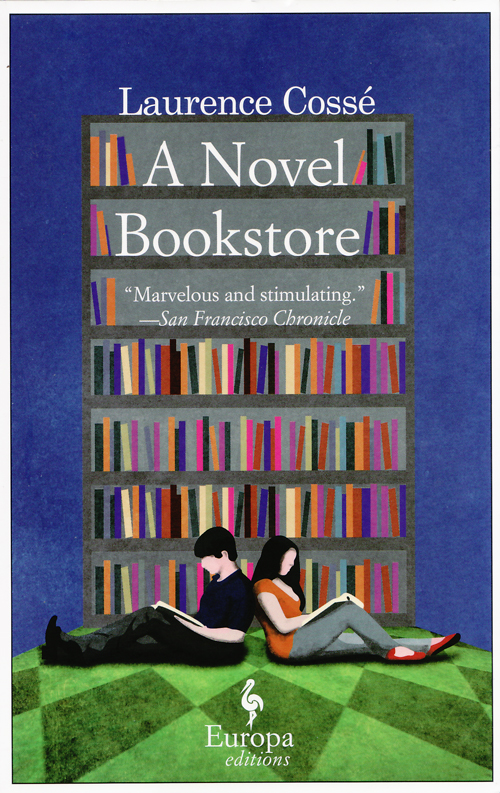
A Novel Bookstore

A Novel Bookstore
by Laurence Cossé
translated from French by Alison Anderson

Have you ever dreamed of opening a bookshop? Have you ever planned what it would be like, how it would be different from all those other bookshops? I can’t decide whether this book would encourage or discourage such an ambition but there’s definitely some wish-fulfilment going on.

The novel opens with a series of attacks on seemingly unconnected people. I don’t want to reveal too much, but the link is The Good Novel, a Paris bookshop opened by rich booklover Francesca and idealistic bookseller Ivan. They discover that they share the same dream of a bookshop that sells only great novels, and pour everything into making their dream a reality, but their shop strikes a nerve in French cultural circles and comes under increasingly severe attacks.

“If I spent my money restoring a Roman viaduct or any other masterwork of our heritage, everyone would think it was a very worthy cause. What we are doing is no different. We are investing our time and money to support and enrich our literary heritage, which is being threatened by forgetfulness and indifference, not to mention disarray in taste. Our cause is undeniable.”

I found that I couldn’t grasp the tone at first. And then just as I was getting the hang of it, there was an odd switch from crime drama to the idealistic story of setting up the dream bookshop. But it’s a surprisingly enjoyable read considering all the action is in the first three chapters.

At the core of the book is the debate between high and low culture. Francesca and Ivan have pinned their hopes on high culture: their choice of “great” novels is primarily classic or overlooked literary works. They opt out of the bestseller lists and new releases, which isn’t the most effective business model and isn’t entirely popular with publishers and other bookshops – it does admittedly smack of snobbery – but of course it’s the authors whose books aren’t chosen for sale at The Good Novel who express the most anger.

“The essential problem raised by the notion of literary value is that this value changes with time. A work that might have been hailed by its contemporaries seems trivial a hundred years later, perhaps even thirty years later. Inversely, another work that was judged unpleasant or uninteresting may now be praised to the skies.”

Personally, I’m torn which side I’m on. Not that I condone the attacks on The Good Novel. And I love heartfelt book recommendations, such as are at the core of Ivan’s bookselling style. But I think getting people reading is always a good thing, and those easy reads and bestsellers – they’re a big part of that process.

“Literature is a source of pleasure, he said, it is one of the rare inexhaustible joys in life, but it’s not only that. It must not be disassociated from reality…There are grown-ups who will say no, that literature is not life, that novels teach you nothing. They are wrong. Literature informs, instructs, it prepares you for life.”

This book is jam-packed with references to “great” books and you could make a very long recommended reading list from it, though how many of them would be available in English translation I don’t know. The other thing it has going for it is a sub-plot that’s a sweet realistic romance. I kept expecting darker things around the corner but this novel’s beauty is its simplicity.

“He had no more imaginary space, nowhere he could escape to, no more expectations, all he could do was make himself available to the present moment, to what was immeasurable, the terrible profusion of moments that make up a day.”

Au bon roman published 2009 by Editions Gallimard, Paris.
Translation published 2010 by Europa Editions.

Source: Won in a giveaway from Savidge Reads.

Challenges: This counts towards the 2013 TBR Pile Challenge.

Kate Gardner Reviews

Nightmares sneak out into the daylight

January 28, 2013July 9, 2015 2 Comments

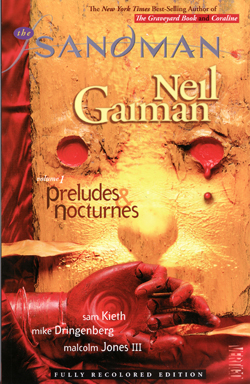
The Sandman

The Sandman Vol. 1 Preludes & Nocturnes
by Neil Gaiman (writer), Sam Keith, Mike Dringenberg and Malcolm Jones III (artists)

I have been told so many times that I should read The Sandman that I just assumed it would be wonderful. It’s Neil Gaiman, it’s a highly acclaimed comic-book series, it’s about dreams and nightmares – it sounded perfect. And it is pretty good, but I think my expectations were too high.

This is the first of 12 volumes, republishing the full original run of The Sandman. The artwork is beautiful in a dark, gothic style. The concept is fascinating and open-ended. Quite simply, the Sandman is the lord of the world of dreams, both good and bad. He can move in and out of the real world, magical realms and dreams themselves.

This volume has a clear complete storyline – in 1916 a magic circle tries to summon Death and instead gets the Sandman, whom they imprison for many decades. This has a terrible effect on the world – with no-one controlling the dream world, some people go mad, others just stay asleep for years. The Sandman must escape and regain control, but it won’t be an easy task.

“Daniel Bustamonte returns to his best dream. But this time the clouds are flimsy, frail, less real. And then the clouds aren’t there at all. Too scared to sleep, he sobs to keep himself awake until dawn.”

“Stefan’s case is new to the doctors. They thought they’d seen every form of shellshock. How long can a boy go without sleeping? When do the nightmares sneak out into the daylight? The morphine is proving useless. It’s sad.”

“Unity Kinkaid finds it harder and harder to stay awake. She now sleeps for almost 20 hours a day. She used to dream; to shift in her sleep, muttering and sighing, locked in half-remembered fantasies. Now she lies unmoving, breath shallow and silent, lost to the world. Unity sleeps.”

I liked the concept, I liked the story and the artwork, I like that it’s dark (even a bit grisly in places) but…I’m not sure exactly what was wrong but it didn’t grab me. The stuff about the world going mad without the Sandman was brilliant but over a little too quickly, I felt a lot more could have been made of it. And there was surprisingly little of the dream world depicted, but I’m sure that’s still to come. Only, I’m not all that bothered about reading the remaining volumes.

Maybe I was in the wrong mood. Maybe I should treat it as much as a work of art as a work of fiction. I’m not sure. I had half a plan to try The Books of Magic next. Perhaps I should lower my expectations first?

First published as The Sandman issues 1–8, 1988–1989, by DC Comics.
This edition published 2010 by Vertigo, DC Comics.

Source: I bought this from my local comic-book shop.

Kate Gardner Reviews

A parody of the writer

January 23, 2013 4 Comments

Aunt Julia and the Scriptwriter
by Mario Vargas Llosa
translated from Spanish by Helen R Lane

This was a book group choice and typically the meeting happened during the nasty cold snap we have had and I decided not to brave the freezing rain to attend. I did however have a brief Twitter chat about the book. Not quite the same but fun!

I knew pretty much nothing going into this book. I didn’t even read the blurb so the format came as a surprise. It’s the semi-autobiographical story (I learned that from Twitter; the copy of the book I had gave no indication) of Mario, a young man juggling a law degree, working full-time for a radio station in Lima, writing short stories and developing a relationship with an older woman (the Aunt Julia of the title, who is not strictly his aunt, but is always known as such). He largely manages this juggling act by never going to university and frequently skiving from his job, none of which seems to bother anyone nearly as much as him dating a 32-year-old divorcee.

(Incidentally this made me, having recently turned 32, feel pretty old. Not that I would dream of dating an 18-year-old, in fact that seems icky, but I do object to being considered old!)

Mario’s story is alternated with the radio serials written by Pedro Camacho, the scriptwriter of the title. This isn’t made clear though, so the first time the story switched I was a bit thrown, especially when it descended into melodrama. Camacho himself is an enigmatic character, with a mysterious background and very high-strung artistic temperament, not to mention some unusual working methods. And his radio serials are a huge hit:

“When I asked them why they liked soap operas more than books, they protested: what nonsense, there was no comparison, books were culture and radio serials mere claptrap to help pass the time. But the truth of the matter was that they lived with their ears glued to the radio and that I’d never seen a one of them open a book.”

Despite the element of auto fiction, there are some clear literary allusions at work. The radio serials are ridiculous but Mario’s real life becomes as crazy and farcical as the radio scripts had been to begin with. And there are various types of writing for a living explored. Camacho writes his radio soaps at formidable speed, churning out ten different storylines. Mario and his assistant rewrite news stories for radio. Mario writes short stories that are never published (usually based on real-life stories he has been told, in a bit of symmetry with the origin of this novel) and he dreams about moving to Paris to live in a writer’s garret. Despite being snide about the radio serials he admires Camacho’s dedication to his art:

“How could he be, at one and the same time, a parody of the writer and the only person in Peru who, by virtue of the time he devoted to his craft and the works he produced, was worthy of that name? Were all those politicians, attorneys, professors who went by the names of poets, novelists, dramatists really writers, simply because, during brief parentheses in lives in which four fifths of their time was spent at activities having nothing to do with literature, they had produced one slim volume of verses or one niggardly collection of stories? Why should those persons who used literature as an ornament or a pretext have any more right to be considered real writers than Pedro Camacho, who lived only to write?”

I found the main character a little frustrating, as 18-year-olds are wont to be, and would have preferred to learn more about Aunt Julia and the scriptwriter, who both remain a little mysterious. In fact, the overall style is detached enough that I didn’t greatly care how things turned out, though I was entertained enough to keep reading,

There are a few other themes covered. Obviously, love, though it’s always love of an overblown teenage/soap opera kind. There is nothing moving or romantic about any of the love stories in this novel. Another is memory. Mario is telling his story from later in life, giving a lot of detail about some days that you could argue the average person just wouldn’t remember. And there’s a character who starts having memory problems, but they’re not dealt with particularly sensitively. Instead they’re the source of comedy, which I found uncomfortable.

That wasn’t the only uncomfortable subject for me. The book includes racism, sexism and religious bigotry and, while they’re not passed off as acceptable views, they are used for humorous value. When I went back and read the blurb on the back of my copy it calls this a “comic novel” and I would argue that it is neither, though it has elements of both.

I found this a very slow read but at no point was it a struggle, I always felt I was enjoying it, so I would probably read Llosa again. What potentially interests me more, though, is that Julia Urquida, the “Aunt Julia” of the title, wrote her own memoir of her relationship with Llosa called What Little Vargas Didn’t Say. It sounds brilliantly bitter from that title!

La tia Julia y el escribidor published 1977. English translation first published in the USA in 1982 by Farrar, Strauss and Giroux.

Source: Bought secondhand via Abe Books.

Challenges: This counts towards the 2013 Translation Challenge.

See also: Mario Vargas Llosa discusses Aunt Julia and the Scriptwriter on World Book Club.

Kate Gardner Reviews

Sunday Salon: Making a list

January 20, 2013January 20, 2013 5 Comments

The Sunday Salon

This weekend my love of lists reached obsessive proportions.

I realised while rewatching The Gilmore Girls that the “Rory Gilmore Reading List” that I had was of every book title mentioned on the show, rather than of books specifically owned by/read by Rory. For instance, there’s a scene where Rory is getting into a state about all the great books out there and how she won’t be able to read them all in her lifetime, and her mother tells her that she needn’t bother with Tuesdays With Morrie or Who Moved My Cheese?, yet those two titles were both on the list.

And this bothers me because apparently I am obsessive about such things. So I am editing the list as I rewatch the show, making sure it only includes Rory books and adding in ones previously missed. The updated list is here, one of my new challenge pages.

What is it about lists that are so appealing? And I don’t just mean giant long book lists (though they do appeal, obviously). I have always enjoyed making lists (particularly if I get to cross things off them, though that isn’t compulsory).

Perhaps all the snow is sending me a bit doolally.

Untitled

Today I might try to read a little more in-between list updating. What have you been up to this weekend?

Kate Gardner Blog

Featured today on Savidge Reads: me

January 17, 2013 1 Comment

Just a quick post to say that if you want to learn a little about me and my books, take a look over at Simon’s blog Savidge Reads where I’m today’s featured blogger in his series Other People’s Bookshelves.

I can also recommend checking out the rest of the series, because who doesn’t like having a nosy of other people’s bookshelves?

Kate Gardner Blog

Man is many things, but he is not rational

January 15, 2013January 23, 2013 2 Comments

The Picture of Dorian Gray
by Oscar Wilde

I have had this sat on my shelves for ages because, even though I’ve watched and loved a few of Wilde’s plays and have fond memories of his children’s stories, something in me said this is old and “classic”, therefore it will be hard. It was not a hard read at all, it was a thoroughly enjoyable one.

I would say that everyone already knows the storyline, but I was surprised to discover how vague my understanding of it was before I started reading. So I will summarise. At the start of the novel, Dorian Gray is young, beautiful, charming and innocent, and is serving as a muse to painter Basil Hallward, who is a little obsessed with him and has just painted his masterpiece, a portrait of Dorian. Dorian remarks that he wishes the painting might grow old while he stays young and beautiful and…well, it happens, but more slowly and darkly than I had expected.

“Hour by hour, and week by week, the thing upon the canvas was growing old…The cheeks would become hollow or flaccid. Yellow crow’s feet would creep round the fading eyes and make them horrible. The hair would lose its brightness, the mouth would gape or droop, would be foolish or gross, as the mouths of old men are. There would be the wrinkled throat, the cold, blue-veined hands, the twisted body.”

Dorian, when he realises what is happening, slowly becomes quite bad. Is this the influence of life in general? The circumstance of being able to look fresh and beautiful no matter how guilty he feels? Is it how Dorian’s nature was always fated to develop? Or is it all the influence of Lord Henry Wotton, a friend he was introduced to by Basil on that fateful day when the portrait was finished? Lord Henry is a fun character, talking largely in aphorisms and painting himself as morally repugnant, but the key seems to be that he doesn’t mean half of what he says, whereas Dorian takes it all to heart.

” ‘I adore simple pleasures,’ said Lord Henry. ‘They are the last refuge of the complex. But I don’t like scenes, except on the stage…I wonder who it was defined man as a rational animal. It was the most premature definition ever given. Man is many things, but he is not rational. I am glad he is not, after all.’ “

This book is so very quotable. Even skipping the slightly trite aphoristic preface (which I have seen quoted from many times), the language is full of both delightfully Wildean phrases but also exquisite descriptions:

“There was a silence. The evening darkened in the room. Noiselessly, and with silver feet, the shadows crept in from the garden. The colours faded wearily out of things.”

The characters are interesting. I didn’t feel I ever got to know any of them well, but they are certainly varied and in some cases fascinatingly complex. Even those characters that might have been verging on caricature are described so well it hardly matters.

“The exaggerated folly of the threat, the passionate gesture that accompanied it, the mad melodramatic words, made life seem more vivid to her. She was familiar with the atmosphere. She breathed more freely, and…would have liked to have continued the scene on the same emotional scale, but he cut her short. Trunks had to be carried down, and mufflers looked for. The lodging house drudge bustled in and out. There was the bargaining with the cabman. The moment was lost in vulgar details.”

Nothing is straightforward and not all of the mysteries of the story are resolved. Which was sometimes frustrating – exactly what are the rumours circulating about Dorian? I can imagine, but I want to know! I suppose that’s one of the moments to remember that this was written in the 19th century – it rarely if ever feels that old.

First published in the July 1890 issue of Lippincott’s Monthly Magazine. Revised and published as a book in 1891 by Ward, Lock and Company.

Source: I have a chunky Complete Works of Oscar Wilde that I have owned for more than 10 years. I think I bought it for myself. Probably.

Challenges: This counts towards the Rory Gilmore Reading Challenge.

Kate Gardner Reviews

Posts pagination

1 … 90 91 92 … 126

Archives

RSS feed: Nose in a book Nose in a book

  • Book review: Taiwan Travelogue by Yáng Shuāng-zǐ
  • October 2026 reading round-up
  • Book review: The Coral Bones by E J Swift

Me on the internets

  • @kate_in_a_book@mas.to (Mastodon)
  • Flickr/noseinabook
  • Instagram/kate_in_a_book
  • StoryGraph/kate_in_a_book

Categories

  • Blog
  • Reviews
  • Uncategorized
  • © Copyright Kate Gardner. All rights reserved.
Proudly powered by WordPress | Theme: Dream by vsFish.