Nose in a book

Reviews and other ramblings

  • Home
  • Reviews archive
    • Book reviews
    • TV reviews
    • Theatre reviews
  • TBR
  • Challenges
    • The Classics Club
    • 2014 Popular-Science Reading Challenge
    • Cookery challenge
    • The Gilmore Girls Reading Challenge
    • 2013 TBR Pile Challenge
    • 2013 Translation Challenge
    • Crime and Punishment read-a-long
  • About
    • Cookie legal stuff
  • Home
  • Reviews archive
    • Book reviews
    • TV reviews
    • Theatre reviews
  • TBR
  • Challenges
    • The Classics Club
    • 2014 Popular-Science Reading Challenge
    • Cookery challenge
    • The Gilmore Girls Reading Challenge
    • 2013 TBR Pile Challenge
    • 2013 Translation Challenge
    • Crime and Punishment read-a-long
  • About
    • Cookie legal stuff

Challenges and read-a-longs and read-a-thons, oh my

January 11, 2013January 19, 2013 8 Comments

I have decided that this is the year when I am going to make more of an effort to join in all of those group activities going on in the book blogging world. I haven’t been much of a joiner to date, but I’ve already spotted several great looking challenges/events that I want to get stuck into. So here’s my list of fun…so far.
2013 Translation Challenge hosted by Ellie of Curiosity Killed the Bookworm

The aim is simply to read one book that is translated into English from another language per month, every month. Seeing as how I had recently concluded that I am a bit rubbish at reading translations, this is the ideal challenge for me, and I have already started reading my first translated book of 2013: Aunt Julia and the Scriptwriter by Mario Vargas Llosa. There is an optional additional challenge to read 12 books translated from 12 different languages. That might be tough, but I won’t say no just yet.
read-a-long-plain-001

Crime and Punishment read-a-long hosted by Wallace of Unputdownables

The thing is, I tried reading this in December and those first 80 pages dragged, I hated the main character, it was all predictably depressing and I decided life was just too stressful at that time to make myself read something that got me down. But I do still really want to read it and it just happens that this read-a-long is scheduled for February and March, which seems like the only way I’m likely to tackle it again any time soon. Also, it’ll count towards the translation challenge! And the Rory Gilmore Reading Challenge (see below).

The Rory Gilmore Reading Challenge

I actually posted about this ginormous ongoing challenge (not unlike the Boxall’s 1001 Books You Must Read Before You Die list) last July, but failed to read anything from it until last week. I think a sensible aim would be 12 books this year. At which rate it will take me 20+ years to complete, but that’s not really the point of giant long lists like this, is it?

2013tbrpilechall

2013 TBR Pile Challenge hosted by Roof Beam Reader

This is almost cheating, as I’d already decided the TBR was too unwieldy for me to be allowed to buy new books until I made a dent in it, but this challenge is specifically about digging out those older books that have sat on the TBR for far too long. And I have to post a list of the books I aim to read, so here goes:

1. A Novel Bookstore by Laurence Cossé
2. Breakfast of Champions by Kurt Vonnegut
3. The Confessions of Max Tivoli by Andrew Sean Greer
4. Immortality by Milan Kundera
5. Other Colours by Orhan Pamuk
6. Chasm: a Weekend by Dorothea Tanning
7. On the Road by Jack Kerouac
8. A Paper House by Mark Thompson
9. The White Tiger by Aravind Adiga
10. Dan Yack by Blaise Cendrars
11. The Stories of English by David Crystal
12. The Heart of the Matter by Graham Greene

Alternates
1. The Prince by Niccolo Macchiavelli
2. Disgrace by J M Coetzee

Bloggiesta

And the rest

I will also be joining in at least one Bloggiesta, giveaway and read-a-thon, so let me know if there’s any coming up. I also have an idea for a little challenge for myself involving all those rarely opened cookery books in our kitchen, but more on that another time. Do you do challenges etc? Which ones caught your eye this year?

UPDATE: I’ve created a new challenges page here.

Kate Gardner Blog

Don’t be so tough early in the morning

January 8, 2013January 25, 2013 1 Comment

To Have and Have Not
by Ernest Hemingway

I have been slowly working my way through a box set of Hemingway. At times completely brilliant, at others it was overblown, racist and inconsistent in style. I can see why it divides people.

The main character is Harry Morgan, a poor man who lives in the Florida Keys with his wife and daughters and, at the start of the book, makes a living in Cuba taking tourists out sea fishing in his boat. But with the depression starting to bite, a rich tourist doesn’t pay a large bill and Harry is forced to accept one of the more questionable business deals he repeatedly gets offered, marking the beginning of his slow decline into crime.

The structure is a little odd, switching between points of view, introducing detailed minor characters who sometimes have a role in the main story but often don’t. The tone and style is initially a lot like Raymond Chandler and it retains a touch of that throughout, though it does get both more real and more political.

“You know how it is there early in the morning in Havana with the bums still asleep against the walls of the buildings, before even the ice wagons come by with ice for the bars?…
‘Listen,’ I told him. ‘Don’t be so tough early in the morning. I’m sure you’ve cut plenty people’s throats. I haven’t even had my coffee yet.’
‘So you’re sure I’ve cut people’s throats?’
‘No,’ I said. ‘And I don’t give a damn. Can’t you do business without getting angry?’ “

There are some nasty characters in this book and Harry certainly isn’t blameless in his descent. He makes some bad choices, but he also has bad luck thrust upon him. The switches in point of view can be very revealing. For instance, Harry is genuinely in love and lust with his wife still but when another character describes her it’s a very unflattering picture that is painted, with a total lack of understanding for how the Morgans’ relationship might work.

Which is a theme, actually – assumptions about other people being proved wrong when the narrative switches to their perspective. There are some surprisingly modern touches, such as the smug misogynist painted as a fool. But Harry’s racism certainly isn’t modern. I can’t remember the last time I read the n*** word so many times in one sitting and it bothered me, but it wasn’t just casual terminology. Harry talks about various coloured people in demeaning stereotypes, painting them as less than human, and no amount of historical leniency can make me okay with that.

Hemingway does show some real knowledge of boating and fishing, with detailed descriptions of bringing a boat in to harbour or chasing down a marlin. Neither is my thing at all but even those sections kept me engrossed, which suggests they were written pretty well.

I’ll continue reading through my Hemingway box set but so far The Old Man and the Sea is still the high point for me.

First published 1937 by Charles Scribner’s Sons.

Source: Secondhand, I think from a book swap.

Challenges: This counts towards the Rory Gilmore Reading Challenge.

Kate Gardner Reviews

Sunday Salon: New year, new books

January 6, 2013January 6, 2013 11 Comments

The Sunday Salon

Every year when my family asks what I want for Christmas and my birthday (they’re pretty close together) I give them a wishlist that is 90% books and every time I have to reassure them that yes, books really really are what I want. You’d think they’d learn. Thankfully, they know me well enough to buy me said books, in addition to a few useful things.

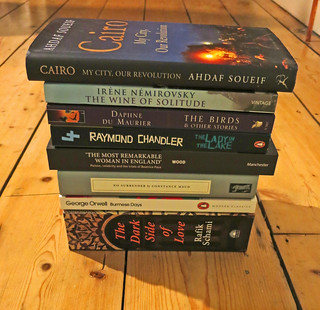
Even though I already own 120 or so unread books and a couple of thousand read books that I have kept because I want to re-read them some day, it makes me super happy to see this stack of new books.

Christmas books

If you can’t quite read those spines, the books are:

Cairo: My City, Our Revolution by Ahdaf Soueif
The Wine of Solitude by Irène Némirovsky
The Birds and other stories by Daphne du Maurier
The Lady in the Lake by Raymond Chandler
The Most Remarkable Woman in England by John Carter Wood
No Surrender by Constance Maud (that’s the pretty Persephone edition)
Burmese Days by George Orwell
The Dark Side of Love by Rafik Schami

And despite already having all of those lovely new books, I tripped and bought a book yesterday – the first trade paperback volume of Sandman by Neil Gaiman (and if I like it there’s 11 further volumes to buy!) – while Tim was picking up his latest comics and earlier this week I ordered a book from Abe Books to complete my collection of the Claudine series by Colette. Can I help wanting to give a loving home to all the books?

Oh, and I also received a belated Christmas card via the Book Bloggers Holiday Card Exchange. This one is from Vasilly and came in a very pretty shiny envelope and contains a great quote about reading.

Card exchange prettiness

Yay, I love Christmas and birthdays! Just eleven and a half months to go to the next time. Did you get any great books lately?

Kate Gardner Blog

Christmas reads in brief

January 1, 2013January 1, 2013 1 Comment

As I may have mentioned once or thrice, most of our spare time lately has been spent chivvying builders/cleaning up after builders/redecorating. While I have managed to squeeze in some reading, I think I’m going to skip writing full reviews for this holiday and get back in the swing next week. That’s a good way to start the new year, right?

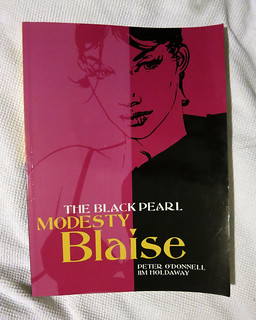
Modesty Blaise: the Black Pearl

Modesty Blaise: the Black Pearl
by Peter O’Donnell (story) and Jim Holdaway (art)

Modesty Blaise: the Green-Eyed Monster
by Peter O’Donnell (story) and Enric Badia Romero (art)

I punctuated my holiday with two volumes of the long-running comic strip about the very British super-capable heroine Modesty Blaise. As I’ve written about her before, there is little new to say. O’Donnell puts her in a variety of locations and intrigues but tries not to make his stories Bond-like, so although she has a good friend high up in the British secret service, she is not a spy. She is a gun for hire, but most of the time she finds her own work, happening, like a young sexy martial-arts-trained Miss Marple, upon crimes and capers wherever she goes. Some stories impressed me with their nuanced political intrigue but then there was the occasional racism that reminded me that this was popular culture in the 1960s and 1970s.

First published in the London Evening Standard and the Glasgow Evening Citizen 1966–1971.
These collections published 2004 and 2005 by Titan Books.

The Clothes They Stood Up In
by Alan Bennett

This tiny book is a novella about a middle-aged couple whose fancy flat is burgled while they’re out at the opera. Everything has been taken, even the carpets, light fittings, toilet rolls and telephones. It’s almost a farce, with the well-to-do middle class slowly picked apart as they try to navigate public telephones and immigrant-run corner shops. Bennett is of course spot-on with his observations and had me laughing out loud from page one. But it’s also moving, sad even, to see how unhappy marriage can be and how far apart people who live together and love one another can become. Highly recommended.

First published in the London Review of Books in 1996. This edition published in 1998 by Profile Books.

Wild Girls: the Love Life of Natalie Barney and Romaine Brooks
by Diana Souhami

On the back of the excellent Mitfords book I thought I’d try another biography. Unfortunately, this one was not as good. It felt a little rushed although perhaps they were really only interesting by virtue of the circles they moved in? Barney was a poet and Brooks an artist. Barney surrounded herself by the elite of Paris culture, particularly the gay section of that crowd, and had affairs with everyone (or rather every woman who would have her). Brooks started out in this crowd but became a recluse. Souhami tells of the wonderful long life of Barney versus the painful slow decline of Brooks and it’s sad but I never felt I had got to know either of them. Extracts from their passionate love letters are repetitive and overblown. Souhami’s intensive research has led to strange chaotic annotations/references in several different formats, which were near impossible to navigate when I actually wanted to. Interesting, but felt like it could have been more than it was.

First published in 2004 by Weidenfeld & Nicolson

So that’s what I read over the holidays. What about you?

Kate Gardner Reviews

Now the year is over

December 31, 2012January 11, 2013 5 Comments

This year, for the first time, I kept some statistics on the books I read. I didn’t go out of my way to read differently, I just recorded what I felt were the key details, with a view to looking at them at the end of the year. Well, here we are. So what have I learned?

Of my 78 books read in 2012, 12 were non-fiction, 3 poetry and 63 fiction. 32 were written by women, 41 by men and 5 had multiple authors covering both genders, so that’s not a bad split. Only 7 were translated, which is pretty poor. And only 15 of the authors were non-UK, non-US. I think I should work on that.

So will I read differently in 2013? I’d like to try but the TBR is getting unwieldy so my first priority is to stop buying books for a while! And I still have to add the generous pile of Christmas books to the TBR, which will make it even longer…

A merry Christmas indeed

And now it’s time to do some painting before I can bring in the New Year with some of that Christmas wine. Happy New Year everyone! Do you have any reading resolutions?

EDIT
I’ve just been poring over my spreadsheet again, as I am wont to do, and spotted that while my reading wasn’t as international as I would have liked, I did read something written by at least one author from every continent, and every continent was represented as a setting as well. However, that’s counting America as one continent. If you split it into north and south, then South America is a big glaring omission from my 2012 reads. Good thing I already have a Peruvian book lined up for January!

Kate Gardner Blog

Merry Christmas

December 24, 2012

Merry Christmas

Have a wonderful holiday, everyone. x

Kate Gardner Blog

There must have been some extraordinary quality

December 23, 2012 4 Comments

The Mitford Girls
by Mary S Lovell

The Mitfords weren’t really on my reading radar until I started book blogging (almost three years ago) and suddenly they were everywhere. After trying to read a volume of Nancy’s letters and failing to see the charm everyone else seemed to have found, I decided it might help to know more about the family and by a stroke of luck, spotted this biography in a charity shop. It worked, in that I am now completely smitten with the Mitfords.

This book is clearly extensively researched – there are 80 pages of notes, index and bibliography at the back – but it manages not to read as a dry product of research, as biographies sometimes can. This is partly due to Lovell’s clear affection for the family, though she only briefly spoke to, rather than knowing intimately, four of the sisters and recounts those meetings very honestly in her introduction. In fact, she does an excellent job of bringing to life her large cast who were largely dead or elderly at the time of writing. Of course, it doesn’t hurt that the Mitfords were such a very interesting bunch of people.

For those who don’t know, the “Mitford Girls” of the title are the sisters Nancy, Pamela, Diana, Unity, Jessica and Deborah, of whom only the youngest, Deborah, is still alive. For much of the 20th century they were household names, for various reasons. Nancy was a bestselling writer, author of many greatly admired biographies as well as novels including The Pursuit of Love that were heavily based on her own family. Diana married Oswald Mosley, leader of the British Union of Fascists, and was a staunch supporter of his political ideals despite decades of hatred from the British public. Unity went even further and became friends with Hitler, in fact was obsessively in love with him and tried to kill herself when Britain declared war in 1939, resulting in brain damage. Jessica was a card-carrying Communist, worked for the civil rights movement in the USA and became such an accomplished journalist that she lectured at universities including Yale and Harvard. Even the less-featured-in-the-headlines Pamela and Deborah lived the kind of lives most of us would find hard to imagine, born as they were the daughters of a Baron, hobnobbing with the great and good of Society, including John Betjeman (family friend), Evelyn Waugh (good friend of Nancy), Winston Churchill (their cousin by marriage), the Kennedys (related by marriage to Deborah) and Harold MacMillan (also related by marriage to Deborah), to name but a few.

I think, because the details were new to me, it was Unity’s story that I found most shocking:

“There must have been some extraordinary quality in Unity that not only attracted Hitler’s attention but caused him to establish a deeper relationship by continued invitations… Unity chatted to Hitler as she would to any member of her family, unselfconsciously bright, always seeking to amuse, entertain or impress. No-one else in his life dared to treat him in the casual manner that Unity adopted.”

Lovell’s job was not, I suppose, an easy one as so very much had previously been published about the family, often directly contradictory. As you might imagine from the differing political affiliations, there were some serious fallings out between members of the family and the combination of sisterly cattiness and a public profile that allowed them to publish their views on any subject in print meant that Lovell did have some work to do establishing the facts. However, sometimes I found this point pressed a little too hard, especially in the earlier sections where I, as a relative newcomer to the story, did not have any preconceptions and therefore got a little bit bored of being told what I had apparently got wrong. Lovell also had a lot of material to wade through, as no less than four of the sisters had written memoirs; they were all prolific letter writers and kept diaries; and being such high-profile figures, many biographies and documentaries of some or all of the family exist.

Despite the title, Lovell also writes quite a lot about the girls’ parents, Sydney and David, and the one brother, Tom. Tom, I suspect, would make a great subject for a biography of his own and does take a bit of a back seat here, though he was clearly universally adored.

My main criticism of this book (and bear in mind here that I thoroughly enjoyed it) would be that Lovell does seem to defend Diana and Unity’s political beliefs but remains critical of Jessica’s Communism (despite stating in her introduction that she would not take a political side). This was also the stance of the parents – Sydney in particular greatly admired Hitler, even after the war – and perhaps it is just that Lovell’s reportage of the opinions of family and friends seemed one-sided because their opinions were heavily sided against Jessica. In fact, on reading this I have come to admire Jessica most of all, as she was instrumental in early civil rights activism in the USA and spent her life bringing to light and campaigning against injustice. As she wrote of her youthful political awakening in Hons and Rebels:

“The discovery of other people’s reality – more than fifty million in England alone! – is one you can grasp from time to time, only to find it eluding you again, its vastness proving too much for you to handle. You discover suffering – not just your own suffering, which you know is largely of your own making, nor the childhood suffering over Black Beauty, David Copperfield or Blake’s Little Chimney Sweep – but you catch disturbing, vivid glimpses of the real meaning of poverty, hunger, cold cruelty.”

In fact most of the passages I marked in the book were about Jessica or noting something that annoyed me: Lovell’s adoption of some of the upper class language (“on non-speakers”, eurgh), her insistence on using nicknames throughout, her repeated use of the phrase “at the height of her beauty”. Except for this one passage, which illustrates the warmth and joy the sisters seemed to be filled with:

“For Nancy, Paris increasingly became the beau idéal of life. She found there an elegance, glitter, warmth and freedom that were lacking in London. One could be uninhibited there without drawing clucks of disapproval, ‘I have often danced all down the Champs Élysées,’ she wrote to Tom, ‘and no-one notices, they are so used to that sort of thing…Oh, I am so excited.’ “

And that’s what makes this a good read. The Mitfords were/are such wonderful characters. I foresee a lot more of them in my reading future!

First published by Little, Brown and Co in 2001.

Kate Gardner Reviews

Bookish things in the post

December 19, 2012December 21, 2012 6 Comments

Life has been hectic for me lately, so I haven’t been paying the blog enough attention, but I’ve had a few bookish arrivals in the post that I thought I might share.

The Book Bloggers Holiday Card Exchange is a very lovely idea run by Courtney and Judith. When I got post from France I was initially confused who it could be from, but when I saw this lovely card inside it twigged:

Card from the Book Bloggers Holiday Card Exchange

My exchange partner was Beth and I love my French card and the very friendly bookish message written inside it, so thank you Beth.

I also received this very exciting book from And Other Stories:

First book on subscription from & Other Stories

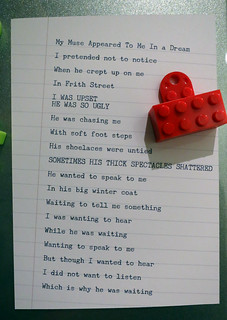
And Other Stories is a small publisher that works on a subscription model. They publish six new books per year, often translations into English. Subscribers get their names printed in a numbered first edition of each book they subscribe to. I was very excited to read my name in this book! And as a bonus they included a few copies of this poem, which I have stuck to our fridge:

Lovely poem from & Other Stories

Have you had any good post lately?

Kate Gardner Blog

He doesn’t have the sense of a billy goat

December 14, 2012December 14, 2012

Fried Green Tomatoes at the Whistle Stop Cafe
by Fannie Flagg

This was a book club pick and I thought somehow that it would be light and fluffy and girly, possibly because that’s how I remember the film (though on rewatching the film this week I discovered it’s not really those things either). It’s certainly an easy, enjoyable read, but it covers a lot of issues without labouring the point and has some very interesting things to say.

In the 1980s middle-aged Alabama housewife Evelyn Couch is visiting a nursing home and gets talking to a resident there, Mrs Ninny Threadgoode. Ninny is old and a little forgetful but also charming and immediately launches into stories about her early life in a small town called Whistle Stop. At the heart of these stories are Idgie and Ruth, the two women who ran the Whistle Stop Cafe from 1929 until it closed. However, inbetween there are snippets about other characters from the town and their lives, all told with a wonderful sense of humour.

“This skinny little man, so black he was a deep royal blue, had caused a lot of trouble for the opposite sex. One gal drank a can of floor wax and topped it off with a cup of Clorox, trying to separate herself from the same world he was in. When she survived, claiming that the liquids had ruined her complexion for life, he became continually uneasy after dark, because she had snuck up behind him more than once and cracked him in the head with a purseful of rocks.”

And at that level it all sounds a bit twee. But this book covers racist violence, domestic abuse, homosexuality, prostitution, extreme poverty and death, which is some pretty dark stuff for a story that’s so nice and chirpy on the surface. I know some at book group felt that this meant none of the themes were really explored, but were just thrown in there, and certainly the only subjects really talked about are female empowerment and death.

But then one of the running themes in this book is not talking about important things. Idgie and Ruth are a couple, which you would think was a big no-no in a small southern US town in the 1930s, but the whole town seems to know and just accept the situation. I wondered if this was because they all consider Idgie an honorary man. She certainly not only joins in with but often takes lead in hunting, fishing, gambling, drinking and the other manly pursuits of the town. But she’s far from being the only strong woman in town.

“Cleo, Idgie’s brother, was concerned…
‘Idgie, I’m telling you, you don’t need to feed every [hobo] that shows up at your door. You’ve got a business to run here. Julian…says he thinks you’d let Ruth and the baby go without to feed those bums.’
…’What does Julian know? He’d starve to death himself if Opal didn’t have the beauty shop. What are you listening to him for? He doesn’t have the sense of a billy goat.’
Cleo couldn’t disagree with her on that point.”

Each chapter takes a different source or viewpoint, so there’s Evelyn’s daily life, Ninny’s reminiscences, the Whistle Stop newsletter and other newspaper articles, and occasionally a plain old omniscient narrator. There’s also lots of jumping back and forth in time, which was confusing at first because there seemed to be sections that were unrelated, but by the end it all ties together. And also, in the end there is no single character who knows everything that the reader does, which I quite liked.

Generally, I found what could have been a heavy-handed moral tale a much more subtle look at life in the southern US. The one unsubtle message was about strong women. Really, it’s Evelyn’s story, and she is discovering through Ninny’s stories how unhappy she is with her life, downtrodden and ignored by her husband.

“After the boy at the supermarket had called her those names, Evelyn Couch had felt violated. Raped by words. Stripped of everything. She had…always been terrified of displeasing men…She had spent her life tiptoeing around them like someone lifting her skirt stepping through a cow pasture.”

As someone at book club pointed out, at the novel’s heart is the power of storytelling. Ninny’s stories have to be good for us to believe they would have such a profound effect on Evelyn. And it is all a rollicking good yarn, with a running theme of tall tales.

I seem to be saying this of every other book at the moment, but I think I would get a lot out of re-reading this.

First published 1987 by Random House.

Kate Gardner Reviews

It is the ideas and stories that count

December 9, 2012 4 Comments

Stop What You’re Doing and Read This!
by various authors

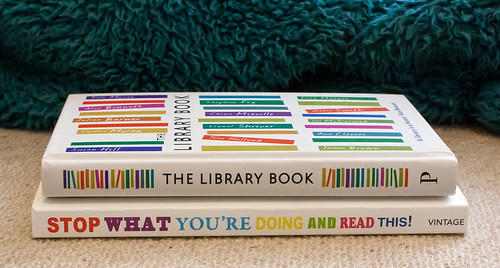
Slightly meanly, I think, the publisher has not credited anyone as the editor of this collection of essays on the topic of reading. Even the introduction is simply signed “Vintage Books, 2011”. I bought this book on a whim at the same time as The Library Book, as they were both pretty and colourful and contained essays by interesting people.

Foyles haul

I think it’s probably not surprising, then, that my reaction to this book is very similar to my reaction to The Library Book. Hit and miss. But perhaps to more of an extreme in this case. The hits had me nodding my head furiously, while the misses in some cases had me furious.

I like that the 10 essays are not only written by big names. They include novelists, poets, publishers, journalists, academics and the founder of a charity, the Reader Organisation. And the wide topic allowed them to take very different angles. Blake Morrison writes intelligently and profoundly about the pleasures and benefits of reading, including why poetry matters:

“It takes courage to own up to dark thoughts and dangerous feelings. But poetry – the most intimate yet public of forums – is the ideal place. Ted Hughes is one writer who recognised this. Writing, he said, was about facing up to what we were too scared to face – about saying what we would prefer not to say, but desperately need to share.”

This illustrates what my favourite of these essays do well – they quote widely, creating a whole reading list for me within their few pages of eloquent argument. Carmen Callil writes interestingly about books in her life and how being a woman in a man’s world led her to found Virago. She shows a great, warm love for books. Tim Parks, in contrast, goes negative. He generalises the average westerner as someone who either doesn’t read or only reads the latest big title:

“If we read fast, superficially, for plot, to get through, so as to congratulate ourselves…we’re not only missing out on certain pleasures, we’re actually putting ourselves at risk, leaving ourselves open to messages and attitudes we haven’t weighed up…”

Not only is this quite ungenerous, not to say judgemental, but I also think it’s wrong. Different books have different effects on us and who is he or I to tell someone that they shouldn’t read a certain book because we didn’t get anything from it? Thankfully Mark Haddon says entirely the opposite:

“This, I think, does a disservice both to readers and to the books themselves…because it’s not true. Visit a prison library and you’ll meet good people whose lives have been saved by potboilers, and psychopaths reading Jane Austen.”

But Haddon also writes intuitively about the act of reading itself:

“Stop reading right now. Look around you…The sense of being inside looking out, of seeing a world that belongs to everyone, but is nevertheless yours alone. It is this uncrossable gulf between me and not-me, between my private experiences and yours, which lies at the heart of being human and which no other medium can touch, and this border is where the novel lives and moves and has its being.”

And then Jeanette Winterson went and ruined it by returning to Parks’ snobbery and turning it up to 11. She goes from praising the King James Bible and Shakespeare to:

“We live under 24/7 saturation bombing from an enervated mass media and a bogus manufactured popular culture. If you don’t read you will likely be watching telly, or on the computer, or listening to fake music from puppet-show bands…The consequences of homogenised mass culture plus the failure of our education system and our contempt for books and art (it’s either entertainment or elitist, never vital and democratic), mean that not reading cuts off the possibility of private thinking, or of a trained mind, or of a sense of self not dependent on external factors…Attention Deficit Disorder is not a disease; it is a consequence of not reading.”

What?!! There is so much wrong with these statements. That last sentence…whooah! Has she ever expounded her theory to a doctor or ADHD specialist? I’d be interested to hear their response! I mean, I think reading is important and rewarding, but that really is taking it too far. And as for her comments on modern pop culture, well that’s her own personal taste and to extrapolate from her dislike to such disparagement is unkind and even ignorant. Music can transport me, make my heart race and my emotions surge – and I don’t mean classical music here, I mean rock, folk, dance and pop music. Not every song, or course, but plenty that I am sure Winterson would turn her nose up at. And let’s not forget that Shakespeare was the pop culture of his day.

I think in general it is a stubborn clinging to the past that frustrated me. A few of the essayists write about how the physical printed book is intrinsically better than ebooks, and how new technology and mass media threaten today’s youth and therefore the entire world. Personal preference is one thing, but I think we have to face up to the fact that we live in an age of transition and be positive about the possibilities the future offers. The final essay by Maryanne Wolf and Mirit Barzillai addresses this well:

“The Greek transition from an oral culture to a literacy-based culture provides a valuable analogue…Socrates argued that the seeming permanence of the printed word would delude the young into thinking they had accessed the essence of some aspect of knowledge, rather than simply decoded it…Will [today’s] young people immersed in technological innovation become adept at prioritising, sorting and critically evaluating information, adapting different types of reading styles based upon their purpose…Will the flexibility of digital text actually enhance the reading experience for many readers, propelling them into a deeper engagement with text, or will such enhancements serve as further distraction?”

I accept that my own preference for reading novels in hard copy is a product of my life to date, but I didn’t exactly dislike my brief dalliances with a borrowed Kindle and I absorb most of my journalistic writing via computer these days. I think a love of music, film, TV, comedy and theatre complements my love of reading, rather than detracting from it (though I won’t deny that they are all competing for my time). I think reading is important, valuable and worth encouraging in others but it is not about to disappear. As Callil says in her essay:

“The human race has been telling stories, and trying to record them on papyrus, on manuscripts, on stones, since the beginning of time. Whether we read on the printed page or on a machine is beside the point. It is the ideas and stories that count.”

Published 2011 by Vintage.

Kate Gardner Reviews

Posts pagination

1 … 89 90 91 … 124

Archives

RSS Nose in a book

  • Book review: Christopher and His Kind 1929–1939 by Christopher Isherwood
  • March 2026 reading round-up
  • Book review: We Have Always Lived in the Castle by Shirley Jackson

Me on the internets

  • @kate_in_a_book@mas.to (Mastodon)
  • Flickr/noseinabook
  • Instagram/kate_in_a_book
  • StoryGraph/kate_in_a_book

Categories

  • Blog
  • Reviews
  • Uncategorized
Proudly powered by WordPress | Theme: Dream by vsFish.