Book review: The Coral Bones by E J Swift
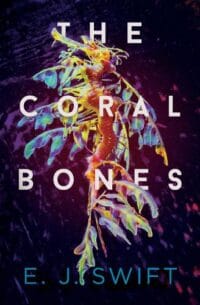
Is it something in the water or have I stumbled on a new micro genre, Australian eco fiction? After the dark, thriller approach of Wild Dark Shore by Charlotte McConaghy, there was a tinge of sci-fi to The Coral Bones by E J Swift. And I loved both books
In the vein of, say, David Mitchell’s Cloud Atlas, The Coral Bones has three interleaved narratives, all set in the same section of Australia’s coastline just under 200 years apart. In the present day, marine biologist Hana is doing all she can to save the coral of the Great Barrier Reef. In the early 19th century, 17-year-old Judith persuades her ship captain father to take her on a sea voyage. In the future, after massive climate and biodiversity catastrophes, Telma’s job is to track down rare animal sightings to help rebuild the world.
We meet Hana first. The novel opens with the discovery of a dead body on an island she’s visiting to help her friend and colleague Aaron with his research. The body, painted entirely white, is found on an inflatable painted with the words “This is what it looks like when coral dies.” Hana writes daily to her ex, Tess, switching between current events and musings on their relationship. She’s unhappy but believes her work is essential, painful as it is.
“When Aaron surfaced I asked him how the coral was looking. He shook his head…I was afraid to dive. The realisation hit me, terrifying in its alienness and its absolutism. I was afraid of what I was going to find, and afraid of my reaction when I saw it. My right leg started twitching. I struggled to control the tremor and for a moment I thought I was going to be sick…I could sense myself growing angry with Aaron for putting me through this, and then my anger turned inwards, at the thought that I would consider leaving him to face the devastation alone.”
Telma’s opening chapter is similarly intriguing and exciting. Almost heist-style, she drives a large truck across a desert that’s too hot to survive in during the day, to a facility where rumour has it an endangered species is being kept as a pet. Telma seems prickly, difficult, and she’s avoiding someone.
Judith’s introduction is the least high-octane, but intriguing. She is parented largely by her companion Belinda since her mother returned to England and her father is always at sea. This leaves her plenty of freedom to study from the extensive library her father has supplied her with. To avoid or at least delay being called to England to be married off, she suggests she can be helpful to her father on his next voyage. She’s a skilled sketch artist and keen observer of nature, so will make a useful – and cheap – assistant for the scientists on board.
Judith’s story – told in the form of a journal – was both the least and most surprising to me. It seemed inevitable that she would wind up married off to someone involved in shipping and the field quickly narrows to a few likely candidates. But her focus is always primarily on science and nature. Born a man she would undoubtedly have been a scientist and she is determined to get as close to that as her circumstances allow. Marriage and romance are far down her priority list.
Again, like Cloud Atlas, these three narratives are linked by more than just overarching themes. Not only are all three about women essentially engaged in marine biology, but there are specific locations they go to and species that they observe. They are also reflective of the migration of humans to Australia (there are minor characters who are native Australians). Though all three women were born in Australia, Judith has (upper class, fancy) English parents; Hana has Japanese grandparents on her father’s side (pearl divers); Telma has a mixed heritage that includes the Philippines, Japan and Britain (climate refugees).
Hana’s story is the most depressing. As a marine biologist living and working now, she is observing the massive loss of coral reef and its associated species of sea life. She and her colleagues struggle with depression wrought by their job cataloguing this huge loss. The dead body thread in her story isn’t so much a thriller element as symbolic of the strength of feeling on this topic. Hana is pulling away from what was until recently a happy, settled life with a woman she still loves, because she sees catastrophe every day.
It’s perhaps odd that I saw hope in Telma’s story. Through her we learn that much of Earth is now uninhabitable to humans and most animal species. Those who have survived have done so in cities that are underground or contained within protective domes – or both. Huge strides have been made in energy generation, fuel efficiency, consumption controls, protective legislation. It came too late for millions of people and far too many species of plants and animals. But I still found hope in the ability of humans to – eventually – figure out the political, social and technological solutions needed to keep society going. This is not a post-apocalyptic world of small bands of survivors fighting over limited resources. It’s a world of mega cities where people are safe, housed, fed, employed. They have hobbies, social lives, love lives.
“A hive of drones rose from the mouth of a hangar, speeding swiftly north in formation before scattering into the darkness of the fields. [Telma] saw the maintenance machines rolling out in their wake…The scale of the operation impressed upon her in a way the cities did not. The cities were complex symphonies, held together by a billion intricate algorithms, but every part of them was reliant upon this: the brute power harnessed from a sun that dealt death and deliverance in equal measure. In the Anthropocene, the sun had become a god again.”
So, I guess I’m open to suggestions for more climate fiction – particularly by Australian writers. Let me know what to add to my list!
First published 2022 by Unsung Stories. Now published by Hachette.
Source: I picked this up in a bookshop but I really don’t remember which one. As I don’t know the author, it was likely a staff recommends title so I feel bad that I didn’t make a note in the book. I’m trying to do that with all my books now.
Leave a Reply