Book review: Wild Dark Shore by Charlotte McConaghy
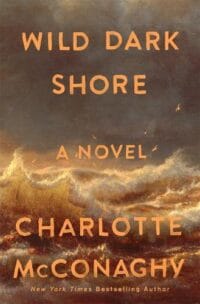 Sometimes a bookseller presses a book into your hands that you had never heard of and it is the most absolutely perfect read for you. Booksellers like that are a precious, precious thing.
During Independent Bookshop Week in June, the Very Small Bookshop in Bristol had a cool way to share book recommendations. Leah, who runs the shop, created six lucky dips under topics including “somewhat bizarre” and “gaaaaaaay”. You picked out a slip of paper with a title and author, and if you liked the sound of it enough to buy the book you got 15% off. I love a book recommendation from someone whose taste I trust/share – and the selection of books in Leah’s shop already vouched for that. Wild Dark Shore by Charlotte McConaghy was my pick from “soft or profound or lovely”. I certainly wouldn’t call it soft, but it’s very profound indeed.
This novel focuses on the Salt family – father Dominic and his three children – who live on an extremely remote sub-Antarctic island called Shearwater. Dominic is the island’s caretaker, a role that he chose after his wife died nine years ago. They live in an old lighthouse, no longer functional for that purpose but bringing with it more than a century of lonely histories. The extreme, harsh environment seems an appropriate setting for grief – perhaps one so extreme it can drive people mad.
There was a research facility here, recently abandoned due to rising sea levels. The Salts will soon have to leave too, but in the meantime they maintain what the scientists left behind: a seed vault. The rising sea level is the first indication that this is a world where climate catastrophe is already happening. Even when they leave Shearwater, the Salts may not be able to find somewhere safe to live. Is this part of the fiction or a depiction of what is really happening in much of the world? I lean to the latter, which is a scary realisation after reading this.
On a wild, stormy night, a woman is washed ashore, almost dead. As the family rally to save Rowan, they discover she has questions they are reluctant to answer. Everyone is keeping secrets, but in this environment they rely on each other to survive.
“She washes in with the storm, draped upon a tangle of driftwood. The girl sees her from among the seals…Rough waves carry the lump in closer…A shape of milky white lit by the moon…The girl wades into the black roar. She dives under and swims out. Reaches for this bulbous thing to help steer it free…A last wave sends the tangle onto the beach and the girl parts the curtain of snarled kelp to reveal a face, and it is not swollen or blue or nibbled; it is breathing.”
Facts are very slowly unravelled. Dominic has a strained relationship with his daughter Fen, and his two sons largely do their own thing – even nine-year-old Orly. What has happened to make a teenage girl choose to sleep in a beach hut down the hill from her family home? Is it really just her love for the seals on that beach? Why does teenage Raff get so angry he uses a punchbag until his hands bleed?
The chapters each focus on one of these five characters, switching between first and third person. So we quickly learn what questions they all have about each other, and some of their fears. We are also immersed in their personal interests. Perhaps inevitably given their home for the past several years, the children are all very knowledgeable about the natural world.
Raff loves music and whale song. His one indulgence is specialised audio equipment that he takes out on a boat when a whale is spotted, recording all he can of their calls. Fen loves the seals but also all the sea birds that inhabit or visit the island. She has named some individual birds and knows their histories. Orly is more interested in the seeds, and tells Rowan about some of the species stored in the vault. He knows an amazing amount for his age, having supplemented his remote schoolwork by spending time with the scientists who lived here.
As for the adults, Rowan has come to the island with one specific question and it takes a while for us to learn more about her. But we come to see that she too loves nature. Dominic is still grieving his wife, talking to her ghost though he knows that could be considered crazy. He throws himself into physical labour every day, trying not to dwell on his demons.
“To live for your children seems a normal thing, a respectable one; to live because of your children is something else. Mine are the blood of me, and the oxygen in that blood, the airflow and the neurons firing, and the stretch and release of muscles in limbs, they are the foundations that make up my skeleton, all the collagen and calcium upon which I stand and fall, and the pulse and the flow and the beat. But I think maybe this is too much for them to be. The breath of a man. The life of him. I think it is too heavy a thing for children to carry.”
I think I would still have loved this book without the overarching mystery. The setting is so evocative – exactly as the title describes it. The nature descriptions are beautiful and clearly well researched without ever info dumping. It’s a frankly terrifying depiction of climate catastrophe, with violent storms sweeping away bits of the island. It’s a very moving depiction of grief and loneliness, how nature can heal but also how humans do need other humans around them – at least some of the time.
And it is also a gripping thriller, which in no way detracts from those other things. It does mean I devoured this book in a few days, staying up far too late into the small hours to finish it. The secrets feel earned, they make sense in context, and at no point did I feel disappointed by a reveal.
The ending of this book shook me deeply. It is hugely moving. I won’t say more than that, for fear of spoilers.
On which note: do not read the blurb on the back of this book, it reveals far too much. Clearly it didn’t ruin my read, but I was a little frustrated to realise I knew about things that still hadn’t happened at the halfway point.
In her afterword, McConaghy explains that while Shearwater is fictional, it is closely based on the real island of Macquarie – including an ugly history of seal hunting. As part of her research she visited Macquarie with her husband and baby. So Dominic’s memories of arriving on Shearwater with baby Orly have some real foundation – though of course McConaghy was only there for a brief visit, not setting up a home and a life.
I have already added McConaghy’s previous novel Migrations to my wishlist. It’s about a biologist in another remote environment, again with a bit of a thriller element to it.
First published 2025 by Flatiron Books.