Nose in a book

Reviews and other ramblings

  • Home
  • Reviews archive
    • Book reviews
    • TV reviews
    • Theatre reviews
  • TBR
  • Challenges
    • The Classics Club
    • 2014 Popular-Science Reading Challenge
    • Cookery challenge
    • The Gilmore Girls Reading Challenge
    • 2013 TBR Pile Challenge
    • 2013 Translation Challenge
    • Crime and Punishment read-a-long
  • About
    • Cookie legal stuff

The silence, the astonishing silence

July 22, 2013

Mrs De Winter book cover

Mrs de Winter
by Susan Hill

I had no idea this book existed – a sequel to one of my favourite classics by a current author I admire – until I spotted it on a shelf in the holiday home. At which I of course ignored the five books I had brought with me on holiday and read this instead. Or as well as some of them. There’s a lot of books in that holiday home. I could probably have packed fewer books.

So if you couldn’t tell from the title, this is a sequel to Rebecca, Daphne du Maurier’s best-loved, and probably best, work. I’ll try to review this without spoiling that storyline but I’m not sure this novel would make sense without reading the Du Maurier book first anyway.

Hill picks up the story 10 years after Rebecca. Maxim de Winter and his wife are still in self-imposed exile, living in a hotel in an unnamed location in Europe, existing as peacefully and dully as they can. But they are forced to make a trip to England, to Cornwall, and it all comes flooding back, all that they have tried to forget. Mrs de Winter is still haunted by the ghost of Rebecca and convinces herself that someone out there has survived who wants her to remember, to suffer. Is she going mad or is there really something to be feared in the England she loves and longs to return to more permanently?

“We were here, home, back at last and my heart was full. I felt released, new born, desperate with a sort of sickness at the sight of the autumn fields, the trees and hedgerows, the sky and the sunlight, even the black flocks of swirling, flapping crows. I was guilty and ashamed, as if I were betraying Maxim and my loyalty to him as his wife, so that then, in a small pathetic gesture that only I could understand I deliberately turned my head away from the window and refused to look at what I saw and loved.”

The story is, like Rebecca, narrated by the second Mrs de Winter and I think Hill has got the voice spot on. I think that because I found her both sympathetic and deeply frustrating, just like I did with Du Maurier. (Possibly because I recognise a lot of myself, or at least some of my worse qualities, in her – the silly fantasies and fear of what people might think of me.) As in the original, there are many painful moments that might have been avoided if she would have just spoken honestly with her husband. She convinces herself that she is shielding Maxim from pain, but of course all secrets will be revealed in the end.

Hill is known for her ghost stories, so was a great choice to capture the tone of Rebecca and give it a believable extension, with some returning cast and some new characters. Maxim is still a snob and his wife is still a self-conscious mouse. But they have changed in these 10 years. Maxim has become, to an extent, reliant on his wife, while she has become stronger, at least insofar as she knows what she wants now. Whether she has the strength to make it happen is another matter entirely.

“That was the moment I saw the eagle. It is something I shall never forget, the blue sky and the silence, the astonishing silence, and then, out of nowhere, that magnificent, soaring bird, high over the crag…But it was wrong, it was spoilt, even this very rare and yet very simple joy had been tainted.”

If I were to find fault with this book it would be that I would have wished for Mrs de Winter to have grown stronger still in the intervening years, less afraid of speaking her mind; in other words to have learned her lesson. But while that would be the perfect happy ending, it wouldn’t have made for a very good sequel. This novel relies on all that positive character-building falling apart far too easily. As with Rebecca, it is largely the narrator’s weakness and self-doubt that allow the horrors to become real. Let’s face it, a stronger woman would have fired Mrs Danvers and destroyed all Rebecca’s belongings pretty early on. But just as Du Maurier convinced us that that wasn’t the second wife Maxim wanted, Hill convinces us that Mrs de Winter still has her reasons for feeling nervous, for keeping secrets.

“We were far apart, I thought suddenly, and yet I did not understand why or how it had happened. We had come through our trials into calm seas, and been as close as it is possible for two people to be. Now it had gone, that completeness, and I wondered if marriage was always like this, constantly moving and changing, bearing one this way and that, together and then apart, almost at random, as if we were floating in it, as in a sea.”

Hill really has done an excellent job of capturing that voice, of making this feel like the sequel Du Maurier would have written, so why was I not bowled over by it? I think perhaps I love the original too much to have all my dreams for what happened next shattered by this brilliantly rendered answer to every question. Of course it wasn’t all light and happiness after the curtains were drawn, Du Maurier made that pretty clear from page one of Rebecca. But until I read this I could dream that a few years later it would all be however I wanted it to be.

Was it a mistake to read this? I hope not. I thoroughly enjoyed being back in that world, reading a love letter to England and also a subtle attack on the stiffness of “society”. I enjoyed the prickling at the back of my neck during the haunting scenes, the growing sense of foreboding and the relief of the moments of happiness in-between. I just have to try to keep this as one possibility of what happened next and still allow myself to dream what I will the next time I re-read Rebecca.

Published in 1993 by Sinclair-Stevenson.

Source: Borrowed from holiday home library.

Kate Gardner Reviews

Holiday in pictures

July 20, 2013July 20, 2013

I have been meaning to blog about our very lovely holiday in Cornwall for a week now, but getting back to real life has been super busy. So here are a few nuggets and some photos. Hope you’re all enjoying lovely weather wherever you are.

The colours of sea and sky were impressive. The British seaside rarely looks this…tropical.
Holiday seas

Typically, I had black and white film in my camera, but I got some nice shots with it.
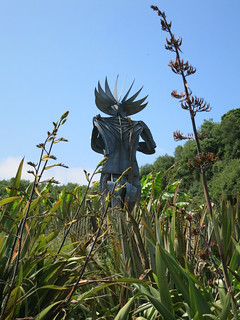
Throwing shapes

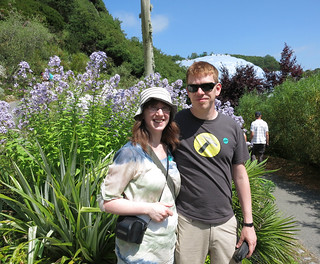
We finally made it to the Eden Project, which is brilliant.
Bright flower Untitled

Untitled

And we generally chilled out with good friends and a great location.
Oh yeah

Astonishingly I didn’t entirely melt in the heat and I managed to read four books in a week! Which totally justifies my packing five books, even if one of the books I read was borrowed from the holiday home, right?

If you want to see more of my holiday photos, they are in a set on Flickr.

Happy July, folks.

Kate Gardner Blog

The extraordinary silence of these long, self-contained days

July 10, 2013July 10, 2013 2 Comments

The Wine of Solitude

The Wine of Solitude
by Irène Némirovsky
translated from French by Sandra Smith

Since reading Suite Française when it was discovered and released I have been eager to read more of Némirovsky’s early novels. This is my second and so far they have failed to come close to the brilliance of her final, inspirational work. Not that this is by any means a bad book, but I suppose I had been expecting something more.

I suspect some of Némirovsky’s own life fed into this novel. It follows a family with a Jewish father who move from Ukraine to Russia to Finland to Paris in the 1910s and 1920s, so the background is the First World War, the Russian Revolution and the stock market rise and fall. Which is a turbulent, exciting and occasionally terrifying background for what is at heart the coming of age of a young woman.

“The smell of cigars and brandy wafted through the house until morning, slipping beneath her door and insinuating itself into her dreams. A faraway rumbling shook the paving stones: artillery detachments were passing by in the street.”

But it’s not that simple. Hélène dearly loves her father but he has no time for her between his gambling and business affairs – everything is about making money for Boris Karol. And Hélène’s mother should never really have become a mother at all, as she just wants to party, have affairs with young men and buy expensive clothes and jewels. Hélène harbours quite deep hatred of her mother, which becomes more bitter as she gets older.

“When she was ten years old she began to find a melancholy charm in the solitude of these Sundays. She liked the extraordinary silence of these long, self-contained days, which were like faint little suns in a different universe where time flowed at a slower pace.”

There is a lot of negative emotion in this book, as if Némirovsky is pressing home the point that money does not equal happiness. In fact, the brief interludes of happiness for Hélène are determinedly simple pleasures – going for afternoon walks with her French governess, sledging in snow, childhood summers in Paris playing with children who don’t judge her for being different, for having fashionable clothes and speaking better French than Russian. But mostly her early life is unhappy. Not terrible or desperate, but unhappy. And part of her journey to adulthood is learning to find and enjoy those simple pleasures, and making the decision whether to be cold and strong like her mother or passionate but breakable like her father.

“A storm was brewing over Paris; the sky was covered in copper-coloured wisps of cloud that slowly moved closer together to form a blanket of pink mist that parted every so often to reveal a dazzling ray of light.”

There is some beautiful writing here, especially in the descriptions of places, but I found the dialogue and descriptions of emotions a little simplistic or false-sounding. There would be pages of Hélène analysing herself in a manner both too detached and knowing but also naively that for me broke the spell.

“No, I won’t read. All those books make me anxious and unhappy. I have to be happy; I have to like other people…Tonight, I’ll cut out pictures, I’ll draw—I’m happy; I want to be a happy little girl.”

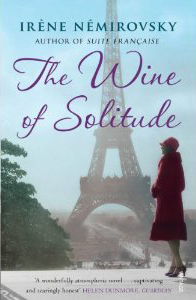
Not that it wasn’t worth reading. And I certainly think there is more to this book than the cover art lets on (a terrible cliché of the elegant young woman in Paris, which doesn’t come close to expressing the darkness that this book contains). It just suffers from my having read what was probably Némirovsky’s best before I read the rest.

First published as Le vin de solitude by Editions Albin Michel in 1935.

This translation published 2011 by Chatto & Windus.

Source: This was a present from my Dad for Christmas 2012.

Kate Gardner Reviews

It is far safer to be feared than loved

July 6, 2013July 10, 2013

Il Principe

The Prince
by Niccolò Machiavelli
translated from Tuscan Italian by N H Thompson

I find military history tedious so this wasn’t the most fun read for me but it’s a classic and it’s only 99 pages so I figured I’d give it a go.

The premise is that Machiavelli wrote this as a textbook for a member of the powerful Medici family and indeed it is formally dedicated to one of them, but it’s unknown if it was ever read by any Medici or even if that was the true intention.

The book is split into short chapters, each of which is a self-contained essay. The first half of them look at types of prince and types of situation whereby a prince might take over a new military history. The second half looks at the qualities a prince should have and the ways he should behave. There’s extensive use of historical examples, many from Italy but also from all over Europe and occasionally further afield.

To be honest, for all the negative reputation of Machiavelli, this is in general sensible or at least realistic-sounding advice. It is sometimes ruthless but not as much as I had expected at all.

“He who innovates will have for his enemies all those who are well off under the existing order of things, and only lukewarm supporters in those who might be better off under the new.”

“The ruler is not truly wise who cannot discern evils before they develop themselves, and this is a faculty given to few.”

“As long as neither their property nor their honour is touched, the mass of mankind live contentedly, and the Prince has only to cope with the ambition of a few.”

Of course, there is an awful lot of focus on war, which I didn’t like too much and objected to morally. Really much of the first half was a struggle against boredom.

“War is the sole art looked for in one who rules…when Princes devote themselves rather to pleasure than to arms, they lose their dominions.”

However, to make up for the objectionable war focus and dull military history there were moments of fascinating philosophical language and that ratio really flipped in the second half, with a lot more commentary on human nature. I especially liked the reference to Chiron the Centaur (a character I learned about in Song of Achilles) as the perfect instructor to teach princes how to use both the natures of man and beast.

“The manner in which we live, and that in which we ought to live, are things so wide asunder, that he who quits the one to betake himself to the other is more likely to destroy than to save himself; since anyone who would act up to a perfect standard of goodness in everything, must be ruined among so many who are not good. It is essential, therefore, for a Prince…to have learned how to be other than good, and to use or not use his goodness as necessity requires.”

The most famous chapter in the book is “Of cruelty and clemency, and whether it is better to be loved than feared”. But the answer given to that choice is not as clearcut as I often see quoted. As with most chapters, there is the ideal answer and the likely compromise. A prince “should desire to be counted merciful and not cruel” but should accept the reputation of cruelty “where it enables him to keep his subjects united and obedient”. And the famous line in this translation reads “it is far safer to be feared than loved”, which is not quite the same as saying it’s better. Indeed, Machiavelli goes on to caution that to inspire fear should not equal inspiring hate. In fact, there’s a whole chapter devoted to evading contempt and hatred.

There’s also an interesting discussion of assassination that might easily have referred to suicide bombers in another time:

“Let it be noted that deaths like this, which are the result of a deliberate and fixed resolve, cannot be escaped by Princes, since anyone who disregards his own life can effect them. A Prince, however, needs the less to fear them as they are seldom attempted.”

Apparently, since Machiavelli turned out later in life to be a liberal forward-thinker, many have argued over the centuries since the publication of The Prince that it’s a satire and was never intended to be taken seriously. Again, I’m not sure if it’s the translation but I didn’t detect any irony at all.

I’m glad I’ve read it and I can see how you could write many more words analysing the text than the original contains, but I am in no great hurry to read more old political philosophy. Especially not if military strategy is a common theme.

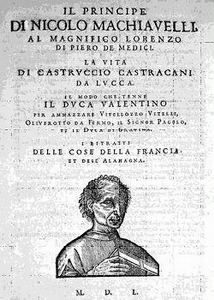
First privately distributed in 1513 under the Latin title De Principatibus (About Principalities).
First published by Antonio Blado d’Asola in 1532 as Il Principe.
This translation first published by P F Collier and Son in 1910.

Source: I honestly don’t remember. It’s a US edition so maybe one of my holidays over that side of the pond?

Challenges: This counts towards the 2013 TBR Pile Challenge.

Kate Gardner Reviews

This, which seems like time, must be instantaneous

July 2, 2013

The Victorian Chaise-longue
by Marghanita Laski

Almost exactly a year ago I went on what I hope will be the first of many trips to Persephone Books in London and, as well as being bought a book by my lovely friend H, I bought this book for myself on the back of several glowing reviews I had read around the internets. I can now add to all the glowing praise with some of my own!

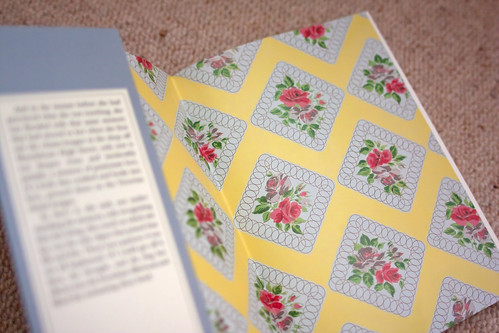
I love end papers

This novella could well be described as sci-fi horror, but it’s both easier to read and more deeply soul-searching than that implies. It explores, through a deceptively simple story, questions about life, death, love, illness, pain, secrets and probably other things that I missed. (Simon of Savidge Reads wrote a fascinating review of this book that pointed out how it depicts the role of women in society.)

Melanie is a young, bubbly wife and mother recovering from a serious bout of TB in the 1950s. After being confined to her bed for eight months, she is thrilled when the doctor says she can be moved to another room, where she is lain on the Victorian chaise-longue, which she bought on a whim while pregnant but has never before been able to use. When she falls asleep in the afternoon, she wakes up in what appears to be not only another house but another time, almost a century earlier, in the body of someone called Milly, the only thing in common being the Victorian chaise-longue, or so she thinks at first.

“It must have been the chaise-longue, argued Melanie. There is no other link; something to do with Milly and the chaise-longue that was so powerful, that even I in the present, just by lying on it, couldn’t help but feel it…This, which seems like time, must be instantaneous, without duration or reality. But I seem real…”

I liked the way Laski dealt with time travel, answering some of the key questions that always come up with her own (possibly unique?) solutions. For instance Melanie can’t say anything out loud that doesn’t fit with the time and place – there’s a disconnect between what she intends to say and what comes out. But Laski also leaves Melanie to puzzle over some of the other time-travel issues, such as how the timeline works: has all this happened before? is this an alternative past? what is time doing in her present? She rejects outright the idea that this is a previous incarnation of herself, which leaves her with the creepy knowledge that if this is real, all the people she is interacting with, including Milly, are long dead in her own present.

“This body I am in, it must have rotted filthily, this pillowcase must be a tatter of rag, the coverlet corrupt with moth, crisp and sticky with matted moths’ eggs, falling away into dirty crumbling scraps. It’s all dead and rotten…She shuddered, and knew she was shuddering in a body long ago dead. Her flesh crawled away and it was flesh that had turned green and liquescent and at last become damp dust.”

I thought Melanie was a great character, full of life and realistic frustration that just as she is recovering from her near-death and is ready to enjoy her husband and child, she is spirited away to some puzzling situation in someone else’s past. She is at times a little too stiff and snooty, but then that’s a key part of the story – Melanie believes herself above these people she finds herself surrounded by, and that’s one of the obstacles she has to overcome to understand what’s going on.

It works brilliantly as a horror story because at first you think the only question is when will she get back to her own present, but then you gradually realise that the details of Milly’s situation mean there are other dangers here. It’s genuinely scary, which is not something I say often!

Marghanita Laski was a fairly well known member of the British literati who was nearly forgotten all too quickly, until Persephone Books republished this. They have subsequently picked out three more of Laski’s books for reissue. I am so grateful that there are outfits like Persephone out there preserving great literature for the future.

First published by the Cresset Press in 1953.
This edition published by Persephone Books in 1999.

Kate Gardner Reviews

June reading round-up

June 30, 2013June 30, 2013

This has been a pretty good month, reading-wise. I’ve got through more books and short stories than previous months, but I’ve also squeezed in some other book-related stuff. I went to see Neil Gaiman talking about his new book, which was pretty awesome. I went to see the new Joss Whedon film of Much Ado About Nothing, which is completely amazing (in fact, I can’t wait for it to come out on DVD so I can watch it all the time). And I took part in the Literary Giveaway Blog Hop, which is always fun.

I’ve also found some time to enjoy the summer so far, including having a whale of a time with Tim flying our new kite yesterday, although I did manage to sunburn for the first time in several years, which I am enjoying a lot less.

Let's do a montage

Books read
A Tiny Bit Marvellous by Dawn French

Winter’s Bone by Daniel Woodrell (review here)

Oryx and Crake by Margaret Atwood (review here)

The Ocean at the End of the Lane by Neil Gaiman (review here)

Selected Stories by Saadat Hasan Manto (review here)

31 Songs by Nick Hornby (review here)

The Victorian Chaise-longue by Marghanita Laski

The Prince by Niccolò Machiavelli

Short stories read
“The gray goose” by Jonathan Lethem (in the New Yorker, May 6, 2013)

“Axis” by Alice Munro (New Yorker fiction podcast)

“Eveline” by James Joyce (Guardian books podcast)

“On exactitude in science” by Jorge Luis Borges (Guardian books podcast)

“The story of my dovecote” by Isaac Babel (Guardian books podcast)

“Summer of ’38” by Colm Tóibín (in the New Yorker, March 4, 2013)

“Unwelcome reminders” by Emma Newman (available online here)

“The drinking problem” by Emma Newman (available online here)

“The first time” by Emma Newman (available online here)

“The delivery men” by Emma Newman (read by the author here)

“The unburdened heart” by Emma Newman (available online here)

“Made-up” by Emma Newman (read by the author here)

“Sea story” by A S Byatt (available online here)

“The swimming pool” by Jekwu Anyaegbuna (available online here)

“The River of Lost Souls” by Isabel Greenberg (available online here)

Kate Gardner Blog

Listening to music and seeing faces in its fire

June 28, 2013 3 Comments

31 Songs

31 Songs
by Nick Hornby

I love Nick Hornby. And this collection of his essays about music might be Hornby at his best. Because when it comes to music, Hornby is a true fan, but not the kind of fan who knows it all and lectures on the roots of all music; he’s a fan in that he loves what he loves with great enthusiasm, and his enthusiasm is infectious.

As the title suggests, these essays centre around a list of 31 songs. Not necessarily Hornby’s favourite 31 songs, though they are for the most part among his favourites. Instead he has chosen songs that give him something to write about. So his selection of “Smoke” by Ben Folds Five gives us an essay about pop lyrics and whether it matters that most pop lyrics aren’t the stuff of great poetry (a subject of great interest to me; in fact I wrote my dissertation on it). I was happy to find, as a fan of Ben Folds, that Hornby’s decision on this matter doesn’t affect his belief that “Smoke” is “lyrically perfect”, and he adds a fascinating postscript:

“It’s possible that this sort of craft goes unnoticed because ‘Smoke’ is just a song, in the way that ‘Yesterday’ and ‘Something’ weren’t just songs. The young men who wrote them were also, unwittingly or not, in the process of changing the world…Their songs have therefore become imbued with all sorts of magic that doesn’t properly belong to them, and we can’t see the songs as songs anymore.”

I found some essays better than others, just as some are more personal than others. There’s a very touching essay centred around “Puff the Magic Dragon” because Hornby’s autistic son responds positively to that song, which is a huge deal when you have a child so severely autistic that he only has three or four words at the age of ten.

Hornby does sometimes contradict himself. For instance, he accuses others of being unnecessarily bleak about the state of pop music today and then makes similar dismissive statements himself. His opening essay says that this is not about songs that are connected with a certain memory, and he’s actually pretty harsh about that as a reason for picking out a song, and yet at least two of the essays are exactly that. I don’t agree with all Hornby’s statements (it’s possibly a product of the time of his writing, but I don’t think the age of the Internet has narrowed musical styles, I think it has widened and democratised them wonderfully), and I don’t always share his taste, but then that’s not the point anyway.

“This book isn’t predicated on you and me sharing the ability to hear the same things; in other words, it isn’t music criticism. All I’m hoping here is that you have equivalents, that you spend a lot of time listening to music and seeing faces in its fire.”

As someone who does indeed listen to a lot of music and loves that moment of being transported by a good song, I really really enjoyed this book. I liked that it demands to be read while listening to music, ideally pop music, which is something I tend not to do, to avoid distraction. Even though Hornby is older than me and we don’t entirely share our music taste, I felt compelled to make a playlist from this book, not of the 31 songs themselves and not of every song mentioned at all (that would be a long playlist) but instead of every song he enthuses about. I used Spotify, so not all the songs were available, but I’m enjoying the results. If anyone’s interested in listening, the playlist is here. But even if you don’t like the look of the song selection (and there is a lot of Rod Stewart on there, I’ll grant you) I still highly recommend this book to any pop/rock music lover.

“‘Caravan’ isn’t a song about life or death, as far as I can tell: it’s a song about merry gypsies and campfires and turning up your radio and stuff. But in its long, vamped passage right before the climax, when the sax weaves gently in and out of the cute, witty, neo-chamber strings, while the piano sprinkles bluesy high notes over the top, Morrison’s band seems to isolate a moment somewhere between life and its aftermath, a big, baroque entrance hall of a place where you can stop and think about everything that has gone before.”

Published 2003 by Penguin. Published in the US as Songbook.

Source: I bought this secondhand.

Challenges: This counts towards the Rory Gilmore Reading Challenge.

Kate Gardner Reviews

Literary Giveaway Blog Hop – the winner

June 27, 2013

Literary Blog Hop Giveaway

And the winner is…

Wendy Reniers

Congratulations Wendy! I’ve dropped you an e-mail and a copy of The Handmaid’s Tale will be on its way to you shortly.

I want to thank Judith again for hosting the blog hop. It’s always a lot of fun to be part of. Until next time, folks!

Kate Gardner Blog

Tears are the perspiration of the eyes

June 25, 2013June 25, 2013

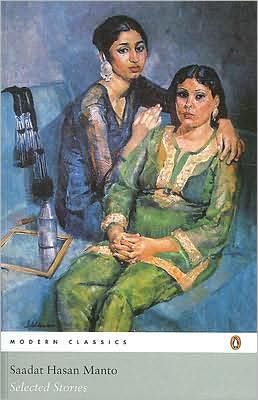
Saadat Hasan Manto

Selected Stories
by Saadat Hasan Manto
translated from Urdu by Khalid Hasan

This collection was recommended – and indeed loaned – to me by a friend after a conversation about classic books in India versus in the UK. Many of the names were the same for both of us, but one literary giant I hadn’t heard of, much less read, was Saadat Hasan Manto. So we had to fix that, obviously.

“It was about this time of year. The monsoons had come and, outside his window, the leaves of the peepal tree danced as the raindrops fell on them…Outside, in the milky dankness of the evening, the leaves of the peepal tree swung in the breeze like a golden ornament on a woman’s forehead.”

Manto wrote in almost every medium but the short story is what he was known for, and this selection, specially translated (though apparently most of Manto’s work has been translated into English before at some point) attempts to provide a representation of his whole career, including stories considered classics, such as “The new constitution”.

When telling people what I am reading I have stumbled over such basic information as his nationality, or country of birth, because the answer to those questions is a bit tricksy. He was born to a Kashmiri family in Amritsar in British-ruled India, later living mostly in Lahore, Bombay and finally Karachi. He died less than a decade after the Partition of 1947, and is quoted in the introduction to this volume as saying that he truly did know whether India or Pakistan was his true homeland.

And that, with the turbulence of those years and tensions between religions and social groups, is central to many of the stories in this collection. Which is a great insight and can be very moving. However, in all I’d say I had a mixed reaction to these stories. The language is often beautiful, not flowery and easy to read – except occasionally for the subject matter. The stories are often erotic, with lots of describing women’s bodies, and they don’t shy away from getting down and dirty at times. This is particularly true because many of the women characters are prostitutes.

And I think this is where I began to have a small problem. Where the male characters are varied, three-dimensional and cover a wide strata of careers, the depiction of women is a little…misogynist. Women are always described physically in detail and tend to be defined by their social position or religion rather than having a clear character.

“Tears flickering over her thick eyelashes will look lovely. It will be like raindrops dancing down a shuttered window. It is possible that you may not think tears to be necessary in women’s eyes, but I cannot even imagine a woman’s eyes without tears. Tears are the perspiration of the eyes. A worker’s brow is only a worker’s brow when it is shining with perspiration. A woman’s eyes can only be a woman’s eyes when they are drowned in tears.”

But that reservation aside, these are good stories. They’re real, sometimes shockingly real. There was one story, “The return”, that left me stunned. In fact, for that one story alone I would rate Manto very highly. I also really liked the (very different) story “Odour”, which is sensuous and strangely touching.

This translation first published by Penguin Books India 2007.

Source: Borrowed from a friend.

Challenges: This counts towards the 2013 Translation Challenge.

Kate Gardner Reviews

Thoughts on ideology

June 24, 2013

“Democracy is an experiment the goal of which is to keep the experiment going. The purpose of democracy is to enable people to live democratically. That’s it. Democracy is not a means to something else; there is no higher good that we’re trying as a society to attain. When we compromise with democracy in order to achieve some other purpose, even when the purpose is to defend democracy, then we are in danger of losing it.”

This quote from Louis Menand in the New Yorker (Mar 4, 2013, p71) really got me thinking. It’s such a basic point and one that should be blindingly obvious, yet I’d hazard it’s a subtlety that’s often lost on politicians.

The piece in the New Yorker, incidentally, was a review of a book about the New Deal. Menand was arguing that Franklin Roosevelt’s success as a politician was rooted in his being “a political pragmatist, someone who is less interested in the ideological provenance of a policy than in its effectiveness” – which sounds like a good thing to me. But it must be pretty rare to rise to the top in politics without a strong ideology, right?

I don’t pretend to know enough about politics or philosophy to be able to say more myself, but I like what Menand has to say.

Kate Gardner Blog

Posts pagination

1 … 84 85 86 … 126

Archives

RSS feed: Nose in a book Nose in a book

  • Book review: Taiwan Travelogue by Yáng Shuāng-zǐ
  • October 2026 reading round-up
  • Book review: The Coral Bones by E J Swift

Me on the internets

  • @kate_in_a_book@mas.to (Mastodon)
  • Flickr/noseinabook
  • Instagram/kate_in_a_book
  • StoryGraph/kate_in_a_book

Categories

  • Blog
  • Reviews
  • Uncategorized
  • © Copyright Kate Gardner. All rights reserved.
Proudly powered by WordPress | Theme: Dream by vsFish.