Nose in a book

Reviews and other ramblings

  • Home
  • Reviews archive
    • Book reviews
    • TV reviews
    • Theatre reviews
  • TBR
  • Challenges
    • The Classics Club
    • 2014 Popular-Science Reading Challenge
    • Cookery challenge
    • The Gilmore Girls Reading Challenge
    • 2013 TBR Pile Challenge
    • 2013 Translation Challenge
    • Crime and Punishment read-a-long
  • About
    • Cookie legal stuff

Category: Reviews

Justifiable anger

June 26, 2011March 11, 2012 3 Comments

An Image of Africa
by Chinua Achebe

This is actually two essays by the great Nigerian author: “An image of Africa: racism in Conrad’s Heart of Darkness”, and “The trouble with Nigeria”. Which are some pretty heavy topics, so it’s possibly best that they total less than 100 pages between them!

The first essay is fascinating, though I would no doubt get more from it had I actually read Conrad’s Heart of Darkness. But then the major reason Achebe came to write this essay is that Heart of Darkness is so widely read and studied that the grotesque myths and caricatures it perpetuates cannot easily be erased from the public consciousness, so perhaps by not reading it myself I’m helping just a little bit?

As the title suggests, Achebe argues that Heart of Darkness is hideously, unforgivably racist. From subtle linguistic differences between descriptions of black and white to outright lies told about African natives, Achebe’s argument seems hard to counter. I found it interesting that he calls Conrad a “great stylist of modern fiction”, which is perhaps akin to saying he ought to have known better. He speaks of Conrad’s fixation with blackness and the word “nigger” but mostly he is concerned with the way the book questions “the very humanity of black people”. Which is a grievous accusation indeed, and certainly I can see why Achebe might feel such anger toward the book.

Achebe doesn’t just look to the book itself but also to modern scholars’ writing about it. Not one of them, he says, has dealt with the subject of racism in Heart of Darkness, which suggests that all those scholars considered racism to be entirely normal and/or acceptable. The possible damage of continuing to teach such a text widely is that such attitudes will continue to be normalised, that the image of Africa as the dark, prehistoric continent will be perpetuated and therefore racism continue.

Reading the second essay is to some extent dependent on having some knowledge of Nigeria and in particular the Nigeria of 1983, when the essay was written. Achebe speaks largely about corruption and rule-breaking in his home country. Though he lambasts his fellow Nigerians, occasionally lapsing into caricature and generalisation, he always comes back to how the country’s leaders have made the situation what it is. He balances out the generalisations with specific examples of men or occasions that highlight his points. Politicians Azikiwe and Owolowo come under particular fire, but I was more interested to hear brief mention of a name entirely new to me, Aminu Kano, who Achebe compares to Mahatma Gandhi and calls a “saint and revolutionary”. I am immensely curious what is behind these words of admiration and am off right now to ask the internet what the story is.

“An image of Africa” was originally given as a lecture at the University of Massachussetts, Amherst, February 1975; later published in the Massachussetts Review 1977.
“The trouble with Nigeria” first published by Fourth Dimension Publishing 1983.
This selection published 2010 by Penguin Books in the “Great Ideas” series.
Kate Gardner Reviews

The problem with build-up

June 20, 2011March 11, 2012 2 Comments

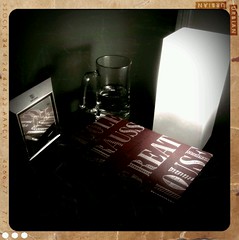
Great House
by Nicole Krauss

I loved Krauss’s two previous novels, Man Walks Into a Room and The History of Love. Add in that this book was shortlisted for this year’s Orange Prize and you have some pretty high hopes and expectations. Were they met? Kinda, ish, not really.

This was one of those books that I started…not struggling with, but I wasn’t particularly drawn into it. Krauss creates complex, believable characters with distinct voices and interesting histories and weaves a story that slowly links these disparate people together, but it took a while for me to be hooked. Once I was, though, I was thoroughly hooked and stayed up far too late three nights in a row to get to the end.

Just one more chapter

This isn’t exactly one story, it’s the tale of several lives that are linked by a desk. Yes – a desk. It isn’t entirely clear, when you meet some characters, how they are connected. The stories come together from various angles, usually made more obtuse by having the narrator of that section not really be the person that it’s about. So there’s Nadia, a writer in New York who spends one night with an enigmatic Chilean poet and then never sees him again, though he haunts her whole life. There’s Arthur in London, caring for his dying wife who is losing her memory. There’s Izzy, an American student at Oxford who falls in love with an Israeli who can never be as close to her as he is to his sister.

“Great House” is a term from Jewish history, originally a quote from the Book of Kings. Most of the characters in the novel are Jewish and the action keeps coming back to Jerusalem and also to the Second World War. The timeline is not always clear, though every so often a date is thrown in to the narrative. It takes a while to puzzle out the desk’s journey across the world and it doesn’t help that there are some red herrings along the way. But while figuring out how the characters are linked is a interesting exercise, you could just as easily read this as separate stories because each one is beautifully written and in most cases I was sorry to get to the end and have to switch to a new narrator again.

I do have a couple of gripes. The book takes in a lot of locations and I thought it telling that New York, which is the author’s home, is not really described and yet is completely believable as a location, whereas Oxford is painstakingly detailed in terms of streets walked down and pubs visited and yet did not feel at all real. Similarly Liverpool. And, frankly, Arthur’s leafy London suburb could have been anywhere, though he doesn’t leave home much so that might be unfair. Jerusalem was better-realised though it didn’t completely come to life for me.

My other gripe is that two sections are told by and about characters whose link to the rest is, if I’ve understood it right, so slight that it seems out of place to have given them so much of the book. It does seem like the link might get stronger after the book ends, but that’s just supposition on my part.

Overall, the strength of the characterisation overcomes everything else for me and I like the book but I didn’t love it like her previous novels.

First published in the USA in 2010 by W W Norton.
Paperback edition published 2011.

On a related note, this month’s Radio 4 Book Club was with Nicole Krauss. They were talking about The History of Love but a lot of her answers are also relevant to Great House, particularly one about developing characters’ voices.

Kate Gardner Reviews

Don’t be put off by the title

June 15, 2011March 11, 2012 1 Comment

The Gospel According to Jesus Christ
by José Saramago
translated from Portuguese by Giovanni Pontiero

This month’s book club pick sounded a tad intimidating and I certainly would never have picked it up if not for the group. What I discovered was a complex, at times difficult, but also beautiful and funny book that I’m glad to have read.

Much could be made of the heretical aspects of this book. It was written by an atheist shortly after the publication of The Satanic Verses and definitely attracted the attention of the Church. But what struck me the most was that it seemed to be at least partly an attempt to answer some genuine questions – if Jesus experienced life as a real human man (whether or not he was the son of God) what would that life have been like? Saramago answers this in depth, from the landscape and food to the people, ways of speaking and acting, and the historical context – Jesus’s part of the world was under Roman occupation, which had its effect on everyday life. Saramago also explores how Jesus might have been treated when he started talking about his relationship with God, the reactions of those close to him and those of strangers.

Of course, it’s about more than that because it also takes some small but significant deviations from the accepted Biblical story. Mary and Joseph conceive Jesus in the usual way, with God only later claiming to have had some part in the union. God is indifferent toward his people but then decides he wants more followers so starts to pay attention and make demands of Jesus. Jesus and Mary Magdalene are lovers. Satan is a friendly, approachable, “human” character. And Jesus is perhaps a little too human even before Mary Magdalene comes along:

“…such is youth, selfish and thoughtless, and there is nothing to suggest that Jesus was any different from other boys his age.”

So yes, it’s certainly heretical. It suggests God only wants to expand his leadership, to have more followers, but is unhelpful in terms of how and tricks Jesus into accepting his fate. It also says that God and Satan are equal, or rather balance each other out. This is certainly not a cuddly, loving God.

The style is a little difficult to start with, written in Biblical rhetoric, sometimes reverent sometimes very not. It can be very detailed and descriptive, even beautiful (OT-like, perhaps), especially near the start. But in other places it is bareboned, more like reading the New Testament. There are no paragraph breaks (a Portuguese thing?) and speech is not marked out by speech marks. But I got used to those things quite quickly and found I was reading at a faster pace than I had expected considering how demanding the prose is in terms of references and allusions. There is a lot of pathos. These characters are so human, with hopes and fears and guilt and temptation and the little niggles of everyday life. It could have been a very serious book, so thank goodness for the wonderful sense of humour:

“…this revelation did not escape Mary despite the angel’s obscure speech, and, much surprised, she asked him, So Jesus is my son and the son of the Lord, Woman, what are you saying, show some respect for rank and precedence, what you must say is the son of the Lord and me, Of the Lord and you, No, of the Lord and you, You’re confusing me, just answer my question, is Jesus our son, You mean to say the Lord’s son because you only served to bear the child, So the Lord didn’t choose me, Don’t be absurd…”

Clearly a lot of research went into it. It directly references not only passages from the Bible but also other religious writings and historical/archaeological knowledge of what life would have been like in that time and place. To a certain extent it fills in the gaps left by the Biblical gospels, therefore there’s lots of detail about Mary and Joseph, and Jesus’ childhood, but it skips quite quickly through the evangelism and miracle-working of Jesus’s last few years.

I was never clear about who the narrator is. The title suggests that it’s Jesus but it doesn’t read like that, it reads like one of his followers. But no-one could know all of this except an omniscient narrator so is it God? Or Satan? Or Jesus but much later from his seat in Heaven talking about “Jesus” in third-person because he’s now Michael?

Whoever it is, the narrator sometimes interjects in a manner that drags you out of the beautifully and believably constructed world of 2000 years ago to the present day, whether by directly referencing something modern or by applying a modern perspective. For instance, the narrator is often at great pains to point out the misogyny of life back then.

Joseph takes centre stage for the first half or so of the book and is therefore fully fleshed out, despite his brief appearance and disappearance in the Bible. He is a good man who, in contrast with the thinking of the time, is tormented by guilt for his own personal wrongdoing, which lays the groundwork for the major difference between Judaism and Christianity, according to this text – that Jews say prayers and give thanks and make sacrifices as part of the collective guilt of mankind, wheras Christianity is about acknowledging and asking forgiveness for personal sins.

At book club we discussed how, because the reader already knows the story, or thinks they do, Saramago plays with this. There’s a sense when reading this book of “when’s it going to get to the part when xyz” and xyz either happens later than expected or in an underwhelming sort-of way or even doesn’t happen at all. But some scenes are taken almost word for word from scripture, cleverly woven in.

There was some symbolism that I noticed but didn’t get, and I suspect it would help to have some solid theological knowledge when reading this rather than just a semi-deliberately forgotten memory of Sunday School and acting out Bible stories for Girls Brigade. I did find myself looking up some passages because they either rang a bell or rang false and the result varied from discovering they were surprisingly similar to the Bible (e.g. the wedding at Cana) to being a combination of different gospels put together in a new way (Jesus’ birth) to being a twist or slightly skewed take on the Biblical telling (Judas betraying Jesus to the Romans). Sometimes the narrator gives us a clue as to how this “true” account might become altered, for instance when Jesus spends 40 days and 40 nights talking to God and Satan he is not in the desert, but almost immediately on his return his followers are talking about it as his time in the desert.

There is so much to say about this book (clearly), and it was definitely a good one to have a roundtable discussion of.

O Evangello segundo Jesus Cristo first published 1991 by Editorial Caminho, Lisbon.
This translation first published 1993 by Harcourt Brace.
José Saramago won the Nobel Prize in Literature 1998

Kate Gardner Reviews

Prepare for tears

June 10, 2011March 11, 2012 1 Comment

Red Dog
by Louis de Bernières

This is the sweetest most wonderful book I have read in some time. I think it’s sort-of aimed at children, at least I hope it is else I will have to have criticisms about some of the slightly condescending explanations and I don’t want to criticise such a lovely lovely book.

The best summary of this book is the one supplied by the author himself:

“In early 1998 I went to Perth in Western Australia in order to attend the literature festival, and part of the arrangement was that I should go to Karratha to do their first ever literary dinner. Karratha is a mining town a long way further north. The landscape is extraordinary, being composed of vast heaps of dark red earth and rock poking out of the never-ending bush. I imagine that Mars must have a similar feel to it. I went exploring and discovered the bronze statue to Red Dog outside the town of Dampier. I felt straight away that I had to find out more about this splendid dog. A few months later I returned to Western Australia and spent two glorious weeks driving around collecting Red Dog stories and visiting the places that he knew, writing up the text as I went along. I hope my cat never finds out that I have written a story to celebrate the life of a dog.”

Red Dog was a Red Cloud kelpie, which is an Australian breed of sheepdog, and lived in the 1970s in and around Dampier, at that time mostly a mining town. De Bernières has lightly fictionalised his account but based it on those stories he collected and it does read like a collected folklore, though there is nothing unbelievable or magical about it. Red Dog was simply a dog who refused to be tied to one owner but somehow became everyone’s dog. As dogs go he had some quirky habits and he wasn’t above stealing his dinner but he was affectionate and loyal to those he befriended and in return most everyone he met considered him a friend. People would take it in turn to de-flea him or take him to the vet for shots and he would sit by their sick children’s bedsides or guide caravan-dwellers to the toilet block at night.

This is such a simple story but de Bernières tells it beautifully, describing the landscape and the weather and using the local dialect just enough to give a real flavour of the time and place. The book is illustrated by Alan Baker with basic but effective line drawings in red and black and they add a fairy-tale quality to the experience.

The only negative, and I really hesitate to say it, is that de Bernières does over-explain some details. It adds to the condescension that at the back of the book there is a “Glossary of Australianisms” which I didn’t find at all necessary, seeing as the few words I didn’t know were made completely clear by context. But as I said above, if this is intended as a children’s book I can forgive all of that.

I really would recommend that everyone read this heartwarming book but doglovers beware, you will need to have tissues handy – it’s the life story of a dog, how do you think it’s going to end?

First published in Great Britain in 2001 by Secker & Warburg.

Kate Gardner Reviews

Flavour of the south

June 6, 2011March 11, 2012 4 Comments

The Romance Readers’ Book Club
by Julie L Cannon

I bought this book on my recent trip to the United States because it looked like both a fun, easy read and an authentic flavour of the southern US. It deals well with some big issues, though it doesn’t come to the conclusions that I would necessarily have hoped for or agreed with.

This book treads a fine line between sweet fluffy teen romance and deeper “issues”-ridden prose with some literary merit. For the most part it is well written and engaging but some of the exposition was clunky, especially at the start. That said, the characters are believable and the story had me interested enough that I read the whole book in one sitting.

The story is that of teenage Tammi, living a secluded life on a farm in Rigby, Georgia, with her strict religious grandparents, or rather step-grandparents, which adds an element of them doing her a favour that is the first clue that all is not actually sweetness and light. Tammi has a lot of chores to do, must dress in the shapeless clothes her grandmother picks out and isn’t allowed to listen to modern music (it’s the 1970s). Which doesn’t exactly make her Miss Popularity at school. Tammi’s only real friends are her Aunt Minna and Uncle Orr, who each live in their own house on the farm and provide an escape. Minna is colourful and eccentric, Orr is severely mentally disabled; both are devoted to young Tammi.

The story proper begins when Tammi gets hold of a stack of steamy romance novels that she knows her grandmother will disapprove of but is eager to read. She persuades a girl at school to join her Romance Readers Book Club and soon a small group is meeting secretly every four weeks to share the illicit thrill. Tammi’s burgeoning sexuality is being stifled by real life and she desperately needs this escape, but she is terrified that it is a huge sin and may be the cause of the endless drought that is threatening her family’s livelihood.

There’s quite a lot going on in Tammi’s world, with peripheral characters having their own dramas that sometimes crash into Tammi’s life. I did find it odd that, aside from sexual matters, Tammi seemed to lack curiosity – maybe she has been too well trained in politeness and not asking questions but she seemed happy to find out what’s going on in dribs and drabs. And even when it came to sex there was a for me heartbreaking scene where she realises she doesn’t actually know what all these metaphors and allusions about passionate encounters are actually getting at. She has no idea what comes after kissing.

I definitely felt a strong sense of place in this novel. Not that I’m familiar with Georgia, but it somehow persuaded me of its authenticity of accent, terminology and people. I also felt that Orr was depicted well; his friendship with Tammi was touching and his inability to cope with having steamy romance novels read aloud to him was surprisingly sad because it marked the first division between Tammi and her favourite companion.

It’s worth pointing out that this book comes from a part of the world where going to church is all-important. Cannon uses some clever misdirection on this topic but actually faith itself is never questioned, only how to interpret the word of God. Tammi’s revolt against the strictness of her grandmother is never very extreme and she repents every tiny thing. In a way, this is actually very clever, because if Tammi had broken away from everything dramatically this would be a story about how romance novels are a corrupting influence, whereas the point of course is that these novels are a natural and badly needed escape and the only harm done is the temporary confusion that Tammi would probably have gone through anyway.

There are a lot of short “excerpts” from the romance novels in question and they really did take me back to being a teenager myself, devouring these books before I had ever even kissed a boy, daydreaming obsessively of being a character in one of those exotic locales with the clichéd dark handsome man. By the time I got my first boyfriend I’d realised those books were trash and moved on but they played their part in my “coming of age” and I suspect I’m not alone in that.

One final point on this novel – the blurb on the back was particularly poor. I know a lot of people say to always ignore it anyway and if I’m buying a book because I like the author or read about it in a review I do ignore the cover as much as I can. But when I’m just browsing unknown books, that blurb is providing useful information. Theoretically. But in this case whoever wrote the blurb got the wrong end of the stick and almost certainly hadn’t read the manuscript. There are several factual errors and it misses out some of the more interesting, serious themes. That said, I’m still glad I picked it up.

First published 2008 by Plume, an imprint of the Penguin Group.

Kate Gardner Reviews

The shock of growing up

June 3, 2011March 11, 2012

Claudine in Paris
by Colette
translated from French by Antonia White

After thoroughly enjoying the first book in the Claudine series, I was glad to already have the second book waiting in my TBR. It was another wonderful, rollicking read and I’m now going to have to search out the other two.

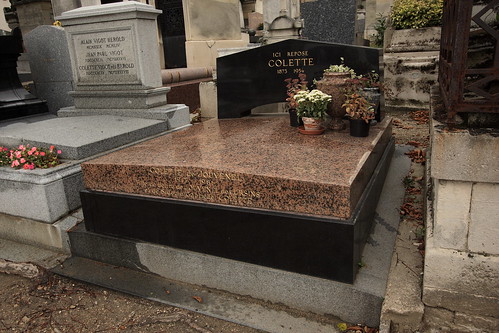
These were the first novels written by Sidonie Gabrielle Colette, who was an absolutely fascinating literary figure. I visited her grave in Paris a few years ago and was moved in a way I hadn’t expected to be (especially considering that previous to this series her novels have failed to move me).

Ici repose Colette

In this volume, Claudine and her father have moved to Paris, so that he can further his studies of slugs. She discovers to her surprise that she suffers greatly from homesickness for her beloved countryside village. She also discovers, on exposure to a new male friend who is gay and an old female friend who has become a rich man’s mistress, that she is far more easily shocked than she would have expected of herself:

“Disgust, yes definitely! There I was, making myself completely sophisticated and disillusioned and shouting from the rooftops ‘Ha, ha! You can’t teach me anything. Ha, ha! I read everything! And I understand everything even though I am only seventeen!’ Precisely. And when it comes to a gentleman pinching my behind in the street or a little friend living what I’m in the habit of reading about, I’m knocked sideways…In your heart of hearts, Claudine, you’re nothing but a common everyday decent girl.”

Well, Claudine may have discovered that the big wide world isn’t as easily bluffed as her old schoolmates were, but she is still far from common or everyday. Claudine is hypersensitive enough to catch a fever when she gets anxious but she is also tomboyish enough to do exercises every morning and speak her mind almost thoughtlessly. She is still vain enough to admire herself in every window or mirror and look coquettishly at every man she sees, but is self-aware enough to know that she is silly and vain and inexperienced to boot. She catches herself feeling jealous of an old friend who is marrying a sensible, dull sort of man and presses her friend the kept woman for information about sex while all the while feeling scared and sickened by the whole business.

Most of all, Claudine is still a witty, entertaining narrator who lets you into her world with disarming honesty, beside the occasionally withheld nugget of interest. The main switch in this book is that Claudine appears to have left behind the lesbian intrigues of school, only revisiting them for the entertainment of her cousin Marcel, who is left hot under the collar by her accounts and begs for more detail. Claudine’s romantic interest now seems to be firmly aimed toward men and marriage.

For all its shocking content and its youthful, not as sophisticated as she’d like to be narrator, this book is extremely well written with a wonderful, colourful cast of characters and a clever humour that must have been a challenge to translate this deftly.

Claudine à Paris first published in 1901 by Paul Ollendorff, attributed to Willy (Colette’s first husband)
This translation first published 1958 by Secker and Warburg

Kate Gardner Reviews

The drama of revolution

May 29, 2011March 11, 2012 1 Comment

The Glass-Blowers
by Daphne du Maurier

I love du Maurier but she was pretty prolific and sadly I think that her lesser known titles are, well, lesser works than the famous ones. At least, that’s been my experience so far. I enjoyed this book and its still better prose than some writers will manage at their peak, but like I’ll Never Be Young Again this wasn’t the captivating read I had hoped for.

An 18th century family saga of the Bussons and some du Mauriers, with an acknowledgement to people who helped the author do family history research, I am divining that this is loosely based on what du Maurier discovered about her ancestors, though how much of reality was used and how much made up I cannot tell. It is set in France just before and during the French Revolution and covers the politics and social upheaval of the time in some detail for a relatively slim volume. Du Maurier has her family of master glass-blowers thoroughly embroiled in the changing times, with family disputes over politics that at first seem minor becoming life-changing, even deadly, as the revolution progresses.

The story is told by the elderly Madame Sophie Duval née Busson to a long-lost nephew, so there are certain facts we learn early on out of order, such as when she last saw the brother whose son has now resurfaced. But for the most part it’s a linear narrative, starting with her parents’ marriage in 1747. In the early chapters it’s all about the hardworking industriousness of the Busson couple and to be honest I found it a little tedious being told what great people they were. Mme Busson, Sophie’s mother, is modern enough to want to learn alongside her husband how to run a glass-house but not so modern that she ever takes any interest in politics (unlike her children, later on). I found her very idealised as a character, but then I suppose the story is told from the perspective of a daughter who always idolised her so that does fit.

It all gets more interesting when the Bussons’ children start growing up and developing characters that are less perfect than their parents. There’s Robert the eldest son, with his love of frivolity, rich people and grand schemes. There’s Pierre, admirer of the philosophy of Rousseau, who wants to help those less fortunate than himself. There’s Michel who suffers from a terrible stammer and is an ardent republican. There’s Edmé the youngest daughter, tomboyish in her wish to put her country and socialist ideals before all else. And there’s Sophie, who for the most part simply wants to emulate her mother by running a glass-house with her husband and keeping out of politics. Except she doesn’t really keep out of it; for much of the book she comments on the political situation with a tone of “I know better” and I don’t just mean hindsight.

I don’t know a great deal about the French Revolution but I do think du Maurier has done an excellent job of combining facts, dates, names, etc with prose that evokes unease or suspicion or terror or heartbreak at the appropriate moments. I could completely believe in the riots borne out of a whisper campaign based on nothing at all. I could believe in the switches of allegiance based on the mood of the country and the limited evidence available.

However, the revolution is a big subject, as is a family saga, and this isn’t a big book. I enjoyed it but I think the content was squeezed in at the expense of any real description or insight. Some of the human drama is skipped past, such as the many couples in the book falling in love. But there are some moments when du Maurier uses brevity beautifully, such as the deaths of young children, which are handled with few words, but aching sadness.

Du Maurier was such an able writer that I will continue to read all her work that I can lay my hands on in the hope that I will find something that lives up to the promise of Rebecca. To which end I am hoping that nothing will come up to prevent me from taking part in the Discovering Daphne readalong hosted by Savidge Reads this October.

First published 1963 by Victor Gallancz.

Kate Gardner Reviews

The truth is buried in there somewhere

May 24, 2011March 11, 2012 2 Comments

A Vindication of the Rights of Woman
by Mary Wollstonecraft

I originally got this book for the Year of Feminist Classics project, but when they actually discussed it back in January I was only about 20 pages in. And then I put it aside for four months. The thing is, while being a hugely important and interesting work, this one is pretty tough to read. Or at least, I thought so.

First up, why was it hard to read? Well, it’s rambling and repetitive to such an extent that even my abridged Penguin Great Ideas edition of 132 pages felt too long. The language is as archaic as you might expect of 1792 and the society to which it refers is so long gone that it’s only recognisable from old novels. This also means that a lot of her arguments and the things she wishes to change have already changed, the fight has been won, so you could argue that it’s no longer relevant.

And yet, it is also eye-opening and indeed educational to be reminded how different society was, how unequal the sexes, and therefore how much progress has been made. Mary Wollstonecraft was arguing against the assumption that women are inherently weak, incapable, over-emotional beings with a natural love of dresses and pretty things; that men are inherently superior and women their slaves. This is not the view of one or two lone misogynists but that of most people in the western world at the time.

Wollstonecraft addresses herself to men and keeps all of her arguments abstract. She does not single out great women of history to look up to and indeed her comments about queens not being the equal of kings make me suspect that she did not subscribe to the now widely held view that Elizabeth I was a fine example of a woman proving herself in a man’s world. What Wollstonecraft does do is paint a series of caricatures of women who have been ruined by their upbringing or society or both.

This text does not set out any rules for women to follow to improve themselves, besides a brief attack on reading novels (which she distinguishes from literature). The primary point seems to be a plea to the powers that be – all male, of course – to at least try providing equal education for girls as for boys, so that women can prove by themselves that their silliness is a result of lack of education first and foremost.

Though education is her primary goal, there are also social changes to be made that are harder to resolve, and indeed Wollstonecraft does more describing how the current state of things is bad than suggesting how it can be changed. She appeals to what men might want in a woman – when sexual passion dries up, don’t they want an interesting, educated companion to share their life with? Don’t they want their children to spend their formative years with a strong, sensible, intelligent caregiver? Don’t they want to share some interests and hobbies with their life partner, to make marriage more enjoyable?

One point that Wollstonecraft makes is that while men have various hobbies and pastimes, women have only one – their appearance – which has a derogatory effect in numerous ways. And this really rang true for me because from what I remember, though it’s been a while, magazines for girls are about that one thing and basically nothing else – how to attract boys, what celebrities are wearing, how to pluck your eyebrows… How on earth this stuff can be regurgitated weekly astounds me but it was and probably still is. Yet lads mags, between the topless/bikini-clad ladies, have articles about cars, gadgets, films, sport. They’re still clichéd topics, sure, but at least there’s some variety, some looking outward to the world. It’s depressing how little has changed since 1792 when you look at details like that.

The passage that struck me the most was related to the above but not quite making the same point. Wollstonecraft argues that men who encourage women to be flirts who obsess over their appearance create women who are too physically unfit to be of any use in the bedroom or in childbirth. Now there’s a point I can agree with!

I’m glad I ploughed my way to the end and I can see why it’s considered important, but this was too poorly structured and hard to read for me to call it great.

First published 1792.

See also: reviews by Amy Reads and Emily of Evening All Afternoon. If you’re interested in Mary Wollstonecraft, it’s well worth taking a look at the excellent project A Vindication of the Rights of Mary.

Kate Gardner Reviews

A break from the norm

May 17, 2011March 11, 2012 2 Comments

Palestine
by Joe Sacco

This is an unusual, interesting, informative but potentially inflammatory work from journalist Joe Sacco. It’s an account of two months spent in Palestine (and occasionally Israel) in 1991–1992, told in graphic novel form.

It’s an interesting idea, this “comic-book journalism” and one that has won Sacco awards, including the 1996 American Book Award for this work. He’s an intelligent man, from what I can tell, and Palestine is a difficult situation that could potentially be too complex or political and therefore dull to many readers. This book is certainly not dull. It’s political, sure, but also moving, graphic, disturbing and compelling.

As journalism goes, this isn’t the third-person, bias-free, author-free account you might expect. The book stars Sacco, following his time in Palestine, his interviewing technique, his thoughts, fears, boasts and worries. Sacco does not do himself favours in his self-depiction. Comic-book Joe is both physically and at times morally unattractive. He admits to craving sordid details that will enliven his journalism. He pushes interviewees for the most disturbing stories and shows little emotional reaction while his translator or host is weeping at what they have heard. He also, unusually for an American, places himself solidly on the Palestinians’ side.

Now I’m not sure if this is a position he took in retrospect, after spending months in Gaza and the West Bank and Jerusalem. He certainly went there with the intention of getting the Palestinian side of the story, because the US tends to only ever hear the Israeli side. It’s a reasonable background to have for his trip. And he clearly knows that he comes across as biased because toward the end of the book we see him spending time with two Israeli women and failing to engage with their arguments. But it did at times make me feel uncomfortable. Very few of the characters he meets are blameless. Yes, the small man on the street, even the soldiers, are ultimately in thrall to what the politicians do or say, but when everyone is throwing stones…who is innocent?

I don’t know a great deal about this situation, a situation that started long before I was born and continues now. I know a lot more than I did before I read this book and I feel both incensed and helpless. Because so many people are trying, have tried, to help. The events of this book happened 20 years ago and it still goes on; people still die, are thrown in jail, live in abject poverty.

Sacco’s artwork is excellent. He draws in black and white, packing in the detail, with lots of big half-page or full-page scenes. He recounts atrocities without getting too graphic, tending instead to concentrate on what he himself saw – one room after another full of people telling him their stories. Which sounds dull. Luckily his humour, in addition to further details from his trip (hazardous roadtrips, riots, menacing soldiers in the street) and the occasional depiction of a story he is being told ensure that this book never gets boring. It is genuinely gripping, in part because from what we learn it seems likely that some of the people we meet will not survive until the end of the story.

I do have a couple of gripes. In a few places early on, Sacco packs a lot of text in to contextualise. Which is necessary and helpful but it’s visually offputting, because to retain the comic-book feel without having many or any pictures he presents the text in various skewiff, haphazard arrangements, sometimes hard to follow. And these are historical events being described which I felt could have been, maybe should have been, illustrated.

Secondly, there’s no real narrative arc. It’s just Sacco’s time in Palestine start to finish. Except not quite because a couple of times he breaks from chronological order to talk about something thematic. But there’s no lessons learned, no how it affected or changed him, no “this is what I’m going to do now I’ve seen what’s happening for real”. Maybe that can’t be helped. If all the world’s politicians can’t figure out what to do then why should I expect an American journalist to have the answers? But somehow I did. The closest he comes is to quote one (Israeli) man he met in Jerusalem:

“Ultimately I don’t think peace is about whether there should be one state or two. Of course that issue is important, but what is the point of two racist states or one racist state…or one racist state dominating another? The point is whether the two peoples can live side by side as equals.”

Of course, what Sacco did was to write and draw this comic series, to spread the word about what life is like in Palestine, what really goes down day-to-day. That’s what journalism is about and it’s an important role. He actually went back and produced a sequel to this, Footnotes in Gaza, in 2009. I definitely want to read it. And that’s saying something. This is not an uplifting read and I don’t expect the sequel to be, but it’s enlightening and if there’s one thing I read for, it’s to be enlightened.

First published as a nine-issue comics series in 1993–1996. Reissued as a single volume with a new introduction in 2001. Published by Fantagraphics Books.

Kate Gardner Reviews

The trials of being above the rest

May 12, 2011March 11, 2012 4 Comments

Claudine at School
by Colette
translated from French by Antonia White

This was the first novel written by Sidonie Gabrielle Colette, the result of her entertaining her first husband with stories of her own schooldays. It is a thoroughly charming read that I was reluctant to put down yet wanted to linger over.

Perfect breakfast

Claudine is sassy, bitchy, talented, beautiful and entitled. She attends the local day school because she refused to be sent to a boarding school, with the result that she’s a rich girl surrounded by the daughters of farmers and shopkeepers. She doesn’t need to do well at school but she takes pleasure in achieving more than the other girls whose future livelihoods depend on their test scores. Really, she should be completely unlikeable. But she’s not. She also has a very sweet relationship with her doting but distracted father.

The book takes the form of Claudine’s diary. She confides her own bitchy actions, with the full awareness that she has acted badly. She also confides all the gossip she has learned and her own intimate thoughts. I mean, this isn’t Judy Blume, no-one’s going to learn how to deal with periods or ill-fitting bras from this book, but she does admit to her crushes and flirtations.

The thing that will stand out for a lot of people about this book is the lesbianism. It’s pretty rife. Claudine herself, as well as the headmistress of the school, know how to gain advantage from flirtation and suggestion with men but are only really interested in women. This is never stated outright, but gradually becomes apparent from the actions of both characters. It’s also never clear if this is accepted by the people around them (or indeed known in Claudine’s case). One character does come under criticism for her lesbian relationship but the criticism is based on the fact that she’s engaged to a man at the time. Which is a fair point.

Claudine is aged 16 and 17 in this novel and it feels like a very realistic portrait of being that age. She is confident and brassy around others but alone she experiences doubts and insecurities about her future, her looks and her love life. This may be partly because she has not fully acknowledged that she is gay, or at least bisexual. She talks vaguely about how one day she will do this, that or the other with a man, without any enthusiasm or interest. She does show great interest in her friend Claire’s string of boyfriends but she vacillates between admiration and disapproval of such an active (and yet virtuous) love life. She pretends to know better how to keep hold of a man, and yet admits to never having been in a situation to put her knowledge to the test.

Looking back, very little actually happens in this book. And in many ways that is the point. Claudine can be obsessively excited by, and then deeply bored by, the day-to-day minutiae of school life. Which is precisely how I remember school being. She views herself as worldly and cosmopolitan but actually lives in a small country village where very little happens. Which I suspect leads to all kinds of fun in the next book in the series, Claudine in Paris.

This book was so much fun. It’s the schoolgirl book I wish I had read when I was a teenager instead of all those sappy American ones. I’m so entranced I fully intend to read all of the Claudine sequels.

Claudine à l’école first published in 1900 by Paul Ollendorff, attributed to Willy (Colette’s first husband)
This translation first published 1956 by Secker and Warburg

Kate Gardner Reviews

Posts pagination

1 … 62 63 64 … 72

Archives

RSS feed: Nose in a book Nose in a book

  • Non-Fiction November 2026
  • Book review: The House of Doors by Tan Twan Eng
  • Book review: Taiwan Travelogue by Yáng Shuāng-zǐ

Me on the internets

  • @kate_in_a_book@mas.to (Mastodon)
  • Flickr/noseinabook
  • Instagram/kate_in_a_book
  • StoryGraph/kate_in_a_book

Categories

  • Blog
  • Reviews
  • Uncategorized
  • © Copyright Kate Gardner. All rights reserved.
Proudly powered by WordPress | Theme: Dream by vsFish.