Nose in a book

Reviews and other ramblings

  • Home
  • Reviews archive
    • Book reviews
    • TV reviews
    • Theatre reviews
  • TBR
  • Challenges
    • The Classics Club
    • 2014 Popular-Science Reading Challenge
    • Cookery challenge
    • The Gilmore Girls Reading Challenge
    • 2013 TBR Pile Challenge
    • 2013 Translation Challenge
    • Crime and Punishment read-a-long
  • About
    • Cookie legal stuff

Author: Kate Gardner

I live in Bristol and I like to read books and share what I thought about them here. I read mostly general or literary fiction, with pretty much every genre making an appearance from time to time. I love to receive comments, whether you've read the same books or not!

The perils of social mobility

January 9, 2012 3 Comments

Pygmalion
by George Bernard Shaw

For some reason, despite loving the film My Fair Lady, I was convinced that this, the play it is based on, would be a bit stuffy and clever-clever. I had no idea how close the film is to the original script, with many of its funniest lines being Shaw. If anything the play is even funnier.

I read this book very carefully, because I was reading a 1947 Penguin edition printed on Bible-thin paper that felt as though it might disintegrate any moment. Though produced cheaply for a mass audience, it is still a thing of beauty, with illustrations by Feliks Topolski, extra scenes written for the 1938 film, a prologue and epilogue by the author, not to mention lengthy interjections from him at the start of most scenes. This is definitely not what reading a play usually feels like.

Bernard Shaw’s tongue is firmly in cheek from the start, with an attempt to write Eliza’s accent abruptly stopped partway through the first scene with the interjection “Here, with apologies, this desperate attempt to represent her dialect without a phonetic alphabet must be abandoned as unintelligible outside London”.

Professor Higgins is, of course, lovably eccentric, bad tempered without realising it and single-minded to boot. He and his friend Colonel Pickering are confirmed bachelors who deliberately ignore all raised eyebrows at them taking a young pretty girl under their wing. Eliza is an impressively strong female character. She has been supporting herself by selling flowers and calculates that if she submits to the professor’s tutelage she can earn a little more in a flower shop. She gets angry when she realises that they have made her appear too refined for such work and only suitable for marriage. She doesn’t want to rely on a man to look after her.

I don’t usually like reading plays; I find it difficult to lose myself in mere dialogue, but in this case Shaw’s interjections/scene settings are so long and descriptive that I almost forgot it was a play. As a bonus, there is an epilogue in which Shaw explains what comes next for Eliza and the rest of the cast, and why it is not the ending that many fans of the play and film might expect. It’s a very nuanced, interesting conclusion.

In short, I loved this and now want to watch the 1938 film, though mostly I want to watch My Fair Lady again.

The play first produced in Berlin, 1913; in London and Paris, 1914.
The film first produced 1938.
First published 1916.
Film version published by Penguin Books 1941.
Kate Gardner Reviews

The wrong side of quirky

January 6, 2012

No one belongs here more than you
by Miranda July

This collection of short stories is probably best described as…odd. July is a filmmaker, writer and performance artist and I remember liking her film Me and You and Everyone We Know. The stories in this book have a similar sense of humour, offbeat and candid, but they also put me on edge.

July’s characters tend to be loners, sometimes for good reason. They are the socially awkward, the fantasy dwellers, the perpetual outsiders. And some writers do a fantastic job of making characters like these sympathetic, of making the reader inhabit them and their view of the world. July somehow does the opposite. She shows the world from their perspective but makes it jagged, difficult and largely unsympathetic. The humour is that awkward, “isn’t real life odd” humour of films such as Napoleon Dynamite or The Squid and the Whale, which for me is a bit of a hit and miss style.

The stories are interesting and explore quite different situations (generally awkward ones) but my main criticism would be that the narrators all tended to sound the same. They considered themselves more observant then others, felt they were making sacrifices for others without ever trying to see a situation from someone else’s perspective, and they were lonely. The other recurring theme (than being an outsider/lonely) was sexual taboos, by which I don’t mean the homosexuality that does indeed crop up several times, but rather themes such as sexual obsession, sex and old people, masturbation; even crossing the line into incest and paedophilia. The former I am fine with reading about but the last two do unnerve me.

July definitely has an original voice and perspective, and some of her observations were beautiful, while others were frankly disturbing. I suppose you might call this the darker side of quirky. Interesting, but not entirely comfortable reading.

Published 2007 by Canongate Books.

Kate Gardner Reviews

The danger of looking away

January 2, 2012

The Last King of Scotland
by Giles Foden

While I liked the film that was made of this novel, I wasn’t sure what more I would get out of the novel. I am glad that I was encouraged to read it because there is so much more here than I expected.

Dr Nicholas Garrigan is not the most likeable narrator, but somehow he keeps you reading. Young and lacking focus, he turns up in Uganda with no clear idea of the country’s politics or why he has chosen to practice medicine there. On his first day in the country, Idi Amin seizes power, his thugs roaming the streets, making the new situation clear. The British Embassy is quick to send Nicholas out of the capital to a remote village where a hospital is run by doctors from all over the world, their wages and equipment sourced from various aid agencies.

At this point Nicholas is just trying to be a doctor, though he can be naïve, or even thoughtless, and is hopeless with women. As the political situation worsens, and his co-workers worry about Amin’s policies, Nicholas determinedly stays out of it. Except that he insists on going to hear Amin speak and is caught up by the big man’s beguiling rhetoric. So when he gets the invitation to become Amin’s personal doctor he gladly accepts, much to the consternation of everyone at the village hospital.

Nicholas is drawn in by Amin’s magnetism and seems willing to overlook the frankly bonkers content of all his conversation. He is slightly afraid of Amin, but also fascinated, and continues to turn a blind eye to the increasing evidence for beatings, torture, death and disappearances at the hands of Amin’s men.

The blurb describes the book as a thriller and to some extent it does become that toward the end, but right from the start we know that Nicholas is narrating this from a few years later, in Scotland, from his own journals, so there is no tension as to whether he survives. But he does insinuate that it got pretty bad and berate himself for his stupidity and blindness.

It’s an interesting book and I felt that I learned a lot. I don’t know where Foden got the idea but the acknowledgements indicate that he did a lot of interviews and research before writing. Which is in an odd sort of way my only quibble with the book. As with all historical fiction I wanted to know which bits were fiction and which real and I would have liked an author’s note or something along those lines.

First published in 1998 by Faber and Faber.

Kate Gardner Reviews

2011 in numbers

December 31, 2011

This was my first full year of book blogging so I thought I’d take a look over what I’ve done.

According to Goodreads I have read 101 books this year (my aim was 100, so yay!) but I have only published 77 reviews, so goodness knows what happened there (actually, I do have a backlog of 10 or so reviews that I am saving to fill the gaps when I start the new year with a couple of big chunksters). Of those 77, one was an audio book and one was a “novelette”.

But what was the gender breakdown? Of the books reviewed, 42 were by men and 35 by women (actually, two were multi-author collections so I have taken the gender of the editor in those cases). As I mentioned here, 44% of books are written by women so my 45% of reviews being of books by women just about scrapes in there.

How international was my reading? It would take some research to figure out where every author lives/lived but a quick count of translations read shows just 13. That doesn’t include foreign (by which I mean non-US, non-UK) authors writing in English, such as Chinua Achebe or Chimamanda Ngozi Adichie. But it’s still something to work on.

All of which I find fascinating and I think I might just start a spreadsheet for the new year (which I’ve seen a few other book bloggers do). I can include nationality, gender and language of author, plus maybe gender of main character? Anything else?

Most importantly, I have enjoyed the majority of the books I have read and look forward to another year of blogging about my reads. Happy New Year everyone!

Kate Gardner Blog

On the bright side

December 30, 2011December 30, 2011

Candide: or, Optimism
by Voltaire
translated by John Butt

This wasn’t as intimidating to read as I feared but it’s definitely intimidating to write about! On the one hand a short picaresque novel about the many adventures of a young German, it’s also a study of philosophy, humanity and life itself.

The story is ridiculous and the characters entirely wooden, but that’s not the point here. Voltaire is witty, ironic, sometimes subtle and sometimes blatant, always clever. Briefly, Candide is the ward of a rich baron who is thrown out when he is discovered kissing the baron’s beautiful daughter, Cunégonde. As his tutor Pangloss had always taught him that “all is for the best” he approaches his series of misadventures with a sort of naïve cheeriness and hardy resilience. He travels the world making his fortune over and over, only to lose it again and again. He is repeatedly arrested, robbed, cheated, whipped, banished and otherwise mistreated. His beloved companions die or are otherwise taken from him, yet to the last page he is determined to find a man who is truly happy and dogmatically discusses his philosophy with anyone who will join in.

One of the many ironies of the story is that Candide actually finds a true paradise in South America – Eldorado – but chooses not to stay because he is restless and because he is concerned for Cunégonde, who last he knew was in the hands of a dastardly king.

The story reminded me of Tom Jones, Gulliver’s Travels and The History of Rasselas, Prince of Abyssinia. A lot happens but even the worst (rape, disembowelment, hanging) is dealt with matter-of-factly. A running joke is Candide’s challenge to find a man who does not think he is most ill-treated man alive. Everyone he encounters has a terrible back story.

Voltaire mocks every religion, nationality and philosophy, which makes the moral message a bit unclear. Is he saying life is inherently awful and we should have no hope? But then why have a hero who survives through so much and remains optimistic?

Definitely worth reading but I still prefer more recent prose style-wise.

First published 1759.
This translation first published 1947 by Penguin.

Kate Gardner Reviews

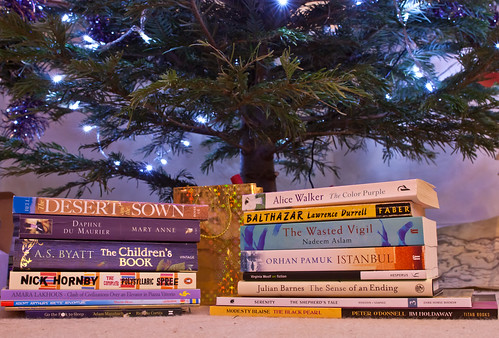
Book booty

December 26, 2011

Unwrapped

Kate Gardner Blog

Merry Christmas

December 24, 2011 2 Comments

ShinyCinnamony

GingeryPrezzies!

Kate Gardner Blog

Girls and guns and science

December 22, 2011 3 Comments

Echo: the Complete Edition
by Terry Moore

So I quite liked this graphic novel, then Tim said that the maths that the whole storyline is based around is complete rubbish and now I’m not sure if that makes a difference or not. I think I still like it.

It’s almost a superhero story, but not quite. Super-clever scientist lady invents a new element and makes herself a suit out of it, then gets blown up by her superiors while wearing it and the suit attaches itself to two unlucky bystanders. That’s the first couple of scenes. The rest of the story follows those two bystanders as they discover what the suit can do and have very different reactions to it. And both get chased by various government agencies and scientists who want their tech back.

This is one of those beautifully drawn graphic novels that includes a lot of panes with no words, so despite this being a huge tome (this was previously published as six trade paperbacks) I tore through it in one day. I probably didn’t pay enough attention to the detail.

The main character is Julie, one of those two bystanders in the desert. She is an artist struggling to pay her bills and resisting signing the divorce papers that her husband has sent. There’s a large supporting cast, but foremost among them are Dillon, who was the boyfriend of the dead scientist lady, and Ivy, a kickass agent for a mysterious organisation. The first time we meet Ivy she is picking flowers with her daughter. In the next scene she is flying a plane on her own and puts it into autopilot while she changes her clothes. Awesome.

The maths/science stuff is complete rubbish and I did get a bit annoyed by it, even before discussing it with Tim. And there’s also a religious storyline that I found a bit questionable, to say the least. But the main characters and their lives on the run are engaging, funny, upsetting, sad and touching in all the right places. A main character appearing to be offended by the suggestion she might be gay is made up for by there being other characters who just happen to gay, without it being a thing.

Throughout the book there are quotes from writers and scientists about man and science, especially the destructive nature of man. Really it’s quite a negative view of science. There are plenty of scientists in the book who are trying to do good, but the suggestion is that it’s futile, that there will always be someone who wants to do something terrible with any new scientific discovery and that someone will always get their way. I prefer not to be that pessimistic.

There’s also a lot of excuses come up with for drawing women wearing very little. In fact, flicking through the gallery of cover art at the end of this collected edition, the majority of them concentrate on Julie and her large chest.

But dodgy science and fan service aside, I really did enjoy this read. I was interested in and cared about the characters, even some we only meet very briefly, and the bikers were very cool. But not as cool as Ivy.

Published 2011 by Robyn Moore.

Kate Gardner Reviews

More of the cold stuff

December 18, 2011December 24, 2011

Antarctica
by Kim Stanley Robinson

I seem to be on a bit of an Arctic/Antarctic bent – had you noticed? After the last two titles I read, Tim suggested this as an appropriate follow-on and it did indeed fit in well. A lot of the history of Antarctica, especially the famous great expeditions of Scott, Shackleton and Amundsen, is recounted here amidst the near-future politics and sometimes scary tale of global warming and eco-terrorism.

Robinson is good at this sort of ensemble cast, giving voice to several characters to give a real overview to a situation without it being obvious that’s what’s going on. Each perspective is distinct and interesting, which I think shows in that each time it switched I was briefly disappointed to be leaving a story thread but then within a page I’d be completely caught up in the next thread.

Despite all the talk about Antarctica being the continent of science, and the scientists therefore at the top in terms of social status, they are the one group we don’t really get to know. Instead Robinson gives voice to the “other people”, a lot of whom (if not all of whom) support the science.

X is a general field assistant, essentially a dogsbody doing whatever work is assigned to him. He is very aware that he is at the bottom of the social strata and longs for change but loves Antarctica too much to leave. He used to date Val, in fact they had a bit of an ugly break-up, which is colouring his world view somewhat and she wishes he would get over it.

Val is a guide, a strong, athletic, experienced outdoors type who leads expeditions “in the footsteps of…”. She is uber-fit and uber-capable and sometimes struggles to hide her impatience with those less fit and capable. She is also fed up with the male attention she gets being a young, attractive woman on a continent with three men to every woman.

Wade Norton is an adviser to Senator Phil Chase (both of whom pop back up in Robinson’s “Science in the Capital” trilogy), and is sent down to Antarctica to investigate rumours of eco-terrorism and the effects of the breakdown of the Antarctic Treaty. The pair have humorous phone conversations that belie the complex politics they are discussing.

There’s also Ta Shu, the initially silly-seeming Chinese poet and Feng Shui expert, whose calm, steady positivity is infectious; and a mysterious eco-warrior who can no longer stand idly by as the global warming situation gets worse and worse, with sea levels rising and extreme weather events frighteningly frequent.

The story fluctuates from positive to negative, from calm to stormy. The icy continent is both a place of unparalleled beauty and of incomparable danger. Extreme tourists who have climbed Everest and the Matterhorn are challenged to the point of misery. Global warming has accelerated alarmingly and at the same time the world population has exploded and first-world governments have all but abandoned attempts to mitigate their emissions. But there are still people trying to do good, seeing the beauty of the world.

This was an exciting, moving read but I did skim some of the hard science bits (there’s a geophysics controversy that is an accurate portrayal of how science works but I must admit I found it dull) and I did get frustrated at the US bias. The two biggest research stations in Antarctica – McMurdo, or “Mac-Town” and the Amundsen–Scott South Pole Station – are indeed both American, run by the NSF, so maybe it’s understandable, but I did feel that the presence of and research carried out by other countries and other organisations was ignored somewhat. Robinson does, though, make a point of showing the vast range of nationalities working on or visiting the continent. He took part in the US Antarctic Program’s Artists and Writers Program, so he did draw on real experience.

He also, perhaps surprisingly for science fiction, shows some of the negative sides of “doing science” – the resentment and antagonism from the unseen support crew, the tendency to have such single-minded focus that the rest of the world doesn’t get noticed, the painfully slow process of peer review and publication. However, the individual scientists that we meet are great people, doing great work.

Somehow this novel is both pessimistic and hopeful, which is artful indeed. And it has made me want to re-read the Science in the Capital series. So much for making a dent in the TBR.

First published in Great Britain in 1997 by HarperCollins.

Kate Gardner Reviews

When men were men

December 14, 2011 3 Comments

Escape from the Antarctic
by Ernest Shackleton

I bow down in awe to this man. Seriously. Ernest Shackleton was a proper, honest-to-goodness hero, and a pretty good writer to boot.

This is a Penguin Great Journeys excerpt from Shackleton’s book South: The “Endurance” Expedition, which of course I now want to read in full, but I think Penguin’s editors did a good job choosing the key section of the story. As the brief introduction explains, the Imperial Trans Antarctic Expedition set out in 1914, led by Ernest Shackleton. His ship, the Endurance was crushed by ice and the crew found themselves marooned on Elephant Island in winter. With no means of contacting the outside world, Shackleton decided that the only solution was to adapt a 20-foot sailing boat as best they could and, with just six men (including himself) cross the 800 miles of stormy, icy ocean to the island of South Georgia, where there was a Norwegian whaling station.

Shackleton’s tone is matter-of-fact but the facts are incredible. Throughout hardship after hardship he is spurred by the knowledge that the lives of the 22 men left behind on Elephant Island depend entirely on his voyage succeeding. He is practical about the condition of each man but his style of leadership won me over from the start. On Elephant Island the expedition cook is taken ill so Shackleton selects one of the men particularly suffering from depression and despair at the state they are in to take the cook’s place, knowing that having plenty to do and a schedule to follow will help the man keep going.

This is not a journal or log-style account but a book written later expanding on notes taken during the voyage, so there is some room for prose that really gets to the heart what it felt like to be on that journey:

“We were a tiny speck in the vast vista of the sea – the ocean that is open to all and merciful to none, that threatens even when it seems to yield, and that is pitiless always to weakness. For a moment the consciousness of the forces arrayed against us would be almost overwhelming. Then hope and confidence would rise again as our boat rose to a wave…”

But it’s not the occasional foray into descriptive prose so much as the bare facts that make this book outstanding. Everyone should read it, and then fret about how totally useless they are by comparison.

South: The “Endurance” Expedition first published 1919.
This extract published in Penguin Books in 2007.

Kate Gardner Reviews

Posts pagination

1 … 103 104 105 … 126

Archives

RSS feed: Nose in a book Nose in a book

  • Non-Fiction November 2026
  • Book review: The House of Doors by Tan Twan Eng
  • Book review: Taiwan Travelogue by Yáng Shuāng-zǐ

Me on the internets

  • @kate_in_a_book@mas.to (Mastodon)
  • Flickr/noseinabook
  • Instagram/kate_in_a_book
  • StoryGraph/kate_in_a_book

Categories

  • Blog
  • Reviews
  • Uncategorized
  • © Copyright Kate Gardner. All rights reserved.
Proudly powered by WordPress | Theme: Dream by vsFish.