Nose in a book

Reviews and other ramblings

  • Home
  • Reviews archive
    • Book reviews
    • TV reviews
    • Theatre reviews
  • TBR
  • Challenges
    • The Classics Club
    • 2014 Popular-Science Reading Challenge
    • Cookery challenge
    • The Gilmore Girls Reading Challenge
    • 2013 TBR Pile Challenge
    • 2013 Translation Challenge
    • Crime and Punishment read-a-long
  • About
    • Cookie legal stuff

Author: Kate Gardner

I live in Bristol and I like to read books and share what I thought about them here. I read mostly general or literary fiction, with pretty much every genre making an appearance from time to time. I love to receive comments, whether you've read the same books or not!

All these books that I have

May 7, 2012 6 Comments

I don’t usually do incoming books posts because most weeks it would be a bit dull. I have been trying for a long while now to buy fewer books than I read, in the vain hope that my TBR will start to look a bit more manageable. However, these past few weeks I seem to have new (to me) books coming out of my ears. Which is nice.

Foyles haul

First I went to the lovely Foyles and bought two collections of essays by various authors – The Library Book and Stop What You’re Doing and Read This! – both of which I think I had heard about on Savidge Reads.
ARCs

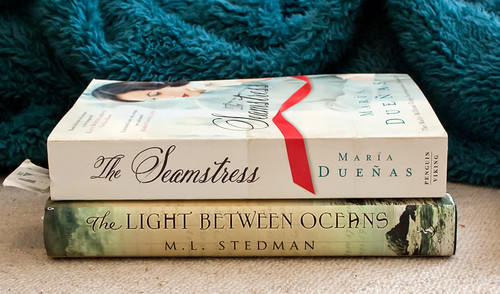
Next up I was sent a couple of books for review by publishers – The Light Between Oceans by M L Stedman (which I reviewed here) and The Seamstress by María Dueñas (which I have just finished reading and am mulling over before I post my review…watch this space!).
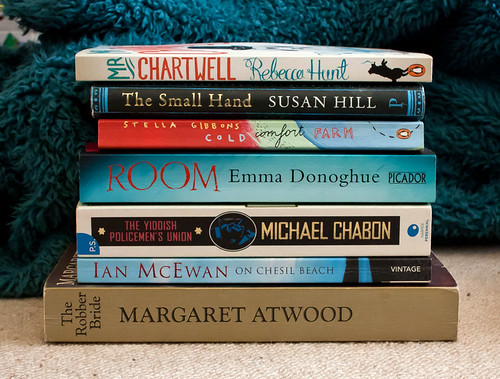
North Greenwich haul

Then this weekend we visited friends in London who on Saturday took us to North Greenwich for brunch and bookshopping. They know me so well! Between West End Lane Books and a long row of charity shops I picked up:
Mr Chartwell by Rebecca Hunt
The Small Hand by Susan Hill
Cold Comfort Farm by Stella Gibbons
Room by Emma Donoghue
The Yiddish Policemen’s Union by Michael Chabon
On Chesil Beach by Ian McEwan
The Robber Bride by Margaret Atwood
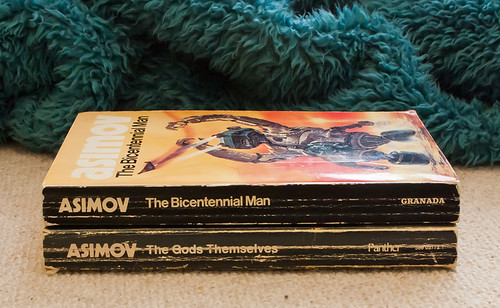
Borrowings

And finally, because the TBR wasn’t groaning enough already, I borrowed some books from the friends we stayed with! But I had good reason. When Tim and I recently watched I, Robot he decided that I was sorely lacking in background knowledge of Asimov so he asked Twitter for recommendations of where to start educating me. Handily, the response was books that Tim doesn’t actually own but I now have on loan The Bicentennial Man and The Gods Themselves.

Now what order to tackle this little lot in?

Kate Gardner Blog

I do not see him in the mirror but feel him

May 1, 2012May 1, 2012

Anatomy of a Disappearance
by Hisham Matar

This short, quick read effectively covers a devastating subject: the loss of a parent. And somehow it manages to be about everything else as well: love, family, identity, growing up and lust.

It is this last that the book might seem to be centred around. The story is narrated by Nuri who is 14 when his father mysteriously disappears, never to be found. Born in Paris, raised in Cairo, Nuri’s family are outsiders, Arabs, from an unnamed other country suffering military dictatorship. Nuri’s father was a government adviser to their king so they are now effectively in exile. After the death of Nuri’s mother when he is 10, the father and son struggle to communicate until one summer they meet Mona, a half-British half-Egyptian beauty aged exactly between them. Father and son both fall in lust but of course it is the father she responds to and marries while 12-year-old Nuri is in torment.

Nuri, like most teenage boys, struggles desperately with his lustful feelings, which are complicated by Mona’s flirtatious behaviour with him and then, later, his father’s absence. Though there are so many other things going on in his life that he could fixate on (boarding school in England; his so-called mother country; his struggle to make friends), in this narrative at least it is Mona who takes centre stage for most of the story. It is only when he gets older that he straightens out his priorities and makes an attempt to look for his father and make a life for himself.

The story is simply told, with what might believably be a young man’s voice recalling his childhood and teenage years and their raw pain. Though the setting moves all over the world, nowhere is strongly evoked except his own mind. While it was beautifully, sparsely done, I couldn’t help but wish for something that had gone deeper. Perhaps follow the adult searches a little and the politics that that might dredge up. But that would be a very different book.

My only other difficulty with this book was that Nuri’s family is so extremely well off, that outside his family, life is made very easy for him. We never see him get a job or struggle for something to do in holidays from his boarding school when he does not feel comfortable staying with Mona. I know this might be petty but I might have sympathised a little more if he was scraping together the funds to go to Switzerland to search for his father.

Not naming the “mother country” is, I would guess, an attempt to distance the fictional story from the author’s true life experience. Matar’s family fled their native Libya to Egypt following political persecution and when he was 20 his father was kidnapped. For many years Matar did not know whether his father was alive or dead. All that must, of course, have informed his writing but in Nuri he has created a believable separate character from himself.

I think I would say I was not as bowled over by this as by Matar’s debut novel In the Country of Men but I would still rank him as an excellent writer to keep an eye on.

First published 2011 by Viking.

Kate Gardner Reviews

The Sunday Salon: I ♥ coffee

April 29, 2012April 29, 2012 5 Comments

The Sunday Salon

I love coffee. I mean: that smell, that taste, that buzz, even the appearance of it steaming away in a cup. And the effort that a good barista puts into getting it just right – it’s a joyous thing. Did I mention I love coffee?

Until this week I had not drunk coffee for about six weeks, since I had a flare-up of irritable bowel syndrome. Having to eat and drink more cautiously for a while is fine (in fact, when my lupus flared in the meantime it was quite helpful – when thinking through brain fog, fewer choices = good) but damn I missed coffee!

I agree

So this week, feeling miles better, I treated myself. I have also read some good books, including The Light Between Oceans and the first few volumes of Y the Last Man by Brian K Vaughan and Pia Guerra. Life is good.

Kate Gardner Blog

The silence that anaesthetises shame

April 26, 2012 4 Comments

The Light Between Oceans
by M L Stedman

This is a beautifully written account of people facing terrible circumstances and decisions. It didn’t move me the way I thought it would (or should) but it got me thinking about love, in all its forms. I can see why this debut novel has already attracted a lot of interest.

The story is set in Western Australia in the 1920s, primarily on a tiny island far off the coast occupied only by the lighthouse keeper and his family. After serving in World War I, Tom is looking for a quiet, useful life when he signs up to “the lights”. He expects to live out his days alone and has accepted that when, on shore leave in the small town of Partageuse, he meets Isabel. She is young, sparkling, headstrong and quick to fall in love.

Izzy has to persuade Tom that she can deal with the life on the island. Shore leave is every three years, with the only other contact with people being a quarterly supply boat. In emergencies a signal can be sent out but otherwise they are quite alone with the lighthouse, cottage, vegetable patch, chickens and goats, at the forefront of every weather front and surrounded by the tempestuous meeting point of two oceans. It is a tough life but Izzy seems up to the task.

The novel begins with the pivotal event before going back to fill in all these details. One day a boat washes up on the island containing a dead body and a crying baby. Izzy has just lost her third child in stillbirth and is out of her mind with grief. The baby appears like a gift from God. But they can’t possibly keep it and not report it, can they?

The story explores grief, truth, lies and choices, sometimes slightly too obviously but at other times very effectively: “History is that which is agreed upon by mutual consent. That’s how life goes on – protected by the silence that anaesthetises shame.”

It’s a hugely emotional story quietly told. I actually thought it was written by a man until I read Stedman’s bio because it is largely viewed from Tom’s perspective. He is stoic, dependable and brave – essentially a good man – where Izzy is impetuous, subject to mood swings and bears grudges. Perhaps this perspective prevented the story from becoming melodramatic or schmaltzy, which is some achievement considering the subject matter, but it also distanced me enough from events that I was not moved by things that I think should have moved me. I should have cried reading this story, or at least come close, but I did not. In fact at times I found it too slow, though it picked up a lot in the third act.

The characters are very well created and I was eager to know what would happen to them. I liked how Tom turned to his duty, becoming more efficient, more clean and tidy, when life got hard. But the best part was the setting. The descriptions of the sea and the weather are stunning: “There are times when the ocean is not the ocean – not blue, not even water, but some violent explosion of energy and danger”. Beautiful.

This book was sent to me by the publisher in return for an honest review.

Published 26 April 2012 by Doubleday, an imprint of Transworld Books.

Kate Gardner Reviews

Hunting for metaphors which might convey something

April 24, 2012June 17, 2012 2 Comments

The Alexandria Quartet
Book 4: Clea
by Lawrence Durrell

And so at last I have finished the quartet. Was it a fitting end, full of vagueness and mystery? Did the poetic unreliable narrator return, both as a narrator and to Alexandria itself?

The Alexandria Quartet

Well, the answer to question two (both parts) is yes but to question one…I’d hazard no. The series began, in Justine, with a lot of vagueness, events in uncertain order and a lot was left unsaid. As the Quartet proceeded, the narrative got clearer and clearer until this book, even though it is once again narrated by Darley, who was previously so unreliable, was perfectly straightforward and linear. I mean, there were memories and extracts from old letters, but they were clearly signposted as such. To be honest I found this disappointing, though it was good to get closure on all the characters and storylines at last.

Which is not to say that the writing in this book is less good than it has been previously. In fact, I have bookmarked more quotable passages than ever. But as a story it didn’t grip me. Which is odd because there was a lot going on in this book. Darley has been called back to Alexandria from his Greek island to return the child he has been looking after to her true father. World War II has finally got under way and Alexandria has not escaped unscathed. Mountolive (the British Ambassador to Egypt) finds Darley a job in the censorship department of the War Office, which is a perfect statement on his narrative. No mention is made of Darley ever having been expected to fight, despite his being a British citizen of, I assumed, good health and young age, but I don’t know what the situation was for ex-pats.

And so, until the end of the war and a short time afterward, Darley catches up with the lives of his old friends, makes sure the girl settles in with her new parents and discovers more details about his previous stay in Alexandria that once again force him to re-evaluate the truth. Clea is, as ever, everyone’s friend and confidante, and a cheery one at that, so through her we hear the little anecdotes that people really do tell about their friends, particularly those who have died. She is a good influence on Darley, encouraging him to not just face the truth but actively seek it. When one friend asks Darley how his writing is going, he replies:

“It has stopped…I somehow can’t match the truth to the illusions which are necessary to art without the gap showing…”

The picture of a city at war is hauntingly real. A lot of the time, Alexandria is on the outskirts of the war, the place where soldiers come on leave from the desert frontlines, but it is for a short time bombarded and the harbour is full of warships rather than pleasure boats.

“How had things changed? It was not danger, then, but a less easily analysable quality which made the notion of war distinctive; a sensation of some change in the specific gravity of things. It was as if the oxygen content of the air we breathed were being steadily, invisibly reduced day by day…”

One thing I found a little strange was that one longish chapter takes the form of an essay written by (Darley’s former flatmate) Pursewarden years earlier after a series of conversations with Darley about literature. It is eloquent and interesting and so, so quotable (“Words being what they are, people being what they are, perhaps it would be better always to say the opposite of what one means”) but it perhaps went on a little long and broke up the story more than necessary for its purpose: making Darley realise he had misjudged Pursewarden.

Despite the apparent changes in Darley, perhaps he is still unreliable, because he still manages to fool himself and he repeatedly declares that he is done with writing yet he narrates as if he is writing it down:

“I am hunting for metaphors which might convey something of the piercing happiness too seldom granted to those who love; but words, which were first invented against despair, are too crude to mirror the properties of something so profoundly at peace with itself…”

And lest all the revelations and clarifications of this book fool us into thinking we are here learning the absolute final truth about these characters, we have this pearl from the wise old doctor Balthazar:

“When one casts around the fields of so-called knowledge which we have partially opened up one is conscious that there may well be whole areas of darkness which may belong to the Paracelsian regions—the submerged part of the iceberg of knowledge.”

So on the whole it was a fitting end to the Quartet. It made me laugh, it made me sad. It has a surprisingly modern attitude to sex, love and homosexuality (though the characters do not necessarily have modern attitudes) and I can now go and have a look at the last discussion of the Guardian Reading Group without having the story spoiled for me!

First published 1960 by Faber & Faber.

N.B. It’s too late now to join in the Guardian Reading Group discussion about this book but you can still listen to the Guardian Books podcast about Lawrence Durrell at 100. It discusses and quotes heavily from The Alexandria Quartet and is well worth checking out.

See also: my reviews of
Book 1: Justine
Book 2: Balthazar
Book 3: Mountolive

Kate Gardner Reviews

The Sunday Salon: Lupus sucks

April 22, 2012 9 Comments

The Sunday Salon

So last weekend‘s feeling a bit bleh turned into a lupus flare and I have lost half my week to the black hole of SLE. Which sucks.

I’m afraid I’m going to vent a little bit about being ill now. It is not my most interesting topic. In many ways I should be grateful that my major lupus symptoms – fatigue and brain fog, with added dizziness and double vision if I push myself – are not painful. Even my lupus symptoms that do hurt – headaches and joint pains – are quite low-level pain. My specialist called them “irritants” once, which is probably accurate but also a little demeaning. Because pain or not, lupus can (and does) still incapacitate me. When it flares I can’t think, I can’t make the most basic decisions like what to eat, in fact I get panicky if faced by a choice. I can’t hold a conversation. I certainly can’t read a book. Standing up long enough to shower completely drains me.

It passes. I am lucky that I only get really bad for a few days at a time now, thanks to medication and fatigue-management techniques. I am lucky that Tim knows me well enough to spot the danger signs and make me rest (if I can be persuaded). But it never goes away. I am always tired. I am always one push-too-hard away from being “lupus tired”.

Rant over.

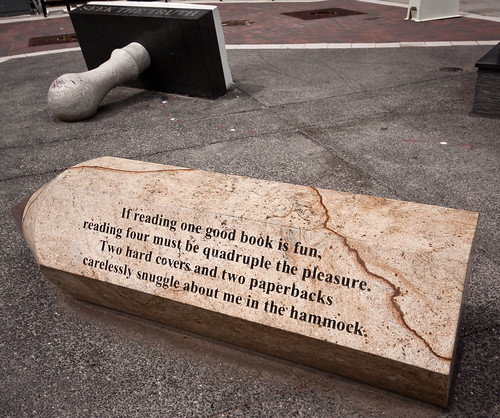
Seek the truth

While I have not read much this week, I do have a small backlog of book reviews so I was still able to post about Balthazar and Mountolive. Yesterday Tim took me to the cinema to see Cabin in the Woods (which I knew nearly nothing about beforehand and that was totally the best way to see it so I will say nothing other than “it’s great”) and to Foyles bookshop, because the TBR is always hungry. Today I will be mostly sleeping.

How was your week?

Kate Gardner Blog

Each man has his own interpretation

April 20, 2012June 17, 2012 4 Comments

The Alexandria Quartet
Book 3: Mountolive
by Lawrence Durrell

Well, I had an inclination that book three would get political and I was certainly proved right, but it also had some other big differences from the two books that precede it. I can’t decide whether I was thrown by this or drawn deeper in than ever.

The Alexandria Quartet

Where the first two books are narrated by an initially un-named first person and set entirely in Alexandria over an approximately two-year time period (plus the occasional jump forward to the time of writing, which seems to be only shortly later), Mountolive is a more traditional third-person narrative, following the titular David Mountolive from his youthful first visit to Egypt, through his illustrious (and well travelled) career with the British Diplomatic Service until he is finally posted back to Egypt as British Ambassador, the position in which he had occasionally popped up in Balthazar.

This takes up the first 100 pages or so, about a third of the novel, but it is essential background to understanding the man and his actions. Despite his limited appearances previously, Mountolive is key to the story we have already heard twice. In true Durrell style we learn of goings-on that were hinted at but never revealed in Justine or Balthazar and all the old characters are intricately tied up in machinations that are at times surprising, at times make complete sense of what before had been blurry.

In some ways this reads like a detective novel, with Mountolive the stoic investigator, a career man who was once passionate and romantic even, but is now middle aged and enjoying the power and status of his new job. The suspect is Nessim, the rich banker who has always seemed suspect and shadowy but now we learn what he is suspected of. And it is of course different things by different people. Indeed, is he even really deserving of suspicion or is he merely a puppet for some other player? Perhaps his wife, the beautiful and seductive Justine. Or his brother, the disfigured and hard-working Narouz. Or his mother, the strong and proud Leila.

Limiting the story (for the most part) to these two men, and switching to the third person, makes this in some ways a more straightforward read than the previous two books. Which is helpful when you are called upon to understand some complex political manoeuvrings. But there are moments when the narrative directly contradicts something previously learned and it becomes blurry again; which version is to be believed? Is this narration actually omniscient or is this narrator better at hiding?

Balthazar at one point says, “Truth naked and unashamed. That’s a splendid phrase. But we always see her as she seems, never as she is. Each man has his own interpretation.”

The language is evocative as ever – “The desert was like a dry kiss, a flutter of eyelashes against the mind” – and even the psychological exploration has not disappeared, such as in this exchange:

“If only we did not have to keep acting a part, Justine.”
“Ah, Nessim! Then I should not know who I was.”

So, will Clea wrap everything up nicely or throw it all back into confusion? I can’t wait to find out.

First published 1958 by Faber and Faber.

See also: my reviews of
Book 1: Justine
Book 2: Balthazar
Book 4: Clea

Kate Gardner Reviews

To imagine is not necessarily to invent

April 16, 2012June 17, 2012 4 Comments

The Alexandria Quartet
Book 2: Balthazar
by Lawrence Durrell

Rather than continuing where the previous book, Justine left off, this is instead a revisit to the same time period by the same narrator after he has learned more information. Except it’s not even just that.

The Alexandria Quartet

The assertions and assumptions of the previous book are thoroughly shaken and the narrator proved without doubt unreliable by his own words and other people’s. Balthazar, the wise old doctor and leader of a Cabal in Alexandria, has read the narrator’s Justine manuscript and annotated it heavily, resulting in the document referred to as the Interlinear. He has included information he knew the narrator to be unaware of and remonstrations where he thinks the narrator has misrepresented a person or event. He knows that some of this, indeed much of it, will be painful for the narrator to learn of.

Despite the strange set-up, this novel is actually more straightforward than Justine, though I don’t know if it would make any sense without having read Justine shortly beforehand. The majority is made up of Balthazar’s lengthy annotations, with the narration linking or commenting on or reconstructing in-between. As before, time is not entirely linear, but events are a little more clear and a lot of hints are sown for the next book to come (I think politics and spywork may be coming slowly to the fore), as well as the occasional explanation of a puzzling detail in book one.

Because so much is in Balthazar’s voice, there is a little less musing on the beauty and life of the city, but that just makes the passages more noticeably beautiful when they come:

“The city, inhabited by these memories of mine…isolated on a slate promontory over the sea, backed only by the moonstone mirror of Mareotis, the salt lake, and its further forevers of ragged desert (now dusted softly by the spring winds into satin dunes, patternless and beautiful as cloudscapes)…”

What there is more of is confusion between the story itself and the books and manuscripts written by various characters. By this point there are, I think, four fictional authors?

Balthazar writes, “To imagine is not necessarily to invent, nor dares one make a claim for omniscience in interpreting people’s actions. One assumes they have grown out of their feelings as leaves grow out of a branch. But can one work backwards, deducing one from the other? Perhaps a writer could if he were sufficiently brave to cement these apparent gaps in our understanding with interpretations of his own…” And later, “Truth is not what is uttered in full consciousness. It is always what ‘just slips out’…”

Our narrator gets a couple of nicknames in this volume including the heavily sarcastic-sounding “Wise One”, surely an ironic comment on his inability to see the truth. Or is that the problem at all? Does he in fact understand exactly what is going on and just exclude certain details from his account? At this point I think either could be true. Possibly a bit of each.

At the end of Justine I was a little uncertain about how this story could continue for three more books, whereas now I already see plenty to fill two more books, let alone any new plot threads that might emerge. I guess this may mean it gets a bit more action-based and less cerebral. World War II does seem to be creeping closer (“rumblings in Europe” are mentioned periodically) and our narrator is a young male British citizen. I look forward to seeing whether any of my guesswork is proved right.

First published 1958 by Faber & Faber.

See also: my reviews of
Book 1: Justine
Book 3: Mountolive
Book 4: Clea

Kate Gardner Reviews

The Sunday Salon: All systems go

April 15, 2012 10 Comments

The Sunday Salon

After last weekend‘s perfect mix of activity and downtime, it feels like life has switched up a gear. Evenings and weekends are full of plans, with many more things needing to be slotted in – when will I find time to read?

One thing I did this week was finally get my latest film processed. I took most of it on our holiday in Wales and I’m pleased with how some of the shots came out, though the scans don’t do them justice. We must find a way to display more photos in our house!

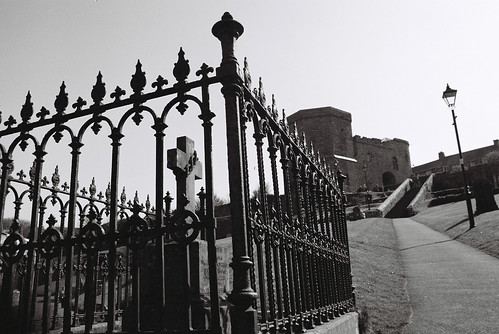
Look up

I haven’t been feeling 100% (it happens) so I have been tempted on getting home from work to just stare at the TV rather than read. Which makes sense when my brain is frazzled but the rest of the time I think reading actually makes me feel a lot better than even my favourite TV shows could. What about you – do you read when you feel unwell?

I also went to the zoo with Tim and a couple of friends. We go to the zoo a lot and always have a good time. Bristol Zoo is very good about breeding and conservation programmes and doesn’t have many large animals so I don’t feel animal lover guilt and can just enjoy the cute animals.

Baby turtles

Kate Gardner Blog

A medium as unstable as words

April 12, 2012June 17, 2012 7 Comments

The Alexandria Quartet
Book 1: Justine
by Lawrence Durrell

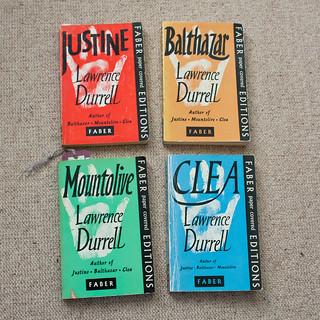
I had sort-of vaguely heard of the Quartet and then a couple of years ago I stumbled across these beautiful old Faber editions in Bristol’s excellent Beware of the Leopard book shop.

The Alexandria Quartet

Except they only had two of the four books. By chance, a few weeks later I found a matching third in another secondhand book shop. But no sign of a fourth. Cut forward almost two years to Tim buying me the the fourth book from Abe Books and I could finally start reading! By coincidence, 2012 would have been the year Durrell turned 100 years old so the Guardian Reading Group chose The Alexandria Quartet as its book for March (these days it is published as a single chunky volume), and through that I was able to garner some insights from people much cleverer than me as I went along.

Which helped. Because this is not a straightforward book. It is a pensive, thoughtful musing upon events an unknown time ago, in an unclear order, narrated by an unnamed narrator. The language is beautiful, evocative, poetic even. The true main character is the Egyptian city of Alexandria, at a guess in the 1930s, and Durrell lovingly brings to life the streets and waterways of this exotic mishmash of cultures. The people of the book are the city’s rich and educated few, so they come from all over the world and various walks of life.

The narration is jumbled throughout, but particularly so at the start. For several pages it skips from thought to thought, without explanation. Various names are mentioned but no-one properly introduced. Early on the narrator quotes the line “It is idle to go over all this in a medium as unstable as words” and later says “(I am inventing only the words.)”

And it continues like this, but with some of those thoughts being a memory, so that details are slowly filled in. Very slowly. It took me most of the book to figure out what its story is, and even then I feel a real pull to get started on the next book in the quartet to clarify some of the many details left partly obscured.

To give some idea of the story, the narrator was in a relationship with Melissa, an exotic dancer in a nightclub with frail health, but fell for Justine, the great Alexandrian socialite whose reputation for beauty and sexual intrigue goes before her, and who is married to the rich, powerful banker Nessim. The narrator and Justine embark on an affair, despite the narrator claiming to love Melissa absolutely and to be afraid of Nessim. From the start it is clear that things did not end well and the narration gradually gathers momentum as it builds towards the conclusion of this part of the story.

But the point isn’t the story. The point is the exquisite language. On the Guardian threads there was talk of the whole thing being more about psychoanalysis than characters in a story and perhaps if you know more than me about psychoanalysis that may be the case, but I loved all the characters and, unusually for me, was not bothered by the slowness of the emerging story. I was entranced by the words.

“Far-off events, transformed by memory, acquire a burnished brilliance because they are seen in isolation, divorced from the details of before and after, the fibres and wrappings of time. The actors, too, suffer a transformation; they sink slowly deeper and deeper into the ocean of memory like weighted bodies, finding at every level a new assessment, a new evaluation in the human heart.”

The narrator pulls his tale together from a number of sources, including his own journals, a novel written before he arrived in Alexandria about many of his friends there, and three of Justine’s diaries, which he has been given. He frequently quotes from these, even substituting names in the novel with those of his friends. So he is undoubtedly unreliable, and I am sure the subsequent books will contain multiple about-turns that will force me to re-evaluate what I have learned, or think I have learned, so far. I can’t wait.

First published 1957 by Faber & Faber.

See also: my reviews of
Book 2: Balthazar
Book 3: Mountolive
Book 4: Clea

Kate Gardner Reviews

Posts pagination

1 … 99 100 101 … 126

Archives

RSS feed: Nose in a book Nose in a book

  • Non-Fiction November 2026
  • Book review: The House of Doors by Tan Twan Eng
  • Book review: Taiwan Travelogue by Yáng Shuāng-zǐ

Me on the internets

  • @kate_in_a_book@mas.to (Mastodon)
  • Flickr/noseinabook
  • Instagram/kate_in_a_book
  • StoryGraph/kate_in_a_book

Categories

  • Blog
  • Reviews
  • Uncategorized
  • © Copyright Kate Gardner. All rights reserved.
Proudly powered by WordPress | Theme: Dream by vsFish.