Book review: Strangers on a Train by Patricia Highsmith
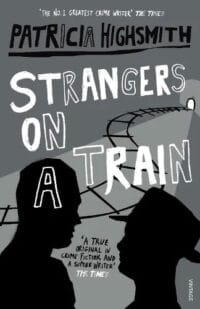 I’m a big fan of the Hitchcock film Strangers on a Train, which is based on a novel by Patricia Highsmith. And I have loved the other Highsmith books I’ve read. So this should have been my ideal read. But I must admit something about this book didn’t gel for me.
Perhaps it’s that the plot is quite different from the film, which I have watched many times. I certainly can’t fault Highsmith’s complex characters or chillingly believable depiction of criminal psychology.
The concept is simple. Two men meet on a train, each wishing (to greater or lesser extent) someone dead. Bruno suggests they swap murders – he will murder Guy’s estranged wife Miriam who won’t give him a divorce, while Guy can murder Bruno’s father who won’t pay him his trust fund. There would be nothing to link them to their crimes and they could time it so the obvious culprit is out of town. Guy laughs off the suggestion but two weeks later Miriam is murdered.
“Bruno slammed his palms together. ‘Hey! Cheeses, what an idea! We murder for each other, see? I kill your wife and you kill my father! We met on the train, see, and nobody knows we know each other! Perfect alibis! Catch?’ …
Bruno’s tobacco-stained hands jumped and trembled on his knees. ‘Air-tight alibis!’ he shrieked. ‘It’s the idea of my life. Don’t you get it? I could do it some time when you’re out of town and you could do it when I was out of town.’
Guy understood. No-one could ever, possibly, find out.”
This is really just the beginning of the nightmare for Guy. For months he wonders whether Bruno was the culprit or if it’s a horrible coincidence. (We don’t have to wonder, as Highsmith describes the murder from Bruno’s perspective, in excruciating detail.) But Bruno can’t quite manage to remain a stranger, inveigling himself into Guy’s life and eventually it’s clear he did it. Somehow, Bruno manages to make Guy think he shares the guilt. And that he owes Bruno a murder.
I think that was the sticking point for me. The idea of a man joking with a stranger about wishing his wife dead, and then that stranger committing the murder – that’s clever and creepy. But for Guy not to report that conversation when Miriam is found dead is weird. And to not go to the police after Bruno confesses, but instead go along with Bruno’s lies, is bizarre.
On the whole, I found Guy in the book far less sympathetic than in the film. He’s meant to be an intelligent man – an architect who’s semi famous after winning a big contract. (I guess for the film they decided the idea of a famous architect was too old-fashioned/had been poisoned by Ayn Rand so they went with tennis star instead.) He has a good job, a solid relationship with his new fiance Anne, plus friends and family. So he has a lot to lose and Bruno makes use of this, choosing just the right fears to prey on.
Bruno is not sympathetic and I don’t think he’s meant to be. This is not a Tom Ripley charmer, though Bruno is striving for something like that. He wants friends but doesn’t know how to make them. His sense of justice and the “right thing” is clearly different from other people’s. The pleasure he takes in killing Miriam is all based on his perception of how happy it will make Guy. When Guy doesn’t express gratitude or pleasure, Bruno is angry but also doesn’t believe Guy is being honest.
The tension in this novel is two-fold – will Bruno be caught, and will he drive Guy to commit murder? The latter is the more interesting psychologically, and this is clearly what Highsmith thought too. The police investigation is in the background for most of the book.
It really is very well written, immensely creepy and chillingly believable. I guess I just missed Hitchcock’s version of Guy – a slightly stupider but far more likeable character.
First published 1950 by the Cresset Press.
Source: Christmas present from family.
One Comments
Comments are closed.