Nose in a book

Reviews and other ramblings

  • Home
  • Reviews archive
    • Book reviews
    • TV reviews
    • Theatre reviews
  • TBR
  • Challenges
    • The Classics Club
    • 2014 Popular-Science Reading Challenge
    • Cookery challenge
    • The Gilmore Girls Reading Challenge
    • 2013 TBR Pile Challenge
    • 2013 Translation Challenge
    • Crime and Punishment read-a-long
  • About
    • Cookie legal stuff
  • Home
  • Reviews archive
    • Book reviews
    • TV reviews
    • Theatre reviews
  • TBR
  • Challenges
    • The Classics Club
    • 2014 Popular-Science Reading Challenge
    • Cookery challenge
    • The Gilmore Girls Reading Challenge
    • 2013 TBR Pile Challenge
    • 2013 Translation Challenge
    • Crime and Punishment read-a-long
  • About
    • Cookie legal stuff

Tag: politics

Memories that approached, invading my body

May 8, 2012 4 Comments

The Seamstress
by María Dueñas
translated by Daniel Hahn

This novel (which is titled The Time In Between in some countries) is one of those where a lot happens later in the book and I am torn about how much to reveal. I don’t think the story hinges on these plot points, but I have a general policy to not give away plot details. So I’ll do my best but…

I think the key to my impression of this book was hidden away in the author’s note at the end. I can see why it was saved until after all of the story has been revealed, but it made me see everything in a different light and half makes me want to re-read the book with the new knowledge that I have. What Dueñas has done is to take a historical story that she wanted to tell, with huge real events and important real people, but shown through the prism of a fictional minor character.

That character is Sira, born in Madrid to a single mother who works hard as a seamstress. Sira is all set to follow in her mother’s footsteps, or perhaps learn to type and become a lowly civil servant, when a man storms into her life and changes everything.

The story is set in the 1930s and 1940s, through the Spanish Civil War and the beginnings of World War II. In Spain, Morocco and Spain again, Sira’s fortunes rise and rise, but as she mixes with richer folk she learns about the politics of her country and is driven to do what she can to help it at this worst of times. She enjoys more than a little luck, with many a kind stranger giving her a helping hand along her way, but she is a likeable enough character. In fact, she is a very strong woman, single for most of the book and independently making her way.

Sira narrates the story in no-nonsense fashion, with few embellishments and few asides. What she describes is believably what would catch the eye of a dressmaker born to a poorer life than the one she later enjoys. She describes the poise and confidence of the rich, the cut and quality of clothes, the size and elegance of rooms or furnishings. Despite essentially following one career on a successful trajectory, Sira thinks of each new stage in her life as a reinvention, requiring changes to her personality as well as her back story. She makes a point of teaching herself how to act above her station – how to stand, how to speak, how to socialise.

At 600+ pages it’s quite a long book, and there were times in the middle when my attention strayed. It felt to me that the whole point of the book was the final section, in Madrid when Franco’s government is teetering towards full collaboration with the Nazis, and that all of the rest had been build-up. It certainly changes pace there, becoming a thriller with a poised, confident female heroine. But perhaps it wouldn’t have worked so well without the full knowledge of how Sira became that woman.

Another slight negative for me, and of course I don’t know if this is Dueñas or the translation, was that there were many times when what could have been a subtle point was overstated, sometimes clumsily even. But I should also say that in general I thought the translation was excellent, dealing very effectively with characters speaking multiple languages to one another.

This book has stayed with me in the days since finishing it and has definitely made me curious to learn more about the Spanish Civil War. And it’s made me want to go to Morocco, but I kinda already wanted to do that!

This book was sent to me by the publisher in return for an honest review.

Published May 2012 by Viking, an imprint of Penguin Books.
Kate Gardner Reviews

I do not see him in the mirror but feel him

May 1, 2012May 1, 2012

Anatomy of a Disappearance
by Hisham Matar

This short, quick read effectively covers a devastating subject: the loss of a parent. And somehow it manages to be about everything else as well: love, family, identity, growing up and lust.

It is this last that the book might seem to be centred around. The story is narrated by Nuri who is 14 when his father mysteriously disappears, never to be found. Born in Paris, raised in Cairo, Nuri’s family are outsiders, Arabs, from an unnamed other country suffering military dictatorship. Nuri’s father was a government adviser to their king so they are now effectively in exile. After the death of Nuri’s mother when he is 10, the father and son struggle to communicate until one summer they meet Mona, a half-British half-Egyptian beauty aged exactly between them. Father and son both fall in lust but of course it is the father she responds to and marries while 12-year-old Nuri is in torment.

Nuri, like most teenage boys, struggles desperately with his lustful feelings, which are complicated by Mona’s flirtatious behaviour with him and then, later, his father’s absence. Though there are so many other things going on in his life that he could fixate on (boarding school in England; his so-called mother country; his struggle to make friends), in this narrative at least it is Mona who takes centre stage for most of the story. It is only when he gets older that he straightens out his priorities and makes an attempt to look for his father and make a life for himself.

The story is simply told, with what might believably be a young man’s voice recalling his childhood and teenage years and their raw pain. Though the setting moves all over the world, nowhere is strongly evoked except his own mind. While it was beautifully, sparsely done, I couldn’t help but wish for something that had gone deeper. Perhaps follow the adult searches a little and the politics that that might dredge up. But that would be a very different book.

My only other difficulty with this book was that Nuri’s family is so extremely well off, that outside his family, life is made very easy for him. We never see him get a job or struggle for something to do in holidays from his boarding school when he does not feel comfortable staying with Mona. I know this might be petty but I might have sympathised a little more if he was scraping together the funds to go to Switzerland to search for his father.

Not naming the “mother country” is, I would guess, an attempt to distance the fictional story from the author’s true life experience. Matar’s family fled their native Libya to Egypt following political persecution and when he was 20 his father was kidnapped. For many years Matar did not know whether his father was alive or dead. All that must, of course, have informed his writing but in Nuri he has created a believable separate character from himself.

I think I would say I was not as bowled over by this as by Matar’s debut novel In the Country of Men but I would still rank him as an excellent writer to keep an eye on.

First published 2011 by Viking.

Kate Gardner Reviews

Each man has his own interpretation

April 20, 2012June 17, 2012 4 Comments

The Alexandria Quartet
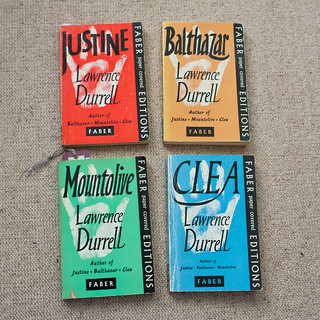
Book 3: Mountolive
by Lawrence Durrell

Well, I had an inclination that book three would get political and I was certainly proved right, but it also had some other big differences from the two books that precede it. I can’t decide whether I was thrown by this or drawn deeper in than ever.

The Alexandria Quartet

Where the first two books are narrated by an initially un-named first person and set entirely in Alexandria over an approximately two-year time period (plus the occasional jump forward to the time of writing, which seems to be only shortly later), Mountolive is a more traditional third-person narrative, following the titular David Mountolive from his youthful first visit to Egypt, through his illustrious (and well travelled) career with the British Diplomatic Service until he is finally posted back to Egypt as British Ambassador, the position in which he had occasionally popped up in Balthazar.

This takes up the first 100 pages or so, about a third of the novel, but it is essential background to understanding the man and his actions. Despite his limited appearances previously, Mountolive is key to the story we have already heard twice. In true Durrell style we learn of goings-on that were hinted at but never revealed in Justine or Balthazar and all the old characters are intricately tied up in machinations that are at times surprising, at times make complete sense of what before had been blurry.

In some ways this reads like a detective novel, with Mountolive the stoic investigator, a career man who was once passionate and romantic even, but is now middle aged and enjoying the power and status of his new job. The suspect is Nessim, the rich banker who has always seemed suspect and shadowy but now we learn what he is suspected of. And it is of course different things by different people. Indeed, is he even really deserving of suspicion or is he merely a puppet for some other player? Perhaps his wife, the beautiful and seductive Justine. Or his brother, the disfigured and hard-working Narouz. Or his mother, the strong and proud Leila.

Limiting the story (for the most part) to these two men, and switching to the third person, makes this in some ways a more straightforward read than the previous two books. Which is helpful when you are called upon to understand some complex political manoeuvrings. But there are moments when the narrative directly contradicts something previously learned and it becomes blurry again; which version is to be believed? Is this narration actually omniscient or is this narrator better at hiding?

Balthazar at one point says, “Truth naked and unashamed. That’s a splendid phrase. But we always see her as she seems, never as she is. Each man has his own interpretation.”

The language is evocative as ever – “The desert was like a dry kiss, a flutter of eyelashes against the mind” – and even the psychological exploration has not disappeared, such as in this exchange:

“If only we did not have to keep acting a part, Justine.”
“Ah, Nessim! Then I should not know who I was.”

So, will Clea wrap everything up nicely or throw it all back into confusion? I can’t wait to find out.

First published 1958 by Faber and Faber.

See also: my reviews of
Book 1: Justine
Book 2: Balthazar
Book 4: Clea

Kate Gardner Reviews

When real life gets terrifying

March 24, 2012March 21, 2012

Some Other Rainbow
by John McCarthy and Jill Morrell

When I was visiting my parents the other weekend, I spotted this on the bookshelves. I had been meaning to read it since my Mum bought it shortly after publication but somehow hadn’t got round to it. Since then I have become a fan of John McCarthy as the host of BBC Radio 4’s excellent programme Excess Baggage so I thought I would take a trip back to the events that made John a household name for a few years in my youth.

If you lived in Britain in the late 1980s/early 1990s you will know who John is but for everyone else, a quick summary. John went to Beirut in 1986 as part of his job as a TV news producer. He was supposed to work there for four weeks and then come home to his girlfriend Jill who he had left looking for a flat that they could buy together. Lebanon was in the midst of civil war at the time and westerners were being taken hostage but the situation had seemed to be getting better. Then, on the drive to the airport to fly home, John was kidnapped. He was held hostage for five years.

Though I lived through these events, I was quite young so a lot of the detail was either new to me or I had forgotten. It is an incredible story. The book is split so that John will narrate what happened to him over a certain time, then Jill will tell her story of that time. And while John’s story is inherently more interesting, some of the real shocks come from Jill’s side. It was not until his release that a political group claimed John as their hostage (Islamic Jihad, who actually released him as their envoy to the UN). There was no video or photograph of him sent home. In fact, for four years, until his fellow hostage Frank Reed was released, Jill had no way of knowing that he was alive.

There are so many details in this book that shook me hard. The hostages had to be blindfolded whenever the guards were within sight, which in some prisons meant all of the time. They were chained to the wall most of the time, with – if they were lucky – two trips a day to the bathroom. They were moved around a lot, staying in prisons anything from a few days to a year. And with each move they would not know who they would be with at the next location. Both guards and fellow prisoners would disappear and reappear.

John was fortunate not to be held alone after the first six weeks. For the majority of his captivity he shared a cell with Irish schoolteacher Brian Keenan. They formed a strong friendship and found ways to help each other cope. They also found innovative ways to communicate with prisoners in other rooms or cells (their prisons varied between houses, apartments, basements and purpose-built prisons). A moment that really got to me, after reading so much about John and Brian’s companionship, was when they heard knocking from the room next door and translated it as “My name is Terry Waite, I have been alone for over three years.”

Jill, in the meantime, had a lot of difficult decisions to make. She had to decide to what degree to get on with life, whether talking to the press (against Foreign Office advice) would help or hinder John (she had to weigh up the chance of John seeing her on TV or in the press, hopefully lifting his spirits, versus the risk of making him seem more valuable to his captors), whether to do her own investigations into the political situation (again, counter to FO advice). She made the decision, with many of John’s close friends, to campaign for his release. This was partly to keep him on the political agenda, so that deals would not be done with Middle Eastern countries without the hostages being mentioned. But it had the effect that, on his release, she was as much a celebrity as he was and there was a lot of press interest in their renewed relationship.

Both John and Jill had worked in journalism, though neither of them on the writing side, and that does show. Not that the book is at all badly written; rather that it is surprisingly conversational, open, honest but all grounded in the bare facts of what happened. Brian Keenan also wrote a book about his captivity, An Evil Cradling, which I read shortly after publication and found hauntingly beautiful. This is a very different take on the same events.

John is amazingly positive and cheerful, one of those people who is deeply affected by others’ troubles, so he takes great effort to learn how to help his fellow prisoners. He also reaches out to the guards and in some cases makes a connection, though it is never something that he can trust, as he can of course never forget that these men are keeping him like an animal, subject to occasional beatings and with his “belongings” (books, playing cards, dominoes, very occasionally a radio or television but they would usually be banned from listening to news) taken away on a whim. Jill is less cheery, but she makes up for this with incredible determination and brutal honesty about her darkest doubts.

A quick Google reveals that John later co-wrote a book with Brian Keenan, which I would very much like to read. But I also hope that I can go back to enjoying his Radio 4 show without picturing him locked in a dark concrete basement. It’s a horrid image and I have to contradict his statement that he is not a hero. He survived (and helped others to survive), he went on to live life, he is living proof of what the human spirit can endure if it must.

Published 1993 by Bantam Press.

Kate Gardner Reviews

Ranting is not writing

February 22, 2012

Why I Write
by George Orwell

I generally like Orwell’s writing in all its forms, but I must admit this essay collection was not, for me, up to his usual standard. It was all a bit too…ranty.

Three of the four essays here are primarily about politics. The fourth is a short piece about a hanging, which surprisingly was by far the best of the lot. It is clever and funny and touching, describing Orwell’s personal experience of observing a death by hanging in Burma. It is an official state execution and Orwell is acting as one of the legal observers. He describes their procession toward the scaffold and how a dog jumps out at them, excited and wanting to play, not understanding why these men try to shoo him away. He describes noticing the condemned man sidestepping a puddle and how that observation brought home to him how this was not a man who wanted to die. A very interesting and surprisingly not gruesome or depressing piece.

The other essays however, are all rants. By and large I agree with Orwell’s points but he is not nearly so entertaining a writer when he has a bee in his bonnet. Which is ironic considering that the last essay here is “Politics and the English language”, an out-and-out attack on political language and its downhill journey. He accuses writers of imprecision, vagueness and using unnecessary foreign words or metaphors in their prose. His recommendations for improving the standards of writing are all familiar. (In fact, this essay’s concluding six rules for good writing are quoted in more than one style guide I have worked with.) But the way he wraps this up with politics is actually a little vague itself.

He has certainly not followed his own advice in the longest essay in the collection. “The lion and the unicorn” is an 84-page meditation on Englishness, the ongoing Second World War and how socialism will answer all ills. Orwell repeats himself, makes grandiose unprovable statements and generally goes on a bit.

Which is a shame because even here Orwell’s writing is wonderful. There are so many quotable phrases I don’t know where to begin picking them out but I certainly annoyed Tim by reading to him randomly.

It is of course the opening essay, “Why I write”, that initially attracted me to this book. While it does diverge into politics more than you might expect from that title, it also provides great insight into Orwell as a person and includes the cracking line:

“Serious writers, I should say, are on the whole more vain and self-centred than journalists, though less interested in money.”

Essays originally published 1931–1946.
This edition published 2004 by Penguin Books in the Great Ideas series.

Kate Gardner Reviews

The danger of looking away

January 2, 2012

The Last King of Scotland
by Giles Foden

While I liked the film that was made of this novel, I wasn’t sure what more I would get out of the novel. I am glad that I was encouraged to read it because there is so much more here than I expected.

Dr Nicholas Garrigan is not the most likeable narrator, but somehow he keeps you reading. Young and lacking focus, he turns up in Uganda with no clear idea of the country’s politics or why he has chosen to practice medicine there. On his first day in the country, Idi Amin seizes power, his thugs roaming the streets, making the new situation clear. The British Embassy is quick to send Nicholas out of the capital to a remote village where a hospital is run by doctors from all over the world, their wages and equipment sourced from various aid agencies.

At this point Nicholas is just trying to be a doctor, though he can be naïve, or even thoughtless, and is hopeless with women. As the political situation worsens, and his co-workers worry about Amin’s policies, Nicholas determinedly stays out of it. Except that he insists on going to hear Amin speak and is caught up by the big man’s beguiling rhetoric. So when he gets the invitation to become Amin’s personal doctor he gladly accepts, much to the consternation of everyone at the village hospital.

Nicholas is drawn in by Amin’s magnetism and seems willing to overlook the frankly bonkers content of all his conversation. He is slightly afraid of Amin, but also fascinated, and continues to turn a blind eye to the increasing evidence for beatings, torture, death and disappearances at the hands of Amin’s men.

The blurb describes the book as a thriller and to some extent it does become that toward the end, but right from the start we know that Nicholas is narrating this from a few years later, in Scotland, from his own journals, so there is no tension as to whether he survives. But he does insinuate that it got pretty bad and berate himself for his stupidity and blindness.

It’s an interesting book and I felt that I learned a lot. I don’t know where Foden got the idea but the acknowledgements indicate that he did a lot of interviews and research before writing. Which is in an odd sort of way my only quibble with the book. As with all historical fiction I wanted to know which bits were fiction and which real and I would have liked an author’s note or something along those lines.

First published in 1998 by Faber and Faber.

Kate Gardner Reviews

Justifiable anger

June 26, 2011March 11, 2012 3 Comments

An Image of Africa
by Chinua Achebe

This is actually two essays by the great Nigerian author: “An image of Africa: racism in Conrad’s Heart of Darkness”, and “The trouble with Nigeria”. Which are some pretty heavy topics, so it’s possibly best that they total less than 100 pages between them!

The first essay is fascinating, though I would no doubt get more from it had I actually read Conrad’s Heart of Darkness. But then the major reason Achebe came to write this essay is that Heart of Darkness is so widely read and studied that the grotesque myths and caricatures it perpetuates cannot easily be erased from the public consciousness, so perhaps by not reading it myself I’m helping just a little bit?

As the title suggests, Achebe argues that Heart of Darkness is hideously, unforgivably racist. From subtle linguistic differences between descriptions of black and white to outright lies told about African natives, Achebe’s argument seems hard to counter. I found it interesting that he calls Conrad a “great stylist of modern fiction”, which is perhaps akin to saying he ought to have known better. He speaks of Conrad’s fixation with blackness and the word “nigger” but mostly he is concerned with the way the book questions “the very humanity of black people”. Which is a grievous accusation indeed, and certainly I can see why Achebe might feel such anger toward the book.

Achebe doesn’t just look to the book itself but also to modern scholars’ writing about it. Not one of them, he says, has dealt with the subject of racism in Heart of Darkness, which suggests that all those scholars considered racism to be entirely normal and/or acceptable. The possible damage of continuing to teach such a text widely is that such attitudes will continue to be normalised, that the image of Africa as the dark, prehistoric continent will be perpetuated and therefore racism continue.

Reading the second essay is to some extent dependent on having some knowledge of Nigeria and in particular the Nigeria of 1983, when the essay was written. Achebe speaks largely about corruption and rule-breaking in his home country. Though he lambasts his fellow Nigerians, occasionally lapsing into caricature and generalisation, he always comes back to how the country’s leaders have made the situation what it is. He balances out the generalisations with specific examples of men or occasions that highlight his points. Politicians Azikiwe and Owolowo come under particular fire, but I was more interested to hear brief mention of a name entirely new to me, Aminu Kano, who Achebe compares to Mahatma Gandhi and calls a “saint and revolutionary”. I am immensely curious what is behind these words of admiration and am off right now to ask the internet what the story is.

“An image of Africa” was originally given as a lecture at the University of Massachussetts, Amherst, February 1975; later published in the Massachussetts Review 1977.
“The trouble with Nigeria” first published by Fourth Dimension Publishing 1983.
This selection published 2010 by Penguin Books in the “Great Ideas” series.

Kate Gardner Reviews

The drama of revolution

May 29, 2011March 11, 2012 1 Comment

The Glass-Blowers
by Daphne du Maurier

I love du Maurier but she was pretty prolific and sadly I think that her lesser known titles are, well, lesser works than the famous ones. At least, that’s been my experience so far. I enjoyed this book and its still better prose than some writers will manage at their peak, but like I’ll Never Be Young Again this wasn’t the captivating read I had hoped for.

An 18th century family saga of the Bussons and some du Mauriers, with an acknowledgement to people who helped the author do family history research, I am divining that this is loosely based on what du Maurier discovered about her ancestors, though how much of reality was used and how much made up I cannot tell. It is set in France just before and during the French Revolution and covers the politics and social upheaval of the time in some detail for a relatively slim volume. Du Maurier has her family of master glass-blowers thoroughly embroiled in the changing times, with family disputes over politics that at first seem minor becoming life-changing, even deadly, as the revolution progresses.

The story is told by the elderly Madame Sophie Duval née Busson to a long-lost nephew, so there are certain facts we learn early on out of order, such as when she last saw the brother whose son has now resurfaced. But for the most part it’s a linear narrative, starting with her parents’ marriage in 1747. In the early chapters it’s all about the hardworking industriousness of the Busson couple and to be honest I found it a little tedious being told what great people they were. Mme Busson, Sophie’s mother, is modern enough to want to learn alongside her husband how to run a glass-house but not so modern that she ever takes any interest in politics (unlike her children, later on). I found her very idealised as a character, but then I suppose the story is told from the perspective of a daughter who always idolised her so that does fit.

It all gets more interesting when the Bussons’ children start growing up and developing characters that are less perfect than their parents. There’s Robert the eldest son, with his love of frivolity, rich people and grand schemes. There’s Pierre, admirer of the philosophy of Rousseau, who wants to help those less fortunate than himself. There’s Michel who suffers from a terrible stammer and is an ardent republican. There’s Edmé the youngest daughter, tomboyish in her wish to put her country and socialist ideals before all else. And there’s Sophie, who for the most part simply wants to emulate her mother by running a glass-house with her husband and keeping out of politics. Except she doesn’t really keep out of it; for much of the book she comments on the political situation with a tone of “I know better” and I don’t just mean hindsight.

I don’t know a great deal about the French Revolution but I do think du Maurier has done an excellent job of combining facts, dates, names, etc with prose that evokes unease or suspicion or terror or heartbreak at the appropriate moments. I could completely believe in the riots borne out of a whisper campaign based on nothing at all. I could believe in the switches of allegiance based on the mood of the country and the limited evidence available.

However, the revolution is a big subject, as is a family saga, and this isn’t a big book. I enjoyed it but I think the content was squeezed in at the expense of any real description or insight. Some of the human drama is skipped past, such as the many couples in the book falling in love. But there are some moments when du Maurier uses brevity beautifully, such as the deaths of young children, which are handled with few words, but aching sadness.

Du Maurier was such an able writer that I will continue to read all her work that I can lay my hands on in the hope that I will find something that lives up to the promise of Rebecca. To which end I am hoping that nothing will come up to prevent me from taking part in the Discovering Daphne readalong hosted by Savidge Reads this October.

First published 1963 by Victor Gallancz.

Kate Gardner Reviews

No ordinary life

March 20, 2011March 11, 2012 4 Comments

Midnight’s Children
by Salman Rushdie

Wow. I have struggled for three weeks with this book and there were times I hated it, times I wondered why I was punishing myself, but now that I am finished I find myself captivated by it, stunned by the world it created and almost, possibly, missing it.

This is no ordinary book. If the mass of prizes it has won – Booker Prize 1981, James Tait Black Memorial Prize 1981, Booker of Bookers 1993, Best of the Booker 2008 – do not convince you of that, then let me. I read a lot and I assure you that this is a very different book. It most definitely stands out. I am reasonably certain, though, that I will never call it a favourite. It’s just too hard a slog.

Rushdie is not known for being an easy or accessible writer but I have read three other of his books and this was by far the hardest for me. The style is complex, rambling almost, repetitive and yet secretive, at pains to point out patterns and symbolism, to explain history and myth, at the expense of making ordinary lives hard to follow. Although, if we’re to believe the narrator (a tricky one, as I’ll explain), no life is ordinary: “How many things people notions we bring with us into the world, how many possibilities and also restrictions of possibility…To understand just one life, you have to swallow the world. I told you that.”

The story is told by Saleem Sinai, a 30-year old Indian man, speaking both to us (in the form of writing his autobiography) and to his lover Padma. The book is split into three sections – his family history leading up to his own birth, his childhood, and his adulthood. Unusually for me, I found the adulthood section easiest to read, perhaps that’s because I was finally fully engrossed in the book by that point. Saleem was born at midnight on 15 August 1947 – the exact moment of India’s independence. Thanks to rich parents and a media campaign he is hailed as a symbol of the new nation, and indeed as a narrator he takes great pains to draw parallels between every incident in his life, large or small, and the fate of the nation.

Which is a big story to tell. The first 30 years of independent India were turbulent, to say the least, and Saleem does not move quickly. He lingers on details, gets sidetracked by memories or lost memories, resists telling what is difficult to tell, lies even. He is quite possibly the most unreliable narrator I have come across. He admits this multiple times, accusing his memory of failing him, though he has other excuses on some occasions: “I told you the truth…Memory’s truth…It selects, eliminates, alters, exaggerates, minimizes, glorifies, and vilifies also; but in the end it creates its own reality…and no sane human being ever trusts someone else’s version more than his own.”

And then there’s the magical realism. I have come across this before, but perhaps never quite so fully as in this book. The magical is central to the book and yet, just possibly, could be explained away as not magical at all. I will try not to give away too much, but it relates to how Saleem discovers that he is just one of 1001 children born in India during the first hour of India’s independence, and his attempts to create a community of “Midnight’s Children” and to follow all their fates. They are not all, thankfully, introduced as characters, but a handful of them in addition to Saleem’s own family and neighbours gives this book a large enough cast of characters to confuse me at times. Generally, though, Saleem spends plenty of words on reminding you of who someone is, with a string of nicknames related to characteristics or incidents in their pasts.

There is a lot of humour to balance out the necessarily harsh details of a country that suffered riots, war, police brutality and much else in this time period. Padma, our fellow listener, quite often interjects with disbelief or frustration or even contradiction to Saleem’s narrative. Many characters are described with far-from-subtle abnormalities, bordering on the grotesque, like a cast of circus freaks. Saleem’s view of the world is immensely narcissistic (he does, after all, believe his life to be inextricably linked with that of his great mother country) and yet his cruellest words are often aimed at himself.

Mostly, Saleem is a vessel through which the early story of India and Pakistan can be told. His family is ostensibly Muslim (though not devout) so that though he is born and initially raised in Bombay (as it was then called), other family members go to Pakistan shortly after its creation. The action moves throughout the two countries (three countries, after Bangladesh comes into being), with Saleem somehow being wherever the news is being created, where the eyes of the world are focused (or perhaps should be focused, but aren’t). It’s a stretch, certainly, but the whole is told in such a style that you either have to believe he is making it all up to make his point, or you have to suspend disbelief and accept it all, magic included.

As a story of India it is fascinating and I learned a lot. I was particularly struck by the resistance, almost cynical, to considering India a great nation: “A nation which had never previously existed was about to win its freedom, catapulted into a world which, although it had five thousand years of history…was nevertheless quite imaginary…a country which would never exist except by the efforts of a phenomenal collective will.” And yet it made me want to learn more, want to go there and see the great festivals where paint is thrown over people in joyous celebration of life, where Hindu, Sikh, Christian, Muslim and numerous other religions have existed side-by-side for centuries, thousands of years even (not always peacefully, admittedly), where smell is a hugely important part of daily life (so often left out of descriptions in books, in this one it plays a central role).

But I can’t deny that I struggled, I found it hard to read. Not because of subject matter or lack of interest – the style itself is tough-going. And because of that, those times I have been asked, while reading it, if I would recommend it to others…I honestly didn’t (and still don’t) know how to answer.

See also: review by The Girl.

First published by Jonathan Cape in 1981.

Kate Gardner Reviews

Class commentary

February 27, 2011March 12, 2012 5 Comments

The Pursuit of Love
by Nancy Mitford

The cover of this book is disturbingly pink and in her introduction Zoë Heller describes it as an “unassuming bit of mid-century ‘chick-lit’” but then she also calls it “spiky and intelligent” and that, I think, comes closer to my experience. Do not be fooled by the bright pink – here be politics, acute observation of human life and some tragic events.

The infamous Mitford sisters had never really been on my radar until last year when a friend mentioned reading a volume of their letters to each other and I became instantly fascinated. That letters compilation is still on my wishlist but in the meantime this loosely disguised autobiography has provided my first insight into the Mitfords’ colourful world.

Colourful is certainly the word. A quick search on Wikipedia reveals that if anything this novel tones down the reality somewhat, but the fictional Radlett family are engrossingly colourful. Narrated by cousin and confidante Fanny, the novel follows the lives of the many Radlett children, particularly the irrepressible Linda. From teenage crushes to marriage, divorce, infidelity and loss, the pursuit of love is ever central to Linda, but gradually less so to the novel. Like everyone living through such times, the Radletts’ world becomes increasingly preoccupied by politics and the outbreak of the Second World War.

The Radletts are thoroughly upper class, with an estate in Gloucestershire, a seat in the House of Lords and a love of hunting. As such it is good that Mitford does not make much effort to endear them to us, but instead lovingly picks apart their language, ideals and ideas. Linda has some fantastically flippant lines comparing the parties of Conservatives to those of Communists and insists on classing everyone as Hons or counter-Hons. In many ways I really wanted to dislike her but she was just so funny…

This small book packs a lot of historical and social observation between the comic lines and yet is still an easy, fun read. I look forward to delving further into the Mitford world.

First published in 1945

Kate Gardner Reviews

Posts pagination

1 2 3 4

Archives

RSS Nose in a book

  • Book review: Interstellar Megachef by Lavanya Lakshminarayan
  • May 2026 reading round-up
  • Book review: Passing by Nella Larsen

Me on the internets

  • @kate_in_a_book@mas.to (Mastodon)
  • Flickr/noseinabook
  • Instagram/kate_in_a_book
  • StoryGraph/kate_in_a_book

Categories

  • Blog
  • Reviews
  • Uncategorized
Proudly powered by WordPress | Theme: Dream by vsFish.