Nose in a book

Reviews and other ramblings

  • Home
  • Reviews archive
    • Book reviews
    • TV reviews
    • Theatre reviews
  • TBR
  • Challenges
    • The Classics Club
    • 2014 Popular-Science Reading Challenge
    • Cookery challenge
    • The Gilmore Girls Reading Challenge
    • 2013 TBR Pile Challenge
    • 2013 Translation Challenge
    • Crime and Punishment read-a-long
  • About
    • Cookie legal stuff
  • Home
  • Reviews archive
    • Book reviews
    • TV reviews
    • Theatre reviews
  • TBR
  • Challenges
    • The Classics Club
    • 2014 Popular-Science Reading Challenge
    • Cookery challenge
    • The Gilmore Girls Reading Challenge
    • 2013 TBR Pile Challenge
    • 2013 Translation Challenge
    • Crime and Punishment read-a-long
  • About
    • Cookie legal stuff

Tag: politics

One day in the life

February 12, 2011March 11, 2012

Saturday
by Ian McEwan

I have read a few of McEwan’s books, and have had a pretty variable response to them. This one kept me so thoroughly hooked (staying up until 1 a.m. to finish it) and had such masterful language that it is definitely my favourite so far (oh, except maybe A Child in Time, which was heartbreakingly beautiful).

The story is about one particular Saturday, a day that is both ordinary and extraordinary for main character Henry, a brain surgeon in a wealthy part of London. McEwan goes into a lot of detail in this book, not something I remember particularly of his previous writing, so I suppose maybe it’s intended as a reflection of Henry’s precise nature. There are pages and pages detailing medical procedures, for example, both adding authority to the story and revealing how very much the job is a part of who Henry is.

Henry wakes early, unable to sleep, and by chance sees a plane burst into flames from his bedroom window. This is how his Saturday begins. It goes on to include a squash game, a minor car crash, food shopping, a family reunion and his observation of the Don’t Invade Iraq protest march. Yes, it’s set on that particular Saturday.

It’s an interesting set-up and is executed extremely well. The impending Iraq invasion pervades the whole day. Henry can’t get it out of his mind. He is completely torn on the subject. Not ambivalent – he definitely cares – but he is honestly not sure whether it’s the right thing to do. He’s not concerned about WMDs but he has met Iraqi intellectuals who tell awful tales of Saddam Hussein’s regime, tales that make him think that removing such a man from power could only be a good thing. But Henry’s an intelligent, astute enough man to know that it’s not that simple. For one thing, war is always to be avoided. There’s also the question of what happens next – does the UK suffer from reprisals? Does Iraq get another terrible dictator who inflicts unspeakable crimes on his own people? Does the US try to rule Iraq, causing a much bigger, longer-drawn-out war? Does this give us licence to go invade every other country with a despotic leader who we think is doing bad things?

I think this is part of why I liked the book so much. I relate very strongly to this in Henry. It’s easy to say in hindsight whether something was good or bad, whether it was done well or badly. But at the time I was so uncertain. A lot of my friends went on that protest march through London and a few people were surprised that I didn’t. I’m a pacifist – I could never be for war – but there was a strong argument for removing Saddam from power. It would be wonderful if this sort of thing could be managed through the International Court of Justice, but it’s never that simple.

But back to the book…Henry is in some ways an irritating, smug, well-to-do character who is so far removed from war zones and human rights violations that it could have been hard to care about what he thinks. He certainly has money, a comfortable lifestyle, a loving wife and children, a job he thrives on. His difficulty relating to his creatively minded children could have been clichéd. At a party I might not be inclined to speak to him. But McEwan manages to both find the humanity of this man but also write his story in a way that does not ask you to care. In a way, the whole point is how comfortably middle class Henry is because he epitomises the capitalist consumer, he is the person Al Quaeda despises and wages hate campaigns against. And he is very close in type to the people who actually made the decision about whether or not to go to war. You imagine that he was probably classmates at public school and later university with key cabinet members.

In his favour, Henry is a thinking man and McEwan gives him a believably erudite turn of phrase. For instance, when considering his difficulty with reading poetry, his thoughts run:

“…it cost him an effort of an unaccustomed sort. Even a first line can produce a tightness behind his eyes. Novels and movies, being restlessly modern, propel you forwards or backwards through time…But to do its noticing and judges, poetry balances itself on the pinprick of the moment. Slowing down, stopping yourself completely, to read and understand a poem is like trying to acquire an old-fashioned skill like drystone walling or trout tickling.”

(Incidentally, I’m not sure if I somehow had an American edition but I did get a little annoyed that this well bred Englishman was using American terms like “airplane” and “movie” rather than the British English equivalents, but that’s the sub-editor in me coming out.)

This was a very well executed novel that held me in its thrall and I am very grateful to Kath of [Insert suitably snappy title here…] for recommending it.

First published 2005 by Jonathan Cape
Kate Gardner Reviews

Sharp wit and sharp weapons

August 26, 2010March 11, 2012 3 Comments

Country of the Blind
by Christopher Brookmyre

This book is just right if you have a day free to do nothing but read – whether it’s a restful holiday or a rainy Sunday. The plot is thick and fast and the language fun but also sharp-edged. Brookmyre always picks a clear target in his novels, a dartboard to throw poison arrows at, and in this case it’s the Tory Party, so I was happy.

In fairness there is a scene early on in which a wise (Tory) father advises his youthful (liberal) daughter not to assume that all members of the widely hated party are monsters, quoting Orwell’s Two Minute Hate. When said character advocates more discourse and exchanging of ideas, I had to wonder what Brookmyre thinks of the current UK coalition government. But I digress…

Like all Brookmyre’s novels (at least all those I’ve read, which is a lot of them) this is crime fiction written with vicious humour and some very interesting lead characters, a number of whom feature in his other books. Lead character is investigative journalist Jack Parlabane (in his second outing, because I read this out of sequence) who is about to get married and is therefore earnestly trying to give up his former tendency to get involved in very dangerous things, things that tend to get even more dangerous when he throws himself into the mix. And when he sees the initial reports about the murder of billionaire media mogul (and Tory backer) Roland Voss, Parlabane is more than happy to stay out of it. The police already have the four suspects behind bars, after all. However, the clues soon start piling up that all is not what it seems and Parlabane inevitably gets involved, only to discover that it goes deeper than even he had suspected.

Good crime fiction doesn’t rely on good writing and for every well worded witticism here there’s an unnecessary repetition or an overemphasis that grates a little. I also tend to struggle a little at first with the dialect, as Brookmyre favours setting his novels in his native Glasgow. Not that the entire book is written in dialect, but there’s a lot of speech. Another bugbear I have is Brookmyre’s habit of opening a chapter with the end or middle of a scene, and then going back to how it started, which is interesting (if confusing) once or twice but several times is tedious.

Those reservations aside, I’ll admit that I’m a fan. This is no whodunnit – the who is revealed fairly early on and the how not long afterward. The race to the finish is about whether Parlabane will figure it out and find a way to prove it before too many innocent people die. He doesn’t work alone, of course. His insider in the police, DS Jenny Dalziel, is underused in this story – I seem to remember she had a bigger role in Quite Ugly One Morning – but there’s so many other characters that this is forgiveable.

Parlabane is the classic loveable rogue, with an air of 007 about him. He bends rules left, right and centre but he gets away with it because he is without doubt the good guy and I can’t remember the character ever doing something that I personally disapproved of (unlike Bond).

The book is steeped in references to current affairs and culture and as such I’m not sure how well it will age. Reading this 13 years after publication is one thing – I can well remember the growing frustration at years of Tory government and the hopes for the 1997 election, even if I wasn’t quite old enough to vote yet – but give it a little more time and there may be one too many references to politicians already forgotten.

The other thing that dates this book was something I particularly liked about it: the modernisation of the newsroom. The 1990s saw the end of handmade layouts in favour of DTP software – something I’m more than a little familiar with – and it was with great interest I read the rants of the news editor about the unreliable output from the computer, and about the switch from huge artboards to the now-ubiquitous Mac. It was a minor detail really, but it was one of the things that can make all the difference, allowing you to trust that the author does at least some research – a vital necessity in crime fiction, I would argue.

This really is a fun, well plotted adventure that keeps you reading without relying on unexpected twists or manufactured countdowns. It sat on my to-read shelf for far too long but I suspect that the next one won’t have so much dust gathered on it.

Published 1997 by Little, Brown.

Kate Gardner Reviews

Democracy rules

May 5, 2010 2 Comments

If you do nothing else today

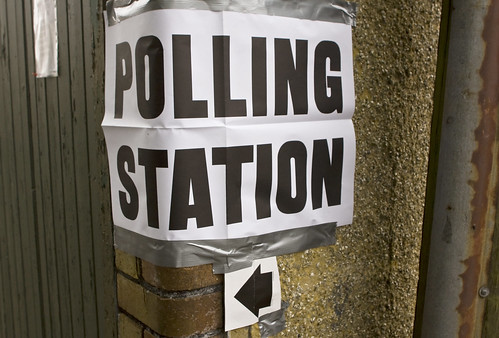
I believe in democracy. I believe in using my vote. I believe in you using your vote, even if I don’t agree with your political views. I am very excited about tomorrow’s election and the possibilities that it holds. Whatever else you do tomorrow, if you are eligible to vote in the UK then use your vote.

Stephen Fry, of course, said all this more eloquently than I could. But I will try to explain briefly. Politics is important because it’s not just boring old men bickering about complicated stuff in London. Politics is everyday life, your life. It’s everything from how much tax you pay to how and when your rubbish gets collected, from the number of nurses staffing a hospital ward to how quickly potholes get fixed. Your biggest opportunity to have your say in all those things is to use your vote.

If you don’t yet know which way to vote there are some great websites to help you make up your mind – VoteMatch, VoteForPolicies, and of course the manifesto of each party is on their website. More specific to your local area, you can read about your MP candidates at TheyWorkForYou.

Kate Gardner Blog

Posts pagination

1 … 3 4

Archives

RSS Nose in a book

  • Book review: Interstellar Megachef by Lavanya Lakshminarayan
  • May 2026 reading round-up
  • Book review: Passing by Nella Larsen

Me on the internets

  • @kate_in_a_book@mas.to (Mastodon)
  • Flickr/noseinabook
  • Instagram/kate_in_a_book
  • StoryGraph/kate_in_a_book

Categories

  • Blog
  • Reviews
  • Uncategorized
Proudly powered by WordPress | Theme: Dream by vsFish.