Nose in a book

Reviews and other ramblings

  • Home
  • Reviews archive
    • Book reviews
    • TV reviews
    • Theatre reviews
  • TBR
  • Challenges
    • The Classics Club
    • 2014 Popular-Science Reading Challenge
    • Cookery challenge
    • The Gilmore Girls Reading Challenge
    • 2013 TBR Pile Challenge
    • 2013 Translation Challenge
    • Crime and Punishment read-a-long
  • About
    • Cookie legal stuff
  • Home
  • Reviews archive
    • Book reviews
    • TV reviews
    • Theatre reviews
  • TBR
  • Challenges
    • The Classics Club
    • 2014 Popular-Science Reading Challenge
    • Cookery challenge
    • The Gilmore Girls Reading Challenge
    • 2013 TBR Pile Challenge
    • 2013 Translation Challenge
    • Crime and Punishment read-a-long
  • About
    • Cookie legal stuff

Tag: family

The sky was the colour of a day-old bruise
August 2, 2013August 2, 2013

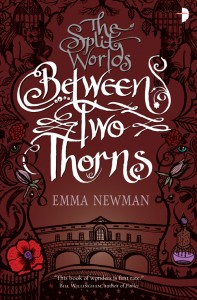
Between Two Thorns

Between Two Thorns
Book 1 of the Split Worlds
by Emma Newman

I went to the launch of this book a few months back (which for some reason I blogged about beforehand but not afterward – very strange) and the only reason I have taken so long to get round to reading it is that it is linked to a series of online short stories that I wanted to finish reading before I started this novel. Then I got impatient with myself and just read this anyway! I will go back to those short stories now.

Disclaimer: Emma Newman is a local author to me and we have met a couple of times, as well as having a few conversations over the internet. I think she is very lovely and this may or may not have coloured my opinion of her book. Which I really liked. I think it’s probably very good whether or not you ever so slightly know the author.

Newman has come up with something special in the Split Worlds. She has created a fantasy world with a multitude of characters and things going on that feed into not only 50+ short stories and three novels (at least??) but also interactive games. But you could absolutely read this novel on its own, or any one of the short stories on their own, and enjoy it for itself, without the extra knowledge of all the other stuff.

What’s great is that although Newman has clearly put a lot of thought into world-building, there’s no noticeable chunks of exposition in this novel. You get dropped straight into a funny but sinister incident involving a drunk man desperate for a wee on his way home from the pub and all the details you need to understand what is going on and how that links to the other characters are added gradually and skilfully.

“‘Tea, sir?’ Axon picked up the teapot. Ekstrand peered at it suspiciously.
‘It is Assam, isn’t it, Axon?’
‘Indeed, sir.’
‘All right,’ he muttered and started to pace. ‘It’s all happening at the same time. I never did trust Sundays and this only adds weight to my theory.'”

There are quite a few characters but arguably the main one is Cathy, one of the “fae-touched” who is trying to break free from her family and live in the normal world known as Mundanus by – shock, horror – going to university. However, those who inhabit the magical mirror world she is hiding from, the Nether, will not leave her in peace. In the meantime, Max, a sort of policeman of the Split Worlds who is separated from his own soul, has stumbled on a breach of the Split Worlds Treaty so huge that there’s no knowing how high up in society the trouble goes or who he can trust.

I like the idea of the magical world and the normal world co-existing, and Newman paints both equally well. Characters in both worlds drink a lot of tea. But the worlds themselves are very different, or at least their people and societies are. The Nether seems to be stuck in a facsimile of 18th-century Britain, all very patriarchal and anti-technology and formal, with rigid rules governing everything and everyone, especially women. Mundanus is the world as it is now, in the 21st century, which makes for a huge contrast in some ways. Really, it’s a wonder Cathy is the only one looking to escape the Nether! But the Nether also sounds quite wonderful, with its silver sky and all the possibility of magic.

“‘Bloody weather,’ she muttered and then silently took it back. The sky was the colour of a day-old bruise and the wind was bitter but she still loved it just for being there. She never wanted to see a silver sky again.”

While you could read this as a standalone book, I was left wanting more, eager to buy part two and read it soon despite my enormous TBR. Thankfully my procrastination on getting round to reading this one means that book two, Any Other Name, has already been published (and indeed I bought it last weekend) and book three, All is Fair is coming soon, in October.

Published 2013 by Angry Robot.

Source: I bought this at the book’s launch at Forbidden Planet in Bristol.
Kate Gardner Reviews

A sunburst split the seams of the clouds

May 14, 2013 2 Comments

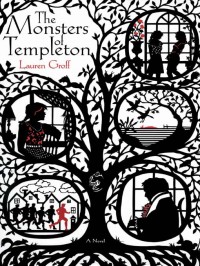
The Monsters of Templeton

The Monsters of Templeton
by Lauren Groff

A good friend mentioned this book to me because it features a friendship between two girls, one of whom has lupus, and that was enough to interest me. However, that is just one plot thread in a novel that has so much going on you could easily accuse it of that typical feature of the debut novel – that the author threw everything into it – except that that sounds like a bad thing and I really really enjoyed this.

I tried describing the story to Tim and I think overwhelmed him with all the stuff, and yet it doesn’t read like a plot-heavy novel because the writing is lyrical and the elements are given room to breathe, not rushed through. I’m not quite sure how Groff achieved this in just 360 pages but I suspect it is because she has wound everything up together, so that it is all linked.

“We have run through the dark orange days of July, run through the summer mornings soft as mouse fur, through the drizzle, through the baking heat…This is called solace, our morning run.”

The central character is Wilhelmina, or Willie, Upton, a 28-year-old archaeologist who turns up on her mother Vi’s doorstep heartbroken and lost after a disastrous affair with a married man. She has come home to Templeton, the small New York town where she not only grew up, but was the direct descendent of the town’s founder, the semi-legendary Marmaduke Temple. Vi decides that this is the moment to reveal to Willie that she is not, as she had been told, the result of free love in a San Francisco hippy commune, but instead that her father is someone in Templeton, someone Willie has known all her life. But Vi doesn’t tell Willie who, instead she gives her a clue about his ancestry, sending Willie digging through the town archives and old family letters. Alternate chapters are narrated by characters from the town’s past, giving both a flavour of the history of the town and clues to Willie’s quest.

Back in the life Willie has run away from in California, her best friend Clarissa is seriously ill, having been diagnosed with lupus on the brink of multiple organ failure and now months into a treatment regime that is kept quite vague, frustratingly for me as I had an obvious interest in that part. This was inevitably the thread that was going to be hardest for Groff to sell to me and to be honest I think it was done pretty well, with only a couple of minor misfires. Clarissa teeters between exhaustion and boredom/frustration at being home and not able to work, which rang pretty true for me. Her boyfriend Sully cares for her but is angry at Willie for not being there, for having disappeared first on a months-long archaeological dig and now back to her mother.

“There was a painful rubbery silence then, when the noise of the crowd down at the park burbled up to the house and a few chirps from the frog-pool began to rise and the grandfather clock ticked and ticked in the dining room.”

And then there’s the monster. Yes, an actual monster. On the day Willie arrives back in Templeton, a huge dead creature is found floating in the lake that the town is built on the edge of. The creature is dragged to the shore and then away to a laboratory where a series of biologists fail to identify it. But the residents of the town know that it was their monster, that it had been there in the lake longer than the town, and without it everything feels wrong, empty somehow.

This last thread was the one I found difficult to reconcile with the rest of the novel. There’s a touch of the mystical or fantasy in the story of the monster. In the historical sections of narrative we learn that troubled souls have always been drawn to the monster (indeed, a number have committed suicide by walking into the lake) and Willie herself may be one of these characters linked to the monster. It’s a fairly clear metaphor for the life of the town and for Willie’s emotional state and sometimes I liked the touch of surreal that it added to the novel, but at others I found it a little out of place.

There is so very much going on in this novel that I haven’t yet touched on. There’s the complicated mother-daughter relationship between Vi and Willie. Hippie feminist Vi appears to have found God and a drippy priest for a boyfriend, much to Willie’s chagrin. And Willie wants to curl up and be a child again just as Vi has found herself ready to move on from being a mother above all else. There’s the similarly complicated friendship between Willie and Clarissa, college buddies who can get on each other’s nerves as well as love unconditionally, who can hold back and keep secrets from each other but also at times be brutally, painfully honest.

There are many more subjects covered, such as the concept of home or belonging to a place, and the importance to some people of having a family history to draw on (though Clarissa, an orphan, seems to feel more drawn to Templeton as a home than Willie is). And of course the mysteries and secrets behind every door, behind every face. Whether it’s a broken heart or something much darker, everyone is hiding something.

“Outside, Templeton was still a pigeon gray, but over the far hills a sunburst split the seams of the clouds and blazed one stamp of trees a strange green-gold. I had dressed in a short yellow sundress from high school because I felt so sad and only that dress seemed to hold an element of light in it.”

Between the chapters there are old photographs labelled with the names of characters going back to Marmaduke Temple and even the last native people who lived on the land before the town was founded. It was perhaps not surprising to find, on reading the author’s note, that the fiction was loosely based on Groff’s hometown of Cooperstown, right down to the town’s famous author – James Fennimore Cooper – who wrote semi-fictional accounts of his town and the characters in it. In fact, readers more familiar with Cooper’s writing than me will probably know that he called his fictional town Templeton and many of the historical character names used by Groff are also his. Groff has written a love letter to her hometown and an homage to its great writer.

Despite its everything but the kitchen sink storyline, this novel is beautiful, with interesting, sympathetic but fallible characters and a very skilled use of multiple voices to bring a whole town to life. Perhaps it would be more generous to call it multi-layered, which it certainly is, as well as intelligent and probing. I will definitely look out for the author’s other books.

Published 2008 by Hyperion.

Source: Borrowed from a friend.

Kate Gardner Reviews

She believed in the worst and knew herself to be imagining the best

November 23, 2012 5 Comments

Saplings
by Noel Streatfeild

This is one of those books that I wished didn’t have to end, though in a way I was glad that it did because it’s the tale of a downward spiral. It’s also a beautiful book physically, being my first (finally!) read from Persephone Books.

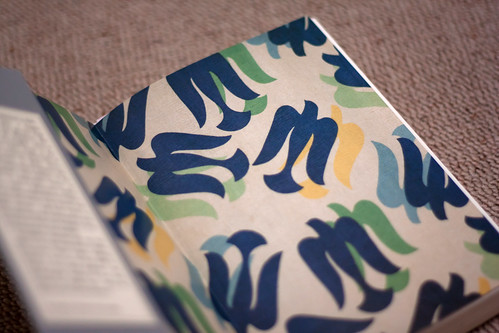
End paper gorgeousness

Streatfeild is famous for her children’s books, especially Ballet Shoes, but she also wrote books for adults, though they never sold as well. This may possibly be the pick of the bunch but Saplings is so wonderfully good that I am saddened it’s the only one of Streatfeild’s novels for adults currently in print.

It’s a clever, sharply observed book about children, family and war. The Wiltshires are a happy, comfortable middle-class family, with two parents, four children, a nanny and a governess, a home in London and holidays to the seaside. But from the first pages the potential cracks are there. The adults are worrying about the inevitability of war and whether London is a safe place for children. The father Alex worries that war will take him away from his family. The mother Lena worries that she will have to go with the children when all she wants is to be at Alex’s side. The baby of the family, four-year-old Tuesday, frets because the adults are clearly worried, while 11-year-old Laurel mixes together war-time fears with more mundane worries about school:

“She believed in the worst and knew herself to be imagining the best. As a shield she made loud fun of all war precautions…It didn’t matter being the plain one at home, people were used to it. If only she had managed to be super at something, then she could have gone to the Abbey School carrying her ability like a screen.”

The story follows the family from summer 1939 until summer 1944, such a short time but of course one of huge change for Britain as a whole. Streatfeild never tries to extrapolate the wider changes going on, she simply illustrates them through the Wiltshires and their extended family and friends. Things do not just suddenly fall apart, the descent from happiness is gradual. Some of it is unavoidable – evacuating the children to their grandparents’ house and then to boarding school, for their own safety. But a lot of what happens is far more subtle. Things aren’t said that should be, expressions are misunderstood, situations are mishandled. It is a heartbreaking study of avoidable unhappiness. And I thought this passage a very good description of a panic attack:

“He saw the attacks as if they had shape. Huge, black and soft, ready to fall on him…First he felt a tenseness in his diaphragm, which got steadily worse til he was hard in front, as if he were made of wood. Then he had a sinking sensation. The people around him were still there but on a different level, beyond reach…he had to get away alone and let the attack reach its climax. Then everything swam before his eyes, his heart beat quicker and quicker, there was thumping in his ears…”

The prose in insightful rather than poetic but once I realised that the slightly irritating idyll of family life at the start of the story was both part-facade and about to break apart anyway, I was carried along by the momentum of the story. Streatfeild does not keep surprises or mysteries up her sleeve, the narration is open in a way the Wiltshire family never can be. If anything this lesson may be repeated a little too often, but it is such a realistic one, touching on both the stoicism of wartime and the very English habit of keeping one’s emotions to oneself. She does allow herself a few characters who know the children well enough, or are just observant enough, to see what other adults don’t, but the wartime setting keeps these saviours away for long periods.

And without wishing to give anything away, everything is not alright in the end. Bad things have happened and those who are in a good or safe place know that it may not last. This was, after all, published while the war was still going on, and after several years of “It’ll all be over by Christmas,” optimism had faded, even when things were finally going well for the Allies. But also, the two oldest children, Laurel and Tony, have grown up over the course of the story and are 16 and almost 15 at the novel’s close, so they are seeing the world differently in more ways than one.

This is a story full of heart, and completely on the children’s side. Even the best of the adult characters gets thing wrong from the children’s perspective, and Streatfeild shows how a thoughtless word or imagined slight can lead to months of real misery. I wanted so badly for things to suddenly be all good, but of course life isn’t like that.

I chose this book after reading Liz’s review and it was bought for me by my very loveliest friend H who took me on a special trip to Persephone Books a few months ago. Thanks to both of them!

First published 1945 by Collins.
Published by Persephone Books in 2000.

Kate Gardner Reviews

Life is only worth living because we hope it will get better

October 31, 2012 4 Comments

Swimming Home
by Deborah Levy

I had heard quite mixed reviews of this novel but it was on the staff picks shelf at the very lovely Mr B’s Emporium of Reading Delights in Bath so I took a chance. I can see why it has divided people. As the blurb says, “it wears its darkness lightly”.

The set-up is that familiar one of the middle-class English family holidaying in a villa on the French Riviera when a stranger intrudes. Or is it? There are clues throughout that things are not what they seem and to the last page I was not sure if all or any of the events recounted had actually happened.

“He leaned his head out of the window and felt the cold mountain air sting his lips…They knew the past lived in rocks and trees and they knew desire made them awkward, mad, mysterious, messed up…He asked her again to please, please, please drive him safely home to his wife and daughter.
“‘Yes,’ she said. ‘Life is only worth living because we hope it will get better and we’ll all get home safely.'”

What it appears to be is the story of famous poet Joe Jacobs and his absent war correspondent wife Isabel, whose marriage is breaking down. But there’s also their teenage daughter Nina, childlike for her 14 years but trying to be one of the adults. And there’s family friends Laura and Mitchell, a couple who run a boutique shop in London and who never seem comfortable in this holiday setting. And then there’s Kitty Finch, the stranger who turns up floating naked in their outdoor swimming pool, unembarrassed by her nakedness or the apparent mix-up that has brought her there.

There are some plot threads that seem so inevitable that Levy has put their conclusions on the first page to save the reader wondering. Yes, we do have a philandering husband and a beautiful, strange young woman thrown in his path. Yes, we do have characters dealing with depression and thoughts of death. And if you take it all at face value then you might say that what happens is no more than the sum of these parts. But I think that the writing demands more of its reader.

There are two obfuscating themes: identity and fiction. Joe, we learn early on, is Jozef to his wife, JHJ to his readers. Everyone lies or withholds information or tells different versions of the truth. Not only is Joe a poet, but Kitty is an aspiring writer eager for his opinion of her work, and then later in a section told from Nina’s perspective there are short poems thrown into the narrative as if she, too, is a poet, an inventor of fictions. Characters seem to repeat each other’s words or actions as if the novel is being rewritten even as you read it.

“No one dared say they minded, because the war correspondent was controlling them all. Like she had the final word or was daring them to contradict her. The truth was her husband had the final word because he wrote words and then he put full stops at the end of them.”

Add to all this that two characters have a history of depression and related illnesses and a third character is constantly stoned, and you have yourself a thoroughly unreliable narrative. What seems like a quick, easy, fluid read becomes so much more than the sum of its parts.

Published 2011 by And Other Stories.
Shortlisted for the Man Booker Prize 2012.

Kate Gardner Reviews

All just programming

August 8, 2012September 10, 2012

Old Paint
by Megan Lindholm

This is a novelette from Asimov’s Science Fiction that Tim encouraged me to read. It’s a touching, simple story set in a near-ish future and playing on American tropes.

I hadn’t realised until looking her up for this review that Megan Lindholm also writes as Robin Hobb, which is a name that is much more familiar to me but also one I wouldn’t pick up because she writes that traditional swords and magic fantasy that I’m not a fan of. Well, turns out she can write SF pretty well so maybe I’ll look up more of her work written under her real name.

This is the story of a poor-ish family in an American city in the late 21st century. Suzanne and her two school-age kids share a small flat with one computer between them and have no car, much to the children’s shame. But when they inherit their grandfather’s huge muscle car they are even more embarrassed. Especially when their mother insists on actually driving it rather than letting it drive itself like everyone else does.

To say much more about the storyline would be to give too much away, but it’s an interesting take on the American love affair with cars. From an environmental perspective it’s hopeful, because all cars run on electricity, with back-up solar cells for when they can’t get to a charge point. Despite the advances in technology, this is a story about people. Suzanne reminisces about her teenage relationship with this same car. And yes, I know how that sounds and yes, to a certain extent the story does anthropomorphise the car (“Old Paint” is the name they give it), though it does acknowledge this directly:

“We all know that Old Paint is just following the directives of his programming. He’s not really…alive. He just seems that way because we think of him that way. But it’s all just programming.”

But that’s not what it’s about. Suzanne’s long-since given-up-on relationship with her father is rescued after the fact by this gift and her children learn to appreciate her through it as well. Which sounds odd, but trust me, it works.

There are more SF elements than my synopsis perhaps suggests but they are subtly done so that, aside from one thing that’s central to the story, it’s all background. It’s a very believable near future, with only one significant change from now.

First published in the July 2012 issue of Asimov’s Science Fiction.

Kate Gardner Reviews

The person you thought you knew

July 23, 2012 4 Comments

The War of the Wives
by Tamar Cohen

I was intrigued by this book from the synopsis and I am left feeling very smug that I know myself well – because I loved it. It isn’t perfect but it is gripping and thought-provoking, and story and character are equally strong.

To save you even having to read the blurb, the tagline on the front of this book tells you all you need to know (when did books start having taglines? Is that a thing now?): “At your husband’s funeral you don’t expect to discover his other wife.” So it’s about grief, lies, family, bigamy, but also modern life in London and how change can make you realise what kind of person you are.

The storytelling is narrated alternately by the two wives, Selina and Lottie. Initially there’s a little bit of stereotyping. Selina is well off, uptight, a kept woman who keeps her very nice, very big house in Barnes in impeccable order and doesn’t check the price tag before buying yet another cashmere coat. She was married to Simon for 28 years, they have three children, aged 17 to 26, and while there’s not really any passion left she still loves her husband. She worries about ageing, her children’s choices of partner and why her youngest son insists on eating junk food.

Lottie is artistic, but illustrating children’s books isn’t making her a living so she also has a job she dislikes in a hotel. She lives in a flat in North London with her and Simon’s daughter Sadie, who is 16 and very difficult. She and Simon were married 17 years and they were still very passionate about each other, though they had money troubles and they fought a lot.

Cohen takes as her structure the five stages of grief. So the wives’ hatred of each other and what Simon did really comes to the fore in the “Anger” section. And the book inevitably wraps things up in the “Acceptance” section. Which was where, looking back, I feel a little disappointment. A lot of mysteries turn out to have been red herrings, which I should have seen coming when a potential major storyline just didn’t go anywhere. But what this does is keep the focus on the families, which is definitely Cohen’s strength. That and her fantastic turn of phrase that can combine urbanity and sentiment in clever, often comic, ways:

“I know how you can think you know someone, really know someone, only to find the person you thought you knew turns out to be a hollow timber structure with someone entirely different inside – a plastic wheelie bin of a someone.”

I liked the depiction of the children through their mothers’ eyes. I liked the way the women developed from the stereotypes they saw each other as being into complex, interesting characters. I liked the ultra-current setting – not just Twitter and Facebook but also preparations for the London 2012 Olympics – but I do worry that it will date the book quickly. I suppose that’s a decision the writer and her editor have already made.

The main flaw, I would say, are the prologue and epilogue, which is a shame because they are the first and last impressions. I found the epilogue especially jarring and completely lost my hold on the fictional world I had until then been enjoying thoroughly. But the rest of the book is good enough to forgive the slight lapse.

This book was kindly sent to me by the publisher in return for an honest review.

Published 2012 by Doubleday, an imprint of Transworld Publishers.

Kate Gardner Reviews

My first step from the old white man was trees

July 21, 2012

The Color Purple
by Alice Walker

When I read the first page of this book I wasn’t sure I could carry on. Walker plunges right into the heart of the awful beginnings of her story. But I made myself continue and within a few pages I was hooked.

The story is told in the form of letters, initially all addressed to God, from Celie. She tells how from the age of 14 she was repeatedly raped by her pa and bore him two children, both taken away from her. This has destroyed her ability to have further children so she is offloaded as a wife to Albert, a man looking for a trouble-free mother to his children. He beats her and makes no secret of his hate for her. Her beloved sister Nettie lives with them briefly before being forced to run away when she rejects Albert’s advances.

It’s all pretty bleak. And then along comes Shug Avery. The love of Albert’s life, she is a nightclub singer and quickly becomes Celie’s first real friend. Finally joy, happiness and the ability to talk openly come to Celie and she gradually finds the strength to make her life what she wants it to be.

Obviously, I knew this from reputation, but I realised it was a few chapters before it is clear that all the characters are black (at least, initially they all are). They are simply poor, ill-educated farm folk. But as Celie gets older and meets more people she learns what it means to be black. She learns about black people in other cities, other countries and even other continents. And she learns about being a woman, how she doesn’t have to be subservient.

Although the book goes very firmly from dark to light, it never gets over-sentimental or mawkish. Celie’s matter-of-fact tone gradually gains humour and worldliness. Always observant, she reports the moments and the conversations that have made her who she is at the end of the story:

“I believe God is everything, say Shug…My first step from the old white man was trees. Then air. Then birds…it come to me: that feeling of being part of everything…And I laughed and I cried…It sort of like you know what, she say, grinning and rubbing high up on my thigh.
“Shug! I say.
“Oh, she say, God love them feelings. That’s some of the best stuff God did…
“God don’t think it dirty? I ast.
“Naw, she say. God made it. Listen, God love everything you love &ndash and a mess of stuff you don’t. But more than anything else, God love admiration.
“You saying God vain? I ast.
“Naw, she say. Not vain, just wanting to share a good thing. I think it pisses God off if you walk by the color purple in a field somewhere and don’t notice it.”

Now, I’m not religious, but there was something very moving about Shug’s idea of God and I love how it freed her and later Celie to follow their own rules. Not to give too much away, but this book includes some frank talk about sex and some homosexuality, not to mention all of the affairs characters keep having. Which I hadn’t expected and found refreshing. Yes, these are poor black people in the segregated southern USA in I think the 1930s and 1940s (there’s some vague talk about war breaking out in Europe) but take away the poverty and politics and they’re still human beings with hearts to give and break and libidos to follow.

The style of writing took some getting used to. Beside the dialect, Celie doesn’t always name characters or explain a situation clearly until much later. And time was passing far more quickly than I realised. There are sometimes years between letters. Also, the absence of speech marks was sometimes confusing. But looking beyond all that, it is a wonderful book well worth the pain of the early chapters.

First published in the USA in 1983 by Harcourt Brace Jovanovich.
Winner of the Pulitzer Prize.

Kate Gardner Reviews

Sunday Salon: Here and there

July 15, 2012November 23, 2012 6 Comments

The Sunday Salon

We keep on doing lots of stuff with our weekends. Mostly of the fun variety, which is good, but it isn’t half cutting into my reading time!

Last weekend we went to visit my family. As my Nan has been ill we dropped by to see her and my Grandad, which was lovely as she is now doing well. We saw my Mum’s new house that she moved into a few weeks ago. I got to spend time with my little brother who I hardly ever see. I showed Tim a few more sights from my younger days. And we enjoyed being in the countryside. Even if it was raining almost constantly.

Untitled

Before we came home, my Dad had the brilliant idea to take me and Tim fossil hunting. That was so much fun! We were on the Severn Estuary and it was hideously muddy but we found loads of real actual fossils, which was amazing. And the dog had a whale of a time.

Untitled

This weekend I went to London to see my friend H while our menfolk did their man thing at Farnborough Airshow. I finally got to go to Persephone Books, which is just as wonderful as I had imagined. Huge thanks to H for taking me there and buying me one of their beautiful books. We also talked endlessly and painted our nails and had a generally brilliant time.

Persephone Books

It’s all been great. But I’m still a teeny bit glad that we don’t have much planned for the next few weekends. What have you been up to lately?

Kate Gardner Blog

The places to which your blood is anchored

June 12, 2012 3 Comments

The Tiger’s Wife
by Téa Obreht

I am trying not to let my jealousy of young, beautiful, successful Téa Obreht colour my feelings about this book because she is undeniably talented and deserving too. This novel felt original and inventive by using traditional folktale-type storytelling.

How do you describe what this book is about? It’s about the civil war that broke up Yugoslavia; it’s about love in its many forms; it’s about the affection we bestow on objects, animals or even people who can never return it; it’s about how superstitions and folk stories are created and why they are important. But it begins and keeps on coming back to the death of a beloved grandfather.

The narrator, Natalia, is a doctor who is travelling to an orphanage across the newly formed border to deliver vital vaccines and other medical care when she receives news of her grandfather’s death. This story is already complicated by odd details and family secrets, and then when she arrives at the orphanage she finds another complicated situation awaits, tied up in distrust and superstition and national identity. Obreht weaves into this story not one but effectively three further plots: Natalia’s relationship with her grandfather, the story her grandfather told her of the Deathless Man, and the story she pieced together after his death of the Tiger’s Wife.

At first, the “facts” within the novel versus the fictions seem clear, but as the novel progresses they are increasingly wound up together until they cannot be separated. The main recurring theme is the tiger. During Natalia’s grandfather’s childhood, a tiger escapes from the zoo in the big city and comes into his village, triggering local legend for generations to come and consolidating the boy’s love of The Jungle Book, a copy of which he carries with him for the rest of his life. Natalia’s earliest memories are of going to the zoo every week with her grandfather and his particular love of the tiger there, and later his distress for the tiger during the zoo’s war-enforced closure. Obreht describes scenes from the tiger’s point of view and yet never once anthropomorphises him.

The writing is lyrical without being longwinded. In fact, a lot is packed in and it was a long way into the book that I realised just how much it was about the war that broke up Yugoslavia. In a way, this is dealt with in an underhand way because the country is never named. Natalia’s home is just the City and all the other placenames given are fictitious. But between Obreht’s background and the details that are given, it seems likely that the setting is the Balkans. The City of two rivers that is untouched by years of civil war until a sudden onslaught of bombing might easily be Belgrade. I don’t know if the names are withheld out of sensitivity for which side of the new borders the characters are from, or if this is just another element of mystique adding to the fable quality of the story. Certainly, when the narrative delves into the histories of characters they seem to match up with the history of the Balkans, with invasions from Turks and Germans, and there is an interesting discussion of people who have only just become one nation, with one identity, coming to terms with its dissolution.

“When your fight has purpose—to free you from something, to interfere on behalf of an innocent—it has a hope of finality. When the fight is about unravelling—when it is about your name, the places to which your blood is anchored, the attachment of your name to some landmark or event—there is nothing but hate, and the long, slow progression of people who feed on it and are fed by it, meticulously, by the ones who come before them. Then the fight is endless, and comes in waves and waves, but always retains its capacity to surprise those who hope against it.”

Obreht does a good job of combining a modern feeling in the first-person narrator, who is real and rounded, and an old-fashioned round-the-fire storytelling vibe. My only gripe would be that toward the end I started to feel that there were too many stories at once. Every notable character within each story gets a full backstory and I started to notice that details overlap or repeat, which I am sure has significance but was too many levels for me. But maybe that just means that it will reward re-reading.

First published in 2011 by Weidenfeld & Nicolson.
Winner of the Orange Prize for Fiction 2011.

Kate Gardner Reviews

What might have happened

May 11, 2012

The Uses of Enchantment
by Heidi Julavits

Once again this is a book I read about on a book blog and liked the sound of but can no longer where it was I read about it. I must come up with a better system! But more to the point, was I right that it was my sort of book? Well, yes and no.

I have never studied psychology or psychoanalysis, nor have I any strong interest in it, but it seems to crop up so often in my reading that I’m beginning to think I should take a course or something. This book picks apart the psyche so thoroughly there is no clear line between the “real” of the story and the imagined. Which is the whole point. I think. That and something about teenage girls and sexuality.

Mary disappeared for a few weeks when she was 16 years old. At first she said she could not remember what happened, though she thinks that she had been kidnapped and sexually abused. Months later, following analysis, she agreed with her psychologist that she had made it all up, and subsequently became a minor local celebrity. Years later she returns to the family home in a Boston suburb for her mother’s funeral and finally faces up to the family tensions that she has been hiding from. But which version of the past is true? Does she even know herself?

If her psychologist is right, Mary is precociously bright, though she has managed to hide it from everyone else. Woven into her changing stories are details from Freud’s Dora, from the case of Bettina Spencer – another girl from her prep school who disappeared under similar circumstances years earlier – and witches condemned to death in nearby Salem. She certainly has issues related to her distant, Puritanical mother and her own sexual urges, but is she in control of what she is doing in response to those issues? Is this all, as she claims at one point, a highly original method of completing a school assignment on Dora?

The story is told in three threads – the present day, starting with Mary’s mother’s funeral, the notes of her first psychologist, Dr Hammer, and a series of chapters titled “What might have happened”. Details from one thread crop up again in another in a way that doesn’t make sense unless at least one of these threads isn’t the whole truth.

It’s a fascinating premise and told well enough to keep me reading hungrily, but there was something awry. The language made me disengage at times. Julavits is one of those writers who use a lot of unusual words. Perhaps they are the most precisely correct word but using a word that is not in common usage will make most readers stumble, I think. There was also a slightly troubling treatment of teenage girls who claim sexual abuse and psychologists who help them – not exactly mockery or disbelief, but a definite hint that teenage girls will lie about such things given the chance and adults should know better than to believe them. But perhaps I have misinterpreted on that point. Perhaps it is more of a statement about uptight New England rich white people and their attitudes to sex. Certainly Mary says more than once that her mother wants desperately for her to be proved a liar because she would rather have a liar for a daughter than a rape victim.

I think maybe my difficulty with truly enjoying this book is that it touches on some big issues but, for all its deep knowledge of psychoanalysis, it doesn’t feel like it really truly explored those issues. All I feel I have explored is the human (and in particular the teenage girl’s) capacity to imagine.

There were some touches that I loved. Speech marks were only used in the present day sections of the book, and not in all of those. Was that a clue to what was real? There are some objects discovered early on in the present day narrative that seem significant but do not get their reveal until near the end of the book, and it took me a moment to notice the key difference between the two versions of the objects. If trustworthy, this difference is a clue to the truth. Or to part of the truth.

First published 2006 by Anchor Books.

Kate Gardner Reviews

Posts pagination

1 … 3 4 5 6

Archives

RSS Nose in a book

  • Book review: Interstellar Megachef by Lavanya Lakshminarayan
  • May 2026 reading round-up
  • Book review: Passing by Nella Larsen

Me on the internets

  • @kate_in_a_book@mas.to (Mastodon)
  • Flickr/noseinabook
  • Instagram/kate_in_a_book
  • StoryGraph/kate_in_a_book

Categories

  • Blog
  • Reviews
  • Uncategorized
Proudly powered by WordPress | Theme: Dream by vsFish.