Nose in a book

Reviews and other ramblings

  • Home
  • Reviews archive
    • Book reviews
    • TV reviews
    • Theatre reviews
  • TBR
  • Challenges
    • The Classics Club
    • 2014 Popular-Science Reading Challenge
    • Cookery challenge
    • The Gilmore Girls Reading Challenge
    • 2013 TBR Pile Challenge
    • 2013 Translation Challenge
    • Crime and Punishment read-a-long
  • About
    • Cookie legal stuff
  • Home
  • Reviews archive
    • Book reviews
    • TV reviews
    • Theatre reviews
  • TBR
  • Challenges
    • The Classics Club
    • 2014 Popular-Science Reading Challenge
    • Cookery challenge
    • The Gilmore Girls Reading Challenge
    • 2013 TBR Pile Challenge
    • 2013 Translation Challenge
    • Crime and Punishment read-a-long
  • About
    • Cookie legal stuff

It’s giveaway time! Literary Giveaway Blog Hop (23–27 June)

June 23, 2012June 28, 2012 30 Comments

**This giveaway is now closed. The winner will be announced shortly.**

1Q84

You can win a copy of all three books (in two lovely hardback volumes) of 1Q84 by Haruki Murakami. All you have to do to enter is leave a comment below saying that you’re interested before midnight on 27 June. I will then pick a name out of a (metaphorical) hat and announce the lucky winner.

1Q84 is the story of Tengo and Aomame, set in a 1984 Tokyo that somehow morphs into the rather more sinister 1Q84. It wasn’t exactly my favourite read of this year but many others have raved about it and I’m hoping these beautiful books can find a more appreciative home.

This competition is open to anyone living in Europe (sorry, but hardbacks + postage).

This blog hop is run by Judith of Leeswammes. To find out more check out the blog hop announcement. And do take some time to visit some of the other participants, listed below.

List of participants
  1. Leeswammes
  2. Candle Beam Book Blog
  3. Musings of a Bookshop Girl
  4. The Book Whisperer
  5. Book Journey (US/CA)
  6. breieninpeking (Dutch readers)
  7. bibliosue
  8. heavenali
  9. I Read That Once…
  10. The Parrish Lantern
  11. The Bibliomouse (Europe)
  12. Tell Me A Story
  13. Seaside Book Nook
  14. Rikki’s Teleidoscope
  15. Sam Still Reading
  16. Nishita’s Rants and Raves
  17. Readerbuzz
  18. Books Thoughts Adventures (North America)
  19. 2,606 Books and Counting
  20. Laurie Here (US/CA)
  21. Literary Winner (US)
  22. Dolce Bellezza
  23. The House of the Seven Tails
  24. The Book Diva’s Reads (US)
  25. Colorimetry
  26. Roof Beam Reader
  27. Kate’s Library
  28. Minding Spot (US)
  29. Silver’s Reviews (US)
  30. Book’d Out
  31. Fingers & Prose (US)
  32. Chocolate and Croissants
  33. Scattered Figments
  34. Lucybird’s Book Blog
  35. The Book Club Blog
  1. Lizzy’s Literary Life
  2. The Book Stop
  3. Reflections from the Hinterland (US)
  4. Lena Sledge’s Blog
  5. Read in a Single Sitting
  6. The Little Reader Library (UK)
  7. The Blue Bookcase (US)
  8. 1morechapter (US)
  9. The Reading and Life of a Bookworm
  10. Curled Up with a Good Book and a Cup of Tea
  11. My Sweepstakes City (US)
  12. De Boekblogger (Europe, Dutch readers)
  13. Exurbanis
  14. Sweeping Me (US/CA)
  15. Living, Learning, and Loving Life (US)
  16. Beauty Balm
  17. Uniflame Creates
  18. Escape With Dollycas Into A Good Book (US/CA)
  19. Curiosity Killed The Bookworm
  20. Nose in a book (Europe)
  21. Sharon’s Garden of Book Reviews (US)
  22. Giraffe Days
  23. Page Plucker
  24. Based on a True Story
  25. Read, Write & Live
  26. Devin Berglund (N. America)
  27. Ephemeral Digest
  28. Under My Apple Tree (US)
  29. Annette Berglund (US)
  30. Book Nympho
  31. A Book Crazy, Jane Austen Lovin’ Gal (US)
  32. Love, Laughter, and a Touch of Insanity

Kate Gardner Blog

Crossing the Rubicon

June 19, 2012September 27, 2015 3 Comments

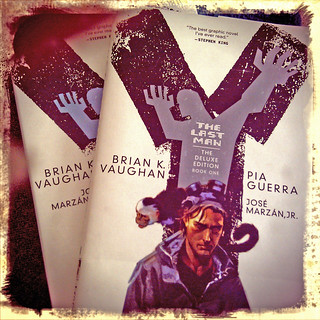
Y: the Last Man
The complete series
by Brian K Vaughan and Pia Guerra

This is a series of comic books that Tim really really wanted me to read so I told him I would if he would help me write the review afterward. Here is our joint effort.

Y: the Last Man begins with all humans and animals with a Y chromosome dying at the same instant, apart from 20-something-year-old Yorick and his monkey Ampersand. Yorick suddenly goes from being just some ambitionless and jobless guy to having everyone after him, as the potential key to the whole situation. But do all women want or even need men to come back?

First, a quick taste of the dialogue:

“[You’ve] crossed the fucking Rubicon.”
“The what?”
“Shut up.”
“I’m serious. What is that? ‘Crossing the Rubicon’?”
“It’s just a saying, all right? Means you’ve passed the point of no return—that you’re fucked.”
“But why does it mean that? What’s a Rubicon?”
“Jesus Christ! You just executed a human being, and all you—”
“You don’t know, do you?”
“—”

Y: the Last Man

Kate: You really wanted me to read this series. Why in particular?

Tim: It’s a very well written, touching, non-superhero comic book based on a strong SF trope. I am still trying to be your guide in SF and comics. Plus, y’know, literature plays a large part. And I know you love literature. What did you think of the literary allusions?

K: You had told me there would be literary references so I think I was expecting more than there was. But it’s actually done well, quite subtly, and I think it’s very true that an ardent reader would place a lot of value on finding people he could talk to about books, even in the middle of global disaster.

T: Also, the art is beautiful, I love the graphical themes that tie the issues/books together.

K: For science fiction, there’s not much science. It’s mostly about the impact on society of a major humanity-changing event.

T: True. SF that doesn’t dwell too much on the “plumbing” of the event can be very good SF. The beauty of this one is the way that Brian K Vaughan toys with characters (and the reader) having different theories for what caused the plague, all in different levels of mysticism/science. I often like this in stories, and that kind of uncertainty can really lend itself to some great storytelling. Take Bladerunner, or Total Recall, or Forever War, or I Am Legend, or Gateway, or Drowned World or… okay, there are a lot of titles that use the uncertainty and not-explaining attitude to SF. Is uncertainty in the heart of a plot an SF thing, or a general good lit thing?

K: It’s not just SF. It’s also not always good (but it often is).

Although our main characters keep facing violence and aggression, the all-female society does pull itself together and get stuff working over time. A comment is made that if the situation were reversed men would have been way more warlike and disorganised in reaction. In fact, a lot of women react with hatred for men and determination that women are better off.

T: Yep. You know, every English teacher I ever had was a feminist.

Several women are shown or implied to have become lesbian or start self-identifying as male as a result of the plague. Is this a cis-hetero/masculine fantasy or an offensive assumption? It is important to note that many other women do NOT.

K: I don’t think it’s handled in a male-fantasy way, whatever that would be. I think it’s realistic that some women would be open to it immediately while others would gradually turn to it from a lack of the alternative and others would resolutely refuse. It could have been discussed more but that’s a BIG conversation.

T: And it’s interesting that the one woman in the book who was already lesbian becomes, basically, celibate.

K: The main character is a man. Is this actually quite a masculine book with an idealised view of women?

T: Do you mean masculine or male chauvinist? I think you need Yorick as a contrast to the assumed macho male, and to evoke reactions (to him being male) from all the other (female) characters they meet. It would have been very easy to have him exist in the story just as a foil or a mirror. What’s impressive is that he is a character with depth without being macho or heroic.

K: Agreed. If anything Yorick is happy when he sees communities figuring shit out and would prefer to blend into the background and let women get on with it.

Though it eventually opens out, a large part (indeed all of the early stuff) of the story is set in the US, with a classic cross-country road trip. Would it have been too conceptual to see more of the world from the start?

T: I don’t know. I think it was important to concentrate on one thread of plot to begin with, allowing some measure of claustrophobia. It’s important because with the death of half of society, communications failed. The point is that the characters we follow don’t know what’s happening in their own city (to start with), and it gradually opens out as communications and society open out. I thought it was a well used device.

K: One observation I made early on was that the cities were falling apart, essentially war zones, while small towns were making it work. Is that realism or idealism?

T: I think it’s realism. There’s a bunch of reasons for it, though. Firstly, you start off in the domesticated east coast, and head west, towards the frontier, “can do” spirit. But I think, more importantly, (as seen in Make Room, Make Room or Caves of Steel) cities don’t exist in a vacuum, they rely on technology – that in this case failed (the power plants blew up, etc) – and a constant stream of food and supplies into the city (transport also broke down). The people living in more rural areas were not only more self-sufficient and practical to start with, they already had handy generators and the ability to grow/catch food. Cities cannot exist without civilization (I checked. I tried playing a whole game of Civ without building a city and it didn’t get anywhere).

Thank you Tim for the discussion and indeed the original recommendation. It is an excellent series.

Originally published 2002–2008 by DC Comics.
Deluxe editions published 2008–2011 by Vertigo.

Kate Gardner Reviews

Sunday Salon: Books in series

June 17, 2012June 17, 2012 7 Comments

The Sunday Salon

I have been thinking recently about how I review books in a series. I have not exactly been consistent up until now. Do you guys have any rules that you follow?

The thing is, different series throw up different problems. In some cases it is near impossible to discuss sequels without giving away spoilers from the earlier books. I found this a little with The Alexandria Quartet but I had so much to say about each book that I still gave each a separate post.

Sometimes spoilers aren’t an issue. For instance, the Claudine books reveal plot developments in their titles! But then the plot is hardly the point here.

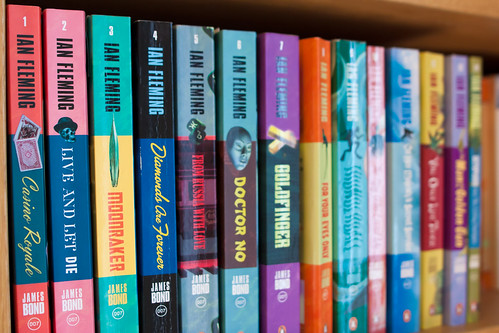
In some cases there isn’t much new to say about successive books in a series, other than the new plot, so reviews get progressively shorter. I suspect this will be the case with the Philip Marlowe books, but I’ve only read the first two so we’ll have to see. It’s one of the reasons I haven’t yet published a review of the James Bond books (which I’m halfway through reading). I’ll probably write about one of them but I see no point discussing every one separately. (For exactly this reason, I have reviewed just one of the Modesty Blaise books I have read.)

Line up

With comic books/graphic novels I have tended to write a single post about the whole series. With Scott Pilgrim, I was so eager to read the whole series that I didn’t want to stop to make notes in-between. With Echo I would have run across the problem of spoilers, so my review really concentrated on the first book and overarching themes (I had both of these problems with Y: the Last Man, a review of which is coming later this week). With Southland Tales, I just didn’t think they were very good and so, though I had a lot to say, I saved myself from writing three separate negative reviews by just doing the one!

I am thinking about this because in the past couple of years I have read a fair few first titles in a series, and in some cases I really really want to read the rest (Tales of the City, for example) but I’m not sure I’ll be able to write much about it so I put it off. I know that’s silly, that this blog shouldn’t stop me from reading great books, but there we are.

Do you have any favourite book series? And do you review every book you read?

Kate Gardner Blog

Local bookshops: Beware of the Leopard

June 16, 2012June 16, 2012 4 Comments

Beware of the Leopard is a secondhand bookshop in the heart of Bristol’s Old City, overflowing with books and a particular treasure trove of old annuals. Not to mention that awesome name (a quote from Hitchhiker’s Guide to the Galaxy).

Beware of the Leopard

It occupies two units opposite each other in the covered market, plus as many boxes and shelves in-between as they can fit. It looks haphazard but is actually well organised, you just need to know the system. It’s not really a place to go with a specific book in mind, it’s more of a browse and stumble across several gems sort of a place.

Just browsing

The shelves are crammed close together so that you are constantly manoeuvring around other customers, which makes for a pretty friendly experience! And the staff know their stock, so it’s always worth asking.

Beware of the Leopard benefits from having a fantastic location within St Nicholas Market, which is my (and many other Bristolians’) favourite lunchtime venue. So many tasty foods to choose between, my mouth is watering at the thought. And when you look up, it’s an impressive building too.

Untitled

Beware of the Leopard
66–69 & 77 St Nicholas Market
St Nicholas Street
Bristol
BS1 1LJ

Kate Gardner Blog

The places to which your blood is anchored

June 12, 2012 3 Comments

The Tiger’s Wife
by Téa Obreht

I am trying not to let my jealousy of young, beautiful, successful Téa Obreht colour my feelings about this book because she is undeniably talented and deserving too. This novel felt original and inventive by using traditional folktale-type storytelling.

How do you describe what this book is about? It’s about the civil war that broke up Yugoslavia; it’s about love in its many forms; it’s about the affection we bestow on objects, animals or even people who can never return it; it’s about how superstitions and folk stories are created and why they are important. But it begins and keeps on coming back to the death of a beloved grandfather.

The narrator, Natalia, is a doctor who is travelling to an orphanage across the newly formed border to deliver vital vaccines and other medical care when she receives news of her grandfather’s death. This story is already complicated by odd details and family secrets, and then when she arrives at the orphanage she finds another complicated situation awaits, tied up in distrust and superstition and national identity. Obreht weaves into this story not one but effectively three further plots: Natalia’s relationship with her grandfather, the story her grandfather told her of the Deathless Man, and the story she pieced together after his death of the Tiger’s Wife.

At first, the “facts” within the novel versus the fictions seem clear, but as the novel progresses they are increasingly wound up together until they cannot be separated. The main recurring theme is the tiger. During Natalia’s grandfather’s childhood, a tiger escapes from the zoo in the big city and comes into his village, triggering local legend for generations to come and consolidating the boy’s love of The Jungle Book, a copy of which he carries with him for the rest of his life. Natalia’s earliest memories are of going to the zoo every week with her grandfather and his particular love of the tiger there, and later his distress for the tiger during the zoo’s war-enforced closure. Obreht describes scenes from the tiger’s point of view and yet never once anthropomorphises him.

The writing is lyrical without being longwinded. In fact, a lot is packed in and it was a long way into the book that I realised just how much it was about the war that broke up Yugoslavia. In a way, this is dealt with in an underhand way because the country is never named. Natalia’s home is just the City and all the other placenames given are fictitious. But between Obreht’s background and the details that are given, it seems likely that the setting is the Balkans. The City of two rivers that is untouched by years of civil war until a sudden onslaught of bombing might easily be Belgrade. I don’t know if the names are withheld out of sensitivity for which side of the new borders the characters are from, or if this is just another element of mystique adding to the fable quality of the story. Certainly, when the narrative delves into the histories of characters they seem to match up with the history of the Balkans, with invasions from Turks and Germans, and there is an interesting discussion of people who have only just become one nation, with one identity, coming to terms with its dissolution.

“When your fight has purpose—to free you from something, to interfere on behalf of an innocent—it has a hope of finality. When the fight is about unravelling—when it is about your name, the places to which your blood is anchored, the attachment of your name to some landmark or event—there is nothing but hate, and the long, slow progression of people who feed on it and are fed by it, meticulously, by the ones who come before them. Then the fight is endless, and comes in waves and waves, but always retains its capacity to surprise those who hope against it.”

Obreht does a good job of combining a modern feeling in the first-person narrator, who is real and rounded, and an old-fashioned round-the-fire storytelling vibe. My only gripe would be that toward the end I started to feel that there were too many stories at once. Every notable character within each story gets a full backstory and I started to notice that details overlap or repeat, which I am sure has significance but was too many levels for me. But maybe that just means that it will reward re-reading.

First published in 2011 by Weidenfeld & Nicolson.
Winner of the Orange Prize for Fiction 2011.

Kate Gardner Reviews

Coming soon: Literary Giveaway Blog Hop (23–27 June)

June 6, 2012June 28, 2012 1 Comment

Literary Giveaway Blog Hop

It’s back! Once again, Judith of Leeswammes’ Blog is hosting the Literary Giveaway Blog Hop. Quite simply, 50+ book bloggers will be giving away literary books between 23rd and 27th June. Brilliant, right?

If you want to join in the giveaway, you can sign up here. If you just want a chance to win stuff then check back in on 23 June to see what’s on offer!

Kate Gardner Blog

Let our life stories become tragic art

June 5, 2012 3 Comments

Snow Flower and the Secret Fan
by Lisa See

This is the kind of book I went through a phase of reading several years ago – Asian country, female narrator, historical setting (often during a civil war) and generally following the daily life of poor(ish) folk. So I have some comparison. This one stood up well in terms of teaching me new stuff but less well as regards quality of story. Sadly.

Lily is born in 1830 to a modest farming family in the Chinese province of Hunan. As second daughter she has little worth and is just another mouth to feed until the Matchmaker delivers surprising news: if her feet are bound properly, she will have perfect feet, which will secure her both a good marriage (which her family will benefit from) and a laotong – a lifelong best friend (other girls must leave their childhood friends behind when they marry). But secrets, reversals of fortune and an attempted peasant rebellion all threaten both her happiness and her friendship.

The book is narrated by Lily, from her earliest memories aged five or so, and from the age of seven she is largely confined to the “women’s chamber” and discouraged from paying attention to the world of men, so we hear little about the history or politics of the time, but there is still plenty to tell. See did a lot of research into nu shu, the secret women’s writing, and frames her story around it, but she also details the horrors of foot binding, the rituals of daily life and special occasions to the point that I frequently felt I was learning a lesson rather than reading a story. It’s a fascinating lesson, and after years of research I understand why she wanted to use what she could, but it might have been nice to have a little more, I don’t know, insight?

Perhaps I wasn’t helped by my dislike of Lily. She and her laotong Snow Flower are matched at the age of seven, visit one another often and write to each other in-between, so they appear to be extremely close. Yet they almost always stick to formalised language that allows for misunderstandings and misinterpretations that cause them both pain and suffering:

“My writing is soaked with the tears of my heart,
An invisible rebellion that no man can see.
Let our life stories become tragic art.
Oh, Mama, oh, sisters, hear me, hear me.”

I can accept that their writing might have remained this rigid but in person too? They are often alone together – after they are married, when they visit they share a bed with each other and banish husbands to another room – so how come they never speak naturally even then? The insinuation of Lily’s narrative is that she insisted on this formality and in that way caused all the ensuing problems. But really?

Maybe I am struggling with suspension of disbelief. I’m not saying it’s a bad book. I was very interested and entertained but I did not feel absorbed.

First published 2006 by Bloomsbury Publishing.

Kate Gardner Reviews

Sunday Salon: Holidaying

June 3, 2012 8 Comments

The Sunday Salon

It’s been a busy busy week. Amazing how much more you can do when you don’t go to work! Okay, so I’m on holiday for a week and a half, which we are filling with three short breaks in a row. We seem to have managed once again to coincide our plans with glorious sunshine, which is not strictly good for me but I love how happy it makes everyone.

Part 1: London
In London, we went to museums with Tim’s parents, watched fox cubs playing from a friend’s balcony and sat reading in royal parks.

Urban fox

Part 2: Bristol
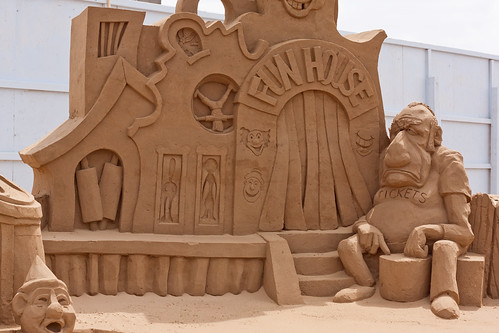
Then we came back to Bristol and enjoyed our city at a slower pace, took in a film at the excellent Watershed and went on a day trip to see the amazing sand sculptures in Weston-super-Mare.

Grumpy

Part 3: Melton Mowbray
Finally, we hopped on a train to Leicestershire to chill with friends in the countryside, which is where we are now.

Red

I am relaxed, I have done lots of reading (you can read my reviews of Enduring Love and Mr Fox, posted earlier this week) and I didn’t have to dip into my savings. Who needs fancy foreign holidays? (I’m not saying I never want one again. Just to be clear, I still want to see the world. But this has been a good holiday. That is all.)

Kate Gardner Blog

A person could die trying to love him

May 31, 2012 2 Comments

Mr Fox
by Helen Oyeyemi

This is a strange and beautiful book. It has disjuncts that cannot be explained but somehow the whole works anyway.

St John Fox is a writer in New York City with a sweet, devoted wife in Daphne and a spirited muse in Mary Foxe, who is no less of a threat to Mrs Fox because her husband made her up. After, all that makes Mary his perfect woman.

Mary accuses St John of killing her off in one of his stories and so begins their game. His short stories are interspersed into the narrative, often starring Mary and/or himself. But the reality, after all, includes an imaginary woman, so is that just one of Mr Fox’s stories too?

Through St John’s imagination Mary can switch from wickedly playful to sweet and timid: from “Abominable Mr Fox, Contemptible Mr Fox, Nefarious Mr Fox,” to “But what can I do for Jonas? Last summer I spent almost an hour blowing dandelions off their stems towards him, so that he had a chance to wish for everything he wanted. He was very polite about it, but it can’t have meant much to him. Jonas thinks about eternity and other things that make wishes seem tiny and silly.”

The stories are disconnected by place (Europe, Asia, Africa) but also time. Mr Fox appears to be living and writing in the 1930s but some of the integrated stories (possibly all?) appear to be set in the present. Not the 2010s as someone in the 1930s might have imagined it, but as it really is. There are also some stories that appear to have no link at all to Mr Fox and his two women, aside from the fact that he is trying to write a love story with a happy ending (at which he continually fails).

These sound like problems or accusations, but they are somehow not. I loved this book. It is magical and inventive and surprising. Oyeyemi’s language is wonderful; simply phrased but with such imagination.

“She looked into his eyes – they were like a famine. Seeing them sent hurt and light through her. His eyes kept asking, asking, and she knew that a person could die trying to love him.”

A real treat.

Published 2011 by Picador.

Kate Gardner Reviews

What idiocy, to be racing into this story and its labyrinths

May 29, 2012 1 Comment

Enduring Love
by Ian McEwan

This is a story of love in all its forms, and both how painful and how uplifting that love can be. It also manages to be a compelling thriller, beginning with an event that sets wheels in motion for a series of misfortunes, building up to a dramatic climax.

Clarissa and Joe are happy, utterly in love after many years together. While at a picnic, they unwittingly become part of a terrible accident. At first it seems that the rest of the book will be them coming to terms with tragedy. But it quickly turns out to be something else, or at least, as the narrator, Joe keeps insisting that something else is going on, but Clarissa and the police don’t believe him. Is this a classic case of the unreliable narrator? Or is there a genuine terror stalking Joe and Clarissa, ready to erupt at any time?

For a start, Joe is easily lost in daydreams or work-related thoughts from the reality at hand. From the first page he is challenging his own memory. Did it happen the way he describes? He knows certain details conflict with other witness accounts gathered by the police and Clarissa’s memory. He says, “I’m holding back, delaying the information. I’m lingering in the prior moment because it was a time when other outcomes were still possible.”

Joe is a freelance science writer, a successful one, but also a man who feels that he made a mistake leaving research behind, so he is not entirely happy with where he is. He loves Clarissa unreservedly but she is unable to have children, which has always been a huge source of pain for them both. It’s a set-up that allows pure happiness to fall apart very quickly.

Through a psychological thriller framework, McEwan examines relationship love, parental love, religious love (though only at the extreme end), the love shared in friendship, sibling love (quite briefly) and obsessive love. It also examines a few forms of psychological instability, from the uncertainties of grief through to a far more troubling example.

McEwan writes well and keeps the possibilities open as he carries us along to the climax. In true thriller style, the augurs are all there that something is coming, but as a literary novel you know that the actual ending may be a more mundane realisation of truth.

I didn’t greatly like Joe. He is a bit dismissive of Clarissa, even condescending at times. While he has acquired tidbits of knowledge from far outside his original physics training, he seems to assume Clarissa’s only interests are her scholarly work on Keats, and children. I’m not sure if this is a failing of the character or of McEwan. Certainly, neither of the other female characters comes off well from Joe’s descriptions either. One is a widow too distracted by her loss to pay attention to her children, the other essentially a bimbo. I hope the problem is Joe’s.

Interestingly, although this all sounds plot-driven, despite having watched the film made of this book a few years back, I could not remember where it was going. Perhaps that’s just my memory, or the film was somehow incoherent, but perhaps it is because this book is sneakily about the writing after all: “What idiocy, to be racing into this story and its labyrinths, sprinting away from our happiness.”

First published 1997 by Jonathan Cape.

Kate Gardner Reviews

Posts pagination

1 … 95 96 97 … 124

Archives

RSS Nose in a book

  • Book review: Christopher and His Kind 1929–1939 by Christopher Isherwood
  • March 2026 reading round-up
  • Book review: We Have Always Lived in the Castle by Shirley Jackson

Me on the internets

  • @kate_in_a_book@mas.to (Mastodon)
  • Flickr/noseinabook
  • Instagram/kate_in_a_book
  • StoryGraph/kate_in_a_book

Categories

  • Blog
  • Reviews
  • Uncategorized
Proudly powered by WordPress | Theme: Dream by vsFish.