Nose in a book

Reviews and other ramblings

  • Home
  • Reviews archive
    • Book reviews
    • TV reviews
    • Theatre reviews
  • TBR
  • Challenges
    • The Classics Club
    • 2014 Popular-Science Reading Challenge
    • Cookery challenge
    • The Gilmore Girls Reading Challenge
    • 2013 TBR Pile Challenge
    • 2013 Translation Challenge
    • Crime and Punishment read-a-long
  • About
    • Cookie legal stuff
  • Home
  • Reviews archive
    • Book reviews
    • TV reviews
    • Theatre reviews
  • TBR
  • Challenges
    • The Classics Club
    • 2014 Popular-Science Reading Challenge
    • Cookery challenge
    • The Gilmore Girls Reading Challenge
    • 2013 TBR Pile Challenge
    • 2013 Translation Challenge
    • Crime and Punishment read-a-long
  • About
    • Cookie legal stuff

Musical interlude: When your mind’s made up

May 24, 2012 1 Comment

I’m still getting back into the swing of reading after a bad couple of weeks so in the meantime here is a lovely chilled song for a summer’s day: “When your mind’s made up” by Glen Hansard and Marketa Irglova.

If you haven’t seen it yet, I highly recommend the film this comes from, Once.

Happy Thursday!

Kate Gardner Blog

Sunday Salon: Happiness

May 20, 2012 4 Comments

The Sunday Salon

For no special reason and after a bit of a rubbish week, today I am feeling good. Really truly happy. Which is nice.

I have barely read 100 pages this week and life is pretty busy so reviews might be a bit sparse for a while. But we have some holiday coming soon so hopefully I’ll be able to play catch-up then. If we can manage not to plan ourselves too many other activities!

I have found time/brain power to post reviews of The Library Book and The Big Sleep, both of which I recommend. And my tired brain was glad that I now have a system for headlines so I didn’t have to pluck something out of thin air. I pick a quote from the book. Do you have a system for writing headlines? Do you use the title of the book you review?

I’m off out now to explore the Southbank Bristol Art Trail (I love my city). In the meantime, to spread my mysteriously good mood, here is a picture of gorillas having fun at our local zoo.

At play

Kate Gardner Blog

I may break a few rules

May 17, 2012April 28, 2016

The Big Sleep
by Raymond Chandler

The first book in the Philip Marlowe series (though not the first I’ve read) this blackly funny story of the darker side of LA confirmed my love for Chandler and his purple prose. I read it for book club, which led to a hilariously highbrow conversation about what has never aspired to be more than pulp fiction. But it’s good pulp fiction.

The plot is…complicated. I was beginning to think I had missed something towards the end and then Marlowe explains the whole thing to another character, which I suspect his publisher made him put in there. The story begins with the private detective being hired by dying millionaire Sternwood to deal with a pesky blackmailer. It seems straightforward but one bad guy leads to another and Sternwood’s two daughters are both troublesome, turning it all into one big knot of murder and intrigue.

Marlowe himself is an intriguing character. He’s a good guy and has a strong moral code that he imposes on himself, yet he delights in pissing off the police or letting people believe that he’s up to no good. And he’s not above kissing a girl and then discarding her. He’s clever, but not so clever that he’s pieced it all together from the start. He gives the impression of a devil-may-care attitude but looking closely at his actions you realise he actually cares very much. As he explains to Sternwood, “I do my best to protect you and I may break a few rules, but I break them in your favour.”

Chandler’s LA is of course marvellously seedy. Even the rich Sternwood girls are caught up with gangsters and crooks, from the petty to the top of the pile. It is his (and by extension Marlowe’s) understanding of the criminal world, and how several seemingly distinct cases are tied up together by the associations between people, that makes the book brilliant and confusing.

And it’s funny. Marlowe’s narration is full of sharp observations and ironic humour. I love lines like “You have to keep your teeth clamped around Hollywood to keep from chewing on stray blondes.” The language in general is gorgeously overblown, which is a style some members of my book club found offputting. But I can’t help adoring a book that sets a scene: “I got down there about nine, under a hard high October moon that lost itself in the top layers of a beach fog.”

For a book written in the 1930s, there is an interesting attitude towards homosexuality. Marlowe uses language that would be considered homophobic today but elsewhere he appears open-minded about such things. When joking about his impending death, he says “Don’t scatter my ashes over the blue Pacific. I like the worms better. Did you know that worms are of both sexes and that any worm can love any other worm?”

I think I preferred Farewell My Lovely, but this was still a great read and I fully intend to read the rest of the series.

First published 1939 by Alfred A Knopf.

Kate Gardner Reviews

This place will lend you books for free

May 15, 2012 2 Comments

The Library Book
edited by Rebecca Gray

This collection of essays, musings and stories about public libraries has been compiled in support of the Reading Agency‘s library programmes. Which is definitely a cause I can get behind. They are all big names, from Zadie Smith to Alan Bennett to Susan Hill to Stephen Fry, but sadly the levels of enthusiasm and quality are a little variable.

I think part of the problem is that several of the essays cover the same ground: memories of the writer’s first library followed by a vociferous attack on the idea of closing any of them. Some writers are more practical, looking at how libraries and librarians can change with the times. Seth Godin makes a good case for the necessity of the librarian as gatekeeper of information. Bella Bathurst talks about libraries as places where people can mix, can make connections, can interact, whoever they are.

Other writers use fiction, including a very nice extract from China Miéville’s novel Un Lun Dun (though I can’t help think that’s cheating, when everyone else seems to have written their contribution specially). And I like that not all of the writers are novelists. There are also several journalists and, my personal favourite, Nicky Wire, whose piece is titled “If you tolerate this…” and discusses (among other things) the background behind that great Manic Street Preachers lyric “Libraries gave us power”.

This book is certainly a conversation-starter. Though my position on public libraries was never in dispute, I have learned more about the potential arguments against spending public money on them and gained many weapons in the arsenal against such attacks.

I love libraries. To me, these days, they share much in common with bookshops, in that I’m stepping into a room crammed full of books and I get to take some home with me. But then these days I can afford to buy enough books to keep up with how much I read. When I was a child I read so, so much more (and admittedly the books were smaller, generally) and neither I nor my parents could have afforded that without the local library. But libraries are about more than just reading. They are community centres. They are public access to the internet. They are free access to information. They are equal access to culture. They are great.

Published 2012 by Profile Books.

Kate Gardner Reviews

Sunday Salon: Here comes the sun

May 13, 2012 6 Comments

The Sunday Salon

I’m back! I didn’t post last weekend because I was in London visiting friends. We did karaoke, watched films and chilled together, plus I bought too many books. And now I can ask you all which of the two Joss Whedon films currently out do you prefer? I vote Cabin in the Woods but they are both excellent, of course.

This week it was World Lupus Day, which I didn’t do anything special for, unusually. But I will take this opportunity to encourage you to learn more about lupus, a good start being Lupus UK or the Lupus Foundation of America.

10 May is World Lupus Day

This week also saw the rain finally stop and the sun come out, so I am going to stop waffling and enjoy my summery Sunday. Is it summery where you are today?

Kate Gardner Blog

What might have happened

May 11, 2012

The Uses of Enchantment
by Heidi Julavits

Once again this is a book I read about on a book blog and liked the sound of but can no longer where it was I read about it. I must come up with a better system! But more to the point, was I right that it was my sort of book? Well, yes and no.

I have never studied psychology or psychoanalysis, nor have I any strong interest in it, but it seems to crop up so often in my reading that I’m beginning to think I should take a course or something. This book picks apart the psyche so thoroughly there is no clear line between the “real” of the story and the imagined. Which is the whole point. I think. That and something about teenage girls and sexuality.

Mary disappeared for a few weeks when she was 16 years old. At first she said she could not remember what happened, though she thinks that she had been kidnapped and sexually abused. Months later, following analysis, she agreed with her psychologist that she had made it all up, and subsequently became a minor local celebrity. Years later she returns to the family home in a Boston suburb for her mother’s funeral and finally faces up to the family tensions that she has been hiding from. But which version of the past is true? Does she even know herself?

If her psychologist is right, Mary is precociously bright, though she has managed to hide it from everyone else. Woven into her changing stories are details from Freud’s Dora, from the case of Bettina Spencer – another girl from her prep school who disappeared under similar circumstances years earlier – and witches condemned to death in nearby Salem. She certainly has issues related to her distant, Puritanical mother and her own sexual urges, but is she in control of what she is doing in response to those issues? Is this all, as she claims at one point, a highly original method of completing a school assignment on Dora?

The story is told in three threads – the present day, starting with Mary’s mother’s funeral, the notes of her first psychologist, Dr Hammer, and a series of chapters titled “What might have happened”. Details from one thread crop up again in another in a way that doesn’t make sense unless at least one of these threads isn’t the whole truth.

It’s a fascinating premise and told well enough to keep me reading hungrily, but there was something awry. The language made me disengage at times. Julavits is one of those writers who use a lot of unusual words. Perhaps they are the most precisely correct word but using a word that is not in common usage will make most readers stumble, I think. There was also a slightly troubling treatment of teenage girls who claim sexual abuse and psychologists who help them – not exactly mockery or disbelief, but a definite hint that teenage girls will lie about such things given the chance and adults should know better than to believe them. But perhaps I have misinterpreted on that point. Perhaps it is more of a statement about uptight New England rich white people and their attitudes to sex. Certainly Mary says more than once that her mother wants desperately for her to be proved a liar because she would rather have a liar for a daughter than a rape victim.

I think maybe my difficulty with truly enjoying this book is that it touches on some big issues but, for all its deep knowledge of psychoanalysis, it doesn’t feel like it really truly explored those issues. All I feel I have explored is the human (and in particular the teenage girl’s) capacity to imagine.

There were some touches that I loved. Speech marks were only used in the present day sections of the book, and not in all of those. Was that a clue to what was real? There are some objects discovered early on in the present day narrative that seem significant but do not get their reveal until near the end of the book, and it took me a moment to notice the key difference between the two versions of the objects. If trustworthy, this difference is a clue to the truth. Or to part of the truth.

First published 2006 by Anchor Books.

Kate Gardner Reviews

Memories that approached, invading my body

May 8, 2012 4 Comments

The Seamstress
by María Dueñas
translated by Daniel Hahn

This novel (which is titled The Time In Between in some countries) is one of those where a lot happens later in the book and I am torn about how much to reveal. I don’t think the story hinges on these plot points, but I have a general policy to not give away plot details. So I’ll do my best but…

I think the key to my impression of this book was hidden away in the author’s note at the end. I can see why it was saved until after all of the story has been revealed, but it made me see everything in a different light and half makes me want to re-read the book with the new knowledge that I have. What Dueñas has done is to take a historical story that she wanted to tell, with huge real events and important real people, but shown through the prism of a fictional minor character.

That character is Sira, born in Madrid to a single mother who works hard as a seamstress. Sira is all set to follow in her mother’s footsteps, or perhaps learn to type and become a lowly civil servant, when a man storms into her life and changes everything.

The story is set in the 1930s and 1940s, through the Spanish Civil War and the beginnings of World War II. In Spain, Morocco and Spain again, Sira’s fortunes rise and rise, but as she mixes with richer folk she learns about the politics of her country and is driven to do what she can to help it at this worst of times. She enjoys more than a little luck, with many a kind stranger giving her a helping hand along her way, but she is a likeable enough character. In fact, she is a very strong woman, single for most of the book and independently making her way.

Sira narrates the story in no-nonsense fashion, with few embellishments and few asides. What she describes is believably what would catch the eye of a dressmaker born to a poorer life than the one she later enjoys. She describes the poise and confidence of the rich, the cut and quality of clothes, the size and elegance of rooms or furnishings. Despite essentially following one career on a successful trajectory, Sira thinks of each new stage in her life as a reinvention, requiring changes to her personality as well as her back story. She makes a point of teaching herself how to act above her station – how to stand, how to speak, how to socialise.

At 600+ pages it’s quite a long book, and there were times in the middle when my attention strayed. It felt to me that the whole point of the book was the final section, in Madrid when Franco’s government is teetering towards full collaboration with the Nazis, and that all of the rest had been build-up. It certainly changes pace there, becoming a thriller with a poised, confident female heroine. But perhaps it wouldn’t have worked so well without the full knowledge of how Sira became that woman.

Another slight negative for me, and of course I don’t know if this is Dueñas or the translation, was that there were many times when what could have been a subtle point was overstated, sometimes clumsily even. But I should also say that in general I thought the translation was excellent, dealing very effectively with characters speaking multiple languages to one another.

This book has stayed with me in the days since finishing it and has definitely made me curious to learn more about the Spanish Civil War. And it’s made me want to go to Morocco, but I kinda already wanted to do that!

This book was sent to me by the publisher in return for an honest review.

Published May 2012 by Viking, an imprint of Penguin Books.

Kate Gardner Reviews

All these books that I have

May 7, 2012 6 Comments

I don’t usually do incoming books posts because most weeks it would be a bit dull. I have been trying for a long while now to buy fewer books than I read, in the vain hope that my TBR will start to look a bit more manageable. However, these past few weeks I seem to have new (to me) books coming out of my ears. Which is nice.

Foyles haul

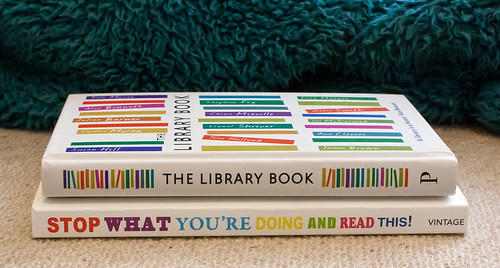
First I went to the lovely Foyles and bought two collections of essays by various authors – The Library Book and Stop What You’re Doing and Read This! – both of which I think I had heard about on Savidge Reads.

ARCs

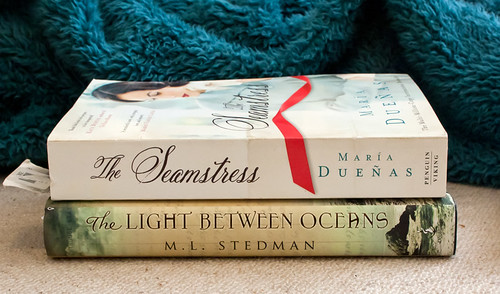
Next up I was sent a couple of books for review by publishers – The Light Between Oceans by M L Stedman (which I reviewed here) and The Seamstress by María Dueñas (which I have just finished reading and am mulling over before I post my review…watch this space!).

North Greenwich haul

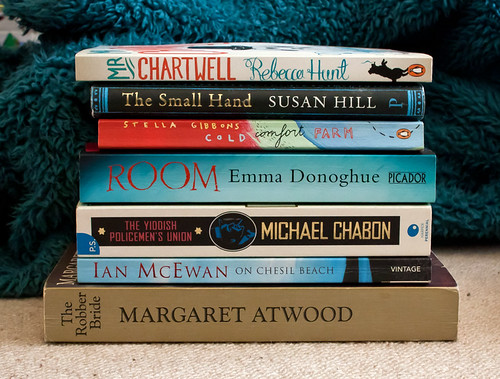
Then this weekend we visited friends in London who on Saturday took us to North Greenwich for brunch and bookshopping. They know me so well! Between West End Lane Books and a long row of charity shops I picked up:
Mr Chartwell by Rebecca Hunt
The Small Hand by Susan Hill
Cold Comfort Farm by Stella Gibbons
Room by Emma Donoghue
The Yiddish Policemen’s Union by Michael Chabon
On Chesil Beach by Ian McEwan
The Robber Bride by Margaret Atwood

Borrowings

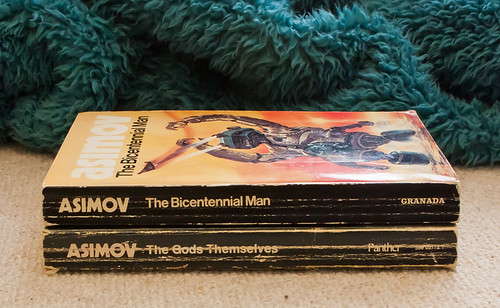
And finally, because the TBR wasn’t groaning enough already, I borrowed some books from the friends we stayed with! But I had good reason. When Tim and I recently watched I, Robot he decided that I was sorely lacking in background knowledge of Asimov so he asked Twitter for recommendations of where to start educating me. Handily, the response was books that Tim doesn’t actually own but I now have on loan The Bicentennial Man and The Gods Themselves.

Now what order to tackle this little lot in?

Kate Gardner Blog

I do not see him in the mirror but feel him

May 1, 2012May 1, 2012

Anatomy of a Disappearance
by Hisham Matar

This short, quick read effectively covers a devastating subject: the loss of a parent. And somehow it manages to be about everything else as well: love, family, identity, growing up and lust.

It is this last that the book might seem to be centred around. The story is narrated by Nuri who is 14 when his father mysteriously disappears, never to be found. Born in Paris, raised in Cairo, Nuri’s family are outsiders, Arabs, from an unnamed other country suffering military dictatorship. Nuri’s father was a government adviser to their king so they are now effectively in exile. After the death of Nuri’s mother when he is 10, the father and son struggle to communicate until one summer they meet Mona, a half-British half-Egyptian beauty aged exactly between them. Father and son both fall in lust but of course it is the father she responds to and marries while 12-year-old Nuri is in torment.

Nuri, like most teenage boys, struggles desperately with his lustful feelings, which are complicated by Mona’s flirtatious behaviour with him and then, later, his father’s absence. Though there are so many other things going on in his life that he could fixate on (boarding school in England; his so-called mother country; his struggle to make friends), in this narrative at least it is Mona who takes centre stage for most of the story. It is only when he gets older that he straightens out his priorities and makes an attempt to look for his father and make a life for himself.

The story is simply told, with what might believably be a young man’s voice recalling his childhood and teenage years and their raw pain. Though the setting moves all over the world, nowhere is strongly evoked except his own mind. While it was beautifully, sparsely done, I couldn’t help but wish for something that had gone deeper. Perhaps follow the adult searches a little and the politics that that might dredge up. But that would be a very different book.

My only other difficulty with this book was that Nuri’s family is so extremely well off, that outside his family, life is made very easy for him. We never see him get a job or struggle for something to do in holidays from his boarding school when he does not feel comfortable staying with Mona. I know this might be petty but I might have sympathised a little more if he was scraping together the funds to go to Switzerland to search for his father.

Not naming the “mother country” is, I would guess, an attempt to distance the fictional story from the author’s true life experience. Matar’s family fled their native Libya to Egypt following political persecution and when he was 20 his father was kidnapped. For many years Matar did not know whether his father was alive or dead. All that must, of course, have informed his writing but in Nuri he has created a believable separate character from himself.

I think I would say I was not as bowled over by this as by Matar’s debut novel In the Country of Men but I would still rank him as an excellent writer to keep an eye on.

First published 2011 by Viking.

Kate Gardner Reviews

The Sunday Salon: I ♥ coffee

April 29, 2012April 29, 2012 5 Comments

The Sunday Salon

I love coffee. I mean: that smell, that taste, that buzz, even the appearance of it steaming away in a cup. And the effort that a good barista puts into getting it just right – it’s a joyous thing. Did I mention I love coffee?

Until this week I had not drunk coffee for about six weeks, since I had a flare-up of irritable bowel syndrome. Having to eat and drink more cautiously for a while is fine (in fact, when my lupus flared in the meantime it was quite helpful – when thinking through brain fog, fewer choices = good) but damn I missed coffee!

I agree

So this week, feeling miles better, I treated myself. I have also read some good books, including The Light Between Oceans and the first few volumes of Y the Last Man by Brian K Vaughan and Pia Guerra. Life is good.

Kate Gardner Blog

Posts pagination

1 … 96 97 98 … 124

Archives

RSS Nose in a book

  • Book review: Christopher and His Kind 1929–1939 by Christopher Isherwood
  • March 2026 reading round-up
  • Book review: We Have Always Lived in the Castle by Shirley Jackson

Me on the internets

  • @kate_in_a_book@mas.to (Mastodon)
  • Flickr/noseinabook
  • Instagram/kate_in_a_book
  • StoryGraph/kate_in_a_book

Categories

  • Blog
  • Reviews
  • Uncategorized
Proudly powered by WordPress | Theme: Dream by vsFish.