Nose in a book

Reviews and other ramblings

  • Home
  • Reviews archive
    • Book reviews
    • TV reviews
    • Theatre reviews
  • TBR
  • Challenges
    • The Classics Club
    • 2014 Popular-Science Reading Challenge
    • Cookery challenge
    • The Gilmore Girls Reading Challenge
    • 2013 TBR Pile Challenge
    • 2013 Translation Challenge
    • Crime and Punishment read-a-long
  • About
    • Cookie legal stuff

Coming soon: Literary Giveaway Blog Hop

October 29, 2013October 28, 2013

Literary Giveaway Blog Hop

Two giveaways in one year? Well, if Judith will keep on doing such a stellar job organising them! The Literary Giveaway Blog Hop will take place on 9–13 November. Keep an eye out for more details when the time comes, and remember it won’t just me giving a book away – a whole long list of bloggers will be giving away literary goodies!

For more details or to sign up for your own giveaway, check out the announcement post on Leeswammes.

Kate Gardner Blog

Cosy and comfortable in their little house

October 28, 2013

Little House in the Big Woods

Little House in the Big Woods
by Laura Ingalls Wilder

I didn’t read the Little House books growing up, nor did I watch the Little House on the Prairie TV show, but they are referenced so often and are clearly so beloved that I thought it was about time to rectify the situation. Also, thanks to a bit of a mini lupus flare I’ve been struggling a bit with reading lately so I thought it might not hurt to try a few children’s books!

At this point I have read three of the series and I must admit it took me a while (a book and a half) to be won over but I am now engrossed and want to read the rest of the original Wilder books. I am intrigued by the decisions she made about which parts of her life to write about (albeit fictionalised) and which facts to retain, change or drop entirely. No doubt her publisher had some part in these decisions, but she was also apparently heavily influenced by her daughter Rose Wilder Lane, who was already a successful writer herself when she persuaded her mother to write down some of her stories of childhood.

On reflection, this first book paints the picture that appeals to me the most. But I am predisposed to like woods (I grew up in the Forest of Dean). The life of the Ingalls family (Ma Caroline, Pa Charles, big sister Mary, baby sister Carrie and Laura – aged five – plus their bulldog Jack) sounds idyllic, in a basic, rustic kind of way. They live, as the title suggests, in the middle of the woods in Wisconsin, with Laura’s grandparents, uncles, aunts and cousins all within a few miles in the same woodland. They have a small garden and raise animals or hunt for their meat. They make a little money from selling animal pelts to buy the few things they need that they can’t provide for themselves.

Not a lot happens and, while it’s fun to learn how maple syrup tapping works or how Pa makes his bullets, this book wasn’t especially gripping. It must have been less idyllic than described or the family would never have left, but nothing in this book gives you a clue as to what was wrong with this life. (I suppose you might suggest the lack of schools or the opportunity to make a little more money, but neither of those is any more available in their next home.) The writing is also a little simplistic – of the three Little House books I’ve read so far this was the one that felt most clearly like a children’s book. Ingalls referring to herself in the third person, as Laura, also threw me at first, but I guess that’s just a clear marker that this is fictionalised.

“They were cosy and comfortable in their little house made of logs, with the snow drifted around it and the wind crying because it could not get in by the fire.”

Remembering how long ago these books were written, and how much longer again it is since the time in which they’re set (1868 onward), I’ve tried not to judge them on things like gender politics and racism, but as you’ll see from my mini reviews through the next couple of weeks, there are some things I just couldn’t ignore!

Published 1932 by Harper and Brothers.

Source: Project Gutenberg Canada.

Kate Gardner Reviews

On owning an e-reader

October 26, 2013 3 Comments

So I’ve had the Kindle for a couple of months now. I didn’t really know how I’d take to it but figured it would be useful for travelling. Already I find that I am doing about half of my reading on it. But what’s it actually like?

Bookses old and new

I genuinely like reading on the Kindle. The e-ink screen is just as comfortable as paper on my eyes, it’s light and easy to hold in one hand, so it’s kind on my joints, and I like being able to highlight or annotate passages as I read without worrying about whether it counts as defacing a book!

So am I a complete convert? Well, not quite. I still have an emotional attachment to physical books. Now, whether that’s just because I like them as objects to own, or whether there’s more to it, I’m honestly not sure. I definitely love my library, filled with books I have read and loved, with little collections by favourite authors. I like to look at those shelves and remember reading each of those titles. I appreciate a well-made book – a hardback with designed endpapers, head and tail bands and cloth cover (such as anything made by the Folio Society) is a truly beautiful thing. But I also have many a cheap paperback that I hold dear.

On the negative side of ebooks, there’s the DRM/ownership issue. Strictly, you are long-term renting most digital products rather than buying permanent ownership. I figure once I’ve paid for a book I should have the right to lend it to my friends, leave it to my children or give it away to a library or charity shop. I know this is still being figured out and everyone seems to have just accepted the switch in music, but I’m just not convinced. I mean, when I meet my favourite authors what will I get them to sign?

And let’s not forget bookshops. I love going to physical bookshops, and while I don’t think Amazon is entirely evil, I would prefer not to be completely limited to buying from them. So maybe an e-reader other than a Kindle is the solution, as the whole epub versus mobi thing does mean with any other e-reader I could at least buy from other digital vendors, and apparently a growing number of US bookshops are selling ebooks in store (they upload the book to a cloud account) so hopefully UK bookshops will follow suit.

So for now I’m largely downloading free ebooks from Project Gutenberg and continuing to buy physical books. But I really do like reading on the Kindle, so maybe that will change in time.

Do you use an e-reader? Have you tried a few different ones? Let me know your thoughts!

Kate Gardner Blog

The dark afterlight of accomplished tragedy

October 20, 2013 2 Comments

the-infernal-desire-machines-of-doctor-hoffman

The Infernal Desire Machines of Doctor Hoffman
by Angela Carter

I have wanted to read more Angela Carter since I fell completely in love with Nights at the Circus a couple of years ago. So I enthusiastically added my vote when this was suggested for book club. It didn’t win me over quite in the same way but I still think it’s an amazing piece of writing.

This book can be pretty disorienting. It begins with a set-up so completely strange that it takes a while to understand what is happening. And throughout the book there are themes and incidents that are so shocking they disorient you all over again.

“I think I must have been one of the first people in the city to notice how the shadows began to fall subtly awry and a curious sense of strangeness invaded everything…Sugar tasted a little salty, sometimes. A door one had always seen to be blue modulated by scarcely perceptible stages until, suddenly, it was a green door.”

The story is narrated by Desiderio, a civil servant in the great unnamed capital city, and he describes the ongoing war with Doctor Hoffman, a physicist/magician who has declared a reality attack on the city. Apparitions and mirages fill the city, often with terrible consequences. Desiderio’s minister tries to stand up to this attack by becoming the Minister of Determination, his department responsible for figuring out what is real and what isn’t. But the real story begins when Desiderio leaves the city on a quest to find someone the minister believes will lead them to Doctor Hoffman.

So begins a journey with more than a touch of Gulliver’s Travels about it (in fact, Gulliver’s Travels is referenced multiple times) – in each chapter a new distinct territory is travelled to, with distinct people, always ending in near-misadventure for Desiderio, and of course for the reader there’s some serious political points being made.

“I must admit that all my guests enchanted me and I, in turn, enchanted them for, here, I had the unique allure of the norm. I was exotic precisely to the extent of my mundanity…They wondered at the masterpiece of sterility I remembered for them.”

The recurring theme, as the title suggests, is sex/desire. But sex in this book is never sexy, it is extreme, varied and frequently shocking in how matter-of-factly it is described, covering all manner of proclivites including paedophilia, rape, bestiality, violent sex, pornography and voyeurism. The sex, like the rest of the story, gets more fantastical as the book goes on, so although shocking things still happen, it gets less shocking because it’s less “real”.

“I see them all haloed in the dark afterlight of accomplished tragedy, moving with the inexorability of the doomed towards a violent death.”

Tied up with but some extent separate from the sex/desire theme is that of gender. This is definitely a feminist book but it makes its point in an odd way. Gender differences are made much of in every group of people/beasts encountered and women are always subjugated in some way. The satire is so stylised that some sections could be construed as hideously racist or sexist if you didn’t see the point being made (for instance, the “river people”, natives of this unnamed South American country, are eager to marry off their nine-year-old daughter and also suffer from the effects of in-breeding).

The 19th century travelogue style means that there is a certain distance maintained from all the characters, even the narrator, so that there is little psychological insight into the characters, but conversely there is plenty of psychological insight into human nature in general, albeit mostly about the nature of desire.

“None of these gobbets and scraps issuing from a mind blunted by age and misfortune made much sense to me. Sometimes a whole hour of discourse plashed down on me like rain and I would jot down from it only a single phrase that struck me. Perhaps: ‘Things cannot be exhausted’; or ‘In the imagination, nothing is past, nothing can be forgotten’.”

I know some at book group didn’t take to the florid language (which I’ll admit I love) but also pointed out what I hadn’t really noticed – the text is crammed full of references and could be analysed endlessly. It’s a cracking good adventure, but not a fast read thanks to all that detail in the language. It also describes itself as a love story, but I must admit I struggled to see the love buried under all the lust. Perhaps that was, after all, the point.

“We pursued one another across the barriers of time and space; we dared every vicissitude of fortune for a single kiss before we were torn apart again and we saw the events of the war in which we were enlisted on opposite sides only by the light of one another’s faces.”

There is so much more that could be discussed – the treatment of different languages and cultures; foreshadowing and even outright stating how things will turn out (on reflection the opening chapter tells the whole story, but it all seems so strange at that point that I had completely forgotten by the end of the book). I am definitely enthused to read more Carter but I’ll admit the disturbing nature of much of this one means I didn’t love it.

First published 1972 by Rupert Hart-Davis.

Source: I bought this from Foyles Bristol.

Kate Gardner Reviews

From veggie to…pesce?

October 16, 2013 2 Comments

I made a decision a few months ago that for me was a really big deal, though it has little to no impact on anyone else. It will make me less of a pain at mealtimes, but there’s limited people who got to see me being a pain anyway, I hope! What am I talking about? After almost 19 years of being a strict vegetarian I have started eating fish.

Fish 'n' Chips

As I say, this was a big decision and not one I took lightly. I became – and stayed – vegetarian for a raft of reasons, many but not all of which apply to both meat and fish. I’m not going to list all my reasons for the big switch here, but they include the fact that between IBS and lupus it’s really useful to have more options of where and what I can eat. And I also like the idea of being able to travel more widely without stressing about what I’ll be able to eat there (it really helped in Sicily; the diet there seems to be at least 50% fish and seafood).

For the record, the idea of my eating meat still makes me feel a bit sick (I have no problem with others eating meat, that’s just my personal reaction) but somehow fish has always been a completely separate thing in my head. And I don’t feel that I was lacking any nutrients on a fully vegetarian diet. My various health problems mean I’ve been pretty closely monitored by the docs over the last 10 years and not once has it been suggested that something was wrong with my diet.

What I really wanted to write about here is the process of adding fish to my diet, because almost everyone I’ve spoken to about it has been really interested. Or maybe they were all being polite. Anyway, once the decision was made, Tim and I made a careful plan. There were a few things to consider. The primary worry was that fish would turn out to be an irritant to my IBS, because that would be a complete fail. Slightly less worrying was the possibility that I wouldn’t be able to properly digest fish after so many years. I say less worrying, because the human body is pretty impressive and quickly adapts to changes in diet, so that would only have been a temporary problem. And the third worry? That I just plain wouldn’t like it. The thing is, as a child I really disliked fish, but then I also disliked tea, coffee and other things I’ve come to love.

We started with a small quantity of smoked salmon in some pasta. It was probably the first smoked salmon I ever ate and man was it tasty. And such a strong flavour; I hadn’t expected that, somehow. I really didn’t want to wait a whole week for the next culinary experiment but, y’know, we were being sensible and all. Next up, Tim poached some haddock. Another success, this time with the mild kind of taste I’d been expecting. Week after week, I discovered new textures and flavours, all of which I loved. I even, when Tim had to go away for work, cooked myself a tuna steak (loved the taste but I was a bit put off by how much it looked like a slab of meat on my plate).

So far the only fails have been prawns (I was a bit bothered that they still look like the animal, if that makes sense, and I threw them up, which may have been psychological or may have been a genuine reaction; I’m avoiding them for now) and small fry (a bit of an ordering fail while in Italy, to be honest, but good to know that it is possible for me to dislike a fish dish!).

I am finding this whole thing genuinely exciting, there is so much new stuff for me to discover! And it even makes me a little sad to think that in a year’s time or maybe even less, fish will just be one more ordinary ingredient in my regular diet, rather than a new discovery. For now, though, it’s all about the fun. (Tonight we made monkfish tacos with homemade guacamole – super tasty!)

I do feel a twinge of guilt now and then, because for so long being a vegetarian was part of who I am. It’s very strange defining myself as pescetarian. But so much fun queuing up all the possible permutations of fish dishes! Fish lovers out there: what dish do you recommend?

Kate Gardner Blog

Silence sits immense upon my soul

October 12, 2013 2 Comments

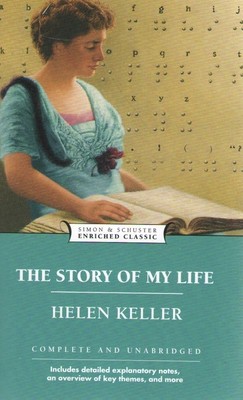
The Story of My Life

The Story of My Life
by Helen Keller

I had of course heard of Helen Keller and, knowing that she became a highly respected feminist, socialist and equal rights activist, I thought the story of her life might be pretty interesting. However, this book was written when she was in her early 20s, still studying at university, so really it’s all about her being deafblind. And that could still have been good, but, well, I found it odd.

That’s not to say it’s badly written, or even bad. For those not familiar with her, Helen Keller was the first deafblind person to receive a bachelor of arts degree, back in 1904. The fact that she was educated at all was pretty unusual for the time, and when she showed intellectual promise she became a bit of a sensation, which I guess is why she was able to publish an autobiography when she was still so young.

“When I try to classify my earliest impressions, I find that fact and fancy look alike across the years that link the past with the present. The woman paints the child’s experiences in her own fantasy.”

It’s certainly interesting to read a first-hand account of her early education – being introduced to the concept of words and language is already something I find fascinating, but how do you bring that concept to someone who can neither see the objects nor hear the words?

“Children who hear acquire language without any particular effort; the words that fall from others’ lips they catch on the wing, as it were, delightedly, while the little deaf child must trap them by a slow and often painful process. But whatever the process, the result is wonderful.”

The answer is largely via touch. Keller lost her sight and hearing aged 19 months and didn’t begin her education until she was 7. In-between she had formed her own understanding of the world through touch and an improvised sign language and remembers happily playing with the cook’s daughter and her own little sister. But once her family employed Anne Sullivan, a partially blind woman who had attended a special school for the blind, as her governess, she finally discovered language.

“There is nothing more beautiful, I think, than the evanescent fleeting images and sentiments presented by a language one is just becoming familiar with – ideas that flit across the mental sky, shaped and tinted by capricious fancy.”

It does suffer from being written by someone so young. It’s a bit naïve and quite defensive – I get the impression negative things had been written about her in the press and one of the aims of this book was to redress those points, which is understandable but doesn’t make for great writing. She also generalises quite a lot, not acknowledging that her situation is unusual not just because of her disability but equally because of the help she received.

It may seem like an odd reaction, but it bothered me that Keller didn’t seem aware of her advantages in life – clearly her family had money to invest in her education and her little bit of fame helped her too. Admittedly, the final chapter is basically one long acknowledgements section, but really many of those names and anecdotes should have been integrated into the main story, rather than it appearing that she got everywhere she did under her own steam. I know it’s not her fault that she is so often dependent on others, but I found it very odd to read, for example, the sentence “I enjoy a spin on my tandem bicycle” with absolutely no mention of the fact that someone else would always have to cycle it with her.

It is weird now how she was considered such a sensation purely for her disability, and perhaps I am a little hard on her because the tone is so very much in the vein of ‘look how much I’ve achieved’, which I find grating. Knowing that she later used her education, fame and experience to help others softens me toward her, but she isn’t yet that person when writing this. I am also a little put off by the religious overtones and language, which are partly of course a product of her time, and possibly even the nature of the books available to her in Braille.

The book is genuinely interesting when she discusses how she interacts with the world and how she learned to communicate – I would have liked more detail about that. In the early chapters you might be forgiven for not being sure what her disability is, as she often describes sights and sounds. It is quite a long way through the book when she acknowledges that “so many of my impressions come to me through the medium of others’ eyes and ears”. I loved the descriptions of her conversing with others by placing a hand on theirs as they sign words letter by letter using ASL. Or of her reading lips using her fingers. It is so hard to imagine and she manages to at least open the door to her world a crack.

“Silence sits immense upon my soul. Then comes hope with a smile and whispers, ‘There is joy in self-forgetfulness.’ So I try to make the light in others’ eyes my sun, the music in others’ ears my symphony, the smile on others’ lips my happiness.”

First published 1903.

Source: Project Gutenberg.

Challenges: This counts towards the Rory Gilmore Reading Challenge.

Kate Gardner Reviews

Holiday catch-up

October 10, 2013October 14, 2013

I have finally finished my first sweep through the holiday photos, so I thought I’d write a few tidbits about our trip to Sicily while the memories are fresh and the remnants of having thoroughly chilled out for a week are just about detectable.

We picked Sicily for two reasons: we like Italy (great food, great wine, great art, lovely people) and one of the ways to get there is via a train that goes on a boat! Guess how we travelled! Sadly we only had a week off work so we couldn’t sensibly do the whole journey by train (we did that four years ago to Florence and I can highly recommend it) but we were able to fly from our local airport to Rome and then catch the sleeper train to Sicily. It’s pretty basic as sleepers go – no dining car (we felt like royalty when we dined on the sleeper train from Paris to Florence, it was seriously classy) – but I still love the experience of falling asleep to the chug of the train, peeking behind the window blind at the lights of the towns and cities as you rumble past. The service arrives at the ferry port at a slightly unsociable 6am, which may be why Tim and I were almost alone up on the decks of the ferry (you can choose to stay on the train or get out for the half-hour crossing) but I feel my overexcited inability to stay asleep paid off as watching the sun rise as we pulled in to Messina harbour was pretty special.

Welcome to Sicily

The rest of the train journey was pretty beautiful: the sea on one side of us and Mount Etna on the other. Sicily really is gorgeous. Thankfully that includes Siracusa, where we stayed for a week of relaxing, eating good food and ogling fancy millionaires’ yachts, enjoying the warm sunshine and sea air.

Untitled

We stayed on the island of Ortigia, which is the historic district of Siracusa and it’s exactly what that suggests: old narrow streets, lots of churches and pavement cafes, largely pedestrianised, well looked after. The rest of the city doesn’t have so much to recommend it, but we did venture out to the Archaeological Park to look at the remains of the Greek ampitheatre and other ancient ruins.

Untitled

I swam in the Med for the first time in my life. And we spent a couple of evenings sat in a bar on the harbourside just watching the sun set. Man, I’m jealous of two-weeks-ago-me right now.

Untitled

On the way home, we had a half-day in Rome so we had a walk around the Roman Forums and Colosseum. Frankly the former were more impressive, but that might be the combination of crowds of people around the Colosseum, our camera battery dying just before we reached the Colosseum and the skies getting distinctly grey at that point.

Untitled

One thing Rome does have going for it is an absolutely giant bookshop in the Termini train station. In fact Italy in general seems to have a lot of bookshops still, which was nice to see.

Okay, that’s enough reminiscing. I miss holiday. If you want to see more of my holiday snaps, I am gradually adding to them to a set on Flickr.

Now the question is, do I carry on learning Italian using the Duolinguo app (which to be honest I think increased my confidence much more than my ability!) or pick a new language to learn a smattering of? (This question is also known as the Now That Holiday Is Over Where Shall I Plan To Go Next Syndrome.)

Kate Gardner Blog

Watching the vanishing sunset against the deepening blue

October 6, 2013

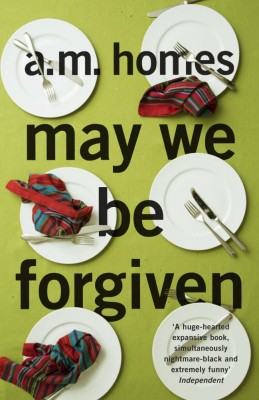
May We Be Forgiven

May We Be Forgiven
by A M Homes

This is a strange book that at first I – not exactly struggled with, but I did wonder if I should be engaging with it more. A lot happens and it covers quite a range of issues, but with a sense of humour and fun that kept me reading on.

It’s the story of a year in the life of Harry, a middle-aged history professor who has an obsession with Richard Nixon and, at the start of the book, a wife he seems to have no emotional engagement with. After Harry’s brother George has a car accident that leaves him mentally unbalanced and a young boy orphaned, Harry’s life changes out of all recognition, as does he.

“Was there ever a time when you thought – I am doing this on purpose, I am fucking up and I don’t know why.”

The book is very fast-moving to begin with, in fact I realised on page 20 I’d missed something huge even as another huge event was happening, but the bulk of the book is about the fallout from those events and the pace settles down.

Similarly, to begin with Harry’s narration is odd and unengaging but he gradually becomes a warmer character. If I were to summarise his story arc it would probably sound trite or possibly even soap-opera-like, but it’s actually funny and nuanced and, for the most part, feels real. The book deals with death and grieving, mental illness, loneliness, third world aid and the vulnerability of both children and old people. But it’s a pretty chunky book so there’s plenty of room to explore those issues without it getting too heavy.

“‘Were we always Jewish?’ Ashley asks.
‘Yes.’
The ceremony concludes, and one of the guests turns to me and says, ‘Given the circumstances, I think the rabbi did a very good job. What did you think?’
‘It’s my policy not to review funerals.'”

The humour grew on me as I got used to Harry, and was sometimes surreal, though it was also sometimes crude. And while Harry became a warmer character, I’m still not sure I really liked him by the end. I certainly cared how things turned out for him, which I guess is what matters.

“There’s something wonderfully melancholic about being outside on a spring evening watching the vanishing sunset against the deepening blue; the outlines of the old thick trees, full of bright fresh leaves, the surprising, gentle tickle of a breeze, and it somehow feels so good to be alive.”

Published 2012 by Granta Books.
Winner of the Women’s Prize for Fiction 2013.

Source: Amazon.

Kate Gardner Reviews

Neil Bartlett puts Great Expectations on stage

October 3, 2013

Great Expectations
Bristol Old Vic, 2 October

Great Expections at Bristol Old Vic
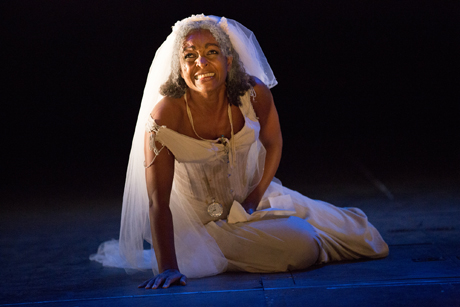
Adjoa Andoh as Miss Havisham. Photography by Mark Douet.

This new stage adaptation of Dickens’ great novel had the atmosphere right from the very first moment. Though I was initially thrown by the unusual staging, I immediately knew where I was and with whom, and greatly enjoyed reliving the story of Pip.

The first impression can’t help but be that staging, with a sparse set and minimal props (at one point the actors were stood in a completely empty black stage) and most of the cast on stage for key scenes, acting as a chorus of voices and/or visible stage hands. I did find this initially distracted me from the acting but once you get used to it it’s actually very effective and immediate.

The cast (especially Tom Canton, who played Pip) narrated the story as well as acting it, often switching between the two mid-sentence. A lot of Dickens’ original language has been absorbed into both the script and the acting, which makes sense of and emphasises the beauty of the language. I laughed out loud but I also came close to tears several times.

That is something the play does brilliantly – it gets Dickens’ humour and really uses it. Dickens characters are notoriously a mix of caricature and realistic, and the acting reflected that, with some characters (e.g. Miss Havisham’s relative Sarah Pocket, played by Miltos Yerolemou) consistently playing it for laughs. However, I did think Estella and Miss Havisham might have merited a few more subtle moments. Pip is just the right mixture of pathos, innocence, frustrating boy making mistakes and downright arrogant/self-serving young man.

I loved the use of doors as props – it was original and effective. For instance, the bewildering size of Miss Havisham’s house was created by having several actors holding doors that they move around to create a maze of corridors. However, the other major prop – microphones on stands – I was less convinced by. The actors would occasionally speak into the microphones to add sound effects, which sounds good on paper but again was something that for me jolted me out of being absorbed by the story and reminded me that these were actors on a stage.

Overall, though, the sound staging was excellent and formed a big part of the wonderfully chilling atmosphere. And that scene, you know, the last one with Miss Havisham (played by Adjoa Andoh), was absolutely brilliantly staged, with Andoh putting her heart and soul into it. I’m so glad they really went for it. It’s supposed to be a big dramatic moment and deserves this treatment.

The more I reflect on it, the more I realise how well this adaptation was done. In just 2.5 hours they get to the heart and soul of a fairly big, dense work of fiction. They even made me want to go back and read Dickens, which isn’t something I’ve wanted to do for a few years now!

Disclaimer: Tickets were kindly supplied to me by the theatre in return for an honest review.

The show runs until 2 November.

Kate Gardner Blog

The earth had become a strange and placid panorama

October 1, 2013

Over the Front in an Aeroplane

Over the Front in an Aeroplane
and scenes inside the French and Flemish Trenches

by Ralph Pulitzer

I spotted this piece of journalism when I was browsing Project Gutenberg for books to add to my Kindle. I’m not a big fan of novels about fighting wars but for some reason wartime journalism interests me. (It might be because for a while in my youth I aspired to be Kate Adie.) As far as I can tell this book is sadly now largely forgotten and I’m sure there are better accounts out there of the First World War, but I liked this and thought Pulitzer did a good job of describing the war to the folks back home in the US.

“‘So far,’ an English staff-officer remarked to me, ‘we English have been bungling amateurs in the art of war contending against trained professional specialists. But with a couple of years’ more experience I believe we shall know as much about it as they do, and then we shall win.'”

This Pulitzer, by the way, was the son of Joseph Pulitzer, the newspaper magnate who bequeathed money to Columbia University that became the Pulitzer Prizes. In 1911 Joseph died, making Ralph the head of a major news corporation aged just 32. Which perhaps explains why in this book Pulitzer is not treated just as any other journalist. In fact, he devotes a whole chapter to the average journalistic experience of the frontline, which he makes sound quite cosy, if also frustrating (good food and hotels, not much access to the action).

“With a snap and a roar the battle plane started slowly forward, gained in speed till we were running along the big field like a racing automobile, then suddenly the people standing around dropped away from us as if on a gigantic express elevator leaving one standing on the upper floor of a skyscraper, and in a moment more the earth had become a strange and placid panorama with which we had no connection or concern.”

Pulitzer spent a month – August 1915 – in France and Belgium visiting various sites on or near the frontline. The book is structured in a slightly odd way that feels as though it may have been a series of columns before it was a book, or perhaps that was just his ingrained writing style. Each chapter details an experience of some kind, from the first and title chapter of flying over the frontline near Paris, to a grenade-throwing lesson, to a comparison of the French and Belgian trenches.

Each experience necessarily begins with making nice to the relevant generals and in early chapters the many levels of command to be met and receive hospitality from is detailed perhaps a little more than necessary, but it certainly gets the point across that no journalist, even Pulitzer with his extra special access, can truly claim to have experienced the frontline like any soldier. There are descriptions of meals that had me salivating, including plenty of wine, champagne and brandy.

“The officers of all the armies feel that it is infinitely more important to prove to you that they can give you a good cup of coffee and a good cigar than it is to show you the most beautiful battle that was ever fought.”

It was genuinely fascinating to read an account from so early in the war that was nevertheless aware that this fight would continue for a few more years, from an American whose country was not involved in the war but knew it almost certainly would become involved. Pulitzer shows boyish excitement about technological advances in weaponry (i.e. fancy new guns) but also talks about the human cost of war, both in lives lost and in homes/villages/ways of life lost.

“One must realise that [the Belgians] are practically an army without a country. One must understand that when they get furloughs they cannot spend them with their families in their homes, getting comfort and encouragement. They either stay within sound of the firing or spend a bleak six days among the strangers of England or of Northern France.”

Published 1915 by A L Burt.

Source: Project Gutenberg.

Kate Gardner Reviews

Posts pagination

1 … 81 82 83 … 126

Archives

RSS feed: Nose in a book Nose in a book

  • Book review: Taiwan Travelogue by Yáng Shuāng-zǐ
  • October 2026 reading round-up
  • Book review: The Coral Bones by E J Swift

Me on the internets

  • @kate_in_a_book@mas.to (Mastodon)
  • Flickr/noseinabook
  • Instagram/kate_in_a_book
  • StoryGraph/kate_in_a_book

Categories

  • Blog
  • Reviews
  • Uncategorized
  • © Copyright Kate Gardner. All rights reserved.
Proudly powered by WordPress | Theme: Dream by vsFish.