Nose in a book

Reviews and other ramblings

  • Home
  • Reviews archive
    • Book reviews
    • TV reviews
    • Theatre reviews
  • TBR
  • Challenges
    • The Classics Club
    • 2014 Popular-Science Reading Challenge
    • Cookery challenge
    • The Gilmore Girls Reading Challenge
    • 2013 TBR Pile Challenge
    • 2013 Translation Challenge
    • Crime and Punishment read-a-long
  • About
    • Cookie legal stuff
  • Home
  • Reviews archive
    • Book reviews
    • TV reviews
    • Theatre reviews
  • TBR
  • Challenges
    • The Classics Club
    • 2014 Popular-Science Reading Challenge
    • Cookery challenge
    • The Gilmore Girls Reading Challenge
    • 2013 TBR Pile Challenge
    • 2013 Translation Challenge
    • Crime and Punishment read-a-long
  • About
    • Cookie legal stuff

Tag: science fiction

BristolCon11: science

November 12, 2011 1 Comment

There were two panels at BristolCon based around “real” science: “When did science become the bad guy?” and “Sci-fi now”. Both were interesting discussions and shared a few panel members so I thought I’d write them up together.

(Apologies by the way, for the scatty and delayed nature of this post. I wrote it weeks ago and then NaNoWriMo started and I didn’t get round to tidying it up. And now I must get back to writing that novel…)

Tim Maughan kicked us off with the declaration that science is not considered uncool itself, but understanding it is. All these shiny new TV shows about science are pretty but have little or no depth, and certainly don’t teach anything new (though, as a counterpoint, he still rates Sky at Night). Eugene Byrne suggested that this dumbing down was part of a general increased shallowness of the media. In fact, he was quite positive, comparing the 1980s general fear of science to the current feeling that science is an important tool and the great enthusiasm for technology and gadgets. He also controversially put forward the idea that raised tuition fees will be good for science, because potential students will likely lean towards more practical subjects with firmer career prospects.

Simon Breeze made the suggestion that the Internet generation couldn’t build the Internet, which I have to say I disagree with. But I could see how someone might think that – as Jonathan Wright pointed out, technology has advanced so much so quickly that you can’t just learn how things work by taking them apart. Tim Maughan added the interesting point that state schools in the UK teach computing, including HTML and basic coding, but public schools don’t go near it, staying as always behind the times but also creating an odd reverse snobbery.

But what about the cool future science we all thought we’d have by now and don’t? This discussion kept coming back to the idea that technologies are developed when we need them. And of course some things turn out different from exactly what was envisaged. Paul McAuley thought teleportation might be useful, but suggested that the long queues for the booths might make it only fractionally quicker than flying. And drones barely feature in old science fiction yet are becoming scarily real (in military use). Tim Maughan pointed out that the car that drives itself is imminent and Eugene Byrne suggested that increased age and disability in western populations will accelerate technologies like robot cars. Dev Agarwal suggested that the same might be true of investment in cybernetics – e.g. for making people walk again.

The panel all agreed, in response to an audience question, that the future science fiction of 1984 is scarily close to coming true – and we’re all willingly helping it along. From Internet security measures that save our every search term and movement on the Web, to store cards that track our purchases, to CCTV, to social media where we announce our every action, we are creating the surveillance culture that Orwell envisaged, only we’ve forgotten to be horrified by the idea.

Thought-provoking stuff.
Kate Gardner Blog

BristolCon11: the books

October 25, 2011 2 Comments

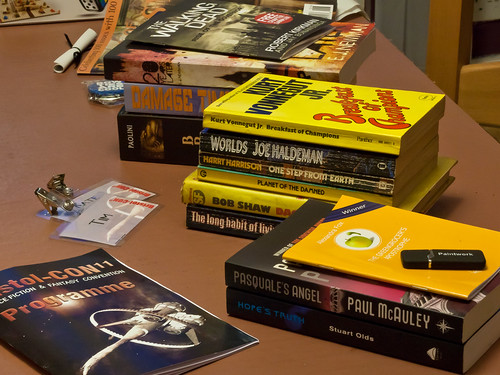
I’m finally getting round to writing down some thoughts about Saturday’s adventures at BristolCon. There’s so much to tell that I will come back to this topic again. But let’s start with the spoils. These are the books that Tim and I came home with:

The spoils

That’s a combination of free, secondhand and new books. There were also badges and fridge magnets and goodness knows what else in our goody bags. The USB stick in the picture is yet another book, in digital form, by local author Tim Maughan. My TBR is most definitely up in three figures again!

I should probably mention that it will likely take me some time to get round to reading any of those books because this year I am taking part in NaNoWriMo, so all my November free time is going towards that. (Which also means that theoretically I will be blogging less.)

In general I loved the day and I’m torn between wanting it to be much better known and bigger next year, and liking it small and friendly as it was. The day ended with a quiz that Tim and I came last in, so despite thinking we’re pretty geeky, turns out we have a lot to learn!

Kate Gardner Blog

Categories aren’t always helpful

October 21, 2011

A History of the Twentieth Century, with Illustrations
a novelette by Kim Stanley Robinson

In preparation for tomorrow’s jaunt to BristolCon, I have been reading some sci-fi short stories this week. Tim recommended this one, which has stuck with him for years (though it may not quite count as sci-fi). You can read it online here.

It’s the story of Frank Churchill (no idea if the Austen reference is deliberate), a writer of history books who is living in New York and taking “light therapy” in an attempt to alleviate his depression. It doesn’t seem to be working so he reluctantly accepts an offer to travel to London to write a complete history of the 20th century, figuring that the UK’s longer hours of daylight in summer will save him having to attend therapy.

The bulk of the story is about his research, with daily trips to the reading room at the British Museum. His findings form part of the story, a sorry litany of war after war after war. Obviously that’s a limited view of the century but it’s certainly believable that in future it’s all that will be remembered.

As with my previous experience of Robinson (or “Stan”, as I believe his friends know him), it’s all about the main character. In the background lurks a vague sense of apocalypse, of things unexplained, but at the forefront is an everyday, relatable human being. Frank is deftly created, a few words rustling up a lifetime of backstory. Every location is described with what feels like insider knowledge, without it becoming a list of buildings and street names (believe me, it happens). I often find that a short story isn’t long enough for me to really care about the outcome but I definitely cared about Frank.

I greatly enjoyed this story and it reminded me that I really should go back and finish Robinson’s Science in the Capital trilogy.

First published in Isaac Asimov’s Science Fiction Magazine in 1991. Reprinted in Remaking History and other stories (Orb, 1994).

Kate Gardner Reviews

Time-travelling horrors

October 16, 2011March 11, 2012 2 Comments

The House on the Strand
by Daphne du Maurier

I read this book as part of Discovering Daphne, an event/readalong run by Savidge Reads and Novel Insights. I seem to have skipped the book that they both raved about (Mary Anne) and chosen to join in with another that didn’t entirely bowl me over.

This is one of du Maurier’s stabs at science fiction (though Tim and I are still debating whether Rule Britannia counts as SF or even speculative fiction). In this instance she’s looking at time travel, but with a curious twist, and really it’s a book about a marriage in trouble and the effects of addiction. Intrigued? I was.

First off, I was thrown to have a male narrator. I don’t think du Maurier does a bad job of giving Dick Young a realistic male voice, but I never warmed to him. He’s middle aged, has just quit a publishing job he disliked in London and is trying to find an alternative to the future his American wife has planned, which is to work for her brother’s publishing firm in New York. To give him some breathing space, his good friend Magnus (or, “the Professor”) has loaned Dick his cottage in Cornwall for the summer rent-free. The only catch is that Magnus has persuaded Dick to try an experimental drug he has produced – a drug that takes the mind back six centuries in time while the body remains in the present.

It’s an unusual idea and du Maurier has thought through the practicalities. Each “trip” lasts a few hours so Dick can sneak them in when his wife and stepsons are not around, though he cannot hide the side-effects from them. It being a small community – and indeed an even smaller one in the 14th century – Dick quickly gets to know the characters that he sees on his trips and is increasingly fascinated by their lives – who is sleeping with who, who is loyal to who – in a way that he would never care about gossip in his own world. He is particularly intrigued by the beautiful Isolda, who he learns early on is married but does not care for her husband.

There are drawbacks to this method of escaping from reality. Dick is seen wandering aimlessly through field and marsh after his invisible cast. He starts to conflate past and present, confused about what has happened in reality. He gets bad tempered with his family and his wife’s friends, constantly distracted by where this or that particular manor house from the 14th century must have stood. He looks up the people from the past in local archives, obsessing about every detail of their lives. He starts to need more of the drug for it to work and suffer worse side-effects.

All of which is gripping and well written and a believable picture of dangerous drug addiction. The problem is, all of the stuff in the past I found deadly dull. The relations between people and their allegiances I found confusing; for the first half very little happens in the past; and I just didn’t care about any of the historical characters. Which is a problem when we are supposed to believe that they are fascinating enough for Dick to become obsessed. The thing is, this is another case where du Maurier has been doing her historical research and has used genuine historical figures of significance to her (in this case the people who lived in and near her beloved Fowey) to build a story around. But she has put in too much of the dull stuff you can learn from archives – names, dates, facts – and not enough character and storyline. It’s a shame when she has used her research so well in other books (e.g. The Glass-Blowers).

It’s fascinating and shows that du Maurier had many strings to her bow, but it’s not her best. Next up in Discovering Daphne? Don’t Look Now and other stories, to be discussed next Sunday.

First published in 1969 by Victor Gollancz.

Kate Gardner Reviews

Back to the classics

September 20, 2011March 11, 2012

The Time Machine
by H G Wells

The Time Machine

This is one of those greatly revered classics that made people look on with admiration while I was reading it, but actually isn’t a particularly hard read. It’s also not the most engaging, but it is full of Big Ideas.

And that’s both its strength and its weakness: this is an intellectual exercise more than it is a piece of entertainment. Wells was a scientist and drew on new exciting ideas in science to create a vision of the future that in its time would have been shocking, provocative, beyond credible and startlingly different from anything else, whereas now the science is widely known and accepted, what is left is a slightly bald political parable.

Somehow I came to this without really knowing the story. I mean, I’ve seen and read references to it (both Family Guy and Futurama have episodes devoted to this story) but I hadn’t seen any of the film versions or read a synopsis so some of it was a surprise to me.

The Time Traveller (as he is known throughout the book) has gathered together a meeting of London intellectuals to tell them about his new invention, the Time Machine. When they don’t believe him, he tells them to come back a week later when he will have seen the future, and it is his account of this trip to the future that forms the bulk of the novella. The format is slightly odd, in that an unnamed (indeed, un-anything) first person narrator attends these two meetings and records them in a manner somewhere between a journalist and a scientist, so that it’s fairly dry but with the occasional interjection of emotion.

The first thing that struck me was that this isn’t that familiar narrative of jumping a few years at a time into humanity’s future, finishing with a quick trip to the end of the world. The Time Traveller jumps straight beyond the human race as we know it, to the year 802,701 AD, and most of the story is set in that one time (though there are a couple of further jumps forward). In this future, human beings have evolved into two distinct species – the gentle, childlike, darkness-fearing Eloi and the ominous, monstrous-looking, light-fearing Morlocks. The Time Traveller can only conjecture how these races came to be and recounts more than one theory that he subsequently rejected upon further observation.

This means that we cannot necessarily trust the Time Traveller’s interpretation, and indeed his descriptions are a little sparse. Can we be sure that these creatures are all that human-like? When he acquires a female Eloi companion he tells us that she is called Weena and she is really the only character to have a name, almost as if he is trying a little too hard to humanise her.

Without being shocked by the conceit of suggesting that mankind might one day evolve, the political allegory seems a little heavy-handed. Wells paints an extreme end to the widening gap between rich and poor, with the idle rich becoming the Eloi and the industrial working class becoming the Morlocks. There is also an interesting point about both having lost the need for intellectual capacity, because “Only those animals partake of intelligence that have to meet a huge variety of needs and dangers.”

I will admit I was more scientifically interested in the descriptions of the further future, with geological timescales having passed, where Wells describes not only an ice age but also changes to the Sun, the Earth’s orbit, various stars, the Moon, tides, even other planets in our solar system. He was building on recent discoveries in physics and this description was no doubt just as revolutionary (and possibly just as provocative) as his evolved humanoids, but it is also beautiful. The story of the Eloi and the Morlocks is essentially a sad one but the continuation of Earth through immense changes in the solar system is somehow uplifting and inspirational.

As a story, I was a little disappointed in The Time Machine – I didn’t find it engaging, the characters are deliberately insubstantial and many of the ideas no longer appear original or daring. However, it is still a clever, inventive take on the travellers’ accounts that it is built on.

First published 1895.

Kate Gardner Reviews

Future terrors

September 14, 2011March 12, 2012 2 Comments

The Handmaid’s Tale
by Margaret Atwood

My immediate reaction on finishing this book was “Oh wow” (in fact, I think I tweeted exactly that). I am so grateful to my book club for getting me to read it and suspect it will be a book to come back to, time and again.

This is an amazing, intense, important story that is also gripping and immensely readable. Atwood cleverly dripfeeds information about what exactly is going on, which makes it a little difficult to describe without any plot spoilers, and because of this I’m extra glad I was able to have a book club discussion about it.

The book’s title and the Bible quote at the start of it (Genesis 30:1–3) make reasonably clear at least one element of the story, even if the details are only slowly filled in. The society in which this book is set, the Republic of Gilead, designates certain women as handmaids and their sole purpose is to bear children. A handmaid is assigned to a married couple who have been unable, for whatever reason, to have children themselves. The handmaid is stripped of her former name and must wear a uniform that immediately identifies her role and hides her body and face, as well as obscuring her view of the world. It is a curiously old-fashioned situation in what appears to be a near-future North American setting. But it is of course far more complicated than just this and has its reasons for being as it is.

One other thing that is clear from the start is that there is a great fear of the state, via hidden spies or cameras or just loyal citizens willing to speak up about any trangressions of the many rules. One of these rules is that handmaids may not read or write at all, a rule so strictly enforced that the heroine obsesses over one written word that she sees every day. This society places a lot of emphasis on role and status, with the privileged as well as the less so immediately marked out by their clothing. It is a terrifying vision of a totalitarian state (and not just because of the reading and writing thing) partly because as you trace the steps that were taken to create it, it is conceivable that it or something similar could happen. As the narrator says in a prayer:

“If they have to die, let it be fast. You might even provide a Heaven for them. We need You for that. Hell we can make for ourselves.”

But it’s not at all a difficult or even challenging read because its narrator is so engaging and real. The handmaid of the title never reveals her former name, but between documenting her life as a handmaid she reminisces about life before and through that we learn about the background of the current regime as well as about her. It is her job, as a handmaid, to be a vessel and no more and as a narrator she is also a vessel for revealing an exercise in science fiction, but she is also an ordinary, relatable human facing extraordinary circumstances (to us, anyway). She vacillates between embarrassment of and admiration for her mother. She is trying desperately to survive, no matter what it takes, and yet contemplates methods of suicide. She has a fondness for flowers and word games.

Though by no means a comedy, there is a certain wit to Atwood’s writing. Even in the loneliest moments when the world is cold, a small detail seen or heard or remembered will be warm, familiar even.

****Spoiler warning – you might want to skip this paragraph if you’ve not read the book ****

This book was first published in 1985 and to an extent it reveals the fears and preoccupations of its time. Gilead might be described as a fundamentalist state, making it a crime to follow any other than the state religion. The world has suffered as a result of chemicals in the water supply and nuclear reactor meltdowns. There has been an AIDS epidemic and there have been riots over abortion. The same book written now might choose slightly different background events than these, though they are all, of course, still relevant.

****End of spoiler****

At book club we discussed how this future vision is not only possible but could almost be said to be happening in certain strict Islamic states. Indeed, in the decade before this book’s publication Iran suddenly went from being a modern, egalitarian place to a totalitarian, fundamentalist country with women suddenly driven out of higher education and most jobs, suddenly forced to dress and behave differently.

“Women” really is the key word. Though not militantly so, this is a feminist text. It is the story of men either choosing to or being complicit in the subjugation of women. Because we see the world through the handmaid’s eyes, we never really learn much about the lives of men in the Republic of Gilead, but from what we do see their lives are not nearly so bad as for women.

This is not the first Atwood I have read but it is probably the best. It definitely makes me want to read more of her work, particularly any that fall into the speculative/science fiction category.

First published by McClelland and Stewart in 1985.
Winner of the 1985 Governor General’s Award and the 1987 Arthur C. Clarke Award. Nominated for the 1986 Nebula Award, the 1986 Booker Prize and the 1987 Prometheus Award.

See also: review by Connie at The Blue Bookcase.

Kate Gardner Reviews

Dipping my toes in

August 4, 2011March 11, 2012 6 Comments

Two Tales and Eight Tomorrows
by Harry Harrison

Having noticed that my last two book club reads were a tad heavy on the religion front, Tim recommended that I read the Harry Harrison short story “The streets of Ashkelon” and dug it out for me. It happened to be the first story in this collection and I enjoyed it so much I carried on reading the rest of the book.

This was my first experience of Harry Harrison (I think) and I was impressed. Each story has a unique, often complex sci-fi setting but the tales told are very human, accessible and warm. The details of space transport or alien beings are given but not lingered over, except where they are a plot point.

I liked every story but I can see why the blurb on the back cover picks out two in particular. “The streets of Ashkelon” looks at a peaceful, literal-minded alien race who have no concept of gods or religion, until man intervenes. It is an awful and thought-provoking parable. “I always do what teddy says” is just as chilling as that title suggests. Every child has a teddy bear that is programmed by the government to teach children everything from manners to morals. Which is clever but terrifying and, of course, though the idea behind it is to create a better world, there is the potential for a frightening level of manipulation.

My other favourites were “Captain Bedlam” – in which the precise details of space travel are kept a closely guarded secret from the public and space pilot Captain Jonathon Bork feels a complete fraud but can never tell anyone why – and “Rescue operation”, in which an alien falls into the ocean near the coast of a very rural Yugoslav village and visiting astrophysicist Dr Kukovic must cope with narrow-minded fear and lack of provisions in his attempt to keep the alien alive.

There was a certain tendency toward military characters, but that is really my only qualm about these stories and I look forward to reading more from Tim’s vast Harry Harrison collection.

This anthology first published 1965 by Victor Gollancz.
A publication history of each story can be found on Harrison’s website.

Kate Gardner Reviews

Out of this world: science fiction, but not as you know it

June 28, 2011 3 Comments

Attack the books

“Out of this world” is a free exhibition running at the British Library from 20 May to 25 September 2011. It’s an exploration and celebration of science fiction, centred around the library’s collection of first editions and other valuable copies of great books.

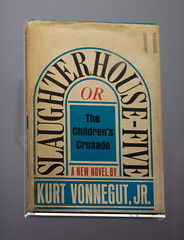
Slaughterhouse-Five

It’s a much bigger and frankly better exhibition than I expected. Like a typical museum show, there are themed cases containing numbered exhibits and a knowledgeable description of each exhibit. There’s also video, audio, interactive stuff and some random memorabilia, plus a series of related workshops. And it has its own mini-website, of course: www.bl.uk/sciencefiction.

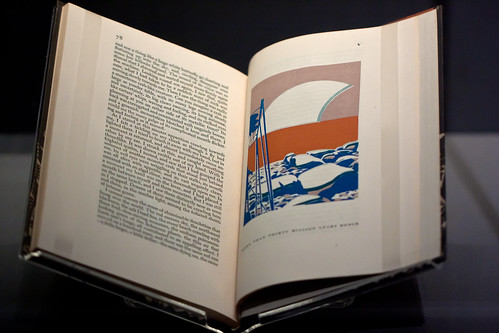
The Time Machine

It has clearly been designed by a team of people who love and respect science fiction and tease out not only the usual obvious questions that SF can deal with, but also some more obscure or difficult ones, such as “What is reality?” and “What does it mean to be human?”

Out of this world

Mostly I just geeked out on the beautiful old books and manuscripts (which tended to be on loan from authors or other museums) but I also added many many books to my wishlist. Highly recommended to anyone who can get to London.

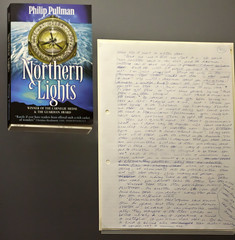
Northern Lights

Kate Gardner Blog

War novels do not necessarily glamourise war

February 17, 2011March 11, 2012 2 Comments

Slaughterhouse 5
or, The Children’s Crusade: a Duty-Dance with Death
by Kurt Vonnegut, Jr

Slaughterhouse-Five

This is a book I had been meaning to read for a long time. I bought it, some people recommended it, and I got excited and lined it up for the recent 48-hr TBR read-a-thon. Then someone else told me it was really hardgoing and I got scared of it. Then some lovely people on Twitter encouraged me to give it a go anyway so I did. Yes, it’s a little crazy but it is a great great book.

There are no surprises in this book. Everything is laid out in chapter one, which is actually a sort-of prologue, or a “Why I wrote this book”. Vonnegut’s style takes a little getting used to. It’s chatty in a realistic kind of way, by which I mean that it’s not always fluid, jumping around between subjects, but not in a stream of consciousness way.

The central story is that of Billy Pilgrim, a WWII soldier, prisoner of war, optometrist and time traveller. At least, he says that he was kidnapped by aliens on the night of his daughter’s wedding and ever since has been able to travel around in time the way they taught him to. This allows his life story to jump around in time, only dealing with the horrors of war in small chunks. I was never entirely clear how seriously we’re supposed to take the time travel thing, or whether Billy himself really believes it. But it makes sense for a person whose whole life has been coloured by the awfulness of witnessing the Dresden firebombing, who was institutionalised and became a fan of cheap science fiction, to latch onto this coping mechanism.

Vonnegut gives Pilgrim a lot of his own wartime experience, often stating things like “I was there too”. It is unclear how much Pilgrim is himself or how much Pilgrim is other people he observed during the war. Despite the awfulness of what both men observed, Vonnegut doesn’t linger on gruesome details. Though they are there, this book is primarily about the emotional impact of war. He states early on that this is an anti-war book and that is undeniably true. There is a very telling quote directed at his publisher: “It is so short and jumbled and jangled, Sam, because there is nothing intelligent to say about a massacre.”

Despite the tough subject matter and obscure manner of storytelling, this is a tender, funny book. It is moving and also oddly innocent – Vonnegut’s subtitle is certainly apt. He shows great sympathy for dogs, horses and children, which challenged my assumption that a war veteran would be hardened emotionally.

First published 1969.

Kate Gardner Reviews

Little Friday review

October 29, 2010

Little Lost Robot
by Paul McAuley

This is actually a short story, not a novel, that Tim had been trying to get me to read for some time. It was first published in Interzone, which has been home to some excellent science fiction, so I finally gave it a go.

The story begins impersonally, describing the “superbad big space robot” as it travels through the universe, fulfilling its killing mission. Gradually it becomes more and more personal. The machine has four “subselves”, programs I suppose, that run it together, in collaboration. They repair damage, formulate tactics, arm weapons and discuss their next move. Over time the robot has taken a lot of damage, including to its memory, and this is where it gets interesting.

It’s such a short story that I’d rather not give away much more than that. I found myself a little doubtful that I would like the story at first. It was a robot at war, described distantly and with reverence. But the story slowly zeroes in on the robot’s Librarian subself, imbuing it with something approximating personality, self-doubt, humanity even. It’s a very cleverly written and structured piece and toward the end I definitely felt warmth for this cold space warrior.

It probably helps, reading this, to have some familiarity with computing terminology. The robot uses a combination of strictly mechanistic terms (time periods in teraseconds, rather than being broken down into years) and oddly human terms (anger, loneliness, tenderness).

The story wasn’t what I expected. The title suggested to me something cute and sweet, maybe Wall-E-like and, though there are similarities, that’s not what this is. This is the super-efficient soldier slowly revealing his inner humanity and it’s definitely touching, but it’s not cute.

Published 2008 in Interzone 217. You can read it here or listen to it here.

Nominated for the BSFA Award for Best Short Fiction 2008.

Kate Gardner Reviews

Posts pagination

1 … 4 5 6

Archives

RSS Nose in a book

  • Book review: Interstellar Megachef by Lavanya Lakshminarayan
  • May 2026 reading round-up
  • Book review: Passing by Nella Larsen

Me on the internets

  • @kate_in_a_book@mas.to (Mastodon)
  • Flickr/noseinabook
  • Instagram/kate_in_a_book
  • StoryGraph/kate_in_a_book

Categories

  • Blog
  • Reviews
  • Uncategorized
Proudly powered by WordPress | Theme: Dream by vsFish.