Nose in a book

Reviews and other ramblings

  • Home
  • Reviews archive
    • Book reviews
    • TV reviews
    • Theatre reviews
  • TBR
  • Challenges
    • The Classics Club
    • 2014 Popular-Science Reading Challenge
    • Cookery challenge
    • The Gilmore Girls Reading Challenge
    • 2013 TBR Pile Challenge
    • 2013 Translation Challenge
    • Crime and Punishment read-a-long
  • About
    • Cookie legal stuff
  • Home
  • Reviews archive
    • Book reviews
    • TV reviews
    • Theatre reviews
  • TBR
  • Challenges
    • The Classics Club
    • 2014 Popular-Science Reading Challenge
    • Cookery challenge
    • The Gilmore Girls Reading Challenge
    • 2013 TBR Pile Challenge
    • 2013 Translation Challenge
    • Crime and Punishment read-a-long
  • About
    • Cookie legal stuff

Tag: science fiction

Beyond the edge of infinity

October 30, 2012October 30, 2012 2 Comments

Ringworld
by Larry Niven

My education in the greats of science fiction continues at the behest of Tim. In this case we’d been having a conversation about hard SF, which is not something I’ve dipped into much, and I’m beginning to think that’s for the best.

It’s not that I struggled to grasp the science concepts, as I did with, say, Asimov’s The Gods Themselves. But this book had so much going on with so many different strands of ideas coming together (or not) in relatively few pages that there wasn’t really room left for those little details and little moments that develop characters and relationships between them.

The story begins with the 200th birthday of (human) Louis Wu. While celebrating his birthday in a fun, innovative manner, he is intercepted by an alien who is putting together a space voyage and wants Louis to be part of it. Louis is eternally restless (and has been taking youth drugs for most of his life so his age is not an issue, in fact his experience is vital) and the alien makes the offer very attractive with the promise of new technology for humankind.

The full crew of four are the first alien, Nessus, of the puppeteers, another alien, Speaker To Animals, of the kzin, Louis and another human, 20-year-old Teela Brown. Louis is puzzled by this last selection as Teela not only has no relevant experience but she also shows no initial curiosity for travel. But Nessus has his reasons. The puppeteers are a highly advanced, apparently cowardly species. The kzin are fearsome, aggressive creatures who have fought (and lost) a war with humankind and are now gradually learning to live peaceably as neighbours.

So much thought has gone into every detail of this book. Niven has chosen to have these aliens not be humanoid in appearance, but to share enough of humans’ basic needs (air, water, etc) to be able to exist in the same atmospheric conditions. Each species has its general characteristics, but the individuals in the story have their own quirks and exceptions. There’s a sense of fun and humour running through it all that prevents the huge ideas from feeling too serious or unwieldy.

“Louis Wu the man ached. If his body didn’t begin adjusting soon, his joints would freeze him in sitting position and he’d never move again. Furthermore, his food bricks were beginning to taste like—bricks…But Louis Wu the tourist was being royally entertained.”

The object of the mission is to investigate something the puppeteers have seen in far-off space, the Ringworld of the title. There is a lot of discussion in the early part of the book about population growth and running out of space, so it comes as no surprise that the Ringworld is a massive engineered world, essentially choosing the perfect distance from the right kind of sun and making a planet in a ring all around that orbit. It is unfathomably huge and Niven puts in some really good descriptions of the crew trying to get their heads around its size, and mostly failing.

“The Ringworld was obtrusively an artifact, a made thing. You couldn’t forget it, not for an instant; for the handle rose overhead, huge and blue and checkered, from beyond the edge of infinity. Small wonder Nessus had been unable to face it. He was too afraid—and too realistic.”

But this isn’t just a story about four people in space and giant ideas. It’s also an adventure story, a study of how strangers cope when thrown together for a long time, with arguments both petty and genuine threatening their survival as much as circumstances do. And there’s a lot more SF ideas thrown into the mix that I can’t discuss here because they come up later in the novel, sometimes in interesting plot twists that turn everything up to that point on its head.

So it’s a great novel for discussion and I can see why people revere it and refer back to it. But there were some things that annoyed me. Louis seems to be only interested in women for sex. When there is a suggestion that one of the aliens has a mate of the same gender, Louis is startled by it. I would hope a 200-year-old was not so easily shocked as that! And although Teela is in no way an insignificant character, or helpless, she is as much an idea as a person. She’s a bit one-note and, while she does develop through the novel, it’s the idea that’s being developed, not her personality.

I’m sure the ideas will stay with me but the language…not so much.

First published 1970 by Ballantine Books.
Winner of the Hugo, Locus, Ditmar and Nebula awards.
Kate Gardner Reviews

All just programming

August 8, 2012September 10, 2012

Old Paint
by Megan Lindholm

This is a novelette from Asimov’s Science Fiction that Tim encouraged me to read. It’s a touching, simple story set in a near-ish future and playing on American tropes.

I hadn’t realised until looking her up for this review that Megan Lindholm also writes as Robin Hobb, which is a name that is much more familiar to me but also one I wouldn’t pick up because she writes that traditional swords and magic fantasy that I’m not a fan of. Well, turns out she can write SF pretty well so maybe I’ll look up more of her work written under her real name.

This is the story of a poor-ish family in an American city in the late 21st century. Suzanne and her two school-age kids share a small flat with one computer between them and have no car, much to the children’s shame. But when they inherit their grandfather’s huge muscle car they are even more embarrassed. Especially when their mother insists on actually driving it rather than letting it drive itself like everyone else does.

To say much more about the storyline would be to give too much away, but it’s an interesting take on the American love affair with cars. From an environmental perspective it’s hopeful, because all cars run on electricity, with back-up solar cells for when they can’t get to a charge point. Despite the advances in technology, this is a story about people. Suzanne reminisces about her teenage relationship with this same car. And yes, I know how that sounds and yes, to a certain extent the story does anthropomorphise the car (“Old Paint” is the name they give it), though it does acknowledge this directly:

“We all know that Old Paint is just following the directives of his programming. He’s not really…alive. He just seems that way because we think of him that way. But it’s all just programming.”

But that’s not what it’s about. Suzanne’s long-since given-up-on relationship with her father is rescued after the fact by this gift and her children learn to appreciate her through it as well. Which sounds odd, but trust me, it works.

There are more SF elements than my synopsis perhaps suggests but they are subtly done so that, aside from one thing that’s central to the story, it’s all background. It’s a very believable near future, with only one significant change from now.

First published in the July 2012 issue of Asimov’s Science Fiction.

Kate Gardner Reviews

One man cries ‘Doom’

July 12, 2012 1 Comment

The Gods Themselves
by Isaac Asimov

This is a complex but mindblowingly clever book. It took far too long for me to get through as it required actual thinking but I would still rate it very highly.

The book is split into three sections. In the first we learn that scientists have discovered (and implemented) a way to create unlimited clean energy using a link with a parallel universe, named the Electron Pump. The scientist who invented the method, Hallam, is lauded as a hero, the saviour of mankind. But his colleagues dislike him and one in particular, Lamont, is concerned that the Electron Pump has not been fully thought through and could very well threaten the future of mankind.

This section delves into how science works via the importance of publication and attribution, but also the politics and power struggles. It’s genuinely moving to follow someone trying his best to selflessly save humanity:

“You want me to fight the good fight? I’d like to. There’s a certain drama in going down in a good cause. Any decent politician is masochistic enough to dream now and then of going down in flames while the angels sing. But…shall I demand every man give up the personal comfort and affluence he has learned to get used to, thanks to the Pump, just because one man cries ‘Doom’ while all the other scientists stand against him?”

The characters (and this was probably where I found my main criticism of The Bicentennial Man) are well enough developed that I missed them when the narrative left them behind. Which happens at the end of each section. An entirely new setting and group of characters inhabit each part of the book. Which makes sense, but was also a little frustrating.

The middle section is set in the aforementioned parallel universe – a very carefully thought through idea of alternative intelligent life forms adapted to different fundamental constants. I found this section fascinating but also really tough. Asimov has worked so hard to create completely non-human intelligent life that it’s pretty hard to grasp. Or it was for me.

And I think that’s my only real gripe with the book. It was hard. Perhaps I shouldn’t have tried to understand the high-level physics concepts but just skimmed over them. Would I have enjoyed it more but found it less impressive? Probably.

First published in Great Britain by Victor Gollancz 1972.
Winner of the Hugo and Nebula awards for the year’s best SF novel.

Kate Gardner Reviews

How do you judge a human being?

June 28, 2012June 28, 2012 1 Comment

The Bicentennial Man and other stories
by Isaac Asimov

Just over a month ago watching a certain Hollywood film starring Will Smith led to a conversation about Asimov, which led to my being told I really should read some of the SF great man’s work. It took me a while (I am a little slow on the reading front right now) but I have now read a book by Asimov. And it was good.

What I really liked about this collection of short stories (putting aside the clever ideas etc for a moment) is the way it was put together. This was published in 1977 and compiled by Asimov himself. It’s not just that he selected 12 stories (or actually one poem and 11 stories). The whole book is one long author’s introduction punctuated by the stories under discussion. It’s charming, funny in places, and completely humanises a man who might otherwise seem dauntingly and unapproachably intelligent.

But what about the stories? They’re smart, original and engagingly written. They suffer a little from more idea than character but to be honest they suffer more from age. Asimov wrote a lot of stories set in or referring back to the near future, i.e. now. And it shouldn’t matter that he didn’t accurately predict the way the world changed but it does stand out when you read a story set in 2001 and it contains big clunky computers (did anyone envision they would get so small so fast?) and a world government.

My favourites were the robot stories (each marked out by a prologue of the Three Laws of Robotics). As far as I can tell they are all set in the same timeline, and can therefore be read as an alternative history/future (some longish timespans are covered). Each story takes one central idea (e.g. “feminising” robots to make them appeal more to consumers) and explores it in clever, interesting ways. My favourite story in the collection, “That thou art mindful of him”, explores the Three Laws themselves, beginning with a robot designer consulting with a robot on how to get humans to accept robots (a longstanding difficulty faced by US Robots and Mechanical Men Inc.):

“That brings us to the Second Law.”

“The Law of Obedience.”

“Yes. The necessity of obedience is constant. A robot [is] constantly obeying orders—Whose orders?”

“Those of a human being.”

“Any human being? How do you judge a human being so as to know whether to obey or not?…I mean, must a robot follow the orders of a child; or of an idiot; or of a criminal; or of a perfectly decent intelligent man who happens to be inexpert and therefore ignorant of the undesirable consequences of his order? And if two human beings give a robot conflicting orders, which does the robot follow?”

A lot of the stories feature moral dilemmas and the explorations are fascinating. It’s also interesting to see that Asimov was somewhat of a feminist, though perhaps not one who felt comfortable writing female characters, as his women tend to be important and intelligent, but rarely if ever play a central role. I’ll be interested to see how this did or didn’t change over Asimov’s career, as I have no doubt I will be reading much more of his work.

Works first published 1966–1976.
This collection first published 1977 by Victor Gollancz.

Kate Gardner Reviews

Crossing the Rubicon

June 19, 2012September 27, 2015 3 Comments

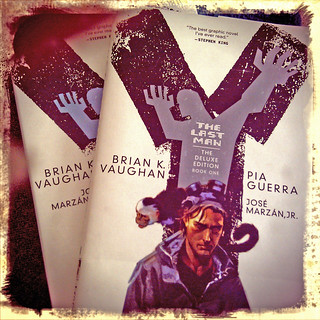
Y: the Last Man
The complete series
by Brian K Vaughan and Pia Guerra

This is a series of comic books that Tim really really wanted me to read so I told him I would if he would help me write the review afterward. Here is our joint effort.

Y: the Last Man begins with all humans and animals with a Y chromosome dying at the same instant, apart from 20-something-year-old Yorick and his monkey Ampersand. Yorick suddenly goes from being just some ambitionless and jobless guy to having everyone after him, as the potential key to the whole situation. But do all women want or even need men to come back?

First, a quick taste of the dialogue:

“[You’ve] crossed the fucking Rubicon.”
“The what?”
“Shut up.”
“I’m serious. What is that? ‘Crossing the Rubicon’?”
“It’s just a saying, all right? Means you’ve passed the point of no return—that you’re fucked.”
“But why does it mean that? What’s a Rubicon?”
“Jesus Christ! You just executed a human being, and all you—”
“You don’t know, do you?”
“—”

Y: the Last Man

Kate: You really wanted me to read this series. Why in particular?

Tim: It’s a very well written, touching, non-superhero comic book based on a strong SF trope. I am still trying to be your guide in SF and comics. Plus, y’know, literature plays a large part. And I know you love literature. What did you think of the literary allusions?

K: You had told me there would be literary references so I think I was expecting more than there was. But it’s actually done well, quite subtly, and I think it’s very true that an ardent reader would place a lot of value on finding people he could talk to about books, even in the middle of global disaster.

T: Also, the art is beautiful, I love the graphical themes that tie the issues/books together.

K: For science fiction, there’s not much science. It’s mostly about the impact on society of a major humanity-changing event.

T: True. SF that doesn’t dwell too much on the “plumbing” of the event can be very good SF. The beauty of this one is the way that Brian K Vaughan toys with characters (and the reader) having different theories for what caused the plague, all in different levels of mysticism/science. I often like this in stories, and that kind of uncertainty can really lend itself to some great storytelling. Take Bladerunner, or Total Recall, or Forever War, or I Am Legend, or Gateway, or Drowned World or… okay, there are a lot of titles that use the uncertainty and not-explaining attitude to SF. Is uncertainty in the heart of a plot an SF thing, or a general good lit thing?

K: It’s not just SF. It’s also not always good (but it often is).

Although our main characters keep facing violence and aggression, the all-female society does pull itself together and get stuff working over time. A comment is made that if the situation were reversed men would have been way more warlike and disorganised in reaction. In fact, a lot of women react with hatred for men and determination that women are better off.

T: Yep. You know, every English teacher I ever had was a feminist.

Several women are shown or implied to have become lesbian or start self-identifying as male as a result of the plague. Is this a cis-hetero/masculine fantasy or an offensive assumption? It is important to note that many other women do NOT.

K: I don’t think it’s handled in a male-fantasy way, whatever that would be. I think it’s realistic that some women would be open to it immediately while others would gradually turn to it from a lack of the alternative and others would resolutely refuse. It could have been discussed more but that’s a BIG conversation.

T: And it’s interesting that the one woman in the book who was already lesbian becomes, basically, celibate.

K: The main character is a man. Is this actually quite a masculine book with an idealised view of women?

T: Do you mean masculine or male chauvinist? I think you need Yorick as a contrast to the assumed macho male, and to evoke reactions (to him being male) from all the other (female) characters they meet. It would have been very easy to have him exist in the story just as a foil or a mirror. What’s impressive is that he is a character with depth without being macho or heroic.

K: Agreed. If anything Yorick is happy when he sees communities figuring shit out and would prefer to blend into the background and let women get on with it.

Though it eventually opens out, a large part (indeed all of the early stuff) of the story is set in the US, with a classic cross-country road trip. Would it have been too conceptual to see more of the world from the start?

T: I don’t know. I think it was important to concentrate on one thread of plot to begin with, allowing some measure of claustrophobia. It’s important because with the death of half of society, communications failed. The point is that the characters we follow don’t know what’s happening in their own city (to start with), and it gradually opens out as communications and society open out. I thought it was a well used device.

K: One observation I made early on was that the cities were falling apart, essentially war zones, while small towns were making it work. Is that realism or idealism?

T: I think it’s realism. There’s a bunch of reasons for it, though. Firstly, you start off in the domesticated east coast, and head west, towards the frontier, “can do” spirit. But I think, more importantly, (as seen in Make Room, Make Room or Caves of Steel) cities don’t exist in a vacuum, they rely on technology – that in this case failed (the power plants blew up, etc) – and a constant stream of food and supplies into the city (transport also broke down). The people living in more rural areas were not only more self-sufficient and practical to start with, they already had handy generators and the ability to grow/catch food. Cities cannot exist without civilization (I checked. I tried playing a whole game of Civ without building a city and it didn’t get anywhere).

Thank you Tim for the discussion and indeed the original recommendation. It is an excellent series.

Originally published 2002–2008 by DC Comics.
Deluxe editions published 2008–2011 by Vertigo.

Kate Gardner Reviews

What if?

February 16, 2012

Murder Born
by Robert Reed

This intriguing novella explores ideas around murder, revenge and capital punishment. It’s not the lightest read, but definitely one to make you think.

In his introduction, Reed says “[State] executions carry huge consequences…in the end not even the most Old Testament of these souls [families of the victim] are left happy, or even at peace…I asked myself what would make state-sponsored murder into the only moral response…I guess this is my bid for transparent justice.” Still intrigued?

Shawn is a photojournalist who is travelling home from an assignment in Asia when he gets a call from his ex-wife to say that their teenage daughter is missing, last seen with her boyfriend. So begins Shawn’s descent into the world of crime and punishment, with a science-fiction twist that makes it all even more complex and difficult.

And that’s as much as I can say about the plot without giving too much away, because the idea is revealed slowly, step by step. It has been carefully thought through and every “what if” I thought of came up and was dealt with. It is a very clever, hugely thought-provoking idea that I imagine will stay with me for a long long time.

That said, this novella won’t be for everyone. The story is all about the idea and, while characters weren’t wooden, they weren’t completely rounded either. It also owes a certain something to the murder mystery template, with the plot suddenly wrapping up very quickly after the “big reveal”. But it is well written, with a middle America setting that is both anywhereville and completely real. And while the topic could be considered political, the story doesn’t actually take sides or offer a clear solution, though you can take a guess at Reed’s position from the idea that he has come up with.

I really recommend not just that you read this, but also that you get someone else to read it so that you can talk it over afterward. Many thanks to Tim for doing just that to me!

First published in Asimov’s Science Fiction February 2012 issue

Kate Gardner Reviews

Girls and guns and science

December 22, 2011 3 Comments

Echo: the Complete Edition
by Terry Moore

So I quite liked this graphic novel, then Tim said that the maths that the whole storyline is based around is complete rubbish and now I’m not sure if that makes a difference or not. I think I still like it.

It’s almost a superhero story, but not quite. Super-clever scientist lady invents a new element and makes herself a suit out of it, then gets blown up by her superiors while wearing it and the suit attaches itself to two unlucky bystanders. That’s the first couple of scenes. The rest of the story follows those two bystanders as they discover what the suit can do and have very different reactions to it. And both get chased by various government agencies and scientists who want their tech back.

This is one of those beautifully drawn graphic novels that includes a lot of panes with no words, so despite this being a huge tome (this was previously published as six trade paperbacks) I tore through it in one day. I probably didn’t pay enough attention to the detail.

The main character is Julie, one of those two bystanders in the desert. She is an artist struggling to pay her bills and resisting signing the divorce papers that her husband has sent. There’s a large supporting cast, but foremost among them are Dillon, who was the boyfriend of the dead scientist lady, and Ivy, a kickass agent for a mysterious organisation. The first time we meet Ivy she is picking flowers with her daughter. In the next scene she is flying a plane on her own and puts it into autopilot while she changes her clothes. Awesome.

The maths/science stuff is complete rubbish and I did get a bit annoyed by it, even before discussing it with Tim. And there’s also a religious storyline that I found a bit questionable, to say the least. But the main characters and their lives on the run are engaging, funny, upsetting, sad and touching in all the right places. A main character appearing to be offended by the suggestion she might be gay is made up for by there being other characters who just happen to gay, without it being a thing.

Throughout the book there are quotes from writers and scientists about man and science, especially the destructive nature of man. Really it’s quite a negative view of science. There are plenty of scientists in the book who are trying to do good, but the suggestion is that it’s futile, that there will always be someone who wants to do something terrible with any new scientific discovery and that someone will always get their way. I prefer not to be that pessimistic.

There’s also a lot of excuses come up with for drawing women wearing very little. In fact, flicking through the gallery of cover art at the end of this collected edition, the majority of them concentrate on Julie and her large chest.

But dodgy science and fan service aside, I really did enjoy this read. I was interested in and cared about the characters, even some we only meet very briefly, and the bikers were very cool. But not as cool as Ivy.

Published 2011 by Robyn Moore.

Kate Gardner Reviews

More of the cold stuff

December 18, 2011December 24, 2011

Antarctica
by Kim Stanley Robinson

I seem to be on a bit of an Arctic/Antarctic bent – had you noticed? After the last two titles I read, Tim suggested this as an appropriate follow-on and it did indeed fit in well. A lot of the history of Antarctica, especially the famous great expeditions of Scott, Shackleton and Amundsen, is recounted here amidst the near-future politics and sometimes scary tale of global warming and eco-terrorism.

Robinson is good at this sort of ensemble cast, giving voice to several characters to give a real overview to a situation without it being obvious that’s what’s going on. Each perspective is distinct and interesting, which I think shows in that each time it switched I was briefly disappointed to be leaving a story thread but then within a page I’d be completely caught up in the next thread.

Despite all the talk about Antarctica being the continent of science, and the scientists therefore at the top in terms of social status, they are the one group we don’t really get to know. Instead Robinson gives voice to the “other people”, a lot of whom (if not all of whom) support the science.

X is a general field assistant, essentially a dogsbody doing whatever work is assigned to him. He is very aware that he is at the bottom of the social strata and longs for change but loves Antarctica too much to leave. He used to date Val, in fact they had a bit of an ugly break-up, which is colouring his world view somewhat and she wishes he would get over it.

Val is a guide, a strong, athletic, experienced outdoors type who leads expeditions “in the footsteps of…”. She is uber-fit and uber-capable and sometimes struggles to hide her impatience with those less fit and capable. She is also fed up with the male attention she gets being a young, attractive woman on a continent with three men to every woman.

Wade Norton is an adviser to Senator Phil Chase (both of whom pop back up in Robinson’s “Science in the Capital” trilogy), and is sent down to Antarctica to investigate rumours of eco-terrorism and the effects of the breakdown of the Antarctic Treaty. The pair have humorous phone conversations that belie the complex politics they are discussing.

There’s also Ta Shu, the initially silly-seeming Chinese poet and Feng Shui expert, whose calm, steady positivity is infectious; and a mysterious eco-warrior who can no longer stand idly by as the global warming situation gets worse and worse, with sea levels rising and extreme weather events frighteningly frequent.

The story fluctuates from positive to negative, from calm to stormy. The icy continent is both a place of unparalleled beauty and of incomparable danger. Extreme tourists who have climbed Everest and the Matterhorn are challenged to the point of misery. Global warming has accelerated alarmingly and at the same time the world population has exploded and first-world governments have all but abandoned attempts to mitigate their emissions. But there are still people trying to do good, seeing the beauty of the world.

This was an exciting, moving read but I did skim some of the hard science bits (there’s a geophysics controversy that is an accurate portrayal of how science works but I must admit I found it dull) and I did get frustrated at the US bias. The two biggest research stations in Antarctica – McMurdo, or “Mac-Town” and the Amundsen–Scott South Pole Station – are indeed both American, run by the NSF, so maybe it’s understandable, but I did feel that the presence of and research carried out by other countries and other organisations was ignored somewhat. Robinson does, though, make a point of showing the vast range of nationalities working on or visiting the continent. He took part in the US Antarctic Program’s Artists and Writers Program, so he did draw on real experience.

He also, perhaps surprisingly for science fiction, shows some of the negative sides of “doing science” – the resentment and antagonism from the unseen support crew, the tendency to have such single-minded focus that the rest of the world doesn’t get noticed, the painfully slow process of peer review and publication. However, the individual scientists that we meet are great people, doing great work.

Somehow this novel is both pessimistic and hopeful, which is artful indeed. And it has made me want to re-read the Science in the Capital series. So much for making a dent in the TBR.

First published in Great Britain in 1997 by HarperCollins.

Kate Gardner Reviews

Secrets and gangs

December 4, 2011December 4, 2011

20 Years Later
by E J Newman

The synopsis of this book greatly appealed to me – a story for young adults about people trying to survive in London 20 years after a mysterious event has destroyed humanity as we know it – so I jumped at the chance to get an advance copy. I may also have been attracted by the fact that one of the rival gangs in the story is called the Gardners. Sadly they turned out to be nasty nasty people. Darn.

Newman does a good job of eking out the details, both of what happened in the past and of what is happening now. The central characters are all 15 years old (or thereabouts, they don’t really know; they don’t bother with such things in this version of the year 2032) and therefore never knew the world before “It” happened, though there are older people around who occasionally drop a fact or two.

The story starts with Zane, a boy living with his mother Miri in an uneasy truce with two of the neighbouring gangs – the Bloomsbury Boys and the Red Lady’s Gang. They are unusual for not being part of a gang themselves and are often caught in the middle of vicious animosities. Zane’s longing to belong makes gang membership seem attractive but he is aware that he is not like other boys – he has an instinctual hatred for violence.

When Titus and his sister Lyssa stray unknowingly into Bloomsbury Boys territory a chain of events begins that leads Zane to the truth behind everything – including the fact that he is different from other people in more than just his attitude to violence.

I am reluctant to reveal much more than that, though the publisher’s blurb on the back cover gives away almost everything. I hate that. But it didn’t stop me enjoying the story. Actually, I raced through it, eager to know what happened next. A lot is packed into just over 300 pages and there are sequels in the works, so there were questions left unanswered and story threads left hanging.

One thing that stood out was that these 15 year olds are very different from the teenagers I have ever known, but this is a clear authorial decision. These characters are fighting for their lives, literally. They have no formal education, no early years of being carefree children; their intellect is dedicated to self-preservation, mastering weapons and early-warning systems. Most of the boys have never met a girl (aside from Miri) and so have never faced that side of being a teenager. Which makes them oddly childish; in fact one adult character in the book remarks on how young Zane is, compared with when he was a teenager, back before It happened. It makes the characters an odd combination of capable and self-reliant beyond almost anyone I know, and shockingly but sweetly naïve.

If you’re thinking that the author’s name seems familiar, why yes this is the same “E Newman” of the Split Worlds project. You see, a couple of months ago, I saw a Tweet from a local author about something called BristolCon, which sounded fun (and indeed was) and also that she would have copies of her new book there for reviewers. So I went along and I picked up a copy and then it was NaNoWriMo so I didn’t do a whole lot of reading for a month but I did interact with @EmApocalyptic and read a bunch of her short stories (and indeed featured one on this website). I am glad that I finally had time for her novel and look forward to the sequels.

Published 2011 by Dystopia Press.

Kate Gardner Reviews

Apocalypse and trams

November 20, 2011

Future Bristol
edited by Colin Harvey

This collection of short stories was compiled by a local writer (who sadly died earlier this year) to showcase science-fiction writing from in or around Bristol, so all the authors either live here or nearby or have done at some point. Though the depictions of the future are very varied, there are some common themes that say something about both Bristol and the preoccupations of the present.

I must say that in general I was more impressed by the ideas in this volume than the writing. This is mostly a taste thing. I like to have good strong characters and will happily forego storyline if the characters are written well enough. This volume conformed to that common criticism of science fiction that character comes second fiddle to ideas. I don’t actually think that’s true of the very best science fiction, but it was certainly true here. If I haven’t got to know a character, how am I going to care when crazy future apocalyptic things start happening to them?

That said, I really liked all of the ideas in these stories. I preferred the subtler futures where the city has changed and future generations have slightly different words for places and landmarks, and only vague ideas of where a name like “the Circus” or “Canesh’m” has come from. Meaningless to an outsider of course but brilliant for anyone familiar with the city.

Futures varied but tended toward the pessimistic – manmade or environmental disasters, global warming, spiralling crime – and even the more positive ideas had negative aspects. There’s the hackers who use stolen nanotechnology for the common good, only the corporations are watching their every step. There’s the urban explorers who encounter aliens in Clifton Rocks Railway. There’s the flooded city where pirates are back in full force and the police must tread carefully (possibly my favourite visually, though obviously heavily reminiscent of The Drowned World).

I think my favourite story, or at least the one that I have kept thinking about the most, was the one written by Colin Harvey himself. It’s called “Thermoclines” and is about a future when humans have evolved into winged creatures because they cannot touch the ground for fear of “the grey”. From a small community in south Wales, young Garyn is a star hunter but is tested to the limit when a rare visit from outsiders takes him on the long journey to “Brisel”, or what’s left of it. I liked that this story doesn’t try to explain everything, its hints and suggestions raising more questions than answers. It’s also one of the better examples of characterisation in the collection.

This was an interesting project and as an adopted Bristolian I loved the insider’s views of the city (and indeed disliked the more touristy moments, lingering on Clifton and the suspension bridge). I loved that multiple authors mentioned bringing back trams to the city, or found uses for the derelict Parcelforce building next to Temple Meads railway station. This definitely answered my search for stories set in Bristol, but I’m not convinced I’ve found any great new voices here.

Published 2009 by Swimming Kangaroo Books.

Kate Gardner Reviews

Posts pagination

1 … 3 4 5 6

Archives

RSS Nose in a book

  • Book review: Interstellar Megachef by Lavanya Lakshminarayan
  • May 2026 reading round-up
  • Book review: Passing by Nella Larsen

Me on the internets

  • @kate_in_a_book@mas.to (Mastodon)
  • Flickr/noseinabook
  • Instagram/kate_in_a_book
  • StoryGraph/kate_in_a_book

Categories

  • Blog
  • Reviews
  • Uncategorized
Proudly powered by WordPress | Theme: Dream by vsFish.