Nose in a book

Reviews and other ramblings

  • Home
  • Reviews archive
    • Book reviews
    • TV reviews
    • Theatre reviews
  • TBR
  • Challenges
    • The Classics Club
    • 2014 Popular-Science Reading Challenge
    • Cookery challenge
    • The Gilmore Girls Reading Challenge
    • 2013 TBR Pile Challenge
    • 2013 Translation Challenge
    • Crime and Punishment read-a-long
  • About
    • Cookie legal stuff
  • Home
  • Reviews archive
    • Book reviews
    • TV reviews
    • Theatre reviews
  • TBR
  • Challenges
    • The Classics Club
    • 2014 Popular-Science Reading Challenge
    • Cookery challenge
    • The Gilmore Girls Reading Challenge
    • 2013 TBR Pile Challenge
    • 2013 Translation Challenge
    • Crime and Punishment read-a-long
  • About
    • Cookie legal stuff

Tag: poverty

Book review: A Fine Balance by Rohinton Mistry
February 27, 2022March 9, 2022 1 Comment

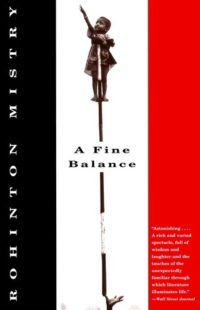
A fine balance book coverAfter tearing through books in the first half of January, I decided it was a good time for a big book and Rohinton Mistry’s epic A Fine Balance certainly fit that bill.

A Fine Balance is epic in scope, but the bulk of it takes place in one single year: mid-1975 to 1976. In an unnamed Indian city on the coast, four people are thrown together, their lives increasingly integrated as political unrest leads to restricted freedoms in the form of the Emergency.

Mistry does a wonderful job of giving all the characters complex backgrounds and motivations, so that time after time, someone who is introduced as an annoyance or outright villain becomes a sympathetic character, even someone to root for. He also takes the time to give thorough backgrounds for our four leads before the main narrative gets going.

First we have Dina, a Parsi woman who was widowed young and has struggled to maintain a life independent of her controlling older brother. She is brittle and judgmental, but this is often a facade to hide her fear of losing the life she has. After years of working as a seamstress to make ends meet, her eyesight is now failing and she must turn to two new sources of income: taking in a tenant and subcontracting sewing work to tailors she can supervise.

Continue reading “Book review: A Fine Balance by Rohinton Mistry”

Kate Gardner Reviews

A fellow can’t live without giving his passive acceptance to meanness

February 8, 2020

The heart is a lonely hunterThe Heart is a Lonely Hunter
by Carson McCullers

This is a beautiful, devastating novel that explores loneliness and poverty. It starts quietly and builds to an angry climax. I can’t quite fully believe that Carson McCullers was only 23 when she wrote this.

Set in a small mill town in 1930s Georgia, the plot revolves around John Singer, a deaf man who touches the lives of several others. He has a job at a jeweller, is educated (including knowing sign language) and serenely gets on with his life. After his deaf friend and room mate Spiros Antonapoulos is taken away to an asylum, some of the town’s more disaffected residents begin to notice Singer, turning to him as a confidante.

This group includes Mick Kelly, a tomboyish teen girl who is developing a deep love for music, though her family can’t afford for her to pursue this love beyond listening to other people’s radios. She tries to describe music to Singer in a way that is so moving that it doesn’t seem strange.

Continue reading “A fellow can’t live without giving his passive acceptance to meanness”

Kate Gardner Reviews

There is a tax on success

January 18, 2019

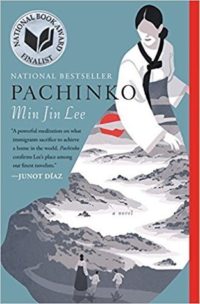
PachinkoPachinko
by Min Jin Lee

This is an epic family saga spanning two countries and most of the twentieth century. It took some time to lure me in, but once in I really loved it.

Pachinko starts in Korea in 1910 – the year when Japan invaded and occupied the country. Lee briefly sketches the family background of the woman who is to become the heart of the book: Sunja. She is the only surviving child of a couple who run a small boardinghouse in a fishing village near Busan. Their tenants are mostly fishermen and their income is small, but their reputation is strong enough that even as times get tough in Korea, they manage to get by.

Sunja is poor, uneducated and plain-looking, and as such she doesn’t expect to marry, but circumstances conspire to match her with an educated man who wants to take her with him to Japan to build a new life, so in 1933 they emigrate. But in Osaka she discovers that there is a form of poverty that is far worse than the way she was raised – because it is based on and maintained by racism. No Japanese company will hire Koreans except for the lowest of menial tasks.

Continue reading “There is a tax on success”

Kate Gardner Reviews

Did not finish because there’s only so much smug old guy I can take

June 2, 2018

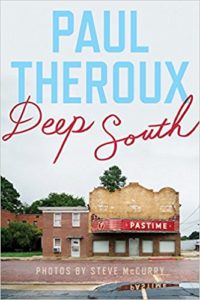
Deep South
by Paul Theroux

I don’t usually review books that I don’t finish, but I find I have a lot to say about this book. I know there will be people who disagree with me because Paul Theroux is much lauded for his travel writing, and at a sentence level I would have to agree that he’s a great writer. But there was something about this book that made me deeply uncomfortable, and it was not the non-revelation that there is serious poverty in the southern United States, or that racial tensions continue to exist there.

Theroux has a high sense of self-importance and takes great pleasure in displaying how well read and well travelled he is. He repeatedly makes sweeping generalisations that are designed to demonstrate his open-mindedness or liberal politics but actually serve to make the opposite point. He keeps presenting the reader with terribly nice southern black men who turn out to have street smarts but little education, and then white men who are hideously racist and gun-crazy. He’s over-simplifying complex issues, and not in a particularly interesting way.

Continue reading “Did not finish because there’s only so much smug old guy I can take”

Kate Gardner Reviews

Leaving because it is no longer possible to stay

April 11, 2018

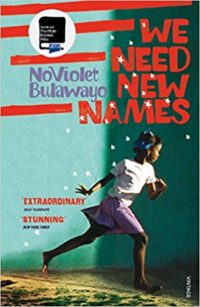
We Need New Names
by NoViolet Bulawayo

This was my favourite of the six books I read over Easter weekend on the theme of refugees and migration. Perhaps it’s because it’s written from the perspective of a young girl. I know child narrators are difficult to do well, but when they are, I really respond to them.

Darling is 10 years old and lives in a shanty town called Paradise in Zimbabwe (though the country is never named, it’s clear where it is). She spends her days with her friends and lives with her mother and Mother of Bones.

At first it seems innocent, though the poverty is clearly extreme. Hints are dropped, details revealed of how far from paradise this is. Darling and her friends have their ways of dealing with unfairness and poverty and violence, but something worse is always just round the corner.

Continue reading “Leaving because it is no longer possible to stay”

Kate Gardner Reviews

Whichever history the whites chose for you

April 3, 2018

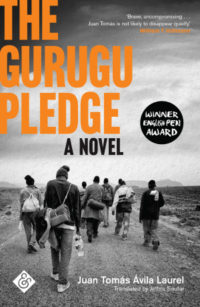
The Gurugu PledgeThe Gurugu Pledge
by Juan Tomás Ávila Laurel
translated by Jethro Soutar

This is the first of three books I read last weekend that create fiction from real-life accounts. It hadn’t even occurred to me before that was a genre!

On the Gurugu mountain in Morocco next to the border with the small Spanish enclave of Melilla, people from all over Africa hide in caves and tents in a makeshift camp, waiting to make their attempt on the border wall that could get them to European soil. To pass the time, the people on Gurugu mountain tell stories about where they have come from and play football (which also keeps them warm on this northerly point of the continent).

“There are some five hundred of us, black Africans all, and we just want to live, you know? We just want to live, but living is a serious business in Africa, for it’s often very hard and lots of people barely manage it…we need to eat. Do you understand me, Sir? Eat or manger, according to whichever history the whites chose for you.”

Continue reading “Whichever history the whites chose for you”

Kate Gardner Reviews

The unreliable measuring device of words

March 28, 2016March 28, 2016

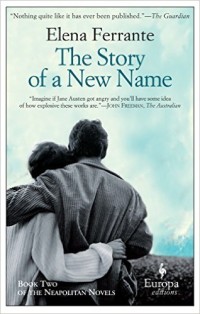
the story of a new nameThe Story of a New Name
by Elena Ferrante
translated from Italian by Ann Goldstein

This is book two of the famed Neapolitan Novels, which started with My Brilliant Friend. This review does contain spoilers for the first book, which I also highly recommend. Arguably you could come to this book cold – everything you need to know from book one is repeated – but you’d be missing out on a key part of the experience in my opinion.

Elena and Lila are on the verge of adulthood. Married at 16, Lila is gradually realising that marriage is not a quick fix to make her brother rich, and that being married to someone she doesn’t love is fine until she does fall in love.

For Lila, marrying Stefano, the grocer, was supposed to be the lesser of two evils – her other rich suitor in book one being Marcello Solara – but either way Lila is tied up with the dangerous Solara family and not in the powerful position as one of their wives. Did she make the right choice? She spends frivolously and flirts with both Solara brothers despite her husband’s violent temper. Has she shut down all true feeling? She is smart and aware, surely she knows the dangerous ground she is treading?

“She was beautiful and she dressed like the pictures in the women’s magazines that she bought in great numbers. But the condition of wife had enclosed her in a sort of glass container, like a sailboat sailing with sails unfurled in an inaccessible place, without the sea.”

Continue reading “The unreliable measuring device of words”

Kate Gardner Reviews

We were always going toward something terrible that had existed before us

August 11, 2015

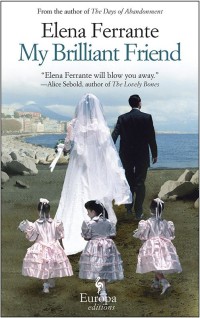
my-brilliant-friendMy Brilliant Friend
by Elena Ferrante
translated from Italian by Ann Goldstein

I had read conflicting reviews of this book, so I’d put it to one side for a while. But then along came the Books on the Nightstand Summer Bingo, with that classic square “A random book from a shelf”. So I stood in front of the TBR shelves, closed my eyes, waved my hand around, and lo and behold this was what I picked out.

The framework is the story of two girls’ friendship in Naples in the 1950s, but through Elena and Lila we really get to know a whole neighbourhood and all the minutiae of money, class, society and education that will affect the lives of everyone born there.

To begin with Elena and Lila are not all that different. Elena, who narrates the story, is the daughter of a porter at the city hall, while Lila is daughter of a shoemaker. Elena admires Lila from a young age and so wants to be her friend that she hangs around nearby, playing with her doll at the same street corner, until Lila has tested her bravery enough times to form a lasting bond.

“Up or down, it seemed to us that we were always going toward something terrible that had existed before us yet had always been waiting for us, just for us…Adults, waiting for tomorrow, move in a present behind which is yesterday or the day before yesterday or at most last week: they don’t want to think about the rest. Children don’t know the meaning of yesterday, of the day before yesterday, or even of tomorrow, everything is this, now: the street is this, the doorway is this, the stairs are this.”

Continue reading “We were always going toward something terrible that had existed before us”

Kate Gardner Reviews

The essence escapes but its aura remains

July 28, 2015

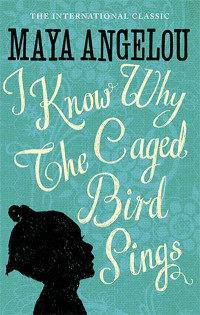
i know why the caged bird singsI Know Why the Caged Bird Sings
by Maya Angelou

Once again, I thought I had read this before and that this would be a re-read, but nope, it was all new to me. I guess that sometimes happens with much-talked-about books. Anyway, now I actually have read it and it is just as amazing as everyone always said it is.

This is the first book in Maya Angelou’s seven volumes of autobiography, covering her childhood in Arkansas and California. Hers was an eventful life, and yet her writing is beautiful enough that the book hardly needs events to make it a great read.

Angelou was sent with her brother to live with their grandmother when she was three, and this is where her story begins. She was very aware of her status as a black girl with a plain face and writes with a tense humour about the white side of town. But she had a comfortably-off family (her Momma ran a successful general store) relative to many others in Stamps, Arkansas – a downtrodden, dirt-ridden place from her descriptions.

“A light shade had been pulled down between the Black community and all things white, but one could see through it enough to develop a fear-admiration-contempt for the white ‘things’…But above all, their wealth that allowed them to waste was the most enviable.”

Continue reading “The essence escapes but its aura remains”

Kate Gardner Reviews

White people don’t care where they send you

July 22, 2014

The Extraordinary Journey of the Fakir who got Trapped in an IKEA Wardrobe

The Extraordinary Journey of the Fakir who got Trapped in an IKEA Wardrobe
by Romain Puértolas
translated from French by Sam Taylor

This book has already been a huge success in France and the publishers of the English translation are clearly hoping for similar sales figures. I hope they get them, even though I didn’t love it.

It would be wrong to say I am ambivalent about this book – it does not invite ambivalence. Rather, I both loved aspects of it and was frustrated or disappointed by others. It could well be a bit of a Marmite book.

At first glance – especially for the first few chapters – this is a very silly comedy, one that did make me laugh (or rather, snigger) a few times, though it’s not entirely to my comedic taste. Then, just as I was struggling to decide how I felt about all this slapstick silliness (it has a very Clouseau vibe) and the rather tricky main character, some serious issues get thrown into the mix (primarily human trafficking/illegal immigration) and, for me, it all picked up considerably. I know from online reviews that some people have objected to this combination of serious and silly but I actually thought that was handled fairly well – that was not my objection.

“A fakir by trade, Ajatashatru Oghash (pronounced A-jar-of-rat-stew-oh-gosh!) had decided to travel incognito for his first trip to Europe. For this occasion he had swapped his ‘uniform’, which consisted of a loincloth shaped like an enormous nappy, for a shiny grey suit and a tie rented for peanuts from Dilawar (pronounced Die, lawyer!), an old man from the village.”

It’s a difficult novel to summarise but the title does a fairly good job of the start! Ajatashatru Oghash Rathod has travelled from his home village in Rajhastan to Paris to buy a bed of nails from IKEA. He’s brought only a counterfeit €100 note, his real funds having been entirely spent on his airfare and visa, which I felt nicely set up the balancing act between his poverty and his shaky morals. When he gets trapped in a display model of a wardrobe in IKEA, it of course happens to be one that is earmarked for hasty transport (i.e. it isn’t disassembled) to England, where the fakir is discovered in a lorry with five illegal immigrants.

This neatly opens the door for an exploration – a largely scathing one – of border controls in a few different western European countries through the eyes of someone – an Indian with a legal Schengen visa – who doesn’t already know their ins and outs (such as the fact that the UK is not Schengen). One of Puértolas’ many former careers was as a French border guard and his inside knowledge shows, in a good way. He clearly has great sympathy for those who leave behind unimaginable poverty, hunger and disease in search of a better life, and great hatred for those who take advantage of such desperation. There are some tough details in this book, though they are never lingered on.

“It is not the fear of being beaten that twists our guts. No, because on this side of the Mediterranean we do not suffer beatings. It is the fear of being sent back to the country from which we have come, or, worse, being sent to a country we don’t know, because the white people don’t care where they send you.”

So I appreciated the subject matter, I found the story very readable and when the comedy got a little less broad it was more to my taste (or perhaps it even grew on me)…but I still didn’t love it. I might argue that the serious issues were handled a little too lightly and that they deserved to be explored more deeply, but then that would be a very different book. In fact, I am hopeful that the comedic tone of this novel will bring the issues surrounding human trafficking and illegal immigration to a wider conversation. (Indeed, at the hairdresser I spotted that this book is one of British Vogue magazine’s picks for their summer reads, which is a good start.)

My problem then is that the fakir’s reactions to his unlikely journey are trite, his opinions of the world are voiced clumsily and I never could decide if the book is racist. Certainly, it uses racial/national/gender stereotypes for comedic effect – for instance, the inability of any European to pronounce Indian names correctly – and up to a point that’s fine, but I often felt the line had been crossed.

I suppose that leaves me not ambivalent but also not decided.

L’extraordinaire voyage du fakir qui était resté coincé dans une armoire Ikea published 2013 by Le Dillettant.
This translation published July 2014 by Harvill Secker.

Source: This book was kindly sent to me by the publisher in return for an honest review.

Kate Gardner Reviews

Posts pagination

1 2

Archives

RSS Nose in a book

  • Book review: Interstellar Megachef by Lavanya Lakshminarayan
  • May 2026 reading round-up
  • Book review: Passing by Nella Larsen

Me on the internets

  • @kate_in_a_book@mas.to (Mastodon)
  • Flickr/noseinabook
  • Instagram/kate_in_a_book
  • StoryGraph/kate_in_a_book

Categories

  • Blog
  • Reviews
  • Uncategorized
Proudly powered by WordPress | Theme: Dream by vsFish.