Nose in a book

Reviews and other ramblings

  • Home
  • Reviews archive
    • Book reviews
    • TV reviews
    • Theatre reviews
  • TBR
  • Challenges
    • The Classics Club
    • 2014 Popular-Science Reading Challenge
    • Cookery challenge
    • The Gilmore Girls Reading Challenge
    • 2013 TBR Pile Challenge
    • 2013 Translation Challenge
    • Crime and Punishment read-a-long
  • About
    • Cookie legal stuff
  • Home
  • Reviews archive
    • Book reviews
    • TV reviews
    • Theatre reviews
  • TBR
  • Challenges
    • The Classics Club
    • 2014 Popular-Science Reading Challenge
    • Cookery challenge
    • The Gilmore Girls Reading Challenge
    • 2013 TBR Pile Challenge
    • 2013 Translation Challenge
    • Crime and Punishment read-a-long
  • About
    • Cookie legal stuff

Tag: grief

K-drama review: Just Between Lovers

June 8, 2025June 8, 2025

Just Between Lovers poster

The drama Just Between Lovers (JTBC 2017–2018), also known as Rain or Shine, is at the more serious end of the K-dramas I have watched. I really enjoyed it despite not having expected something with this tone.

The story’s background is loosely based on the real-life disaster in 1995 when Sampoong Department Store in Seoul collapsed. In reality 502 people were killed and 937 injured. In the TV show, the collapse of the fictional S-Mall kills 48 people and the drama focuses on two of the survivors 10 years later.

Lee Kang-doo (played by Lee Jun-ho) and Ha Moon-soo (Won Jin-ah) both lost a family member when S-Mall collapsed and they are still dealing with grief as well as their own trauma. Kang-doo was badly injured in the disaster and still struggles with physical pain as well as nightmares about the time he spent trapped in the rubble. He works in temporary construction jobs. He acts tough but is sweet at his core.

Moon-soo has trained as an architect specializing in safety regulations. She has her life together but suffers from her mother’s alcoholism. And though she has lost much of her memory from the day S-Mall collapsed, it still haunts her. She’s practical and not easily phased.

Continue reading “K-drama review: Just Between Lovers”
Kate Gardner Reviews

Book review: Boy Friends by Michael Pedersen

September 26, 2024September 28, 2024

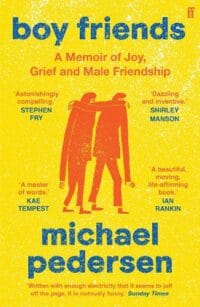
boy friends book coverThe world is hardly lacking stories about male friendship but we rarely hear about those friendships in romantic or passionate language. There are plenty of examples of female friendships that are romanticized, passionate, even obsessive. But I think society pushes us to believe men don’t experience friendship like that. Michael Pedersen is here to show that society is wrong on that point.

He wrote Boy Friends: a Memoir of Joy, Grief and Male Friendship in the months immediately following the death of his best friend Scott. Scott isn’t actually named until the final line of the acknowledgements at the back of the book, because the entire memoir is written directly to him. Emotions don’t get much more intense than in a letter to a loved one who’s just died and this book certainly has intensity and passion. It also has humour and quiet contemplation, self-scrutiny and hope.

“More than missing dinner, eating dinner with you, sharing dishes and stories, cocooned in, is the thing I will miss most of all. Just me and you and scran and sincerity and silliness and smut…A scientist working with gorillas in the Congo has discovered that these great apes hum and tunefully exhale while eating, composing hoppity food songs. Via euphonic noise-making, and body percussion, we did the very same – composed mealtime melodies. Dinnertime has been an awful lot quieter since you left.”

Continue reading “Book review: Boy Friends by Michael Pedersen”

Kate Gardner Reviews

Book review: Brown Baby by Nikesh Shukla

February 27, 2023 1 Comment

brown baby book coverJust when I’ve got used to the recent trend of memoirs written in the form of a series of essays, journalist and novelist Nikesh Shukla adds a new twist in his book Brown Baby. While each chapter takes a different topic from his own life, they are not essays but instead letters to his eldest daughter, affectionately nicknamed Ganga. 

Except that his daughter is still young (under 10, I believe) so she most likely won’t be reading this book for a while yet. It’s certainly not written as though it’s intended for primary-school-aged children and Shukla acknowledges a few times that his intended audience won’t be his first reader, that she will come to it in several years’ time, if at all.

So why this format? It’s a hook, of course; not many books are written in second person. And it was probably a useful exercise for Shukla to organise his thoughts when approaching writing this. But it does also add a layer of meaning for us readers who aren’t children of Shukla’s. Initially it feels intrusive, like this is genuinely a personal letter from a father to a daughter, in which he opens up to her for possibly the first time. But once I got past the feeling I was eavesdropping, I think the format made this more impactful.

Continue reading “Book review: Brown Baby by Nikesh Shukla”

Kate Gardner Reviews

Book review: The Memorial by Christopher Isherwood

March 28, 2022 1 Comment

The Memorial

I forget when I discovered Christopher Isherwood, but of course the first of his books that I read was Goodbye to Berlin and I was hooked. I have been gradually adding more of his books to my library and none of them has yet disappointed.

This is Isherwood’s second novel, published when he was just 28, which is remarkable in hindsight. It depicts a group of family and friends in the aftermath of the First World War, jumping around in time in the 1920s.

The two primary locations are London and a small Cheshire village. Sisters-in-law Lily and Mary do not get on well with each other, but having both lost their husbands in the war, their lives move closer in some ways, as do those of their children.

Each chapter is not only set in a different year, it is told from a different character’s perspective. From the large ensemble cast, we not only get to see through the eyes of Lily and Mary but also Lily’s son Eric, as well as Edward – childhood friend of Lily’s husband.

“Edward didn’t feel the cold. He started forward again, his overcoat flapping loose around him, singing to himself. He was beautifully warm all over, and the thing which kept whizzing round in his head gave him a pleasant sensation of deafness which was in itself a kind of warmth, blunting the edges of the freezing outside world.”

The book opens in London, with a fairly cosy, chatty look at Mary’s bohemian home filled with artistic and activist friends. Equally cosy is Lily getting close to a new gentleman friend, while fretting about her son who has disappointed her in some unnamed way. It’s a shock then to jump to Berlin, where a lonely Edward is struggling with survivor’s guilt and PTSD, contemplating suicide.

Continue reading “Book review: The Memorial by Christopher Isherwood”

Kate Gardner Reviews

The years slip by, stealthily, on tiptoes; they whisper behind our back, making fun of us

September 12, 2021September 12, 2021

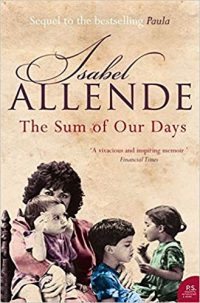
The Sum of Our Days book coverThe Sum of Our Days
by Isabel Allende
translated from Spanish by Margaret Sayers Peden

This is the third volume of memoir that Allende wrote, which is perhaps an odd place to jump into someone’s life. When I bought this I was attracted purely by her name, after having read and loved House of the Spirits. But it was made extra odd by the circumstances in which this book was written. Allende’s daughter Paula died in 1992. The following year she published her second memoir Paula, mostly written while Paula lay in a coma that they knew she probably wouldn’t wake up from. She started writing this third memoir after Paula’s death and addresses it directly to her daughter, updating her on the extended family as if she had moved away rather than died.

Allende talks candidly about her writing process, her relationships, her hopes and fears, along with all the details of her life. And Allende’s life is surprisingly eventful. Admittedly, this book covers 13 years but the big stuff all happens in the first couple of years following Paula’s death.

Continue reading “The years slip by, stealthily, on tiptoes; they whisper behind our back, making fun of us”

Kate Gardner Reviews

Someday, everyone will disappear, scattered into the blackness of time

February 10, 2020February 10, 2020

Kitchen book coverKitchen
by Banana Yoshimoto
translated from Japanese by Megan Backus

This novella and short story about grief are an excellent demonstration that you can depict dark, devastating emotion without being hyperbolic or overwrought.

“Kitchen part 1”, “Kitchen part 2” and “Moonlight shadow” each follows a young person (college age ish) who has lost a significant person from their lives. The relationship to the deceased is different and on the surface the reactions are different, but at heart the grief is similar.

One of the keys that Yoshimoto taps into is the comfort of specific places, for example a kitchen or a bridge in a park, in helping the process of grief. In “Kitchen”, Mikage doesn’t even need a specific kitchen to help her feel better – any kitchen will do, though she is particularly enamoured by the kitchen of her friend Yuichi, a young man she barely knew before her recent bereavement.

Continue reading “Someday, everyone will disappear, scattered into the blackness of time”

Kate Gardner Reviews

Emptiness would move in, first into her favourite places

June 9, 2019June 9, 2019 2 Comments

Next World NovellaNext World Novella
by Matthias Politycki
translated from German by Anthea Bell

I’ve had this book on my wishlist since it was published, as it got great reviews from people I trust. I did enjoy it, but it didn’t quite live up to my high expectations. This is my Germany selection for the EU Reading Challenge.

The story is simple but completely original. Hinrich Schepp wakes up one morning to find his wife Doro dead at her desk. Rather than call a doctor or undertaker, he decides he must read the papers she had been working on, as a goodbye gesture. So begins a process of memory, re-evaluation and inter-textual analysis that’s both sweet and…creepy.

Doro had dug out an old short story of Hinrich’s and annotated it. They’re both scholars of Chinese; this is Hinrich’s only attempt at fiction and he knows it isn’t good. (We’re treated to the full story, in chunks, to judge just how clunky his writing is.) But it isn’t the writing quality that Doro is commenting on. She appears to have been convinced that Hinrich was fictionalising an episode from their life together, one that has caused them both pain for many years.

Continue reading “Emptiness would move in, first into her favourite places”

Kate Gardner Reviews

I can sense the border between when time dribbles on and stretches

March 30, 2019March 30, 2019

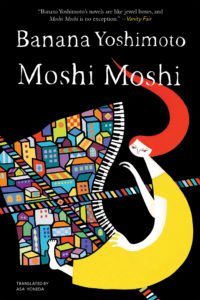
moshi moshiMoshi Moshi
by Banana Yoshimoto
translated from Japanese by Asa Yoneda

This is an odd book. I loved some things about it, but I didn’t love it. Which is a shame as it sounded so thoroughly up my alley.

Yoshie is in her early 20s when her semi-famous musician father dies in bizarre circumstances. Finding the family home overwhelming in her grief, she moves to the small, hip neighbourhood Shimokitazawa. She loves her quirky, arty new locale and her new job at a cafe there. But just as she is settling in, her mother shows up and insists on moving in with her.

Yoshie is having nightmares about her father, while her mother claims that their family home is haunted by him. The dead father is a constant presence through the book, necessarily so, as the whole arc of the story is the mother and daughter’s shared grief. (The significance of the title is that “Moshi moshi” is how you answer the phone in Japanese, and one of the plot threads is about the father’s mobile phone.)

The depiction of Shimokitazawa is wonderful – it really came alive for me and made me want to go there. There is an element of middle-class folk from a fancy neighbourhood playing at being poor and romanticising “the simple life”, but there is also something very enticing in Yoshimoto’s descriptions of the local shops and restaurants.

Continue reading “I can sense the border between when time dribbles on and stretches”

Kate Gardner Reviews

In Africa, you feel primordial

October 13, 2015 1 Comment

leaving timeLeaving Time
by Jodi Picoult

I was eager to read this after sampling the prequel novella Larger Than Life. That told the story of Alice, an animal psychologist studying elephants in Africa. This novel picks up the story with Alice’s daughter Jenna.

Jenna is 13 and wants to find her mother, who went missing when she was 3. Her father is in an asylum and she now lives with her grandmother, who won’t talk about Alice. Jenna has secretly been investigating for a while, but now her summer vacation has arrived and she’s saved some money. She approaches two people for help: Serenity, a psychic, and Virgil, a private detective. Between them, they try to figure out what happened that night 10 years ago.

Continue reading “In Africa, you feel primordial”

Kate Gardner Reviews

Life changes fast. Life changes in the instant

February 12, 2014 2 Comments

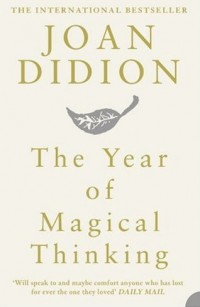
The Year of Magical Thinking

The Year of Magical Thinking
by Joan Didion

Since discovering Didion last year, I have been eager to read more of her work, and where better to start than her famous memoir of the year following her husband’s death? Thankfully my book club agreed and we picked it for our February meeting.

This book wasn’t quite what I expected. I thought it would be very slow and contemplative, so I started it well ahead of book club. But actually I sped through it, I might almost call it gripping. The book starts with Didion’s husband John Gregory Dunne dying of a sudden heart attack. But at the same time their daughter Quintana was in intensive care fighting pneumonia, so Didion couldn’t let herself fall apart or retreat into herself. She dealt with this odd delay in her grief by writing about it, then and there.

“Life changes fast. Life changes in the instant. You sit down to dinner and life as you know it ends.”

This is very much a memoir of that specific year in Didion’s life, not of her life before. Nor is it about her husband, though obviously memories of him do feature, but only in relation to Didion experiencing them resurfacing, which often results in some of the book’s more moving moments. She will mention in a very matter-of-fact way that she can no longer drive down certain streets or let herself see certain landmarks because the memories they recall threaten to break her, and it is only when you think about what she has said that you realise how close to the edge she is.

“One day when I was talking on the telephone in the office I mindlessly turned the pages of the dictionary that he had always left open on the table by the desk. When I realized what I had done I was stricken: what word had he last looked up, what had he been thinking? By turning the pages had I lost the message?”

Because what’s interesting about this book is that although it is raw and honest, Didion’s emotions are processed in a very cerebral, intelligent way, so initially she seems a little cold or detached (which is no doubt partly shock), and it takes time to realise that this is a very emotional, hurt person, dealing with that pain the only way she can. As the book goes on, feelings come more to the fore, and some of the more recognisable signs of grief such as regrets and obsession over details emerge.

“What would I give to be able to discuss this with John? What would I give to be able to discuss anything with John? What would I give to be able to say one small thing that made him happy? What would that one that one small thing be? If I had said it in time would it have worked?”

The precarious health of Quintana does of course complicate the grieving process. It gives Didion something to focus on but also an excuse not to get back to “real life”. It’s also the aspect of the book that consolidated my sympathy for Didion, because while it may sound harsh, it’s hard to ignore the fact that Didion and her husband lived a very privileged life – they were famous, successful and well paid, with multiple homes and an intimate knowledge of the best hotels in many a city. I think this bald fact ran the risk of detracting from any sympathy I felt, but for the most part I was fully on Didion’s side, absorbed in her story.

I liked that I was able to recognise the style of Didion the novelist in this book, even though it was a very different beast. She makes use of quotes, repetition, research and fractions of thoughts, returns over and over to certain moments, in an otherwise linear narrative. I was reminded of how much I enjoyed The Last Thing He Wanted and will continue to check out her back catalogue.

First published 2005 by Alfred A Knopf/HarperCollins.

Source: Foyles Bristol.

Challenges: This counts towards the Rory Gilmore Reading Challenge.

Kate Gardner Reviews

Posts pagination

1 2

Archives

RSS Nose in a book

  • Book review: Interstellar Megachef by Lavanya Lakshminarayan
  • May 2026 reading round-up
  • Book review: Passing by Nella Larsen

Me on the internets

  • @kate_in_a_book@mas.to (Mastodon)
  • Flickr/noseinabook
  • Instagram/kate_in_a_book
  • StoryGraph/kate_in_a_book

Categories

  • Blog
  • Reviews
  • Uncategorized
Proudly powered by WordPress | Theme: Dream by vsFish.