Nose in a book

Reviews and other ramblings

  • Home
  • Reviews archive
    • Book reviews
    • TV reviews
    • Theatre reviews
  • TBR
  • Challenges
    • The Classics Club
    • 2014 Popular-Science Reading Challenge
    • Cookery challenge
    • The Gilmore Girls Reading Challenge
    • 2013 TBR Pile Challenge
    • 2013 Translation Challenge
    • Crime and Punishment read-a-long
  • About
    • Cookie legal stuff
  • Home
  • Reviews archive
    • Book reviews
    • TV reviews
    • Theatre reviews
  • TBR
  • Challenges
    • The Classics Club
    • 2014 Popular-Science Reading Challenge
    • Cookery challenge
    • The Gilmore Girls Reading Challenge
    • 2013 TBR Pile Challenge
    • 2013 Translation Challenge
    • Crime and Punishment read-a-long
  • About
    • Cookie legal stuff

Each man has his own interpretation

April 20, 2012June 17, 2012 4 Comments

The Alexandria Quartet
Book 3: Mountolive
by Lawrence Durrell

Well, I had an inclination that book three would get political and I was certainly proved right, but it also had some other big differences from the two books that precede it. I can’t decide whether I was thrown by this or drawn deeper in than ever.
The Alexandria Quartet

Where the first two books are narrated by an initially un-named first person and set entirely in Alexandria over an approximately two-year time period (plus the occasional jump forward to the time of writing, which seems to be only shortly later), Mountolive is a more traditional third-person narrative, following the titular David Mountolive from his youthful first visit to Egypt, through his illustrious (and well travelled) career with the British Diplomatic Service until he is finally posted back to Egypt as British Ambassador, the position in which he had occasionally popped up in Balthazar.

This takes up the first 100 pages or so, about a third of the novel, but it is essential background to understanding the man and his actions. Despite his limited appearances previously, Mountolive is key to the story we have already heard twice. In true Durrell style we learn of goings-on that were hinted at but never revealed in Justine or Balthazar and all the old characters are intricately tied up in machinations that are at times surprising, at times make complete sense of what before had been blurry.

In some ways this reads like a detective novel, with Mountolive the stoic investigator, a career man who was once passionate and romantic even, but is now middle aged and enjoying the power and status of his new job. The suspect is Nessim, the rich banker who has always seemed suspect and shadowy but now we learn what he is suspected of. And it is of course different things by different people. Indeed, is he even really deserving of suspicion or is he merely a puppet for some other player? Perhaps his wife, the beautiful and seductive Justine. Or his brother, the disfigured and hard-working Narouz. Or his mother, the strong and proud Leila.

Limiting the story (for the most part) to these two men, and switching to the third person, makes this in some ways a more straightforward read than the previous two books. Which is helpful when you are called upon to understand some complex political manoeuvrings. But there are moments when the narrative directly contradicts something previously learned and it becomes blurry again; which version is to be believed? Is this narration actually omniscient or is this narrator better at hiding?

Balthazar at one point says, “Truth naked and unashamed. That’s a splendid phrase. But we always see her as she seems, never as she is. Each man has his own interpretation.”

The language is evocative as ever – “The desert was like a dry kiss, a flutter of eyelashes against the mind” – and even the psychological exploration has not disappeared, such as in this exchange:

“If only we did not have to keep acting a part, Justine.”
“Ah, Nessim! Then I should not know who I was.”

So, will Clea wrap everything up nicely or throw it all back into confusion? I can’t wait to find out.

First published 1958 by Faber and Faber.

See also: my reviews of
Book 1: Justine
Book 2: Balthazar
Book 4: Clea

Kate Gardner Reviews

To imagine is not necessarily to invent

April 16, 2012June 17, 2012 4 Comments

The Alexandria Quartet
Book 2: Balthazar
by Lawrence Durrell

Rather than continuing where the previous book, Justine left off, this is instead a revisit to the same time period by the same narrator after he has learned more information. Except it’s not even just that.

The Alexandria Quartet

The assertions and assumptions of the previous book are thoroughly shaken and the narrator proved without doubt unreliable by his own words and other people’s. Balthazar, the wise old doctor and leader of a Cabal in Alexandria, has read the narrator’s Justine manuscript and annotated it heavily, resulting in the document referred to as the Interlinear. He has included information he knew the narrator to be unaware of and remonstrations where he thinks the narrator has misrepresented a person or event. He knows that some of this, indeed much of it, will be painful for the narrator to learn of.

Despite the strange set-up, this novel is actually more straightforward than Justine, though I don’t know if it would make any sense without having read Justine shortly beforehand. The majority is made up of Balthazar’s lengthy annotations, with the narration linking or commenting on or reconstructing in-between. As before, time is not entirely linear, but events are a little more clear and a lot of hints are sown for the next book to come (I think politics and spywork may be coming slowly to the fore), as well as the occasional explanation of a puzzling detail in book one.

Because so much is in Balthazar’s voice, there is a little less musing on the beauty and life of the city, but that just makes the passages more noticeably beautiful when they come:

“The city, inhabited by these memories of mine…isolated on a slate promontory over the sea, backed only by the moonstone mirror of Mareotis, the salt lake, and its further forevers of ragged desert (now dusted softly by the spring winds into satin dunes, patternless and beautiful as cloudscapes)…”

What there is more of is confusion between the story itself and the books and manuscripts written by various characters. By this point there are, I think, four fictional authors?

Balthazar writes, “To imagine is not necessarily to invent, nor dares one make a claim for omniscience in interpreting people’s actions. One assumes they have grown out of their feelings as leaves grow out of a branch. But can one work backwards, deducing one from the other? Perhaps a writer could if he were sufficiently brave to cement these apparent gaps in our understanding with interpretations of his own…” And later, “Truth is not what is uttered in full consciousness. It is always what ‘just slips out’…”

Our narrator gets a couple of nicknames in this volume including the heavily sarcastic-sounding “Wise One”, surely an ironic comment on his inability to see the truth. Or is that the problem at all? Does he in fact understand exactly what is going on and just exclude certain details from his account? At this point I think either could be true. Possibly a bit of each.

At the end of Justine I was a little uncertain about how this story could continue for three more books, whereas now I already see plenty to fill two more books, let alone any new plot threads that might emerge. I guess this may mean it gets a bit more action-based and less cerebral. World War II does seem to be creeping closer (“rumblings in Europe” are mentioned periodically) and our narrator is a young male British citizen. I look forward to seeing whether any of my guesswork is proved right.

First published 1958 by Faber & Faber.

See also: my reviews of
Book 1: Justine
Book 3: Mountolive
Book 4: Clea

Kate Gardner Reviews

The Sunday Salon: All systems go

April 15, 2012 10 Comments

The Sunday Salon

After last weekend‘s perfect mix of activity and downtime, it feels like life has switched up a gear. Evenings and weekends are full of plans, with many more things needing to be slotted in – when will I find time to read?

One thing I did this week was finally get my latest film processed. I took most of it on our holiday in Wales and I’m pleased with how some of the shots came out, though the scans don’t do them justice. We must find a way to display more photos in our house!

Look up

I haven’t been feeling 100% (it happens) so I have been tempted on getting home from work to just stare at the TV rather than read. Which makes sense when my brain is frazzled but the rest of the time I think reading actually makes me feel a lot better than even my favourite TV shows could. What about you – do you read when you feel unwell?

I also went to the zoo with Tim and a couple of friends. We go to the zoo a lot and always have a good time. Bristol Zoo is very good about breeding and conservation programmes and doesn’t have many large animals so I don’t feel animal lover guilt and can just enjoy the cute animals.

Baby turtles

Kate Gardner Blog

A medium as unstable as words

April 12, 2012June 17, 2012 7 Comments

The Alexandria Quartet
Book 1: Justine
by Lawrence Durrell

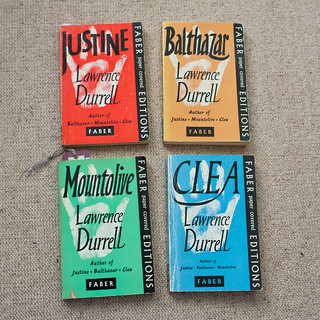
I had sort-of vaguely heard of the Quartet and then a couple of years ago I stumbled across these beautiful old Faber editions in Bristol’s excellent Beware of the Leopard book shop.

The Alexandria Quartet

Except they only had two of the four books. By chance, a few weeks later I found a matching third in another secondhand book shop. But no sign of a fourth. Cut forward almost two years to Tim buying me the the fourth book from Abe Books and I could finally start reading! By coincidence, 2012 would have been the year Durrell turned 100 years old so the Guardian Reading Group chose The Alexandria Quartet as its book for March (these days it is published as a single chunky volume), and through that I was able to garner some insights from people much cleverer than me as I went along.

Which helped. Because this is not a straightforward book. It is a pensive, thoughtful musing upon events an unknown time ago, in an unclear order, narrated by an unnamed narrator. The language is beautiful, evocative, poetic even. The true main character is the Egyptian city of Alexandria, at a guess in the 1930s, and Durrell lovingly brings to life the streets and waterways of this exotic mishmash of cultures. The people of the book are the city’s rich and educated few, so they come from all over the world and various walks of life.

The narration is jumbled throughout, but particularly so at the start. For several pages it skips from thought to thought, without explanation. Various names are mentioned but no-one properly introduced. Early on the narrator quotes the line “It is idle to go over all this in a medium as unstable as words” and later says “(I am inventing only the words.)”

And it continues like this, but with some of those thoughts being a memory, so that details are slowly filled in. Very slowly. It took me most of the book to figure out what its story is, and even then I feel a real pull to get started on the next book in the quartet to clarify some of the many details left partly obscured.

To give some idea of the story, the narrator was in a relationship with Melissa, an exotic dancer in a nightclub with frail health, but fell for Justine, the great Alexandrian socialite whose reputation for beauty and sexual intrigue goes before her, and who is married to the rich, powerful banker Nessim. The narrator and Justine embark on an affair, despite the narrator claiming to love Melissa absolutely and to be afraid of Nessim. From the start it is clear that things did not end well and the narration gradually gathers momentum as it builds towards the conclusion of this part of the story.

But the point isn’t the story. The point is the exquisite language. On the Guardian threads there was talk of the whole thing being more about psychoanalysis than characters in a story and perhaps if you know more than me about psychoanalysis that may be the case, but I loved all the characters and, unusually for me, was not bothered by the slowness of the emerging story. I was entranced by the words.

“Far-off events, transformed by memory, acquire a burnished brilliance because they are seen in isolation, divorced from the details of before and after, the fibres and wrappings of time. The actors, too, suffer a transformation; they sink slowly deeper and deeper into the ocean of memory like weighted bodies, finding at every level a new assessment, a new evaluation in the human heart.”

The narrator pulls his tale together from a number of sources, including his own journals, a novel written before he arrived in Alexandria about many of his friends there, and three of Justine’s diaries, which he has been given. He frequently quotes from these, even substituting names in the novel with those of his friends. So he is undoubtedly unreliable, and I am sure the subsequent books will contain multiple about-turns that will force me to re-evaluate what I have learned, or think I have learned, so far. I can’t wait.

First published 1957 by Faber & Faber.

See also: my reviews of
Book 2: Balthazar
Book 3: Mountolive
Book 4: Clea

Kate Gardner Reviews

Veils, shimmering like curtains

April 9, 2012April 14, 2012

Ariel
by Sylvia Plath

A still life for Easter

This was Plath’s final volume of poetry, published two years after her death, and I could not separate the knowledge of what shortly followed these writings from the words themselves. It was not an easy read.

Death is everywhere in these poems. I got shivers down my spine on almost every page. Yet these are not obvious musings on death but rather word collages. For the most part the poems are constructed of a series of images, with no clear story or scene, but there are a few exceptions. “Gulliver” describes Swift’s character in the scene in Lilliput when he is tied to the ground:

“You there on your back,
Eyes to the sky.
The spider-men have caught you,”

“Daddy” explores her feelings about her father, a complex relationship despite his death early in her life (“I was ten when they buried you”). And “Wintering” is actually the last part of a series of four poems about her new-found vocation of beekeeping:

“Now they ball in a mass,
Black
Mind against all that white.”

But these are exceptions in-between the darker poems (and even those were not entirely free from comment on death). Her depression is ever present:

“I am terrified by this dark thing
That sleeps in me;
All day I feel its soft, feathery turnings, its malignity.” [from “Elm”]

She refers to her previous suicide attempt many times over, making it clear her only regret about it is that she didn’t succeed:

“After all I am alive only by accident.
I would have killed myself gladly that time any possible way.
Now there are these veils, shimmering like curtains” [from “A birthday present”]

But the poem that moved me most was “Years”, where Plath’s pain and anger seem to be at their peak:

“O God, I am not like you
In your vacuous black,
Stars stuck all over, bright stupid confetti.
Eternity bores me,
I never wanted it.”

First published 1965 by Faber & Faber.

Kate Gardner Reviews

The Sunday Salon: Day of chocolate

April 8, 2012April 8, 2012 13 Comments

The Sunday Salon

Ah, four-day weekend, piles of chocolate, plenty of time with my books. What could be better? Oh, and I threw in a bit more culture with a trip to the theatre just for good measure.

After spending Good Friday being thoroughly lazy reading and watching films, yesterday my Dad and brother came to visit and get me out of the house! We went to see the Bristol Old Vic’s excellent Pinter/Beckett double bill A Kind of Alaska/Krapp’s Last Tape. I didn’t know anything about either play but I figured with writers like those you can’t go wrong. Glad to say it was a brilliant show. Both plays are meditations on ageing, in different ways. Both had touches of humour but were overall contemplative pieces. The small cast (three in the first play, one in the second) was fantastic and the Old Vic’s little Studio space was ideally suited.

Yummy churros

Today, friends told me there was a chocolate fair being held in the city centre so we headed down there and enjoyed a few free samples before pigging out on churros and hot chocolate.

While we were in the area, we had a quick browse of the weekly books, arts and crafts market on the harbourside, where obviously I could not help myself buying a couple of books (really I am proud it was just two. I was sorely tempted to pick up handfuls of secondhand PG Wodehouse). My TBR will never get smaller, will it?

Browsing

And there’s still a day and a half stretching out before me with little to do other than read and sleep. Perfect.

Kate Gardner Blog

You’re gonna get screwed but good in this town

April 6, 2012April 28, 2012

Tales of the City
by Armistead Maupin

After hearing this book praised left, right and centre since I started book blogging I figured I had to give it a go. And what a joy it is!

This is the first in what has turned out to be a very long-running series about a large cast of characters in San Francisco. In this book (I don’t know if this is true of any of the rest) the focus is on a boarding house on Russian Hill run by the inimitable Anna Madrigal (who grows her own weed and claims to have been raised in a whorehouse), and in particular her tenant Mary Ann Singleton. Mary Ann has newly arrived in the city from Cleveland and her sweet naivety is in for a shock. Or several shocks.

According to something I heard on Radio 4 (I think it was on A Good Read) the editors of the San Francisco Chronicle, in which this started life as a serial, kept a tally of straight versus gay sex scenes because there was a concern about it being “too gay”. Which tells you a little about the book. It is outrageous and wickedly funny but also intelligent and insightful. The characters lean very slightly into the larger-than-life category but they are not stereotypical or predictable. It really is an achievement that so much silliness can be so lovable.

There are dozens of storylines at work, only a couple of which are wrapped up by the end of the novel. The characters are introduced separately but their lives quickly overlap to the point where I was hard-pressed to remember who knew who from where. I’ll just have to read it again!

The extra character is, of course, the city of San Francisco. Maupin lovingly describes its streets and views and bars and people with all the little details of someone who calls it home. It is very much a tale of 1978, with an undercurrent of the politics and social nuances of the time. I was (perhaps naively) surprised by how much of the “pretentious” of middle-class life today (organic food, over-earnest attempts to appear not racist or homophobic, caring about global warming) was considered pretentious back then too. It is satirical but somehow firmly on the side of the people it satirises. Both prudish innocent (Mary Ann) and sexaholic (most everyone else) are celebrated in their own way.

I can see why it has been called a literary soap opera and it is indeed both those things. It isn’t literary in floweriness but rather in insight and cleverly spare language that gives you just enough, while finding room for some fantastic little jokes with words and meanings. So that’s six more books to add to the wishlist then, I guess!

First published in 1978 in the San Francisco Chronicle.
Published in book form in 1980 by Corgi Books.

Kate Gardner Reviews

Life might have been totally different

April 3, 2012April 28, 2012 3 Comments

1Q84
by Haruki Murakami

It’s my own fault. I was really excited about this book. I built it up in my head. I believed the “magnum opus” hype. I was bound to be let down.

1Q84

I really like Murakami. He’s not my favourite writer but I have loved some of his books and really liked several more, so the prospect of a three-volume masterpiece by him sounded wonderful. Unfortunately it turned out to be my least favourite of his works so far. In fact, at times it had me angry enough to want to throw the book across the room and I nearly gave up on it multiple times. But I soldiered on because this is after all Murakami and there is an intriguing storyline that is not wrapped up until the last page. And I had to know.

So that’s it’s great strength: the story. It’s a very Murakami story, an idea that starts gradually, slowly forming, giving you room to guess what’s going on. It’s weird in a surreal sort of way but it has an internal logic that allows you to see the directions it might go in.

Because it takes most of book 1 (300+ pages) for the basic concept to become clear, I don’t want to say too much about what happens. The chapters alternate between the stories of Tengo and Aomame. Tengo is part-time teacher, part-time writer, who allows himself to be persuaded by an editor friend to rewrite someone else’s entry in a creative writing competition, a story called Air Chrysalis. The situation goes from a bit unethical to downright dangerous when it turns out that there is a lot more to Air Chrysalis than meets the eye.

Aomame is a fitness instructor and also an assassin. But not the ruthless kind who will kill anyone for the right price. She has just one client and kills one particular breed of very bad men. So what links her to Tengo? Well, that would be saying too much, but from the start it is clear that they have a lot in common. They are both about 30 years old, living in Tokyo, with no strong emotional ties to anyone. They have almost clinical attitudes to their sex lives. They are particular about cleanliness and eating well. And because they would clearly get on well, it was wonderful slowly learning about how they were linked, seeing their stories draw together. But.

For one thing, I think 1Q84 is far longer than it needs to be. Murakami has a reputation as a sparse writer but here there is lots of repetition, lots of restating facts – a lot of bulk could have been shed. After the initial teasing out of a detail or plot point it then gets overstated and too obvious. This was to the detriment of the more surreal, magical elements because it made them seem at times clumsy and over-thought.

But I also had issues with some of the major themes in the book. First up: sex. I have no problem with sex scenes, but here I frequently got the feeling that typical male fantasies were being depicted for no good reason. Aomame is straight and at one point turns down an offer of sex with a woman, yet Murakami has her linger on the memory of a teenage lesbian dalliance with a close friend more than once. For no reason that I could fathom, when she remembers two good female friends from her past she thinks about their breasts. And not in a jealous way but in a sexual way. It’s very strange.

Then there’s the parents thing. There are no good parent–child relationships in this book. Tengo is horribly self-centred in his attitude to his father. Both Tengo and Aomame chose to move out from their parents at the earliest possible opportunity, but neither describes anything particularly terrible to explain why. Aomame’s parents were religious, Tengo’s father a distant workaholic, and perhaps with some further details those would have indeed been in some way abusive situations, but for all the very many words, I was never able to see what had been so wrong with either childhood.

Which brings us to the last problem: religion. Oh my word does Murakami have an axe to grind here. I should point out that I am an atheist, I am no fan of organised religion and recognise that it has been the source of a lot of bad stuff. But it has its positive side too and in most cases is probably best described as benign. 1Q84 gives no stock to such nuances. ALL RELIGION BAD could sum its attitude up. Basically, you have a cult that somehow grew out of a non-religious hippy commune and became a child-raping place of evil. And all other religious sects, churches or organisations mentioned are spoken of as if they are just as bad. As if they all brainwash, make children miserable, expect unreasonable things of their followers. Some of the statements I read made me slam the book shut and shout out angrily. At one point there was so much of this nonsense I didn’t know how I could possibly read on, but thankfully the narrative moved past it. (Although this is also a problem because I felt it was very ambiguous whether the nasty child-rape situation had been resolved or not.)

It started well and it ended well. The anger I felt in book 2 never resurfaced, although the boredom with some of the “waiting” sections did. I kept on reading because I wanted to know more, but I could not honestly say I enjoyed the read. This was translated by Murakami regulars Jay Rubin and Philip Gabriel so the style should have been familiar but it genuinely felt poorly edited in places and there were no moments when the writing stood out as beautiful or moving. Tengo and Aomame were typical Murakami characters in that they felt real but at a distance, slightly cold fish, so I could never be in their shoes truly living the story.

It saddens me that I cannot recommend this book and am even a little bit put off reading Murakami at all for a while. But I know other people have loved it so remember this is just my opinion. Others are available.

First published in Japanese in 2009 and 2010 by Shinchosa Publishing.
This translation published 2011 by Harvill Secker.

See also: discussions on Tony’s Reading List and In Spring it is the Dawn

Kate Gardner Reviews

Holiday snaps

April 1, 2012 3 Comments

Last week Tim and I went on holiday to Pembrokeshire with some good friends and it was perfect. We had seaside, a pretty cottage to stay in, log fires, lots of board games to play and the random heatwave meant we had sunshine too, despite it being March.

The beaches were almost empty.
Untitled

I revisited a place that had a profound effect on me when I was younger (17, I think. I read Frankenstein for my A level English while sat on the cliffs outside).
Untitled

I fell in love with the fossa, an animal I had never even heard of before.
Untitled

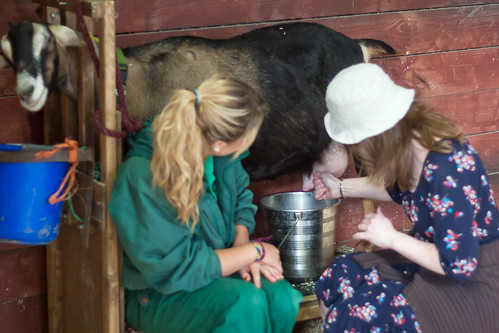
And I milked a goat. It only stood in the bucket once, despite my hideously long nails.
Kate milks a goat

The rest of my photos were on film so they will follow soon. Keep an eye out on my Flickr photostream.

Kate Gardner Blog

Bloggiesta is here!

March 30, 2012April 1, 2012 9 Comments

Bloggiesta

Bloggiesta is an online event for (book) bloggers in which we are encouraged to spend the next three days working on our blog in any way we see necessary. We Plan, Edit, Develop, Review and Organise – no wonder our mascot is called PEDRO! Olé! Bloggiesta is organised by It’s All About Books and There’s A Book.

The Bloggiesta fun begins here with my vague not-nearly-planned-enough to do list; and there’s a lot to be done!

TO DO
1. Change how hyperlinks appear (I don’t like the current style).
2. Tidy up sidebar.
3. Catch up on book blog posts in Google Reader.[Done for now at least!]
4. Contact some publishers about getting their new releases catalogues.
5. Back up all blog content (thanks to Leeswammes for that idea).
6. Read and join in as much as possible with the Bloggiesta discussions on Twitter and other blogs. (If you’re on Twitter, you can use the hashtag #bloggiesta to keep in touch with what’s happening. I am @Nose_in_a_book.)

For me, that last is the real point of all this. I hope to learn a bunch and meet lots of new book bloggers. So, let’s get started!

UPDATE 1 (Sat): I have changed one of my goals to a more realistic one for this weekend because I am already flagging! And catching up with my fellow book bloggers is way more important than most other stuff anyway 🙂

UPDATE 2 (Sun): I will soon be going out for the rest of the evening so here ends Bloggiesta for me. I have achieved everything I set out to and gathered together a bunch of new ideas, not to mention meeting lots of ace new book bloggers (new to me) on Twitter. Thanks to everyone who took part!

Kate Gardner Blog

Posts pagination

1 … 96 97 98 … 123

Archives

RSS Nose in a book

  • November 2025 reading round-up
  • Book review: Resist: Stories of Uprising edited by Ra Page
  • Book review: The Annual Banquet of the Gravediggers’ Guild by Mathias Enard

Me on the internets

  • @kate_in_a_book@mas.to (Mastodon)
  • Flickr/noseinabook
  • Instagram/kate_in_a_book
  • StoryGraph/kate_in_a_book

Categories

  • Blog
  • Reviews
  • Uncategorized
Proudly powered by WordPress | Theme: Dream by vsFish.