Nose in a book

Reviews and other ramblings

  • Home
  • Reviews archive
    • Book reviews
    • TV reviews
    • Theatre reviews
  • TBR
  • Challenges
    • The Classics Club
    • 2014 Popular-Science Reading Challenge
    • Cookery challenge
    • The Gilmore Girls Reading Challenge
    • 2013 TBR Pile Challenge
    • 2013 Translation Challenge
    • Crime and Punishment read-a-long
  • About
    • Cookie legal stuff
  • Home
  • Reviews archive
    • Book reviews
    • TV reviews
    • Theatre reviews
  • TBR
  • Challenges
    • The Classics Club
    • 2014 Popular-Science Reading Challenge
    • Cookery challenge
    • The Gilmore Girls Reading Challenge
    • 2013 TBR Pile Challenge
    • 2013 Translation Challenge
    • Crime and Punishment read-a-long
  • About
    • Cookie legal stuff

What’s in a name

January 23, 2012 1 Comment

Possession
by AS Byatt

This was a re-read that I sadly ended up rushing through because it was for book club and I didn’t give myself enough time. It’s a wonderful book, as literary as they come yet immensely readable.

The story begins with Roland, a postgrad scholar of the eminent (and fictional) Victorian poet Randolph Henry Ash, discovering long-hidden drafts of a love letter from Ash to a mystery woman. This is a potentially huge discovery, Ash having been assumed to be a dull, happily married type.

Thus begins the unravelling of great secrets, but Roland is jealous of his discovery and does not tell his university supervisor or his girlfriend Val. Instead he turns to a complete stranger, fellow academic Maud, because he suspects that the subject of her studies, minor Victorian poet Christabel LaMotte, was also the subject of Ash’s letter.

Between letters, diaries, academic texts, poems and good old-fashioned third-person narrative, there are a lot of switches in style and voice in this book, yet it never feels as though that is the case. Similarly, like the poems being studied for clues, this text is packed full of allusions and references, but it doesn’t feel overly clever or difficult.

In some ways this book is very much a product of its time. It was written in the 1980s and Byatt gently satirises the times. Roland is emasculated by Val’s stronger earning power and neither of them ever says what they mean. Maud is surrounded by feminists who seem obsessed with lesbianism and anti-men sentiments. The shadow of AIDS looms large over thoughts of sex. But this is all subtly kept in the background.

At book club we discussed how you can read this book at many different levels. There is the surface level where it’s a romance/mystery/drama and is fun and enjoyable without requiring any background knowledge. There’s the satire on academia, particularly 1980s academia. And there’s the literary novel, referencing mainly Victorian poetry but also older texts such as Shakespeare and Ovid and I’m sure plenty more that I didn’t spot. The character names are carefully chosen for the literary allusions that they have. And at all these levels it works, works very well, without ever seeming to show off.

I’m told that The Children’s Book is another excellent Byatt read, and that just happens to be on my TBR (a kind Christmas present), so I expect to be breaking that out soon.

First published 1990 by Chatto & Windus.
Winner of the 1990 Booker Prize.

Kate Gardner Reviews

The trouble with eternal life

January 19, 2012

League of Extraordinary Gentlemen: Century 1969
by Alan Moore & Kevin O’Neill

The first two volumes in the League of Extraordinary Gentlemen series were fantastic, a book lover’s dream, so I have continued buying all of the series even as they have gone (in my opinion) seriously downhill.

If you haven’t read any of this series, I recommend you check out the first two books and don’t read this review, because part of the pleasure of the first book is figuring out who the characters are. The first set were all taken from Victorian fiction, and some of those characters became the League, but the hints were dropped slowly as to who was who (in most cases, some were clear from the start).

Since those brilliantly clever beginnings, the plot has jumped forward in time to 1958 (The League of Extraordinary Gentlemen: Black Dossier), back to 1910 (The League of Extraordinary Gentlemen: Century 1910) and now 1969. A final book set in 2009 is in the works.

In this volume, Mina and Allen are growing weary of eternal life (already!) and Orlando is, as ever, mid-change, so there’s a lot of tension in their little group. They have been called upon to investigate the murder of a pop star, which turns out to be related to a circle of black magicians and an attempt to create an antichrist (spot the Harry Potter references…).

As ever, every character and most (if not all) of the background detail is a reference to books, TV or films set in or around 1969. Possibly I’m not as familiar with that time, or possibly the references are getting more obscure (this has been mooted by a few critics) but I didn’t get that pleasure I got from the first few volumes at recognising the fictional references and how they all fitted together. And the 1960s setting appears to have given Moore licence to go all out on the sex front, with far too much of it for my liking (I’m no prude, but I prefer to read about it rather than see it). Add in drugs and psychedelia and it was pretty hard to follow what was actually a simple plot.

No doubt I will still buy the last book in the series, and I am interested to see what 2009 references it will incorporate, but I don’t hold high hopes for it being as good as the first volume.

Published 2011 by Knockabout Comics.

Kate Gardner Reviews

How could I resist that title?

January 16, 2012

The Greengrocer’s Apostrophe
by Alexandra Fox

This tiny little Leaf Book really packs an emotional punch. I am very moved.

It’s quite a straightforward story about an old man caring for his beloved wife, who is slipping away from him, no longer sure who he is. Tom remembers their meeting, their life together, while he prepares breakfast. So simple, but the language is exquisite. Tom is trying to write a song in his head for her, probably the last love song he will ever write, but he is finding it hard.

The title comes from a touching aside in the middle of the book, a short diversion from the main plot in a way, but in another way it’s part of a thread running through the story, a thread about identity and what you do with your life. It’s sad and beautiful.

I picked this book up from a publisher’s stall at BristolCon. The title appealed to me, as did the idea of selling short stories in little individual books. But most of all I am grateful to have discovered this new author. I have just spent hours reading more of her stories online and am excited by the hints that she might be writing a novel.

Published 2005 by Leaf Books.

Kate Gardner Reviews

An image of winter

January 12, 2012 3 Comments

A flash of red

Kate Gardner Blog

The perils of social mobility

January 9, 2012 3 Comments

Pygmalion
by George Bernard Shaw

For some reason, despite loving the film My Fair Lady, I was convinced that this, the play it is based on, would be a bit stuffy and clever-clever. I had no idea how close the film is to the original script, with many of its funniest lines being Shaw. If anything the play is even funnier.

I read this book very carefully, because I was reading a 1947 Penguin edition printed on Bible-thin paper that felt as though it might disintegrate any moment. Though produced cheaply for a mass audience, it is still a thing of beauty, with illustrations by Feliks Topolski, extra scenes written for the 1938 film, a prologue and epilogue by the author, not to mention lengthy interjections from him at the start of most scenes. This is definitely not what reading a play usually feels like.

Bernard Shaw’s tongue is firmly in cheek from the start, with an attempt to write Eliza’s accent abruptly stopped partway through the first scene with the interjection “Here, with apologies, this desperate attempt to represent her dialect without a phonetic alphabet must be abandoned as unintelligible outside London”.

Professor Higgins is, of course, lovably eccentric, bad tempered without realising it and single-minded to boot. He and his friend Colonel Pickering are confirmed bachelors who deliberately ignore all raised eyebrows at them taking a young pretty girl under their wing. Eliza is an impressively strong female character. She has been supporting herself by selling flowers and calculates that if she submits to the professor’s tutelage she can earn a little more in a flower shop. She gets angry when she realises that they have made her appear too refined for such work and only suitable for marriage. She doesn’t want to rely on a man to look after her.

I don’t usually like reading plays; I find it difficult to lose myself in mere dialogue, but in this case Shaw’s interjections/scene settings are so long and descriptive that I almost forgot it was a play. As a bonus, there is an epilogue in which Shaw explains what comes next for Eliza and the rest of the cast, and why it is not the ending that many fans of the play and film might expect. It’s a very nuanced, interesting conclusion.

In short, I loved this and now want to watch the 1938 film, though mostly I want to watch My Fair Lady again.

The play first produced in Berlin, 1913; in London and Paris, 1914.
The film first produced 1938.
First published 1916.
Film version published by Penguin Books 1941.

Kate Gardner Reviews

The wrong side of quirky

January 6, 2012

No one belongs here more than you
by Miranda July

This collection of short stories is probably best described as…odd. July is a filmmaker, writer and performance artist and I remember liking her film Me and You and Everyone We Know. The stories in this book have a similar sense of humour, offbeat and candid, but they also put me on edge.

July’s characters tend to be loners, sometimes for good reason. They are the socially awkward, the fantasy dwellers, the perpetual outsiders. And some writers do a fantastic job of making characters like these sympathetic, of making the reader inhabit them and their view of the world. July somehow does the opposite. She shows the world from their perspective but makes it jagged, difficult and largely unsympathetic. The humour is that awkward, “isn’t real life odd” humour of films such as Napoleon Dynamite or The Squid and the Whale, which for me is a bit of a hit and miss style.

The stories are interesting and explore quite different situations (generally awkward ones) but my main criticism would be that the narrators all tended to sound the same. They considered themselves more observant then others, felt they were making sacrifices for others without ever trying to see a situation from someone else’s perspective, and they were lonely. The other recurring theme (than being an outsider/lonely) was sexual taboos, by which I don’t mean the homosexuality that does indeed crop up several times, but rather themes such as sexual obsession, sex and old people, masturbation; even crossing the line into incest and paedophilia. The former I am fine with reading about but the last two do unnerve me.

July definitely has an original voice and perspective, and some of her observations were beautiful, while others were frankly disturbing. I suppose you might call this the darker side of quirky. Interesting, but not entirely comfortable reading.

Published 2007 by Canongate Books.

Kate Gardner Reviews

The danger of looking away

January 2, 2012

The Last King of Scotland
by Giles Foden

While I liked the film that was made of this novel, I wasn’t sure what more I would get out of the novel. I am glad that I was encouraged to read it because there is so much more here than I expected.

Dr Nicholas Garrigan is not the most likeable narrator, but somehow he keeps you reading. Young and lacking focus, he turns up in Uganda with no clear idea of the country’s politics or why he has chosen to practice medicine there. On his first day in the country, Idi Amin seizes power, his thugs roaming the streets, making the new situation clear. The British Embassy is quick to send Nicholas out of the capital to a remote village where a hospital is run by doctors from all over the world, their wages and equipment sourced from various aid agencies.

At this point Nicholas is just trying to be a doctor, though he can be naïve, or even thoughtless, and is hopeless with women. As the political situation worsens, and his co-workers worry about Amin’s policies, Nicholas determinedly stays out of it. Except that he insists on going to hear Amin speak and is caught up by the big man’s beguiling rhetoric. So when he gets the invitation to become Amin’s personal doctor he gladly accepts, much to the consternation of everyone at the village hospital.

Nicholas is drawn in by Amin’s magnetism and seems willing to overlook the frankly bonkers content of all his conversation. He is slightly afraid of Amin, but also fascinated, and continues to turn a blind eye to the increasing evidence for beatings, torture, death and disappearances at the hands of Amin’s men.

The blurb describes the book as a thriller and to some extent it does become that toward the end, but right from the start we know that Nicholas is narrating this from a few years later, in Scotland, from his own journals, so there is no tension as to whether he survives. But he does insinuate that it got pretty bad and berate himself for his stupidity and blindness.

It’s an interesting book and I felt that I learned a lot. I don’t know where Foden got the idea but the acknowledgements indicate that he did a lot of interviews and research before writing. Which is in an odd sort of way my only quibble with the book. As with all historical fiction I wanted to know which bits were fiction and which real and I would have liked an author’s note or something along those lines.

First published in 1998 by Faber and Faber.

Kate Gardner Reviews

2011 in numbers

December 31, 2011

This was my first full year of book blogging so I thought I’d take a look over what I’ve done.

According to Goodreads I have read 101 books this year (my aim was 100, so yay!) but I have only published 77 reviews, so goodness knows what happened there (actually, I do have a backlog of 10 or so reviews that I am saving to fill the gaps when I start the new year with a couple of big chunksters). Of those 77, one was an audio book and one was a “novelette”.

But what was the gender breakdown? Of the books reviewed, 42 were by men and 35 by women (actually, two were multi-author collections so I have taken the gender of the editor in those cases). As I mentioned here, 44% of books are written by women so my 45% of reviews being of books by women just about scrapes in there.

How international was my reading? It would take some research to figure out where every author lives/lived but a quick count of translations read shows just 13. That doesn’t include foreign (by which I mean non-US, non-UK) authors writing in English, such as Chinua Achebe or Chimamanda Ngozi Adichie. But it’s still something to work on.

All of which I find fascinating and I think I might just start a spreadsheet for the new year (which I’ve seen a few other book bloggers do). I can include nationality, gender and language of author, plus maybe gender of main character? Anything else?

Most importantly, I have enjoyed the majority of the books I have read and look forward to another year of blogging about my reads. Happy New Year everyone!

Kate Gardner Blog

On the bright side

December 30, 2011December 30, 2011

Candide: or, Optimism
by Voltaire
translated by John Butt

This wasn’t as intimidating to read as I feared but it’s definitely intimidating to write about! On the one hand a short picaresque novel about the many adventures of a young German, it’s also a study of philosophy, humanity and life itself.

The story is ridiculous and the characters entirely wooden, but that’s not the point here. Voltaire is witty, ironic, sometimes subtle and sometimes blatant, always clever. Briefly, Candide is the ward of a rich baron who is thrown out when he is discovered kissing the baron’s beautiful daughter, Cunégonde. As his tutor Pangloss had always taught him that “all is for the best” he approaches his series of misadventures with a sort of naïve cheeriness and hardy resilience. He travels the world making his fortune over and over, only to lose it again and again. He is repeatedly arrested, robbed, cheated, whipped, banished and otherwise mistreated. His beloved companions die or are otherwise taken from him, yet to the last page he is determined to find a man who is truly happy and dogmatically discusses his philosophy with anyone who will join in.

One of the many ironies of the story is that Candide actually finds a true paradise in South America – Eldorado – but chooses not to stay because he is restless and because he is concerned for Cunégonde, who last he knew was in the hands of a dastardly king.

The story reminded me of Tom Jones, Gulliver’s Travels and The History of Rasselas, Prince of Abyssinia. A lot happens but even the worst (rape, disembowelment, hanging) is dealt with matter-of-factly. A running joke is Candide’s challenge to find a man who does not think he is most ill-treated man alive. Everyone he encounters has a terrible back story.

Voltaire mocks every religion, nationality and philosophy, which makes the moral message a bit unclear. Is he saying life is inherently awful and we should have no hope? But then why have a hero who survives through so much and remains optimistic?

Definitely worth reading but I still prefer more recent prose style-wise.

First published 1759.
This translation first published 1947 by Penguin.

Kate Gardner Reviews

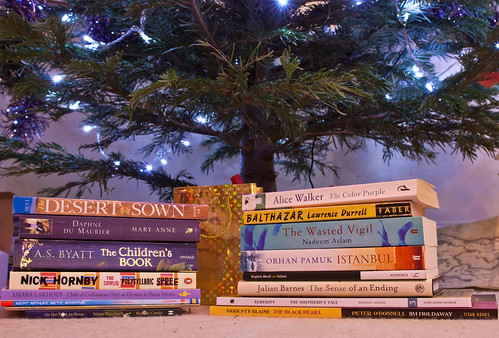
Book booty

December 26, 2011

Unwrapped

Kate Gardner Blog

Posts pagination

1 … 99 100 101 … 123

Archives

RSS Nose in a book

  • November 2025 reading round-up
  • Book review: Resist: Stories of Uprising edited by Ra Page
  • Book review: The Annual Banquet of the Gravediggers’ Guild by Mathias Enard

Me on the internets

  • @kate_in_a_book@mas.to (Mastodon)
  • Flickr/noseinabook
  • Instagram/kate_in_a_book
  • StoryGraph/kate_in_a_book

Categories

  • Blog
  • Reviews
  • Uncategorized
Proudly powered by WordPress | Theme: Dream by vsFish.