Nose in a book

Reviews and other ramblings

  • Home
  • Reviews archive
    • Book reviews
    • TV reviews
    • Theatre reviews
  • TBR
  • Challenges
    • The Classics Club
    • 2014 Popular-Science Reading Challenge
    • Cookery challenge
    • The Gilmore Girls Reading Challenge
    • 2013 TBR Pile Challenge
    • 2013 Translation Challenge
    • Crime and Punishment read-a-long
  • About
    • Cookie legal stuff
  • Home
  • Reviews archive
    • Book reviews
    • TV reviews
    • Theatre reviews
  • TBR
  • Challenges
    • The Classics Club
    • 2014 Popular-Science Reading Challenge
    • Cookery challenge
    • The Gilmore Girls Reading Challenge
    • 2013 TBR Pile Challenge
    • 2013 Translation Challenge
    • Crime and Punishment read-a-long
  • About
    • Cookie legal stuff

Year: 2012

Musical interlude: The Bookshop Band

September 9, 2012

I have heard The Bookshop Band on the radio a couple of times now and I think they’re great. They’re actually local to me, brilliantly, so I will try to check them out live. But for now, here’s a video they made.

“A shop with books in” – a song inspired by bookshops, written for Independent Booksellers’ Week 2012 by The Bookshop Band from The Bookshop Band on Vimeo.
Kate Gardner Blog

The defeating sense that her own shadow was identical to all the rest

September 6, 2012September 10, 2012 2 Comments

NW
by Zadie Smith

A couple of days after finishing this book I am still uncertain of my reaction to it. I don’t mean whether it was good or bad, exactly – I definitely enjoyed the read – but trying to dig deeper than that I am full of uncertainty.

The narrative slips between stream of consciousness, first and third person, and what I suppose you might call soundscape. This sounds like it would be hard to follow and it occasionally is, but for the most part the story is clear. Inasmuch as there is a single story, that is. I am still wrestling with that.

The novel follows three characters in turn, two of whom are much more closely linked than the third. All live in north-west London, in the NW postcode area, hence the title. This is an area I know a little, having friends there, so it was interesting to read a “native” (Smith is herself from NW) description of places such as Kilburn that I know as a frequent visitor.

NW seems preoccupied by wealth, class and the attitudes of people toward each other, both within and outside their social groups. It examines aspiration, ambition and the lack of those things. But it also looks at identity, how we see ourselves and how others see us and how those things rarely match up, even between partners or best friends.

“To Leah it was sitting room, to Natalie living room, to Marcia lounge…Shadows had been passing over the walls of this house since 1888 sitting, living, lounging. On a good day Natalie prided herself on small differences, between past residents, present neighbours and herself…At other times…she had the defeating sense that her own shadow was identical to all the rest, and to the house next door, and the house next door to that.”

These are some big ideas and it’s to Smith’s credit that it reads like a beautifully written story of modern life, not a philosophical treatise. Smith somehow even gets away with writing in dialect, which I usually hate. It’s sharply observed and occasionally very funny.

“Outside he tried to calm himself and realign with the exuberant mood in the street. The sun was an incitement, collapsing day into night. Young bluds had stripped to their bare chests as if in a nightclub already.”

The characters are wonderfully real, complex bundles of contradiction, with interesting flaws and believable back stories, most of which lead back to the same Willesden council estate. Certainly, for a novel preoccupied by ideas of class and self-improvement, there are few scenes of wealth, with the bulk of the story following those who struggle for money (and by that I mean the lower middle class style of money struggles as well as true hand-to-mouth difficulties). In fact, there were a couple of dinner party scenes that seemed so anti-middle-class that I actually cringed.

So the novel is not without fault. The stream of consciousness is perhaps too occasional, the book is divided into very short sections, speech is indicated in different ways in different places (quote marks, no quote marks, dashes, transcript) and there are a couple of complete breaks such as a chapter typeset in the shape of a tree, which between them smacked a little of trying to be literary. It’s also perhaps a little disconnected. I felt there needed to be a more even degree of overlap between the stories.

I haven’t let myself peek yet, but I hear this novel has had some controversial reviews in the press, so I’m now off to check what the Observer had to say… Any of you read this already? Managed to bag yourself an advance copy or rushed out on publication day to buy it? Did it meet your expectations?

This book was kindly sent to me by the publisher in return for an honest review.

Published September 2012 by Penguin.

Kate Gardner Reviews

Some had a whole epic, others just a verse

September 4, 2012March 9, 2015

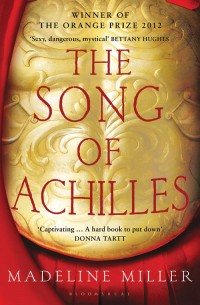
Song-of-AchillesSong of Achilles
by Madeline Miller

I must admit, when I started hearing about this book everywhere, it intimidated me. I mean, it’s based on The Iliad, which I know I should have read but haven’t because it’s always struck me as likely to be hardgoing. But then everyone was just so enthusiastic that I thought, well I might give it a go. And then Simon of Savidge Reads kindly arranged with the publishers to give some copies to his readers and I was one of the lucky winners. And oh man am I glad. Best book of this year so far, no question.

What Miller has done is to take a relatively minor character – Patroclus – and follow his life through his voice. From a quick scan of Wikipedia I think she has changed some details but broadly followed the original story, just filling in the gaps with her amazing imagination.

Miller completely brings it all to life. There is no question that you are in Ancient Greece, that life is tough and war is brewing, and let’s not forget that I am no fan of war stories, but the narrative that Miller weaves had me entranced from start to finish.

The story is the relationship between Achilles and Patroclus, which begins as friendship between boys, with Patroclus learning what it means to get to know a demi-god:

“He said what he meant; he was puzzled if you did not. Some people might have mistaken this for simplicity. But is it not a sort of genius to cut always to the heart?”

Miller’s innovation is to concentrate on the love story rather than the war and gods and adventuring, although that is all there as well. Apparently Plato considered the relationship between Achilles and Patroclus to be the ideal of romantic love, though it wasn’t made explicit in The Iliad and the exact nature of their relationship has been debated for centuries. Well, Miller makes no bones about it. This book makes it 100% clear and explicit that they are gay lovers. And in the most beautiful, heartbreaking, “life depends on this love” type of way. It is achingly romantic but never mushy. Because these are manly men. I mean, Achilles is a half-god-half-man warrior of legendary fury and skill.

Which brings me to another aspect of the story I was apprehensive of: this is a world where life includes gods and fantasy creatures and prophecies and magic. Miller handles this brilliantly. The historical setting allows people to be uncertain of the truth about stories they have heard about gods etc but superstitious enough to just accept magic when it appears. This is a very human story but somehow magical as well. In every respect of that word:

“‘She says that there is strangeness among the gods, that they are fighting with each other, taking sides in the war. She fears that the gods have promised me fame, but not how much.’
“This was a new worry I had not considered. But of course: our stories had many characters. Great Perseus, or modest Peleus. Heracles or almost-forgotten Hylas. Some had a whole epic, others just a verse.”

I’m not sure I am successfully communicating the beauty of this book, so you will just have to read it for yourself:

“This feeling was different. I found myself grinning until my cheeks hurt, my scalp prickling till I thought it might lift off my head.”

Handily, The Readers is running a new book club and this is the first book on the reading list, podcast due imminently. And if you’re interested in the review that sparked my interest, you can check it out on Savidge Reads, here.

First published 2011 by Bloomsbury. Paperback edition published 2012.
Winner of the Orange Prize 2012.

Kate Gardner Reviews

Sunday Salon: Celebrating 10 years

September 2, 2012 2 Comments

The Sunday Salon

Not 10 years of the blog; I’m not that with it! No, this week Tim and I celebrated 10 years together with a holiday in Cambridge. I’d not been before, though I felt like I knew it well from books, films and TV, but it was a real treat to go and soak up the centuries of learning. So much great architecture, culture, science and art. Far too much for a week in fact! At least, it is when you take frequent breaks for pleasant walks, reading books and eating delicious food.

The classic view of the River Cam, complete with punts and bridges, and I think that’s the back of King’s College.
The classic view

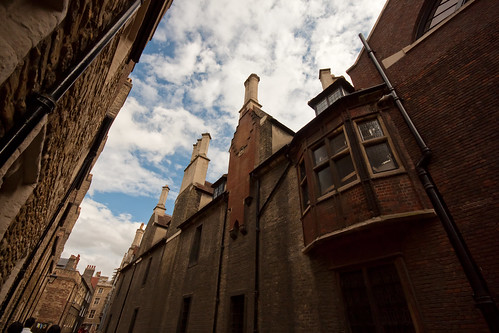
Plenty of narrow cobbled streets and a little less plenty of sunshine.
A glimpse of blue sky

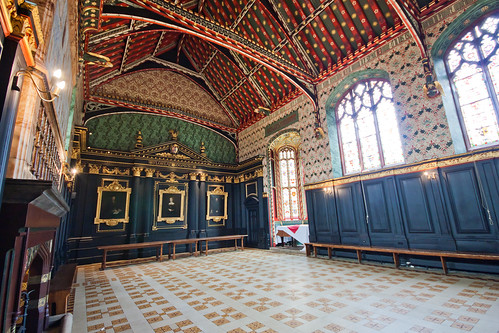
Some seriously impressive architecture and interior décor at these colleges, for instance this hall at Queens’ College.
Restored to magnificence

Plus lots of bookshops, lots of green spaces and bikes everywhere (though not that many actually being ridden while we were there; not sure if that’s because it’s outside of term time or because my expectations were skewed by living in the Cycling City that is Bristol). I took approximately a bajillion photos, a lot of which were on film, so my Flickr photo set will grow, if you’re interested.

Kate Gardner Blog

The ridiculous is very deep in her, where she fights with phantoms

August 29, 2012September 10, 2012

My First Wife
by Jakob Wassermann
translated by Michael Hoffman

This “lost classic” deserves introduction because it’s really quite an odd story. First published in German in 1934, this story was just a small segment buried in a 2000-page trilogy, an autobiographical confession loosely disguised and hidden from view. When Michael Hoffman stumbled across it he was stunned by this powerful account of a marriage and knew he had to bring it to a wider audience and so set about translating it into English for the first time.

The story is that of Wassermann’s alter ego Alexander Herzog, a German-Jewish writer who lives on the kindness of friends and strangers in true Bohemian style until he is introduced to the bizarre character of Ganna Mevis. Claiming to have been misunderstood her whole life, Ganna enthuses gushingly about Herzog’s artistry, sure that he will become a star and that her generous dowry will help him to get there. It is not a comfortable union from the start. Herzog confesses to being cold with her and can never understand her, but he is also spellbound to a certain degree, whether by her constant flattery or sheer weirdness it’s hard to tell:

“You can find a woman lovable without loving her; that’s a dangerous grey area. When I gave her my hand, she could sit there charmed as though that moment was a singing eternity, then she would lean over and press her lips to my fingers with a reverence that sometimes made me say: oh, don’t do that, don’t bother.”

After a few years of uneasy truce the marriage begins to unravel and so begins the legal and financial tangle that make the rest of Herzog’s life hellish. He is made to see how his earlier leniency has cost him dearly, but not before he has spent years defending Ganna to everyone else, as they all see how dangerous she might be:

“One shouldn’t judge Ganna on the basis of single incidents, you need to see her in the round, as the wild nature she is. Her errors, her passions, her mistakes, they are all based on a splendid unity…The ridiculous is very deep in her, where she fights with phantoms…She doesn’t have a clue about reality.”

If this wasn’t autobiographical (with very few details changed, apparently) it might be hard to believe in the character of Ganna. She is utterly vindictive, but that’s not quite the word because she so thoroughly believes that she is in the right and that she has been wronged at every turn. And no wrong is ever forgotten.

Wassermann’s style is at once detached and chatty. He is analysing his own story and making a clear effort to separate himself from events, which is of course impossible even if he has given his story to Herzog, and leads to the occasional “unreliable narrator” moment when he lets slip a detail about himself that you realise explains an awful lot that has gone before.

There is a lot of glib talk about optimism and pessimism, which occasionally becomes profound:

“Even those moments of wanting to die come with a small flame that causes the heart to flicker into life…The least happiness is something so exquisitely precious in the lower depths.”

Wassermann writes movingly of love (albeit not for Ganna) but also of the Great War (“At the Somme a half-brother of mine died…No letter, no farewell, just a silent death.”), of misplaced trust but also of rabid inflation and other signs of political turmoil in Germany and Austria in the 1910s and 1920s. He tries hard to understand how he ended up where he did, a successful author dying in severe debt with his sweetly optimistic lover crushed by the weight of years of doing battle with her predecessor. And really the clues are all there, he is far from blameless.

This is such an interesting read, and eminently quotable at that, but it is not one to race through quickly. It demands of its reader some attempt at understanding this relationship that defies understanding. And I found myself trying to bestow empathy, or at least sympathy, on characters who pages later threw such an emotional response haughtily back at me. I have no doubt that Penguin is right to label this a classic on its first printing in English.

This book was kindly sent to me by the publisher in return for an honest review.

First published in German, within Joseph Kerkhovens dritte Existenz, by Queredo, Amsterdam, 1934.
This translation published in Penguin Classics, August 2012.

Kate Gardner Reviews

All that succession and repetition of massed humanity

August 23, 2012September 10, 2012 4 Comments

Vile Bodies
by Evelyn Waugh

Why oh why have I never read Waugh before? How has this happened? He was clever and funny and acerbic and fun and catty. Can you tell I enjoyed this book?

The novel follows a short time in the lives of the “bright young things”, the high, fast-paced society of 1920s London. From the first page the caustic comic tone is set. No-one escapes a vicious lashing. There are no real heroes, though a case might be made for Adam Fenwick-Symes being the centrepiece. He is certainly the butt of the longest joke: his relationship with lovely but frankly flighty Nina.

The story is really a series of parties and other social engagements. As Adam remarks at one point:

“…’Oh, Nina, what a lot of parties.‘
(Masked parties, Savage parties, Russian parties, Circus parties…parties in flats and studios and houses and ships and hotels and nightclubs, in windmills and swimming baths…all that succession and repetition of massed humanity. Those vile bodies…)”

For all the wit and the lack of getting inside anyone’s head, the characters are not entirely caricatures. There is an element of that certainly, but there are complexities too. When at one point Adam encounters a dressmaker’s dummy, the narration adds:

“…there had been one of these in Adam’s home which they used to call ‘Jemima’ – one day he stabbed ‘Jemima’ with a chisel and scattered stuffing over the nursery floor and was punished. A more enlightened age would have seen a complex in this action and worried accordingly…”

While the goings-on are quite lighthearted and romping, there is the occasional event that you feel ought to be being taken more seriously. But then when I got to the ironically titled final chapter “Happy ending”, I realised that that was the whole point. Without wishing to give anything away, Waugh neatly provides the excuse for all this living to excess, while maintaining his pessimistic tone.

The satire of society does come at a price. Emotion is limited or absent completely, despite the central love story of Adam and Nina, not to mention some other serious goings-on that might demand an emotional response. And politicians are present and roundly mocked but their politics not dealt with at all. I suppose it is quite a small book and to keep its momentum it had to have a narrow focus.

One subject that does muscle its way into the narrative is tabloid journalism, in particular the gossip columns. This was handled so amusingly that I particularly want to read Waugh’s novel Scoop soon.

First published 1930 by Chapman & Hall.

Kate Gardner Reviews

It was only a series of feelings

August 18, 2012September 10, 2012

I'm the King of the Castle

I’m the King of the Castle
by Susan Hill

I think I may have left it a little too long to write this review because I was struggling to think of coherent things to say. Which is not to disparage the book. I really enjoyed it. I had just fried my brain a little with too much stuff.

This is the story of a fight for supremacy between two 10–11 year old boys. Hill perfectly captures how to them it is of utmost importance, while to their parents there is nothing of import going on. Edmund Hooper lives quietly with his father in their big old family home. He is dismayed when his father employs a new live-in housekeeper, Mrs Kingshaw, who brings her son Charles along. He is even more dismayed when it quickly becomes apparent that Mrs Kingshaw is as much a candidate for second wife as she is housekeeper. Her son is equally dismayed by this idea, partly due to jealousy of his mother’s time, but primarily due to the increasing possibility that he will spend his entire life being bullied by Hooper.

The style is slightly odd and stilted, which I suppose you could say reflects the awkwardness and distance between all these characters who ought to be intimately linked. Kingshaw thinks at one point:

“He wanted to say I’ve come here and I don’t like it [but] I’ve got to stay here [so] why can’t we make the best of things? He was willing to put himself out, he would even, just at this moment, have said he would do whatever Hooper wanted, would acknowledge him as a master of his own territory. But he couldn’t put any of it into words, not even to himself, it was only a series of feelings, overlapping one another like small waves. He was confused.”

The relationship between the boys is cleverly created. Physically they are approximate equals but Hooper has confidence and the home territory, giving him the advantage. He terrorises his prey by subtly observing Kingshaw’s many fears and playing on them. Hooper is also the cleverer of the two, knowing just how to behave in front of their parents so that they suspect nothing. Kingshaw is not a sweet innocent, though. When he gets a chance to have the upper hand he takes it, usually.

There are moments of genuine childish play in the middle of it all that give you hope that the parents will be right after all, that two boys of the same age will always become friends if thrown together. But almost as soon as these moments begin, the seeds of doubt are being sown, as the boys size one another up.

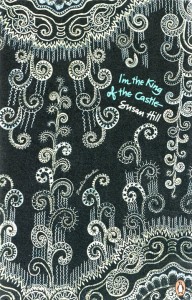
On an aside, I bought the really quite beautiful Penguin Decades edition, with cover art by Zandra Rhodes. I am such a sucker for pretty books.

First published 1970 by Hamish Hamilton.

Kate Gardner Reviews

Rain poem

August 16, 2012August 23, 2012 2 Comments

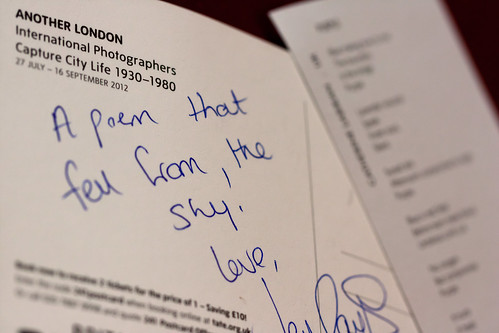
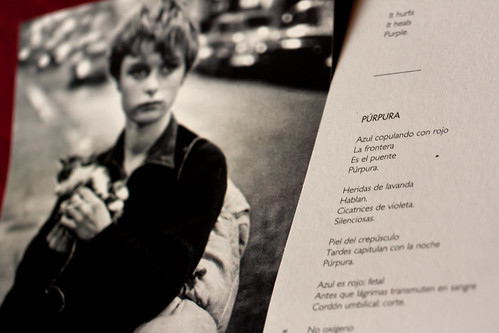
Three weeks ago, the very lovely poet and bookseller Jen Campbell blogged about a fantastic event in London called Raining Poems. She offered to send out some poems from the event and I was thrilled to be one of the lucky winners. My poem arrived today.

Beautiful post

The poem is “Purple” by Catherine Labiran (with a translation into Spanish by Andrés Anwandter).

A poem that fell from the sky

Huge thanks to Jen for the fun post and adding a beautiful poem to my life.

Kate Gardner Blog

Musical interlude: Bluetones

August 16, 2012

Whether it’s a tired, not ready for the world early morning; a lazy, no need to get up late morning; or an I’ve done too much today and want to stop now interlude, this is the perfect sleepy tune. Enjoy.

Kate Gardner Blog

Sunday Salon: British summertime

August 12, 2012August 12, 2012 5 Comments

The Sunday Salon

Many years ago, my sister won a fancy dress competition dressed as British summertime. She wore a swimsuit, kagoule and wellies and carried a bucket, spade and umbrella. And most summers that’s pretty accurate: we’re hopeful but ultimately disappointed. But this year, well it’s been a bit special.

After a month of what felt like solid rain, the sun came out in time for the school summer holidays and, of course, the Olympics. The whole country suddenly found its national pride and got excited about…sport. I’m a little sad that it’s ending today. The Olympics, that is. I’m hoping the summer carries on a little longer.

In-between watching far too much TV we have been enjoying the sunshine with a bit of gardening:
Untitled

and a trip to a city farm:
Mmm, tasty goat ear

All of which means I have done very little reading. I have finally started reading Evelyn Waugh for the first time, and am greatly enjoying Vile Bodies. What have you been up to? Are you squeezing any reading into your summer activities (assuming it’s summer where you are)?

Kate Gardner Blog

Posts pagination

1 … 3 4 5 … 12

Archives

RSS Nose in a book

  • Book review: Interstellar Megachef by Lavanya Lakshminarayan
  • May 2026 reading round-up
  • Book review: Passing by Nella Larsen

Me on the internets

  • @kate_in_a_book@mas.to (Mastodon)
  • Flickr/noseinabook
  • Instagram/kate_in_a_book
  • StoryGraph/kate_in_a_book

Categories

  • Blog
  • Reviews
  • Uncategorized
Proudly powered by WordPress | Theme: Dream by vsFish.