Nose in a book

Reviews and other ramblings

  • Home
  • Reviews archive
    • Book reviews
    • TV reviews
    • Theatre reviews
  • TBR
  • Challenges
    • The Classics Club
    • 2014 Popular-Science Reading Challenge
    • Cookery challenge
    • The Gilmore Girls Reading Challenge
    • 2013 TBR Pile Challenge
    • 2013 Translation Challenge
    • Crime and Punishment read-a-long
  • About
    • Cookie legal stuff
  • Home
  • Reviews archive
    • Book reviews
    • TV reviews
    • Theatre reviews
  • TBR
  • Challenges
    • The Classics Club
    • 2014 Popular-Science Reading Challenge
    • Cookery challenge
    • The Gilmore Girls Reading Challenge
    • 2013 TBR Pile Challenge
    • 2013 Translation Challenge
    • Crime and Punishment read-a-long
  • About
    • Cookie legal stuff

Year: 2012

Bristol Festival of Literature

October 19, 2012 5 Comments

If I had had any spare time at all this week I would have blogged about this sooner but I didn’t so I didn’t. Hey ho. It’s Bristol Festival of Literature time!

I’ve been to two events this year, both of which were great. On Sunday I ventured into Redcliffe Caves to hear Bristol Writers Group read aloud a series of chilling tales. It’s a wonderfully atmospheric location and organisers had done a great job of lining the route from Redcliffe Wharf entrance to the big cavern with candles so that we didn’t even need the torches we’d been advised to bring. (We did need the sensible shoes and camping chairs, though. Glad I was reminded of that advice!) The stories were generally excellent and well chosen for the location – occasionally spooky but mostly choosing more real-life chills than supernatural. (I’m afraid I didn’t take notes of any of the writers’ names. Poor journalism, I know.) And I now want to do a proper tour of the caves even more than I did before.

The second event was at the Thunderbolt pub and entitled “Satire and the city”. Local authors Mike Manson and Jari Moate talked about Bristol, comedy and the subjects that interest them. The title was a little misleading in that satire was not specifically discussed, though it was there to some extent in some of the excerpts they read from their books. Perhaps I need to read one of their books to find out if it was just an accurate description of them as writers. I’d be happy to do that; both were interesting, funny speakers. And another great venue that I’ve been meaning to go to for years and never made it to before.

Bristol Festival of Literature continues until this Sunday, including a big day of many events on Saturday, so there’s still a chance to join the fun. And for more bookish fun, tomorrow it’s also Bristol-Con, which was great fun last year.

Kate Gardner Blog

For shame you must compose yourself and stay very quiet

October 16, 2012October 20, 2012 2 Comments

Hateship, Friendship, Courtship, Loveship, Marriage
by Alice Munro

This collection of short stories was picked by my book group. The title gives a clue to its overarching themes and I had an inkling that Munro was well known for her short stories, but otherwise I didn’t know what to expect. I have an idea that she is a bit of a national treasure in Canada so apologies for my cluelessness.

The stories all deal with relationships, of all kinds – couples, siblings, extended family, friends, acquaintances; even the brief relationships established with strangers under certain circumstances. There is nothing fantastical, or showy, or even hugely eventful (though things do happen that with another writer at the helm could be dramatic, or melodramatic). Munro’s style is quiet, understated, acutely observed but not in the biting, sarcastic manner of many a younger writer. She is generous to her characters, reserving judgement even as she reveals their flaws.

All of which sounds like this could be a light, fluffy read, but it most definitely is not. There is a slightly melancholic air about the stories, a sense of disappointment and disenchantment. Lovers cheat and/or break up, people get sick, people die, people lose touch. But it’s not all downbeat. There are small pleasures, small hopes, moments of pure love:

“Her heart had been dry, and she had considered it might always be so. And now such a warm commotion, such busy love.”

Every story stands up to scrutiny; in fact they are almost certainly improved by it. At book club we all had different favourites and all enthused about each other’s choices. We did all have reservations about the first story, from which the collection takes its title. While clever and interesting, it did not have the everyday feel of the other stories. It starts with a woman arranging to ship furniture across Canada, then tells us who she is and why she is doing it, then continues her story, but it skips perspective several times, zooming in on a character for a few pages at a time. At 54 pages it is the longest story in the book and possibly the most experimental. It certainly intrigued me but also frustrated me, which was actually a reaction I had a few times.

It is almost certainly a good thing to find yourself shouting (on the inside) at a character for their actions – it shows both that you have been drawn into the story and that you find the character believable – how else could you presume to think they would act in a certain way? And Munro definitely populates her stories with believable people. She deftly, in just a few lines, tells you what you need to know and yet sometimes the whole story will be a gradual revealing of a person’s character:

“She looked both frail and hardy, like a daisy on a long stalk.”

Brilliantly, you could just as easily argue that little or nothing happens in these stories, or that too much happens. Those mundane details of everyday life that Munro picks out can seem so inconsequential, yet at the same time you realise that the characters’ concerns are often the same as your own so-called disasters. It is difficult balancing guilt at having moved away from family and the need to build your own independent life and it is galling when someone plays on your guilt.

This is one of many examples where Munro seems to take a side, only to give sympathetic ear to the other side of the debate later on, often in another story. To balance the unwanted family guest, there’s a very sick man who could really do with his family making the effort to visit. That, incidentally, comes in the final and for me most emotionally engaging story, “The bear came over the mountain”.

I am beginning to realise how very much there is to say about these stories and that I already want to re-read some of them. At first I was not impressed and even on immediately finishing the book I felt that it had all been a bit old-fashioned, too much about marriage with most of the wives staying at home and having babies. But the more I reflect the more I see how well Munro has captured the realities of a certain kind of life that is familiar to most of us in the western world. None of her characters is hugely rich or desperately poor. Those who face hardship have support. These are the most middling of ordinary lives, and that is why they ring so true and say so much:

“And yet – an excitement. The unspeakable excitement you feel when a galloping disaster promises to release you from all responsibility for your own life. Then for shame you must compose yourself and stay very quiet.”

Published 2001 by Alfred A Knopf in the US, Chatto & Windus in the UK.

Kate Gardner Reviews

October is Lupus Awareness Month

October 11, 2012October 11, 2012 2 Comments

Lupus Awareness Month

Yes, it’s lupus awareness time again. But rather than regale you with yet more tales of how tired I am feeling, I shall refer you to better bloggers than I who have covered lupus experiences of their own.

Lupus in Flight is written by poet Shaista Tayabali and combines her lovely poems with tales of daily life and doctors. She has unfortunately faced the harsher side of lupus, including many a hospital stay, but her voice remains one of joy.

It’s So Not Sexy is written by singer/songwriter/actress Maurissa Tancharoen Whedon, who may just be my personal hero. Like Shaista she has had some pretty low lows from the evil that is lupus, but she remains a super cool person and, thanks to some friends in celebrity places, is getting the word out there about lupus.

As always, if you want to learn more about lupus, I refer you to Lupus UK and the Lupus Foundation of America. If you have lupus yourself, or indeed any chronic illness, I can highly recommend the website But You Don’t Look Sick for both fun and serious help.

Kate Gardner Blog

NaNoWriMo…again

October 8, 2012 5 Comments

Oh yes I did. I signed up to NaNoWriMo again, despite last year’s mini meltdown and subsequent failure to “win”. I have had a title rolling around in my head for several months and am slowly coming towards an idea of what I want to do with it.

For those who don’t know, NaNoWriMo is a challenge to write a novel in a month. More specifically, the aim is to write a 50,000 word first draft of a novel within the month of November. It is a fantastic impetus for people like me who think of themselves as writers but let those pesky day jobs prevent us from doing any (or much) actual creative writing. As I seem to be a bit rubbish at doing much reading lately, maybe now’s a good time to get my writer head on. We’ll soon see…

Kate Gardner Blog

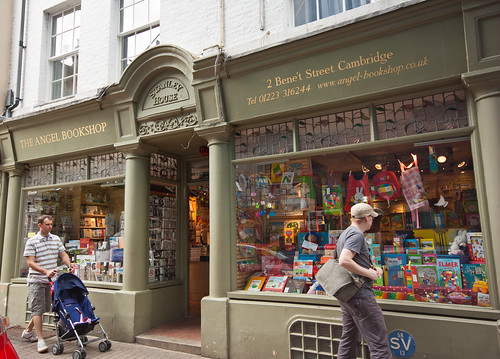
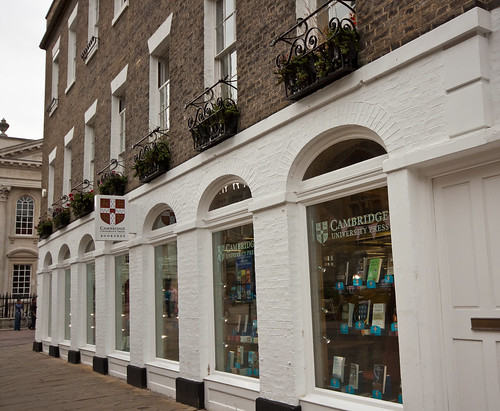
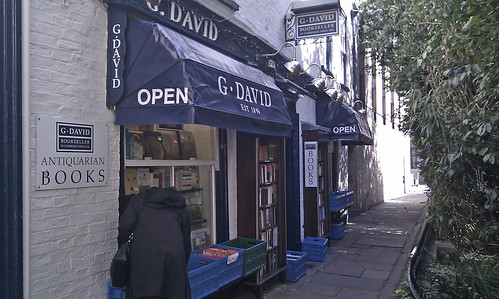
Cambridge bookshops

October 3, 2012October 3, 2012 5 Comments

I know our holiday was a month ago, I have been meaning to post about this and kept forgetting/waiting for my photos to be developed.

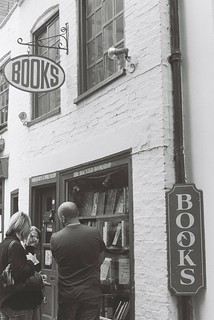
One of the many nice things about Cambridge is its abundance of bookshops. In these times of bookshops, both independent and chain varieties, closing left, right and centre, it’s good to know they’re flourishing somewhere.

The Haunted Bookshop

The Angel Bookshop

Cambridge University Press

G David Bookseller

I particularly liked Heffers bookshop, which is owned by Blackwells and reminded me a lot of their very excellent Oxford branch. Sadly my photo of that storefront came out particularly badly.

Of course, we couldn’t resist buying something in each of several of these lovely lovely shops. I really must stop buying books for a long while now! Here are just some of our purchases. See if you can guess which are for me and which for Tim, though I should warn you that to be crafty some were for both of us. It’s good to share.

Holiday books

(Why yes, that is a first-edition Daphne there. In the classic yellow Gollancz jacket. That will have pride of place on my bookshelves, when I can get to them again.)

Kate Gardner Blog

I am merely bored, not a defiant brat

September 30, 2012 4 Comments

The Chocolate Money
by Ashley Prentice Norton

Does a compelling story outweigh all the other elements of a book being less than compelling? For me, no, but for a lot of other people I suspect it would. So I recommend you keep that in mind while reading my not-so-glowing opinions below.

I was sent this book unsolicited but the premise was vague enough and the straplines on the cover intriguing enough that I gave it a chance. After this I am definitely going back to books I have bought for myself for a while.

The story is that of Bettina, raised by her single-parent chocolate heiress mother Babs. Babs is a slightly brattish partier who loves her daughter but isn’t going to change her life for her. We follow Bettina from the age of 10 to 16 (plus a brief flash forward at the end), dipping into her life at times that I think were supposed to have been picked out for their significance (there is a slightly heavy handed mention of Bettina’s class assignments for an English teacher including her writing about many of the events from the start of the book). The problem is that, while they might be significant (but not out of the ordinary) for the average kid, from a story about a millionaire I sort-of expect more. Or at least different.

Let’s take those cover straplines that I find completely misleading. First, “When you have everything, trust no-one”. That implies a thriller, or at least lots of betrayal and distrust. As far as I can tell the one doing most of the betraying in this book is Bettina. She doesn’t make friends. Though she wants to, she picks the wrong role models and then blames it all on her mother when it goes wrong. And that is the sort of book this is, it’s about a tween/teen’s privileged but oh-so-traumatic life. Not my cup of tea.

And the other strapline? “An adorable child. A phenomenal fortune. A mother like no other.” I did not find Bettina adorable. As far as I can tell none of the other characters did so why should I? The fortune bit is true but Bettina seems strangely clueless about spending it. For instance, when she arrives at boarding school with one small duffel of clothes and sees that all the other girls brought bedding and other home comforts why doesn’t she call some expensive shop in Boston or New York and get a bunch of stuff delivered? It makes no sense.

As for her mother, I felt a lot of the time that I was supposed to be disapproving of Babs and yes, she’s not the ideal mother figure but she’s not that bad either. She isn’t absent, she includes Bettina in her life despite her having a full-time nanny. There is one occasion when she slaps Bettina across the cheek that Bettina is still obsessing about years later, suggesting it was a one-off. And there is one scene when Bettina gets drunk when she’s only 12, which I think was supposed to be shocking, but she does it at a big party at her house so help is immediately at hand and we later learn that afterward her mother teaches her about drinking alcohol. How many millionaire kids have far far worse stories to tell?

Babs does talk coarsely, that is true. I am all in favour of talking to children about sex and relationships but minus the personal element that Babs favours. Also, her refusal to tell Bettina who her father is doesn’t strike me as unreasonable and felt a lot like a contrivance to generate a guessing game for the reader.

Plot holes aside (and there’s a few – she hero worships her mother so why does she want to “escape” her? who does she stay with in Paris every summer?), I did find the story drew me in. Certainly, the middle section, where Bettina is at boarding school, kept me reading late at night and first thing in the morning. It’s an easy writing style and I have always liked school-based/coming-of-age plots. Plus this section had a decent range of characters with different agendas.

I guess my problem is that the writing had nothing going for it other than ease of absorption. It didn’t feel like an authentic child’s voice at all but it wasn’t a knowledgeable “future me looking back” angle either. It does that thing that annoys me of detailing clothes and make-up minutely, but it doesn’t do this consistently, in fact mostly only for Babs. It’s a first-person narration, so shouldn’t Bettina notice everyone in the same way? At least to compare them with her mother?

I struggled to pick out any stand-out quotes so I will just give you the opening line, which is a reasonable example of the whole flavour of the book:

“The day I cut my hair and completely fuck up the Christmas Card, I am merely bored, not a defiant brat like Babs tells all her friends.”

This book was kindly sent to me by the publisher in return for an honest review.

Published 2012 by Bantam Press, an imprint of Transworld Publishers.

Kate Gardner Reviews

Caught up to her among the luminous clouds of deity

September 26, 2012

A Handful of Dust
by Evelyn Waugh

After my recent discovery of Waugh’s genius, I was glad that this title was picked by my book group. I must say it didn’t bowl me over the way Vile Bodies did, and if it hadn’t been for the book group discussion I would have been left very confused by it.

By which I don’t mean that the style or storyline was confusing. I mean that it has an odd tone, one that I didn’t entirely like. It’s, as you might expect, a comedy, but always at people’s expense – the comedy is never about the circumstances or event, so it’s a painful comedy.

The story is that an apparently happy marriage – that of Tony and Brenda Last – very suddenly falls apart thanks to an unappealing interloper. But can it really have been as happy as it first appeared if it is able to fall apart so suddenly and apparently easily? There are clues that boredom may be setting in:

“Although they were both in good health and of unexceptional figure, Tony and Brenda were on a diet. It gave an interest to their meals…Under their present system they denied themselves the combination of protein and starch at the same meal…
‘I’m sure it does me a great deal of good.’
‘Yes, darling, and when we get tired of it we might try an alphabetical diet, having things beginning with a different letter every day.'”

This is a book absolutely loaded with irony (in a possibly very bitter, personal way) and crammed full of vicious attacks on high society and the people therein. It simultaneously deplores and is guilty of snobbery. And yet, if you cut through the irony, what you are left with is really a sad, painfully real story of a marriage falling apart.

“…opinion was greatly in favour of Brenda’s adventure. [She} was filling a want long felt by those whose simple, vicarious pleasure it was to discuss the subject in bed over the telephone. For them her circumstances shed peculiar glamour; for five years she had been a legendary, almost ghostly name, the imprisoned princess of fairy story, and now that she had emerged there was more enchantment in the occurrence, than in the mere change of habit of any other circumspect wife. Her very choice of partner gave the affair an appropriate touch of fantasy…the joke figure they had all known and despised, suddenly caught up to her among the luminous clouds of deity…”

If you asked most people when they were halfway through this book I imagine they would say they didn’t like and didn’t care about any of the characters. And yet when bad stuff happened to them, or threatened to, I found that I did care. (And according to my book group I was not alone in this.) I think Waugh’s real genius is in observing people so well, so minutely, that even his least appealing characters are genuinely believably real.

Which is not to say that there isn’t some element of send-up going on. Considering Waugh’s cleverness it can’t be accidental that the couple at the centre of it all are Mr and Mrs Last. But the last of what? At first, you might conclude that they are the last couple about who married for love rather than money/convenience. But actually there are other love matches in the background and Brenda’s love for Tony disappears so quickly you have to wonder whether it was ever really there.

Perhaps Tony is the last of his generation to care about his big country house; he is completely devoted to it where other families are all selling off their estates. But he’s not very good at being a country gentleman, so maybe that’s not it either.

Perhaps Tony is the last faithful man in high society. There are some painful sequences where various friends (including Brenda) try to throw women at Tony to make the break-up easier on him. And even when he tries to have an affair he just can’t do it. Which should be admirable but somehow makes him look pathetic. (I believe there are elements of Waugh’s own marriage break-up in this novel so it could be that his self-pity and self-hatred became part of Tony’s character. This might also explain the sudden switches in sympathy, sometimes abandoning a character mid-scene.)

There is a long section at the end set in South America that is markedly different from the rest. It was originally a short story, which explains some of the tonal difference, but it actually works well as a new way of looking at British society. It’s pretty racist, which is partly a product of its time but also, I suspect, a comment on the characters who are there for all the wrong reasons, as it’s through their eyes that the racism occurs.

Someone at book group pointed out that Waugh heavily references T S Eliot, and in particular The Waste Land in this novel, which I must admit I missed despite having studied (and enjoyed) The Waste Land at uni and a verse of the poem being the epigraph for it all (and indeed the origin of the novel’s title). Ah well; what was that conversation The Readers were having about not being literary enough…?

First published 1934 by Chapman & Hall.

Kate Gardner Reviews

Sunday Salon: Too busy to get anything done

September 23, 2012 7 Comments

The Sunday Salon

It has been a week and a half since I last posted anything, which I think is my longest break from the blog. Even when we were on holiday for two and a half weeks I scheduled posts in advance. I have been rubbish. Not that I expect anyone is desperately waiting for my next update, but it’s still a bit rubbish. I could blame it on tiredness and illness, and there has been a bit of that, but mostly I’ve been crazy busy (and no, I agree, tired and ill and busy is not a good combo).

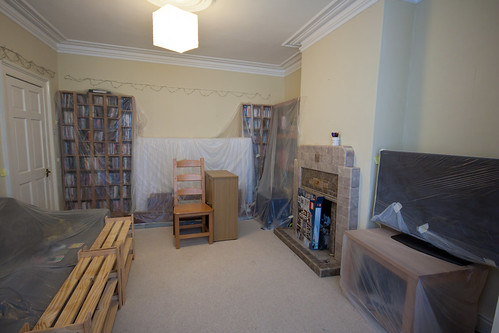
We’ve been having some building work done on our house. Actually, quite a lot of building work. Which leads to a fair bit of DIY, decorating and of course cleaning for us to do. LOTS of cleaning. I haven’t done any real exercise since we went on holiday at the end of August but I feel I’ve made up for it with all the scrubbing and hoovering and whatnot.

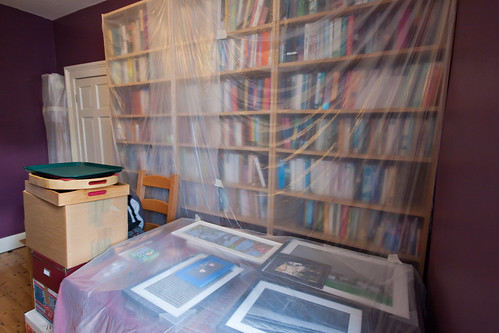
We’re nowhere near ready to show after photos yet but for an idea of the chaos that is our house right now, here is how much we dust-sheeted before the work began (plus sealing up all the doors we could)…

Dust-sheeted

Forbidden books

Playroom lost

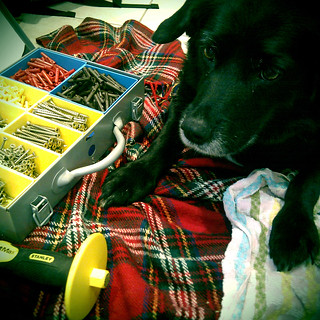
…and it was totally necessary. Black sooty dust everywhere. We don’t have photos of that because it was too dusty to get cameras out. Yeah. Nice. But on the plus side DIY with my Dad and the dogs is fun.

Doggy aid

Now it’s back to the grindstone. Happy Sunday!

Kate Gardner Blog

Holiday reads in brief

September 13, 2012March 17, 2013

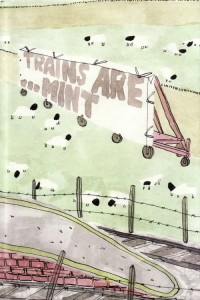
Trains Are Mint

I read quite a few books on holiday and it now feels like an age ago so I’m going to play catch-up with some shorter reviews of slightly unusual books I have read lately.

Trains are Mint
by Oliver East

This is a sweet but odd piece of graphic-novel-style journalism/travel writing. East took his notebook and pen on walks along railway lines from Manchester to Blackpool, drawing and taking notes on whatever grabbed his interest. Which sounds like a fascinating project. And both its niche appeal and its failure to grab me stem from exactly what it is that East finds interesting: rubbish, graffiti, kids hanging out, small railway stations and tumbleweed.

Published 2008 by Blank Slate.

Turning-Point
by Rainer Maria Rilke
Miscellaneous poems 1912–1926
Selected and translated by Michael Hamburger

I love Rilke. I don’t really understand a lot of it but I find it beautiful. In a different mood this might make me feel stupid or at least self-conscious but thankfully I read this book in the stately, studious surroundings of Cambridge and I just enjoyed floating on the words. And using the helpfully supplied German original texts opposite the English translations to remember how I once knew some German but have basically forgotten it all. It may take another read or three to get a little more from it. As Rilke says:

“Do not, do not, do not books for ever
hammer at people like perpetual bells?”

First published as An Unofficial Rilke in 1981. This edition published 2003 by Anvil Press Poetry.

The Hungry Ghost Festival
by Jen Campbell

This is a slim volume, which I have already read most of twice (see above for how this is a good thing with poetry), and I think it’s safe to say that these poems are right up my street. Campbell writes about growing up in north-east England, about being a teenager, the seaside, friendship, gossip, sex and illness. The poems tend to concentrate on the random details that give memories their surreal quality. They are both magical and grittily real.

Published 2012 by The Rialto.

The Beat Hotel: Ginsberg, Burroughs and Corso in Paris, 1957–1963
by Barry Miles

I started reading this book as part of my research for my dissertation at uni. I got halfway through it and then had to concentrate on finishing the dissertation so I put the book down and inevitably I had had enough of Bob Dylan and the Beat poets so I didn’t pick it up again…for eight years. I had forgotten how interesting a read it is. Miles uses lots of primary sources, plus his own interviews with many of the people involved, but slips them seamlessly into the narrative. He has a good grasp of what makes an interesting anecdote. If you have even a passing interest in the Beats I definitely recommend it and defy you to come away not wanting to go straight to Paris!

Published 2001 by Atlantic Books (UK) / Grove Press (US).

Kate Gardner Reviews

A fragility to the space between them

September 11, 2012September 11, 2012

The Woman Who Went to Bed for a Year
by Sue Townsend

There may be a certain symmetry in me reading this book in one day, a day when I was off work sick in bed. I certainly found myself sympathising with main character Eva more than I might have another day.

The day that Eva’s twins leave home for university she takes to her bed and declares that she will not be leaving it again for a year. She asks her husband to use another bedroom from now on. So begins Townsend’s latest comical exploration of modern life. Compared with her other books, this is slightly less about Britain and slightly more about people and coping. But it’s as ever an insightful study of society and humanity.

“Alexander said, ‘I would hate to be you, man. Your heart must look like them ugly pickled walnuts they sell at Christmas. Naasty tings!’
‘I’m one of the most compassionate men I know,’ said Brian…’And if you think that by affecting a West Indian patois I will be intimidated by you, you’re wrong. I’ve got a pal called Azizi – he’s African, but he’s a good chap.’
Alexander queried, ‘But he’s a good chap?'”

Eva is surprisingly sympathetic considering how incredibly self-indulgent her actions are. Even as she is demanding that her sick, elderly mother and mother-in-law take their turns bringing her food and drink, she is so astutely examining herself, asking “the big questions” and paying attention to the rest of the world (ironically, as she has now separated herself from it) that she is difficult to dislike.

Townsend combines the comic and the serious to great effect:

“Ruby said, ‘Look, I’m not getting into another argument about God. All I know is that he looks after me…’
Eva said gently, ‘But he didn’t save you from losing your purse, tickets and passport when you were at East Midlands Airport last year, did he?’
Ruby said, ‘He can’t be everywhere, and he’s bound to be busy at peak holiday time…Do you know, Eva, sometimes I can’t wait to get to heaven. I’m tired of living down here since everything went complicated.'”

Yes, there’s a lot of he said, she said, but there are also phrases that are beautifully formed:

“There was a fragility to the space between them, as though their breath had frozen and could easily shatter if the wrong word were said.”

Sadly, I must admit that Eva is the only character who isn’t a little bit of a caricature. When her astrophysicist husband is introduced he seems quiet and loving and I was hopeful that this would also be an acute examination of marriage/love but it is not. He turns out to be a bit of a joke figure and there is little love between them. Similarly the hyper-intelligent twin children are slightly cliched. But there are a lot of characters in this book who all have a role to play in Eva’s search for answers so perhaps it’s best that they are not all as complex and real as she is.

In some ways this books reminded me of The Unlikely Pilgrimage of Harold Fry – both books take an ordinary person who becomes a temporary celebrity for an odd reason, who becomes the unlikely focus of admirers and newspaper stories and Facebook groups and Twitter hashtags and is disconcerted by this. I suppose it’s a comment on modern life and celebrity and society, but I found it a little hard to believe that people would really get caught up by the story of a woman who decided to take to her bed (though there is a little more to it than that).

Of course, what this book does have in spades is humour. I laughed out loud time and again. It was a real tonic for a bad day and an interesting, perhaps not complete change but certainly slight deviation in focus for Townsend.

This book was kindly sent to me by the publisher in return for an honest review.

Published 2012 by Penguin.

Kate Gardner Reviews

Posts pagination

1 2 3 4 … 12

Archives

RSS Nose in a book

  • Book review: Interstellar Megachef by Lavanya Lakshminarayan
  • May 2026 reading round-up
  • Book review: Passing by Nella Larsen

Me on the internets

  • @kate_in_a_book@mas.to (Mastodon)
  • Flickr/noseinabook
  • Instagram/kate_in_a_book
  • StoryGraph/kate_in_a_book

Categories

  • Blog
  • Reviews
  • Uncategorized
Proudly powered by WordPress | Theme: Dream by vsFish.