Nose in a book

Reviews and other ramblings

  • Home
  • Reviews archive
    • Book reviews
    • TV reviews
    • Theatre reviews
  • TBR
  • Challenges
    • The Classics Club
    • 2014 Popular-Science Reading Challenge
    • Cookery challenge
    • The Gilmore Girls Reading Challenge
    • 2013 TBR Pile Challenge
    • 2013 Translation Challenge
    • Crime and Punishment read-a-long
  • About
    • Cookie legal stuff
  • Home
  • Reviews archive
    • Book reviews
    • TV reviews
    • Theatre reviews
  • TBR
  • Challenges
    • The Classics Club
    • 2014 Popular-Science Reading Challenge
    • Cookery challenge
    • The Gilmore Girls Reading Challenge
    • 2013 TBR Pile Challenge
    • 2013 Translation Challenge
    • Crime and Punishment read-a-long
  • About
    • Cookie legal stuff

Tag: short stories

Spectral shadows across the tamed gardens
February 11, 2013February 12, 2013 2 Comments

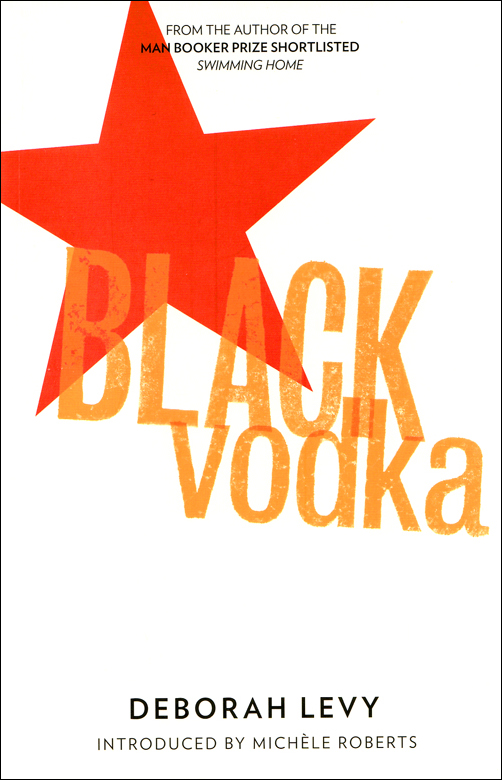
Black Vodka

Black Vodka: Ten Stories
by Deborah Levy

I loved Levy’s novel Swimming Home, which was shortlisted for the Booker Prize last year and Levy was the National Book Awards Author of the Year 2012, so I was pretty excited when I found out this would be the first book in my subscription to And Other Stories.

These are very modern short stories, zipping around different European locations and ethnicities, and incorporating modern technology reasonably well (which is something I basically never say, so kudos to Levy on that). But they’re not about story or location, they’re about emotions and characters and relationships.

“I was instructed in the art of Not Belonging from a very tender age. Deformed. Different. Strange. Go Ho-me Ali, Go Ho-me. In fact I was born in Southend-on-Sea, and so were those boys, but I was exiled to the Arabian Desert and not allowed to smoke with them behind the cockle sheds.”

Most of the stories might be better described as sketches or scenes, which I think I’ve also said about Haruki Murakami’s short stories and I loved both, and I do see some similarities. Both are modern and city-centric, and sometimes the central character can be a little mysterious and cold. But more often, Levy’s characters are warm and racked with emotion.

“At night the satellite dishes on the roofs and walls throw spectral shadows across the tamed gardens. I have grown to love the bronze doorknobs in the shape of jungle beasts: a lion’s head, a tiger, a snake…It gives me a thrill because I know the world is very old.”

Both the characters and the events tend to be oblique, not straightforward. As with Swimming Home there are subtleties at work that mean a few different things could be happening. Sometimes details or even names of characters overlap between stories. I wanted to re-read some of them right away.

My favourite is one of the shortest in the collection, “Placing a call”. It uses the second person and repetition and it’s immediately apparent that the narrator is unreliable. I also loved “Pillow talk”, which is at once a sweet love story and brutally honest.

My only tiny gripe would be that none of these stories is new, they have all been previously published, which smacks a little of cashing in on last year’s award wins, but on the other hand it gives us Levy newcomers a chance to discover more of her great work, and it has definitely solidified my interest in her writing.

Published February 2013 by And Other Stories.

Source: I am a subscriber to And Other Stories.

Kate Gardner Reviews

For shame you must compose yourself and stay very quiet

October 16, 2012October 20, 2012 2 Comments

Hateship, Friendship, Courtship, Loveship, Marriage
by Alice Munro

This collection of short stories was picked by my book group. The title gives a clue to its overarching themes and I had an inkling that Munro was well known for her short stories, but otherwise I didn’t know what to expect. I have an idea that she is a bit of a national treasure in Canada so apologies for my cluelessness.

The stories all deal with relationships, of all kinds – couples, siblings, extended family, friends, acquaintances; even the brief relationships established with strangers under certain circumstances. There is nothing fantastical, or showy, or even hugely eventful (though things do happen that with another writer at the helm could be dramatic, or melodramatic). Munro’s style is quiet, understated, acutely observed but not in the biting, sarcastic manner of many a younger writer. She is generous to her characters, reserving judgement even as she reveals their flaws.

All of which sounds like this could be a light, fluffy read, but it most definitely is not. There is a slightly melancholic air about the stories, a sense of disappointment and disenchantment. Lovers cheat and/or break up, people get sick, people die, people lose touch. But it’s not all downbeat. There are small pleasures, small hopes, moments of pure love:

“Her heart had been dry, and she had considered it might always be so. And now such a warm commotion, such busy love.”

Every story stands up to scrutiny; in fact they are almost certainly improved by it. At book club we all had different favourites and all enthused about each other’s choices. We did all have reservations about the first story, from which the collection takes its title. While clever and interesting, it did not have the everyday feel of the other stories. It starts with a woman arranging to ship furniture across Canada, then tells us who she is and why she is doing it, then continues her story, but it skips perspective several times, zooming in on a character for a few pages at a time. At 54 pages it is the longest story in the book and possibly the most experimental. It certainly intrigued me but also frustrated me, which was actually a reaction I had a few times.

It is almost certainly a good thing to find yourself shouting (on the inside) at a character for their actions – it shows both that you have been drawn into the story and that you find the character believable – how else could you presume to think they would act in a certain way? And Munro definitely populates her stories with believable people. She deftly, in just a few lines, tells you what you need to know and yet sometimes the whole story will be a gradual revealing of a person’s character:

“She looked both frail and hardy, like a daisy on a long stalk.”

Brilliantly, you could just as easily argue that little or nothing happens in these stories, or that too much happens. Those mundane details of everyday life that Munro picks out can seem so inconsequential, yet at the same time you realise that the characters’ concerns are often the same as your own so-called disasters. It is difficult balancing guilt at having moved away from family and the need to build your own independent life and it is galling when someone plays on your guilt.

This is one of many examples where Munro seems to take a side, only to give sympathetic ear to the other side of the debate later on, often in another story. To balance the unwanted family guest, there’s a very sick man who could really do with his family making the effort to visit. That, incidentally, comes in the final and for me most emotionally engaging story, “The bear came over the mountain”.

I am beginning to realise how very much there is to say about these stories and that I already want to re-read some of them. At first I was not impressed and even on immediately finishing the book I felt that it had all been a bit old-fashioned, too much about marriage with most of the wives staying at home and having babies. But the more I reflect the more I see how well Munro has captured the realities of a certain kind of life that is familiar to most of us in the western world. None of her characters is hugely rich or desperately poor. Those who face hardship have support. These are the most middling of ordinary lives, and that is why they ring so true and say so much:

“And yet – an excitement. The unspeakable excitement you feel when a galloping disaster promises to release you from all responsibility for your own life. Then for shame you must compose yourself and stay very quiet.”

Published 2001 by Alfred A Knopf in the US, Chatto & Windus in the UK.

Kate Gardner Reviews

How do you judge a human being?

June 28, 2012June 28, 2012 1 Comment

The Bicentennial Man and other stories
by Isaac Asimov

Just over a month ago watching a certain Hollywood film starring Will Smith led to a conversation about Asimov, which led to my being told I really should read some of the SF great man’s work. It took me a while (I am a little slow on the reading front right now) but I have now read a book by Asimov. And it was good.

What I really liked about this collection of short stories (putting aside the clever ideas etc for a moment) is the way it was put together. This was published in 1977 and compiled by Asimov himself. It’s not just that he selected 12 stories (or actually one poem and 11 stories). The whole book is one long author’s introduction punctuated by the stories under discussion. It’s charming, funny in places, and completely humanises a man who might otherwise seem dauntingly and unapproachably intelligent.

But what about the stories? They’re smart, original and engagingly written. They suffer a little from more idea than character but to be honest they suffer more from age. Asimov wrote a lot of stories set in or referring back to the near future, i.e. now. And it shouldn’t matter that he didn’t accurately predict the way the world changed but it does stand out when you read a story set in 2001 and it contains big clunky computers (did anyone envision they would get so small so fast?) and a world government.

My favourites were the robot stories (each marked out by a prologue of the Three Laws of Robotics). As far as I can tell they are all set in the same timeline, and can therefore be read as an alternative history/future (some longish timespans are covered). Each story takes one central idea (e.g. “feminising” robots to make them appeal more to consumers) and explores it in clever, interesting ways. My favourite story in the collection, “That thou art mindful of him”, explores the Three Laws themselves, beginning with a robot designer consulting with a robot on how to get humans to accept robots (a longstanding difficulty faced by US Robots and Mechanical Men Inc.):

“That brings us to the Second Law.”

“The Law of Obedience.”

“Yes. The necessity of obedience is constant. A robot [is] constantly obeying orders—Whose orders?”

“Those of a human being.”

“Any human being? How do you judge a human being so as to know whether to obey or not?…I mean, must a robot follow the orders of a child; or of an idiot; or of a criminal; or of a perfectly decent intelligent man who happens to be inexpert and therefore ignorant of the undesirable consequences of his order? And if two human beings give a robot conflicting orders, which does the robot follow?”

A lot of the stories feature moral dilemmas and the explorations are fascinating. It’s also interesting to see that Asimov was somewhat of a feminist, though perhaps not one who felt comfortable writing female characters, as his women tend to be important and intelligent, but rarely if ever play a central role. I’ll be interested to see how this did or didn’t change over Asimov’s career, as I have no doubt I will be reading much more of his work.

Works first published 1966–1976.
This collection first published 1977 by Victor Gollancz.

Kate Gardner Reviews

A person could die trying to love him

May 31, 2012 2 Comments

Mr Fox
by Helen Oyeyemi

This is a strange and beautiful book. It has disjuncts that cannot be explained but somehow the whole works anyway.

St John Fox is a writer in New York City with a sweet, devoted wife in Daphne and a spirited muse in Mary Foxe, who is no less of a threat to Mrs Fox because her husband made her up. After, all that makes Mary his perfect woman.

Mary accuses St John of killing her off in one of his stories and so begins their game. His short stories are interspersed into the narrative, often starring Mary and/or himself. But the reality, after all, includes an imaginary woman, so is that just one of Mr Fox’s stories too?

Through St John’s imagination Mary can switch from wickedly playful to sweet and timid: from “Abominable Mr Fox, Contemptible Mr Fox, Nefarious Mr Fox,” to “But what can I do for Jonas? Last summer I spent almost an hour blowing dandelions off their stems towards him, so that he had a chance to wish for everything he wanted. He was very polite about it, but it can’t have meant much to him. Jonas thinks about eternity and other things that make wishes seem tiny and silly.”

The stories are disconnected by place (Europe, Asia, Africa) but also time. Mr Fox appears to be living and writing in the 1930s but some of the integrated stories (possibly all?) appear to be set in the present. Not the 2010s as someone in the 1930s might have imagined it, but as it really is. There are also some stories that appear to have no link at all to Mr Fox and his two women, aside from the fact that he is trying to write a love story with a happy ending (at which he continually fails).

These sound like problems or accusations, but they are somehow not. I loved this book. It is magical and inventive and surprising. Oyeyemi’s language is wonderful; simply phrased but with such imagination.

“She looked into his eyes – they were like a famine. Seeing them sent hurt and light through her. His eyes kept asking, asking, and she knew that a person could die trying to love him.”

A real treat.

Published 2011 by Picador.

Kate Gardner Reviews

The wrong side of quirky

January 6, 2012

No one belongs here more than you
by Miranda July

This collection of short stories is probably best described as…odd. July is a filmmaker, writer and performance artist and I remember liking her film Me and You and Everyone We Know. The stories in this book have a similar sense of humour, offbeat and candid, but they also put me on edge.

July’s characters tend to be loners, sometimes for good reason. They are the socially awkward, the fantasy dwellers, the perpetual outsiders. And some writers do a fantastic job of making characters like these sympathetic, of making the reader inhabit them and their view of the world. July somehow does the opposite. She shows the world from their perspective but makes it jagged, difficult and largely unsympathetic. The humour is that awkward, “isn’t real life odd” humour of films such as Napoleon Dynamite or The Squid and the Whale, which for me is a bit of a hit and miss style.

The stories are interesting and explore quite different situations (generally awkward ones) but my main criticism would be that the narrators all tended to sound the same. They considered themselves more observant then others, felt they were making sacrifices for others without ever trying to see a situation from someone else’s perspective, and they were lonely. The other recurring theme (than being an outsider/lonely) was sexual taboos, by which I don’t mean the homosexuality that does indeed crop up several times, but rather themes such as sexual obsession, sex and old people, masturbation; even crossing the line into incest and paedophilia. The former I am fine with reading about but the last two do unnerve me.

July definitely has an original voice and perspective, and some of her observations were beautiful, while others were frankly disturbing. I suppose you might call this the darker side of quirky. Interesting, but not entirely comfortable reading.

Published 2007 by Canongate Books.

Kate Gardner Reviews

Apocalypse and trams

November 20, 2011

Future Bristol
edited by Colin Harvey

This collection of short stories was compiled by a local writer (who sadly died earlier this year) to showcase science-fiction writing from in or around Bristol, so all the authors either live here or nearby or have done at some point. Though the depictions of the future are very varied, there are some common themes that say something about both Bristol and the preoccupations of the present.

I must say that in general I was more impressed by the ideas in this volume than the writing. This is mostly a taste thing. I like to have good strong characters and will happily forego storyline if the characters are written well enough. This volume conformed to that common criticism of science fiction that character comes second fiddle to ideas. I don’t actually think that’s true of the very best science fiction, but it was certainly true here. If I haven’t got to know a character, how am I going to care when crazy future apocalyptic things start happening to them?

That said, I really liked all of the ideas in these stories. I preferred the subtler futures where the city has changed and future generations have slightly different words for places and landmarks, and only vague ideas of where a name like “the Circus” or “Canesh’m” has come from. Meaningless to an outsider of course but brilliant for anyone familiar with the city.

Futures varied but tended toward the pessimistic – manmade or environmental disasters, global warming, spiralling crime – and even the more positive ideas had negative aspects. There’s the hackers who use stolen nanotechnology for the common good, only the corporations are watching their every step. There’s the urban explorers who encounter aliens in Clifton Rocks Railway. There’s the flooded city where pirates are back in full force and the police must tread carefully (possibly my favourite visually, though obviously heavily reminiscent of The Drowned World).

I think my favourite story, or at least the one that I have kept thinking about the most, was the one written by Colin Harvey himself. It’s called “Thermoclines” and is about a future when humans have evolved into winged creatures because they cannot touch the ground for fear of “the grey”. From a small community in south Wales, young Garyn is a star hunter but is tested to the limit when a rare visit from outsiders takes him on the long journey to “Brisel”, or what’s left of it. I liked that this story doesn’t try to explain everything, its hints and suggestions raising more questions than answers. It’s also one of the better examples of characterisation in the collection.

This was an interesting project and as an adopted Bristolian I loved the insider’s views of the city (and indeed disliked the more touristy moments, lingering on Clifton and the suspension bridge). I loved that multiple authors mentioned bringing back trams to the city, or found uses for the derelict Parcelforce building next to Temple Meads railway station. This definitely answered my search for stories set in Bristol, but I’m not convinced I’ve found any great new voices here.

Published 2009 by Swimming Kangaroo Books.

Kate Gardner Reviews

The Split Worlds

November 1, 2011October 31, 2011 2 Comments

Today marks the start of a new project from local author Emma Newman – Split Worlds. For a year and a day, Em will be posting stories, games and puzzles in the urban fantasy setting of the Split Worlds.

I discovered Em on Twitter and managed to meet her in the real life last month at BristolCon, where we attended a reading of one of her short stories, from her collection From Dark Places. I’ve read two stories from the Split Worlds so far and really like the slightly sinister atmosphere.

Just sign up to receive the first short story and notifications of new content. Go, enjoy!

Kate Gardner Blog

Twists and turns

October 23, 2011March 11, 2012 2 Comments

Don’t Look Now and other stories
by Daphne du Maurier

Though I’ve read quite a few du Maurier novels and even a guidebook to Cornwall that she once wrote, I hadn’t tried her short stories before this week. Thanks to Discovering Daphne, an event/readalong run by Savidge Reads and Novel Insights, I have now, and I’m glad.

The title story was of course made into a successful and critically acclaimed film of 1973, a film I have never seen and only had a rough idea of the storyline to, so I was able to come to it without foreknowledge. I think this greatly helped with my enjoyment of the story so I won’t reveal more of the plot than I knew beforehand: it’s a horror/thriller about a couple who travel to Venice following the death of their child. That’s all I knew (well, okay, I knew there was also something to do with a red coat, but then that’s really it).

As always, du Maurier is greatly skilled at creating complex, believable characters. All of these stories have some element of horror, but for the most part that horror comes from within, from the very human flaw of misreading a situation or other people, from imagining something that isn’t real. When there are “real” horrors, they tend to be somewhat banal, nothing like the troubled or possibly disturbed minds of the characters.

Another great skill of du Maurier’s that is evident here is her ability to describe diverse locations, imbuing them with real atmosphere. (This must be a skill she developed over time because it was something I found specifically lacking in scenes set outside of Cornwall in The Loving Spirit.) This book ranges from Venice to Crete to Ireland to Jerusalem to East Anglia, each time taking a character away from their home in England to a strange new location. There’s the schoolmaster on holiday who gets caught up with a strange American couple. There’s the young actress who decides, following her father’s death, to track down his former best friend. There’s the working class vicar who reluctantly agrees to guide a group of rich strangers around holy sites. And there’s the electronics engineer whose boss seconds him to work on a secret project that combines science fiction and spirituality.

All these stories have a certain tendency to mislead the reader, or at least I personally felt many times that I had been led down one path and was then blindsided by the story’s very different conclusion. As horror goes, there is none of the gore or violence you might expect. Or if there is it’s not described in any detail. These stories are all about the psychological, and even when it gets a bit supernatural or spiritual, the emphasis is on its effect on people rather than whether or not the apparently supernatural is real.

I think “Don’t look now” in particular will bear repeated readings, if only to hunt for the clues to how things turn out that I missed first time around. I think it is the best written and cleverest story in the collection, though none of them was by any means bad. They all share the same fish-out-of-water, sinister atmosphere, yet they are very different. I’m looking forward now to reading the other du Maurier short story collection I have, The Breaking Point.

This collection first published 1971 by Victor Gollancz.

Kate Gardner Reviews

Strangely weird or weirdly strange

August 24, 2011March 11, 2012

Blind Willow, Sleeping Woman
by Haruki Murakami
translated from Japanese by Philip Gabriel and Jay Rubin

This is another of those books that I kept in my work drawer for months on end to read in the occasional lunch break, meaning that by the time I came to the end of it I’d forgotten the first half. Thankfully it’s short stories, so that’s not a huge problem, but it is a drawback in writing this review.

This wasn’t my favourite Murakami to date. Though it’s not unusual for a Murakami story to be more of a character sketch with no clear storyline, several of these stories felt a bit…nothing. There were also some beautiful, wonderfully weird stories, to be clear.

The impression I got from the introduction was that this is a compilation of Murakami’s earliest published writing and certainly there is no overarching theme or even the same translator throughout. There is, however, a certain pattern to his work. He takes an ordinary Japanese person and explores an event or relationship of significance to their life. Occasionally a story tries to tell a whole lifetime but that felt too stretched. A number of times he introduces the story third-hand, as if this is about a friend of a friend, like that adds some kind of authenticity. I found this a little weak, detracting from the power that opening lines can have; should have. In one story he tries to explain himself:

“I think things took place pretty much as set out…though I might have forgotten some of the details, I distinctly recall the general tone. When you listen to somebody’s story and then try to reproduce it in writing, the tone’s the main thing. Get the tone right and you have a true story on your hands. Maybe some of the facts aren’t quite correct, but that doesn’t matter…Turn this around, and you could say there are stories that are factually accurate yet aren’t true at all.”

Which might make for an interesting essay but as an interjection in the middle of a story, for me it just drags me out of the story’s world, interrupts the imaginative process of reading.

But as I said, there were some good stories here and lots of good writing. Two stories centre around how a person’s name is their identity, which was interesting. In “Nausea 1979” a man gets a phonecall every evening where an anonymous voice just says his name then hangs up. This has such a profound effect on him, physically and emotionally, that he begins to wonder if he has a psychiatric illness, but the university hospital turns him away. The police also aren’t interested: “there are two kinds of crime the police won’t bother with: crank calls and stolen bicycles” (which certainly rings true to me). Throughout the story the main character is unnamed but the narrator is addressed as Mr Murakami.

In the second story about names, “The Shinagawa monkey”, a woman keeps forgetting her own name. She has no other memory trouble but the name thing becomes such a problem that even having a bracelet made with her name on it doesn’t resolve the problem and she turns to a councillor with unusual methods. This woman is named and we learn a lot about her life and her past as she struggles to understand what is happening.

The other theme that comes up time and again – throughout Murakami’s work, not just here – is music, specifically jazz. He often meditates on the pleasure of finding that rare vinyl recording of a certain combination of musicians, or the reasons why this performance of a certain song is better than that one. If a Murakami character is into music it is invariably jazz, as if there is no other kind.

This is not a wide study of Japanese society. The characters are middle class with good jobs (or savings to live off if they lose their job) or are students at university. When they marry, the women often stop working to keep house for their husbands. And I was a little disappointed that the one time there was a gay character, this was made a big fuss of.

Perhaps I would have enjoyed this more if my reading had been less disjointed. Or perhaps my reading would have been less disjointed if I’d been enjoying it more.

Most of these stories had been previously published in periodicals, including Harpers and McSweeney’s.
This collection first published 2006 by Harvill Secker.

Kate Gardner Reviews

Dipping my toes in

August 4, 2011March 11, 2012 6 Comments

Two Tales and Eight Tomorrows
by Harry Harrison

Having noticed that my last two book club reads were a tad heavy on the religion front, Tim recommended that I read the Harry Harrison short story “The streets of Ashkelon” and dug it out for me. It happened to be the first story in this collection and I enjoyed it so much I carried on reading the rest of the book.

This was my first experience of Harry Harrison (I think) and I was impressed. Each story has a unique, often complex sci-fi setting but the tales told are very human, accessible and warm. The details of space transport or alien beings are given but not lingered over, except where they are a plot point.

I liked every story but I can see why the blurb on the back cover picks out two in particular. “The streets of Ashkelon” looks at a peaceful, literal-minded alien race who have no concept of gods or religion, until man intervenes. It is an awful and thought-provoking parable. “I always do what teddy says” is just as chilling as that title suggests. Every child has a teddy bear that is programmed by the government to teach children everything from manners to morals. Which is clever but terrifying and, of course, though the idea behind it is to create a better world, there is the potential for a frightening level of manipulation.

My other favourites were “Captain Bedlam” – in which the precise details of space travel are kept a closely guarded secret from the public and space pilot Captain Jonathon Bork feels a complete fraud but can never tell anyone why – and “Rescue operation”, in which an alien falls into the ocean near the coast of a very rural Yugoslav village and visiting astrophysicist Dr Kukovic must cope with narrow-minded fear and lack of provisions in his attempt to keep the alien alive.

There was a certain tendency toward military characters, but that is really my only qualm about these stories and I look forward to reading more from Tim’s vast Harry Harrison collection.

This anthology first published 1965 by Victor Gollancz.
A publication history of each story can be found on Harrison’s website.

Kate Gardner Reviews

Posts pagination

1 2 3 4

Archives

RSS Nose in a book

  • Book review: Interstellar Megachef by Lavanya Lakshminarayan
  • May 2026 reading round-up
  • Book review: Passing by Nella Larsen

Me on the internets

  • @kate_in_a_book@mas.to (Mastodon)
  • Flickr/noseinabook
  • Instagram/kate_in_a_book
  • StoryGraph/kate_in_a_book

Categories

  • Blog
  • Reviews
  • Uncategorized
Proudly powered by WordPress | Theme: Dream by vsFish.