Nose in a book

Reviews and other ramblings

  • Home
  • Reviews archive
    • Book reviews
    • TV reviews
    • Theatre reviews
  • TBR
  • Challenges
    • The Classics Club
    • 2014 Popular-Science Reading Challenge
    • Cookery challenge
    • The Gilmore Girls Reading Challenge
    • 2013 TBR Pile Challenge
    • 2013 Translation Challenge
    • Crime and Punishment read-a-long
  • About
    • Cookie legal stuff
  • Home
  • Reviews archive
    • Book reviews
    • TV reviews
    • Theatre reviews
  • TBR
  • Challenges
    • The Classics Club
    • 2014 Popular-Science Reading Challenge
    • Cookery challenge
    • The Gilmore Girls Reading Challenge
    • 2013 TBR Pile Challenge
    • 2013 Translation Challenge
    • Crime and Punishment read-a-long
  • About
    • Cookie legal stuff

Tag: sex

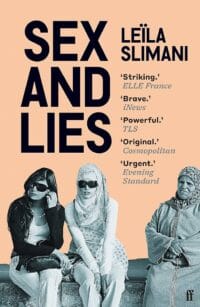
Book review: Sex and Lies by Leïla Slimani
September 2, 2025February 16, 2026 1 Comment

sex and lies book cover

I like essay collections but I tend to buy them at a faster rate than I read them. I fear they’re going to be less gripping than a novel or deal with serious subjects with less levity than fiction usually adds. Neither of which was a problem with Sex and Lies by Leïla Slimani (translated from French by Sophie Lewis).

I first heard about Slimani when her her novel Lullaby was published in English in 2018 and everyone was recommending it. I took one look at the synopsis and decided it was far too dark for me. That novel won Slimani the Prix Goncourt, making her the first Moroccan woman to do so. But it was actually her previous novel Adèle that triggered the conversations that led to Sex and Lies.

Adèle is about a woman living with sex addiction. When it came out in France, there was publicly expressed surprise that a Moroccan woman could have written on that topic, or indeed anything related to sex. Slimani didn’t set out to be shocking or controversial. She was after all following a centuries-old tradition of Arabic-authored literature that is frank about sex. But she acknowledges that in recent decades, things have changed on that front in her native country.

On her two-week Moroccan book tour for Adèle Slimani found that women and young people were keen to discuss sexual topics. But the conversations kept turning to the lack of freedom in modern Morocco. So she kept the conversations going, meeting people – mostly women – who were willing to be interviewed, albeit anonymously for the most part.

Continue reading “Book review: Sex and Lies by Leïla Slimani”

Kate Gardner Reviews

Book review: Fire: the Unexpurgated Diaries 1934–1937 by Anaïs Nin

December 19, 2021March 11, 2022

Fire by Anais NinI spent six months reading Fire: the Unexpurgated Diaries 1934–1937 by Anaïs Nin, which is just one volume of Nin’s massive collection of diaries. I kept the chunky tome on my bedside table, reading a few pages at a time. It took me a while (clearly) to get into the flow of it and I am still torn as to whether I want to hunt down the several other books that would complete the story.

This is not volume one (it’s books 48–52 of the hundreds of handwritten diaries Nin left behind). It’s not even the first part of the most famous trilogy of Nin’s diaries, known as A Journal of Love. But a loose note in the front of my smart hardback copy confirms that I ordered this from a secondhand book dealer in 2011, so I clearly wanted this specific volume and can only speculate that I had read a recommendation somewhere. I had read a few collections of Nin’s short stories and one of her novels, so I knew that I liked her writing. And her life is certainly a fascinating one to me.

Nin wrote diaries from a young age and edited her adult diaries for print during her own lifetime. Initially published from 1966 onwards, the first public versions of these books were cut heavily, removing all mention of her husband Hugh Guiler and several other of her more prominent lovers; changing names and details of other characters in her life. After the deaths of both Guiler and Nin, her long-term partner Rupert Pole took on the mammoth task of editing a new set of “unexpurgated” diaries, restoring those deleted details. His preface states “nothing of importance has been deleted”.

Obviously, this being Nin, this book is very sexually explicit (though I suspect that’s not what was cut first time round). It’s also probably worth knowing before you read this that she struggles with depression at times. Her mood swings wildly, and she acknowledges this. She is also unpredictable beyond her state of mental health. At times Nin will do everything she can to keep everyone she loves happy, pushing herself so hard it seems inevitable she will snap. But at other times she seems wilfully cold and cruel, refusing to acknowledge how her actions must affect her beloveds.

Continue reading “Book review: Fire: the Unexpurgated Diaries 1934–1937 by Anaïs Nin”

Kate Gardner Reviews

All of us who survived on the street could not renounce the charm of the stories we told

September 22, 2019September 22, 2019

Dry SeasonDry Season
by Gabriela Babnik
translated from Slovene by Rawley Grau

This is a strange book, difficult to follow at times, but always lyrical and occasionally outstanding. It’s my Slovenia book for the EU Reading Challenge, written by a Slovene author and starring a Slovene main character, but actually set in Burkina Faso. It seems extra appropriate for this project as its publication was co-funded by the Creative Europe Programme of the European Union.

The book opens with two people in bed together in a hotel room in Ouagadougou. They are Ana – a 62-year-old artist here on holiday – and Ismael, a 27-year-old local who spent much of his life living on the street. It’s an unlikely pairing and one that doesn’t seem destined to last, but as the narrative alternates between their points of view, we discover things they have in common. In a way they are both running away from their daily lives, and as they gradually open up to each other, we learn that neither of them is quite what you expect.

Continue reading “All of us who survived on the street could not renounce the charm of the stories we told”

Kate Gardner Reviews

You basically never find what you were expecting to

December 9, 2018December 6, 2018

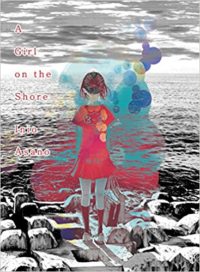
Girl on the ShoreA Girl on the Shore
by Inio Asano
translated from Japanese by Jocelyne Allen

I picked up this manga because it sounded sweet from the plot synopsis – a tale of teenage romance – and the cover art is beautiful. I somehow missed the significance of the cellophane wrapper, not to mention the small label “Ages 18+”.

In some ways my first instinct was right. It’s a good story, often a sweet one, with truly incredible artwork throughout. I frequently paused to show Tim a page that moved me in its beauty, often dialogue-free.

Koume Sato is in her final year of junior high (ages 14–15). She likes pretty boy Misaki, but he uses her and then ignores her, so she runs to Keisuke Isobe, who she knows has a crush on her because he has previously confessed as much. They strike up a relationship, but keep it secret because at school Koume is popular, while Keisuke is considered a weird loner. In public Koume hangs out with a group of girls, gossiping, while at Keisuke’s house she discovers manga and indie music. She is clearly using Keisuke, but it isn’t clear whether or not he minds. Sure, she ignores him most of the time, but then so does everyone, especially since his brother’s suicide.

So far, so right up my alley. There are side characters who in some cases become significant, there are issues about school and studying, and always the gorgeous seaside town setting. But…this is sexually explicit manga, and the two people we repeatedly see having sex are Koume and Keisuke. We learn early on that Misaki demanded that Koume give him a blowjob before telling her he’s not interested, and that her reaction was to run to Keisuke and ask him to sleep with her. Their relationship is almost entirely about sex, and sexual experimentation.

Continue reading “You basically never find what you were expecting to”

Kate Gardner Reviews

Pinging around the universe, hoping for a host

June 15, 2017

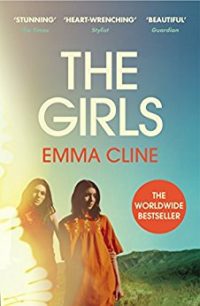
The Girls
by Emma Cline

I had heard mixed reviews of this huge bestseller, so I wasn’t sure what to expect. However, from page one it was clear that this was an impressive book by an author with a masterful grasp of language.

The story is narrated by Evie, a middle-aged woman who is reminded by the intrusion of a teenage couple into her life of the summer of 1969, when she was 14. She was a typically insecure girl, lusting after her best friend Connie’s brother, feeling generally invisible. Then she saw the girls, or more specifically, she saw Suzanne. Suzanne is unwashed, wearing ill-fitting ragged clothes, but she exudes confidence and young Evie is transfixed.

Evie follows her new obsession to a remote ranch where she finds a cult led by a man called Russell. Over her summer holiday she spends more and more time at the ranch, exposed to drugs, sex and other behaviours Russell’s followers think of as adult. Evie clocks right away that Russell has magnetic appeal and that all the girls are sleeping with him, but for her the attraction is still Suzanne.

Continue reading “Pinging around the universe, hoping for a host”

Kate Gardner Reviews

Autumn reads in brief

November 27, 2015

These are some very brief reviews indeed because I have had so much else on this month, I’m frankly amazed I’ve found time to read at all. Before I zone out in front of another half-dozen episodes of The Big Bang Theory, here is what I’ve been reading.


pride of baghdad

Pride of Baghdad
by Brian K Vaughan (writer) and Niko Henrichon (artist)

This is a beautiful, moving and unusual perspective on war. It takes as inspiration the 2003 news story that four lions escaped Baghdad Zoo during a bombing raid in the Iraq War. Vaughan and Henrichon give the lions names and personalities, and this does result in some anthropomorphising, but that can be forgiven because the result is so good.

Continue reading “Autumn reads in brief”

Kate Gardner Reviews

Early summer reads in brief

June 19, 2014June 23, 2014 2 Comments

As you might gather from the sparcity of this blog this month, I’ve been busy. I’ve still been reading, but I’m very very behind on writing reviews, so here’s a few shorter thoughts on recent reads.

captain america

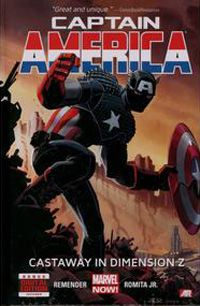
Captain America: Castaway in Dimension Z,
books 1 and 2
by Rick Remender and John Romita Jr

This relatively short storyline is a great example of how comics – superhero comics, at that – can be a really good medium through which to explore unusual or difficult ideas. Cap is doing his thing for the Avengers when he is kidnapped by the evil Dr Zola and taken to Dimension Z, and while he soon escapes his captors it seems that Dimension Z will not give him up so easily. Over time he gets caught up in the ongoing war between Zola’s bioengineered army and the phrox, who look monstrous but are willing to give Cap a home. Which all sounds a bit robots fight monsters grr argh, but while this book is distinctly masculine, it’s also very thoughtful. In fact, my main reservation was that Cap was perhaps too brooding and thoughtful. By far the majority of the text is his thoughts and for several pages I wondered whether he was going to speak at all. But overall I enjoyed it and the take on questions surrounding, among other things, war, parenthood, love, loyalty and belonging.

“Adrenaline surging—enough to jolt a dead man to a waltz. Need the help—so long as I don’t pass out. Pain—the shattered left hand screaming at me—it has no business maintaining a grip on a B-52 in a dead drop. Thank the adrenaline…His howl—agony…a reminder of what happens to a million people if you fail—millions of screams.”

Published 2013 by Marvel.

Source: Borrowed from Tim, who bought them at Excelsior! comic shop, Bristol.


Tales from the Secret Annexe
by Anne Frank
translated from Dutch by Susan Massotty

It pains me, after rediscovering the talent of Anne Frank earlier this year, to conclude that this collection of her essays and short stories is so far below the standard of her diary that it should probably never have been published. There are signs of her writing ability, certainly, and I don’t doubt that if she had lived she would have produced a collection after the war that would have shone with greatness. But this isn’t it; these are the writings of a child and it shows. Even her moving essays about hope and charity suffer from youthful naivety. The first part of the collection is especially odd, as it is a series of alternative accounts of events that are also included in Anne’s diary – essentially discarded early drafts. The book isn’t entirely without merit: it’s perfectly readable, provides a little extra depth to the picture of Anne for anyone who has read her diary, and the foreword is actually the best summary I have read of the Frank family’s war-time experience.

“Everyone is born equal; we all come into the world helpless and innocent. We all breathe the same air…Riches, power and fame last for only a few short years. Why do we cling so desperately to these fleeting things? Why can’t those who have more than enough for their own needs give the rest to their fellow human beings?”

Verhaaltjes, en gebeurtenissen uit het Achterhuis published 1982 by Bert Bakker.
This edition published 2010 by Halban.

Source: I bought it at Anne Frank House, Amsterdam.


Sex Criminals volume 1: One Weird Trick
by Matt Fraction and Chip Zdarsky

It really tells how much I enjoyed the first volume of Hawkeye by Matt Fraction that I was eager to check out his other current project despite a title that didn’t seem entirely aimed at me. However, it turns out that this is another fun, well written and stylishly presented series. The premise is that librarian Suzie stops time whenever she has an orgasm, an ability she discovered in her teens and has quietly enjoyed since, while getting on with her otherwise normal life. Until she meets Jon, who not only shares her ability, but has ideas about what they could do with it. Her library is closing due to lack of money, they can stop time – it seems like robbing the bank will be an easy solution. But when is life ever easy? Although this comic is undeniably explicit and R-rated, it’s actually much less explicit than some Alan Moore stuff I’ve read and, importantly, far more honest about sex. As Suzie and Jon get to know each other we learn about their teen years, discovering masturbation and other sexual acts, which is a subject that, while not quite taboo, is usually dealt with extremely lightly. This comic combines a good level of honesty and humour with a bit of action adventure thrown in.

Published 2014 by Image Comics.

Source: Borrowed from Tim, who bought it from comiXology.

Kate Gardner Reviews

I was penetrated by sunlight

February 28, 2013

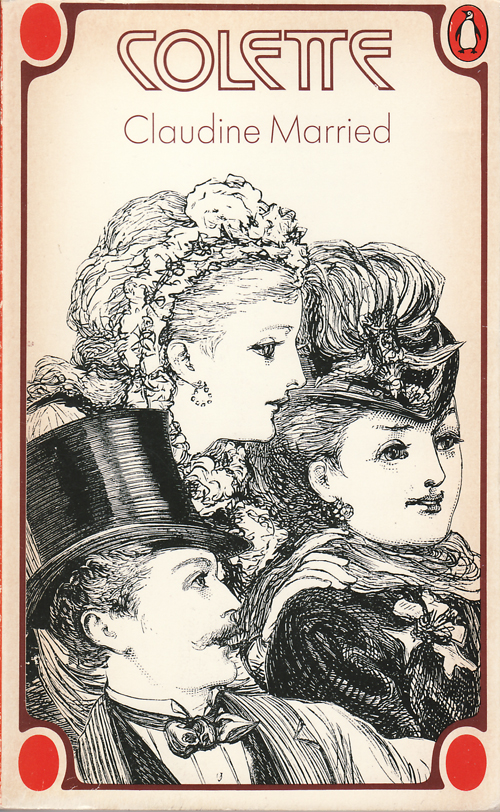
Claudine Married
by Colette
translated from French by Antonia White

Claudine Married

Getting hold of this book was a little bit of a saga. I came across the first Claudine book in a secondhand bookshop and fell in love with both the charming story and the attractive old Penguin edition I had picked up. I resolved to collect the set of four in the same design and soon had three, but this one proved a bit of a challenge. Twice I ordered it from sellers on Abe Books only for the sale to fall through because they didn’t have it in stock after all. It was with some excitement I finally lined up my little collection.

It’s a shame then that this instalment didn’t quite live up to the first two, though I hasten to add that it’s still a beautifully written and insightful book. But one of the things that I liked about the character of Claudine was her mixture of naughty wilfulness and youthful innocence. Now she is innocent no more. Or isn’t she?

In this third book in the Claudine series she returns to Paris from a long, leisurely honeymoon with her husband Renaud. She is just 18 years old and her husband in his 40s, which gives us an early clue as to his sexual tastes. There is an uncomfortable section where the newlyweds visit Claudine’s old school and both flirt outrageously with the 15-year-old girls boarding there.

Sexual attraction had been a major topic of the series previously but here that’s what it’s all about. Claudine had dabbled with both sexes before her marriage and the pattern continues. As well as loving her husband, she falls hopelessly in lust with a new acquaintance, Rezi, the buxom wife of a jealous invalid. Renaud immediately sees this and encourages Claudine in what she sees as him being an understanding husband, but I read as straightforward lechery. I won’t say which of us was right, but Claudine certainly has some lessons to learn.

As always, Colette writes with great affection for the French countryside.

“At least I had been able to bathe my bare hands and trembling legs in thick, deep grass, sprawl my tired limbs on the dry velvet of moss and pine-needles, rest without a thought in my head, baked by the fierce, mounting sun. I was penetrated by sunlight, rustling with breezes, echoing with crickets and birdsong, like a room open on a garden.”

This book is fairly sexually explicit but it’s not Henry Miller. The deed itself is usually skipped past. The narrative concentrates instead on Claudine’s reaction to events. It was with some relief I realised that her reluctance to give in to her desire for Rezi stems from wanting to be faithful to her husband, not the fact that Rezi is a woman. She has, after all, been there before.

I can see why it took almost 60 years for an English translation to appear in print but I do wonder how shocking (or not) these novels were in France.

First published as Claudine amoureuse 1902.
Published as Claudine en ménage after the above edition had been destroyed.
This translation published 1960 by Secker & Warburg.
My edition published 1972 by Penguin Books.

Source: I bought it secondhand via Abe Books.

Challenges: This counts toward the 2013 Translation Challenge.

Kate Gardner Reviews

Hunting for metaphors which might convey something

April 24, 2012June 17, 2012 2 Comments

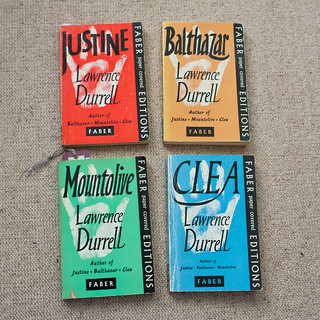
The Alexandria Quartet
Book 4: Clea
by Lawrence Durrell

And so at last I have finished the quartet. Was it a fitting end, full of vagueness and mystery? Did the poetic unreliable narrator return, both as a narrator and to Alexandria itself?

The Alexandria Quartet

Well, the answer to question two (both parts) is yes but to question one…I’d hazard no. The series began, in Justine, with a lot of vagueness, events in uncertain order and a lot was left unsaid. As the Quartet proceeded, the narrative got clearer and clearer until this book, even though it is once again narrated by Darley, who was previously so unreliable, was perfectly straightforward and linear. I mean, there were memories and extracts from old letters, but they were clearly signposted as such. To be honest I found this disappointing, though it was good to get closure on all the characters and storylines at last.

Which is not to say that the writing in this book is less good than it has been previously. In fact, I have bookmarked more quotable passages than ever. But as a story it didn’t grip me. Which is odd because there was a lot going on in this book. Darley has been called back to Alexandria from his Greek island to return the child he has been looking after to her true father. World War II has finally got under way and Alexandria has not escaped unscathed. Mountolive (the British Ambassador to Egypt) finds Darley a job in the censorship department of the War Office, which is a perfect statement on his narrative. No mention is made of Darley ever having been expected to fight, despite his being a British citizen of, I assumed, good health and young age, but I don’t know what the situation was for ex-pats.

And so, until the end of the war and a short time afterward, Darley catches up with the lives of his old friends, makes sure the girl settles in with her new parents and discovers more details about his previous stay in Alexandria that once again force him to re-evaluate the truth. Clea is, as ever, everyone’s friend and confidante, and a cheery one at that, so through her we hear the little anecdotes that people really do tell about their friends, particularly those who have died. She is a good influence on Darley, encouraging him to not just face the truth but actively seek it. When one friend asks Darley how his writing is going, he replies:

“It has stopped…I somehow can’t match the truth to the illusions which are necessary to art without the gap showing…”

The picture of a city at war is hauntingly real. A lot of the time, Alexandria is on the outskirts of the war, the place where soldiers come on leave from the desert frontlines, but it is for a short time bombarded and the harbour is full of warships rather than pleasure boats.

“How had things changed? It was not danger, then, but a less easily analysable quality which made the notion of war distinctive; a sensation of some change in the specific gravity of things. It was as if the oxygen content of the air we breathed were being steadily, invisibly reduced day by day…”

One thing I found a little strange was that one longish chapter takes the form of an essay written by (Darley’s former flatmate) Pursewarden years earlier after a series of conversations with Darley about literature. It is eloquent and interesting and so, so quotable (“Words being what they are, people being what they are, perhaps it would be better always to say the opposite of what one means”) but it perhaps went on a little long and broke up the story more than necessary for its purpose: making Darley realise he had misjudged Pursewarden.

Despite the apparent changes in Darley, perhaps he is still unreliable, because he still manages to fool himself and he repeatedly declares that he is done with writing yet he narrates as if he is writing it down:

“I am hunting for metaphors which might convey something of the piercing happiness too seldom granted to those who love; but words, which were first invented against despair, are too crude to mirror the properties of something so profoundly at peace with itself…”

And lest all the revelations and clarifications of this book fool us into thinking we are here learning the absolute final truth about these characters, we have this pearl from the wise old doctor Balthazar:

“When one casts around the fields of so-called knowledge which we have partially opened up one is conscious that there may well be whole areas of darkness which may belong to the Paracelsian regions—the submerged part of the iceberg of knowledge.”

So on the whole it was a fitting end to the Quartet. It made me laugh, it made me sad. It has a surprisingly modern attitude to sex, love and homosexuality (though the characters do not necessarily have modern attitudes) and I can now go and have a look at the last discussion of the Guardian Reading Group without having the story spoiled for me!

First published 1960 by Faber & Faber.

N.B. It’s too late now to join in the Guardian Reading Group discussion about this book but you can still listen to the Guardian Books podcast about Lawrence Durrell at 100. It discusses and quotes heavily from The Alexandria Quartet and is well worth checking out.

See also: my reviews of
Book 1: Justine
Book 2: Balthazar
Book 3: Mountolive

Kate Gardner Reviews

You’re gonna get screwed but good in this town

April 6, 2012April 28, 2012

Tales of the City
by Armistead Maupin

After hearing this book praised left, right and centre since I started book blogging I figured I had to give it a go. And what a joy it is!

This is the first in what has turned out to be a very long-running series about a large cast of characters in San Francisco. In this book (I don’t know if this is true of any of the rest) the focus is on a boarding house on Russian Hill run by the inimitable Anna Madrigal (who grows her own weed and claims to have been raised in a whorehouse), and in particular her tenant Mary Ann Singleton. Mary Ann has newly arrived in the city from Cleveland and her sweet naivety is in for a shock. Or several shocks.

According to something I heard on Radio 4 (I think it was on A Good Read) the editors of the San Francisco Chronicle, in which this started life as a serial, kept a tally of straight versus gay sex scenes because there was a concern about it being “too gay”. Which tells you a little about the book. It is outrageous and wickedly funny but also intelligent and insightful. The characters lean very slightly into the larger-than-life category but they are not stereotypical or predictable. It really is an achievement that so much silliness can be so lovable.

There are dozens of storylines at work, only a couple of which are wrapped up by the end of the novel. The characters are introduced separately but their lives quickly overlap to the point where I was hard-pressed to remember who knew who from where. I’ll just have to read it again!

The extra character is, of course, the city of San Francisco. Maupin lovingly describes its streets and views and bars and people with all the little details of someone who calls it home. It is very much a tale of 1978, with an undercurrent of the politics and social nuances of the time. I was (perhaps naively) surprised by how much of the “pretentious” of middle-class life today (organic food, over-earnest attempts to appear not racist or homophobic, caring about global warming) was considered pretentious back then too. It is satirical but somehow firmly on the side of the people it satirises. Both prudish innocent (Mary Ann) and sexaholic (most everyone else) are celebrated in their own way.

I can see why it has been called a literary soap opera and it is indeed both those things. It isn’t literary in floweriness but rather in insight and cleverly spare language that gives you just enough, while finding room for some fantastic little jokes with words and meanings. So that’s six more books to add to the wishlist then, I guess!

First published in 1978 in the San Francisco Chronicle.
Published in book form in 1980 by Corgi Books.

Kate Gardner Reviews

Posts pagination

1 2

Archives

RSS Nose in a book

  • Book review: Interstellar Megachef by Lavanya Lakshminarayan
  • May 2026 reading round-up
  • Book review: Passing by Nella Larsen

Me on the internets

  • @kate_in_a_book@mas.to (Mastodon)
  • Flickr/noseinabook
  • Instagram/kate_in_a_book
  • StoryGraph/kate_in_a_book

Categories

  • Blog
  • Reviews
  • Uncategorized
Proudly powered by WordPress | Theme: Dream by vsFish.