Nose in a book

Reviews and other ramblings

  • Home
  • Reviews archive
    • Book reviews
    • TV reviews
    • Theatre reviews
  • TBR
  • Challenges
    • The Classics Club
    • 2014 Popular-Science Reading Challenge
    • Cookery challenge
    • The Gilmore Girls Reading Challenge
    • 2013 TBR Pile Challenge
    • 2013 Translation Challenge
    • Crime and Punishment read-a-long
  • About
    • Cookie legal stuff
  • Home
  • Reviews archive
    • Book reviews
    • TV reviews
    • Theatre reviews
  • TBR
  • Challenges
    • The Classics Club
    • 2014 Popular-Science Reading Challenge
    • Cookery challenge
    • The Gilmore Girls Reading Challenge
    • 2013 TBR Pile Challenge
    • 2013 Translation Challenge
    • Crime and Punishment read-a-long
  • About
    • Cookie legal stuff

Tag: science

What language will the future speak?
July 8, 2014

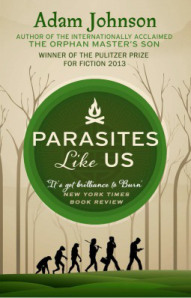
Parasites Like Us

Parasites Like Us
by Adam Johnson

I found this book slow to start but by the end it had a real effect on me – by which I mean I couldn’t stop thinking about it to the extent that I had nightmares! But it is the story of an apocalyptic adventure, so that’s probably a good sign. I think. It’s also a comedy – a very dark one.

The story is narrated by Hank Hannah, an anthropologist at a small university in South Dakota, moderately successful, mostly unhappy and alternately obsessed with and completely disinterested in his own work. We learn on page one that two major events are coming – he’s going to prison and some kind of major apocalyptic event is going to wipe out most humans (along with pigs and birds, apparently). However, most of the novel is about Hank’s life leading up to those events.

“The cold was a force, a pressure you felt against your eyes, and along the frosted buildings the prison lights shone sodium and shrill, casting stiff, cement-coloured halos off the corrugated roofs. The rising moon had its say too – upon open expanses, in the branches of trees, its tincture recast the night in hues of indigo, iodine and tulle.”

Hank’s area of special interest is the Clovis – people who inhabited the Americas from 11,000 to 9000 years ago. He wrote a book contending that the Clovis were responsible for mass extinctions because they over-hunted and is now half-heartedly raking through reams of data to back this up. But one of his graduate students – Eggers – is so fascinated by the subject that he has decided to live for a year as a Clovis, using only Paleolithic technology (which seems to involve being smelly and a lot of illegal hunting). Hank’s other graduate student – Trudy – has her own contentious theory about the lack of Clovis art, and is also the subject of Hank’s inappropriate crush.

There is quite a lot of scientific exposition in this book, but I couldn’t quite figure out Johnson’s attitude toward science. None of the scientists is entirely likeable and they are pretty devil-may-care with the scientific method. With the book’s overtones of dark humour, I did wonder if Johnson was mocking the scientific establishment as a whole, or just certain aspects of it, or certain types of people within it. However, the choice of Hank’s study subject was clearly carefully chosen to have parallels with the current-day story and indeed has made me curious enough to look up the Clovis. (Incidentally, the title can be read two ways – human beings as the parasites, or that parasites like to live off humans, which may give you an idea of the intellectual humour at work here.)

“To speak of the dead is to conjure them, and it would be a crime to beckon them from their graves, to prance them around in some conga line of history before vanquishing them back to the cold, as if their lives were no more than footnotes in the tale of another.”

Hank himself was also difficult to get a handle on. He has an overinflated ego and is generally selfish, but he’s also a very smart, poetic and thoughtful man who is grieving for his stepmother. He has many unattractive traits but in the end I did sort of root for him. Because he narrates the story, and because there’s lots of stuff about hunting and survival, this feels at time quite a masculine book. But it’s saved from being too masculine or at all sexist by the character of Trudy. She’s an athletic, no-nonsense, mixed-heritage woman who rejects Hank’s advances while remaining his friend. She also shows real enthusiasm for the science, certainly more so than Hank. In fact, if anything, I might argue that the women in this book are a little too perfect, but then as it’s a first-person narrative they’re all seen via Hank and he is just the type to idolise women.

“Ten thousand years from now, when people exhumed her bones, what would they know of her life, her spirit?…Would they know of her love of plants, that she longed to see Egypt…Should I have put medicine bottles and a bedpan in her grave, so the future would understand her final struggle? Should I have chiseled out her story, start to finish, in granite, and what language will the future speak?”

Once the root of the Apocalypse becomes clear, the narrative really gets going. There are sections that, as an animal lover, I found toughgoing, but on reflection I think it’s only right that those parts were a bit grim and if anything this proves that Johnson is an animal lover.

However, what really won me over to this book was this line:

“I needed to implore of her, If you leave me, what will evoke you? I should have demanded, Tell me what movie I should watch, what tune I should sing, what book should be open on my chest when I wish to fall asleep and dream of you. Tell me, dear colleagues of tomorrow, tell me that in the future these are questions no-one’s afraid to ask.”

This book was not initially published in the UK, but after Johnson’s second novel The Orphan Master’s Son won the 2013 Pulitzer Prize for Fiction, a UK publisher picked up both this and Johnson’s collection of short stories, Emporium, which I already have waiting on my TBR. It certainly goes to prove that winning prizes does some good for authors, if it gets good-but-neglected books out there into people’s hands.

First published in the USA by Viking Penguin in 2003.
First published in the UK by Transworld in 2014.

Source: This book was kindly sent to me by the publisher in return for an honest review.

Kate Gardner Reviews

Who doesn’t love penguins?

September 4, 2013September 4, 2013

Penguins on Film
Public lecture at Wills Memorial Building, University of Bristol, 4 September

Tim and I (mostly Tim) have a small obsession with Antartica. When we went to Cambridge last year a visit to the Scott Polar Museum was a must, higher even than the Wren Library (only just). We have amassed a small collection of books about the continent and record every TV programme about it.

Some books about Antarctica

I can’t speak for Tim, but for me one of the attractions of Antarctica is undoubtedly penguins. (Yes yes, I know they live elsewhere in the Southern Hemisphere too, even hot places. You can blame film for the association of penguins only with the extreme cold. Apparently.) They are brilliantly characterful animals. However hard you try not to anthropomorphise, watching them waddle along is unfailingly funny. Yet in water they are hypnotically elegant.

Clearly I am not alone in this love. Tonight’s lecture “Penguins on Film” was actually part of the 8th International Penguin Conference but was open to the general public and between the two interest groups the (pretty magnificent) Great Hall at the Wills Building was crammed full. The panellists gave five short talks about some very different experiences of penguins.

emperor penguin
Image source

The main presenter was Lloyd Davis, a world authority on penguins and engaging speaker to boot. He talked about how some misconceptions and misinformation about penguins stem from and are perpetuated by film, from the earliest footage 100 years ago by Frank Hurley (comedic, unnatural behaviour) to March of the Penguins (models of family values? Penguins don’t mate for life, they pick a new partner every season and aren’t necessarily faithful to that one) and many a cartoon in-between (inaccurate habitats or mixes of species).

While this was all a lot of fun, I kinda already knew all this and there’s an extent to which the portrayal of penguins as comedic does some good in engaging public interest. As the rest of the presenters proved, you can use penguins as a starting point to talk about climate change, how science is done, filming techniques and even new robotics technology.

Elizabeth White from the BBC Natural History Unit talked about some of the challenges of filming penguins for the TV series Frozen Planet. It was fantastic to see some clips from that show on a cinema-sized screen and in retrospect it showed the real contrast between BBC footage and basically anyone else!

The tough job of following that fell to Sue Murray of the Yellow-eyed Penguin Trust who showcased a video made in 1939 by amateur ornithologist Lance Richdale of an endangered penguin species that led both to the charity that works to protect the birds and also to a tourism industry that generates millions of dollars for a remote part of New Zealand. Sadly it’s a more interesting story than film, though it was fun to see Richdale’s wife weighing penguin chicks like you might a human baby.

Phil Trathan from the British Antarctic Survey spoke about how he and a colleague used satellite imagery and aerial photography to identify penguin colonies and to track changes in those colonies over the last five years. It was interesting to hear that, while initially his work led to a doubling of the estimated number of emperor penguins (because satellites can see areas basically inaccessible by land), it has also revealed the loss of whole colonies where sea ice is drastically reduced year on year as a result of climate change.

Finally, Bristol University’s very own Peter Barham and Tilo Burghardt demonstrated how the spycams embedded in penguin robots created for the TV series The Spy in the Huddle have been adapted for scientific research uses such as identifying what species of penguin it is looking at or even recognising individual African penguins by the pattern of spots on their chests. Sadly they didn’t have time to explain why this is useful (here’s a video Peter Barham made earlier), though they did find time for a fun demo of the robot’s new ability to recognise human emotions by getting a volunteer up on stage to pull faces at the spycam. No doubt this too will have extrapolations for biological research. If only there had been more than an hour!

Kate Gardner Blog

Margaret Atwood at Bristol Festival of Ideas

August 29, 2013September 4, 2013 2 Comments

Maddaddam
St George’s Hall, Bristol, 28 August

It seems whenever I book tickets for something months in advance, life conspires to try to spoil it for me. Like last night. Once again, Tim wasn’t able to come with me (thankfully some friends from work also had tickets so I wasn’t alone for the journey there at least) and my knee was randomly super painful, particularly on steps. And St George’s Hall has a lot of steps (it is very pretty though). But on the plus side I got to see Margaret Atwood in real life and hear her speak and get her to sign not one but two books for me! So that part was pretty good.

I met Margaret Atwood today

The event was primarily about the Oryx and Crake trilogy, and in particular the third book Maddaddam, which was published in the UK yesterday. So obviously I bought the brand new hardback and got it signed even though I have the other two books in paperback and now they won’t match or even fit on the same shelf. Oops. But it seemed like it would be silly not to, while I was there and she was there. Right?

The interview started with the influences on the trilogy, which is perhaps an easy list to guess for anyone who’s read any of the books, but Atwood embellished with interesting facts and plenty of dry wit. There really are glowing green rabbits (created by splicing jellyfish genes with rabbit), which she says were originally developed for a magician, and spider-goats, developed to create bulletproof silk – “people have opened the genetic toybox and they’re mixing and matching”. When asked if she sees herself as a critic, observer, satirist or optimist of issues such as gene-splicing, Atwood replied that she’s all of those things (which is interesting as I thought the books came down firmly against, but perhaps I misread the tone). She went on to say that people are afraid of what they don’t understand and we’re right to be afraid of our own power but wrong to be scared every time.

Anthropology and psychology seem to be big influences on Atwood (indeed, she subscribes to New Scientist and devours all the popular science, especially biology and epidemiology, she can). When asked about how she was able to describe people living after the, ahem, event of this trilogy, she made the acute observation that basic human traits, “our essential smorgasbord”, have not changed since the days of the caveman – we’re all susceptible to love, rage, jealousy, etc, therefore no changes in technology – or loss thereof – are going to change human emotions.

Talking more generally about storytelling, Atwood said “the reader is the violinist of the text…I’m just the originator”. She also touched on a subject that fascinates me: the link between memory, language, storytelling and religion. Memory evolved to allow us to anticipate the future. And once a language has a past and future tense, we start telling stories, and an important part of that is a theology of where we came from. And that brings us back to Maddaddam, which apparently develops the religion of Crake’s children.

There were many more highlights that I scribbled down but I’ll finish with the story that Atwood seemed most eager to tell: the cover design. The first cover she was sent was flowers and a bee: totally girly and not at all reflecting the content of the book. Inspired by Maureen Johnson’s excellent Coverflip challenge Atwood asked for something different, something dynamic and maybe even scary. It took a lot of revisions but you have to admit that the new cover may have pink on it but it sure isn’t girly. Freaky, unnerving and intriguing, yes.

This event was part of the Bristol Festival of Ideas.

Kate Gardner Blog

Girls and guns and science

December 22, 2011 3 Comments

Echo: the Complete Edition
by Terry Moore

So I quite liked this graphic novel, then Tim said that the maths that the whole storyline is based around is complete rubbish and now I’m not sure if that makes a difference or not. I think I still like it.

It’s almost a superhero story, but not quite. Super-clever scientist lady invents a new element and makes herself a suit out of it, then gets blown up by her superiors while wearing it and the suit attaches itself to two unlucky bystanders. That’s the first couple of scenes. The rest of the story follows those two bystanders as they discover what the suit can do and have very different reactions to it. And both get chased by various government agencies and scientists who want their tech back.

This is one of those beautifully drawn graphic novels that includes a lot of panes with no words, so despite this being a huge tome (this was previously published as six trade paperbacks) I tore through it in one day. I probably didn’t pay enough attention to the detail.

The main character is Julie, one of those two bystanders in the desert. She is an artist struggling to pay her bills and resisting signing the divorce papers that her husband has sent. There’s a large supporting cast, but foremost among them are Dillon, who was the boyfriend of the dead scientist lady, and Ivy, a kickass agent for a mysterious organisation. The first time we meet Ivy she is picking flowers with her daughter. In the next scene she is flying a plane on her own and puts it into autopilot while she changes her clothes. Awesome.

The maths/science stuff is complete rubbish and I did get a bit annoyed by it, even before discussing it with Tim. And there’s also a religious storyline that I found a bit questionable, to say the least. But the main characters and their lives on the run are engaging, funny, upsetting, sad and touching in all the right places. A main character appearing to be offended by the suggestion she might be gay is made up for by there being other characters who just happen to gay, without it being a thing.

Throughout the book there are quotes from writers and scientists about man and science, especially the destructive nature of man. Really it’s quite a negative view of science. There are plenty of scientists in the book who are trying to do good, but the suggestion is that it’s futile, that there will always be someone who wants to do something terrible with any new scientific discovery and that someone will always get their way. I prefer not to be that pessimistic.

There’s also a lot of excuses come up with for drawing women wearing very little. In fact, flicking through the gallery of cover art at the end of this collected edition, the majority of them concentrate on Julie and her large chest.

But dodgy science and fan service aside, I really did enjoy this read. I was interested in and cared about the characters, even some we only meet very briefly, and the bikers were very cool. But not as cool as Ivy.

Published 2011 by Robyn Moore.

Kate Gardner Reviews

BristolCon11: science

November 12, 2011 1 Comment

There were two panels at BristolCon based around “real” science: “When did science become the bad guy?” and “Sci-fi now”. Both were interesting discussions and shared a few panel members so I thought I’d write them up together.

(Apologies by the way, for the scatty and delayed nature of this post. I wrote it weeks ago and then NaNoWriMo started and I didn’t get round to tidying it up. And now I must get back to writing that novel…)

Tim Maughan kicked us off with the declaration that science is not considered uncool itself, but understanding it is. All these shiny new TV shows about science are pretty but have little or no depth, and certainly don’t teach anything new (though, as a counterpoint, he still rates Sky at Night). Eugene Byrne suggested that this dumbing down was part of a general increased shallowness of the media. In fact, he was quite positive, comparing the 1980s general fear of science to the current feeling that science is an important tool and the great enthusiasm for technology and gadgets. He also controversially put forward the idea that raised tuition fees will be good for science, because potential students will likely lean towards more practical subjects with firmer career prospects.

Simon Breeze made the suggestion that the Internet generation couldn’t build the Internet, which I have to say I disagree with. But I could see how someone might think that – as Jonathan Wright pointed out, technology has advanced so much so quickly that you can’t just learn how things work by taking them apart. Tim Maughan added the interesting point that state schools in the UK teach computing, including HTML and basic coding, but public schools don’t go near it, staying as always behind the times but also creating an odd reverse snobbery.

But what about the cool future science we all thought we’d have by now and don’t? This discussion kept coming back to the idea that technologies are developed when we need them. And of course some things turn out different from exactly what was envisaged. Paul McAuley thought teleportation might be useful, but suggested that the long queues for the booths might make it only fractionally quicker than flying. And drones barely feature in old science fiction yet are becoming scarily real (in military use). Tim Maughan pointed out that the car that drives itself is imminent and Eugene Byrne suggested that increased age and disability in western populations will accelerate technologies like robot cars. Dev Agarwal suggested that the same might be true of investment in cybernetics – e.g. for making people walk again.

The panel all agreed, in response to an audience question, that the future science fiction of 1984 is scarily close to coming true – and we’re all willingly helping it along. From Internet security measures that save our every search term and movement on the Web, to store cards that track our purchases, to CCTV, to social media where we announce our every action, we are creating the surveillance culture that Orwell envisaged, only we’ve forgotten to be horrified by the idea.

Thought-provoking stuff.

Kate Gardner Blog

Triumph and tragedy

December 12, 2010

T-Minus: the Race to the Moon
by Jim Ottaviani (author), Zander Cannon and Kevin Cannon (artwork)

I think this comic book is strictly aimed at children but that didn’t stop me from thoroughly enjoying it and learning all sorts of new facts about the space race. And I live with Tim and have been to Kennedy Space Center, so I consider myself reasonably well versed in this stuff.

The story begins in 1957 with the text “T-minus 12 years” and ends (except for a short postscript) in 1969 at “T-minus zero”, the moment when Neil Armstrong set foot on the Moon. The story inbetween shows both the Russian and the American teams of scientists, engineers and pilots, not to mention the politicians who had their own ideas about going into space. There’s more detail about the Americans, possibly because much more information about them is available to an American author, and not every question I had was answered, but overall this was an impressive and entertaining summary of historical events.

Most of the missions get their own panel with a list of pertinent details: rocket used, launch date, flight duration, etc. Deaths and other disasters were not lingered on, which I actually found a little difficult, but there were enough of them to make it clear how immensely daring the astronauts and cosmonauts were. These men and women (the first woman in space was Russian Valentina Tereshkova in 1963 – I didn’t know that before today) really were braving the unknown, human guinea pigs essentially. Early flights went up before having figured out urine disposal or temperature control. There’s a scene where cosmonauts discuss not taking much food on a 2-day flight because the smell in the capsule made them feel too queasy to eat.

There are a couple of jumps back in time to show the development of the science behind space travel, though I’m sure another book this long could have been written/drawn on that subject. The story is reverent without painting everyone involved as perfect. NASA engineer Caldwell C Johnson is picked out as being a workaholic who rarely saw his family, lost track of days of the week and didn’t stop to celebrate each victory on the way because he was already immersed in the next challenge (or indeed the one after that). Russians are shown mocking American failures and achievements, not to mention covering up the cause of Laika’s death and keeping many other details secret. Interestingly, the book does mention that the American and Russian teams met up every so often to discuss their work and that these meetings were friendly affairs, but no detail is given. I don’t know if this is because it’s all classified or if there were no details important enough to pick out for this abbreviated history.

The full-page bibliography reveals that most of the authors’ sources came from NASA, including mission transcripts, but they also spoke to astronauts Buzz Aldrin, Neil Armstrong and Alan Bean. They also say that they didn’t read one particular book they found because it was only available in Russian, which sounds like a bit of a rubbish excuse when researching Russian history. Surely they could have found a Russian speaker to help out? However, they did do a lot of research (they provide a web address for the full list, described as a stack of books “more than ten feet tall”) and it shows.

I heartily recommend this to any adult or child interested in the space race, but I would also be interested in learning more about the Russian side of things.

Published 2009 by Simon & Schuster. Available from GT Labs.

Kate Gardner Reviews

Learning from history

September 10, 2010March 11, 2012

Dignifying Science: Stories About Women Scientists
by Jim Ottaviani

This book greatly appealed to me from the get-go: it’s a graphic novel about women scientists, concentrating on five examples: Hedy Lamarr, Lise Meitner, Rosalind Franklin, Barbara McLintock and Biruté Galdikas. I am ashamed to say that I had no idea what any of those women should be famous for, in fact I’d not heard of two of them at all, and even now I feel that I only know a little about each one. My curiosity has definitely been piqued and I will be adding some books from the extensive references section to my wishlist.

A lot of different artists worked on this and I found the changes in style quite disconcerting, though at times it was used to good effect. For example, in the story of Rosalind Franklin there were pages supposedly narrated by James Watson, Francis Crick and Maurice Wilkins in turn, and the different drawing styles definitely helped prevent the change in voice from being confusing (and hopefully those names have told you what Rosalind Franklin is famous for, if you didn’t know before!).

This book definitely makes more sense if you read all the notes and references. The comic sections don’t always make it clear what the scientific achievement of each person is, and the inclusion of Hedy Lamarr (more of an engineer and, oh yes – actress) may seem a little odd when so many women scientists have been omitted, but as the notes explain – this is really just a taster and therefore concentrates on interesting stories rather than universal coverage. Marie Curie stars in a brief epilogue and prologue, apparently because her letters to her daughter Irene were too fascinating not to use!

There’s a definite sense of humour at work, as you might expect in a graphic novel, and the stories are mostly accessible to the layman. I’m not sure this would get any very young girls enthusing about a science career because the language, historical contexts and science depicted are too dense for that, but it could certainly be a good book to give a teenage girl with a modicum of interest in science or history. And there’s no reason not to give it to boys either because there’s no particular feminist slant aside from the choice of protagonists.

I liked the different levels of success of the women depicted, and the different reasons for it. Lamarr was treated as a pretty girl playing at science (though she wasn’t exactly pushed into acting – she broke off two engagements because the men wouldn’t let her continue acting), Meitner missed out a Nobel prize that she deserved part of (for nuclear fission, on the back of the evidence here anyway, I will read more before I give a definitive view on that), Franklin’s abrupt personality made her difficult to work with and she was snide about Francis and Crick’s model work but she did get an acknowledgement in their paper and in the Nobel acceptance speech (she was dead by then so could not have received the award, which is not given posthumously), McLintock did get a Nobel prize and Galdikas is apparently internationally renowned and respected for her work with orangutans, which continues to this day.

I will admit that I found the story of McLintock pretty dull. I understand the desire to include someone who chose an unusual thing to research (corn genetics) and stuck with that for life, leading to notable advances in the field, but it’s pretty dull and the one interesting thing about her life – that she struggled for years to get a faculty position because of her gender and her chosen area of research and the one position she did get early on was in Germany in 1933, which she had to leave pretty quickly because of the political situation – is not made at all clear in the comic section, only in the later notes.

However, the rest of the book was very interesting indeed. Incidentally, the title Dignifying Science comes from one of Marie Curie’s letters, where she is talking about the problems of being a famous scientist. She continues: “What is not deniable is the sincerity of all the people who do this kind of thing and the necessity of doing it.”

Published 2003 by GT Labs
ISBN 978-0-9660-1064-0

Kate Gardner Reviews

The importance of doing science

June 29, 2010 2 Comments

I am an English graduate. I didn’t study any science subjects after the age of 16 and I was happy with that decision, but I have always had great respect and admiration for scientists. I mean, in my experience they’re all smart people who talk sense and do work that aims to make the world a better place. How can anyone not be impressed by that?

As I’ve got older, I think I’ve started thinking more like a scientist than an arts graduate (though I do hate the emphasis on how divided those two are). I believe in evidence, research, double-blind studies, querying sources, abandoning superstitions and traditions that don’t have any logic behind them. It just seems like common sense to me. But I also believe in “pure science”, blue-sky research with no concrete application, because that’s how humankind develops.

It stuns me that people fail to grasp the point of fundamental science, that anyone can bemoan spending millions on a new particle accelerator or laser facility (especially considering how much has been spent subsidising banks or the car industry in recent years). I say this because today I read this hideous piece by Simon Jenkins, in which he attacks the entire scientific community but has particular venom for the LHC and the new UK Centre for Medical Research and Innovation, and this rebuttal by physicist Jon Butterworth, in which he says that satirising Jenkins made more sense to him than just countering each point of idiocy one by one. And I sympathise, I do. Scientists must tire of respectable newspapers and journalists repeatedly pulling out this story whenever a new major science research centre is announced or opened, despite the overwhelming evidence that it is in fact a good thing. It must seem so obvious to them that Jenkins has no idea what he is talking about, but sadly, it is not obvious to everyone.

I was cornered at a family party recently and asked to justify big spending on theoretical science projects. So I began with the obvious: the internet. An accidental development from the sharing of scientific research that has changed the whole world phenomenally. Family friend was unimpressed. So next I told him about the laser. You know the story, right? It started as an entirely theoretical idea in one of Einstein’s later works. It had no practical application, it was just an experiment to create a beam of light in a laboratory. Blue-sky research. A laser beam was first achieved in 1960 (50 years ago this year), after decades of work. By that point some applications had been identified but it was a further 13 years before any were possible. Ever since, lasers have been continuously improved and developed and uses for them continue to be found everywhere in our daily lives, from barcode scanning and DVD players to medical treatments, precision cutting and welding, and satellite communication.

Family friend rolled his eyes and said that it doesn’t all end that way. Look how long they’ve been trying to make nuclear fusion happen. So I switched tack and talked about another aspect of pure science: it captures imaginations; it teaches us more about the world and indeed universe that we live in; it gets the kids interested, which is vital to get people into careers that are more obviously practical, like engineers and doctors. Tell a child that a giant machine in Switzerland is being used to figure out how the universe formed and they will be far more excited by that than the average adult. Which was proven when family friend changed the subject at this point, clearly bored and unconvinced.

I was and still am exasperated but I am trying to understand. Science is extremely badly covered in mainstream media. You don’t need to read Ben Goldacre to know that, though it’s a good start. Most people trust what they read in newspapers, particularly broadsheets, and sadly that means the perpetuation of ill-conceived opinion and half-truths, overshadowing the brilliance that is happening every day in science. But why? I found a clue when reading George Orwell last weekend. He went to highly respected public schools (St Cyprians, Wellington and Eton) and said that science was taught appallingly badly. Aptitude in science was likely to lead to disdain from teachers and pupils alike. The system required a thorough drilling in classics, good grounding in English literature and history, but little or no science. This is how the “great minds” of twentieth century Britain were raised, the people to whom current journalists turn for inspiration and wisdom. It’s a self-perpetuating cycle of ignorance: intelligent, articulate men and women who can write knowledgeably about philosophy and classical music but haven’t a clue where the isotopes used in radiotherapy come from, or how particle accelerators are used to develop the ever stronger, harder materials that allow higher temperature (and therefore more efficient) power stations to be built. Or any of the other million ways in which pure science is improving our lives.

Tim has this pet theory about the food chain of science. Mathematicians come up with numbers and formulae that have no concrete meaning. Physicists take that maths and use it to model the real world, allowing them to understand the universe a little better. Engineers take that physics and use it to create a real-world device that ends up in your home or workplace. We need that abstract beginning.

EDIT
There’s some great resources on this subject here: interactions.org on benefits to society

Kate Gardner Blog

Posts pagination

1 2

Archives

RSS Nose in a book

  • Book review: Interstellar Megachef by Lavanya Lakshminarayan
  • May 2026 reading round-up
  • Book review: Passing by Nella Larsen

Me on the internets

  • @kate_in_a_book@mas.to (Mastodon)
  • Flickr/noseinabook
  • Instagram/kate_in_a_book
  • StoryGraph/kate_in_a_book

Categories

  • Blog
  • Reviews
  • Uncategorized
Proudly powered by WordPress | Theme: Dream by vsFish.