Nose in a book

Reviews and other ramblings

  • Home
  • Reviews archive
    • Book reviews
    • TV reviews
    • Theatre reviews
  • TBR
  • Challenges
    • The Classics Club
    • 2014 Popular-Science Reading Challenge
    • Cookery challenge
    • The Gilmore Girls Reading Challenge
    • 2013 TBR Pile Challenge
    • 2013 Translation Challenge
    • Crime and Punishment read-a-long
  • About
    • Cookie legal stuff
  • Home
  • Reviews archive
    • Book reviews
    • TV reviews
    • Theatre reviews
  • TBR
  • Challenges
    • The Classics Club
    • 2014 Popular-Science Reading Challenge
    • Cookery challenge
    • The Gilmore Girls Reading Challenge
    • 2013 TBR Pile Challenge
    • 2013 Translation Challenge
    • Crime and Punishment read-a-long
  • About
    • Cookie legal stuff

Tag: Russian Revolution

The extraordinary silence of these long, self-contained days
July 10, 2013July 10, 2013 2 Comments

The Wine of Solitude

The Wine of Solitude
by Irène Némirovsky
translated from French by Sandra Smith

Since reading Suite Française when it was discovered and released I have been eager to read more of Némirovsky’s early novels. This is my second and so far they have failed to come close to the brilliance of her final, inspirational work. Not that this is by any means a bad book, but I suppose I had been expecting something more.

I suspect some of Némirovsky’s own life fed into this novel. It follows a family with a Jewish father who move from Ukraine to Russia to Finland to Paris in the 1910s and 1920s, so the background is the First World War, the Russian Revolution and the stock market rise and fall. Which is a turbulent, exciting and occasionally terrifying background for what is at heart the coming of age of a young woman.

“The smell of cigars and brandy wafted through the house until morning, slipping beneath her door and insinuating itself into her dreams. A faraway rumbling shook the paving stones: artillery detachments were passing by in the street.”

But it’s not that simple. Hélène dearly loves her father but he has no time for her between his gambling and business affairs – everything is about making money for Boris Karol. And Hélène’s mother should never really have become a mother at all, as she just wants to party, have affairs with young men and buy expensive clothes and jewels. Hélène harbours quite deep hatred of her mother, which becomes more bitter as she gets older.

“When she was ten years old she began to find a melancholy charm in the solitude of these Sundays. She liked the extraordinary silence of these long, self-contained days, which were like faint little suns in a different universe where time flowed at a slower pace.”

There is a lot of negative emotion in this book, as if Némirovsky is pressing home the point that money does not equal happiness. In fact, the brief interludes of happiness for Hélène are determinedly simple pleasures – going for afternoon walks with her French governess, sledging in snow, childhood summers in Paris playing with children who don’t judge her for being different, for having fashionable clothes and speaking better French than Russian. But mostly her early life is unhappy. Not terrible or desperate, but unhappy. And part of her journey to adulthood is learning to find and enjoy those simple pleasures, and making the decision whether to be cold and strong like her mother or passionate but breakable like her father.

“A storm was brewing over Paris; the sky was covered in copper-coloured wisps of cloud that slowly moved closer together to form a blanket of pink mist that parted every so often to reveal a dazzling ray of light.”

There is some beautiful writing here, especially in the descriptions of places, but I found the dialogue and descriptions of emotions a little simplistic or false-sounding. There would be pages of Hélène analysing herself in a manner both too detached and knowing but also naively that for me broke the spell.

“No, I won’t read. All those books make me anxious and unhappy. I have to be happy; I have to like other people…Tonight, I’ll cut out pictures, I’ll draw—I’m happy; I want to be a happy little girl.”

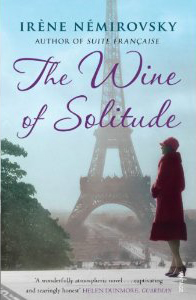
Not that it wasn’t worth reading. And I certainly think there is more to this book than the cover art lets on (a terrible cliché of the elegant young woman in Paris, which doesn’t come close to expressing the darkness that this book contains). It just suffers from my having read what was probably Némirovsky’s best before I read the rest.

First published as Le vin de solitude by Editions Albin Michel in 1935.

This translation published 2011 by Chatto & Windus.

Source: This was a present from my Dad for Christmas 2012.

Kate Gardner Reviews

Not as sweet as it sounds

November 25, 2010March 11, 2012 3 Comments

The Heart of a Dog
by Mikhail Bulgakov
translated from Russian by Michael Glenny

This book was selected for our local book group, partly because most of us had never read any of “the Russians”. Including me, unless Nabokov counts (I’ve only read Lolita, which he wrote in English, and he left Russia when he was 18 so it’s a bit tenuous).

I’ve always wanted to explore this group of authors but didn’t know where to start. The Heart of a Dog was probably a good choice in that it’s short and easy to read, but it’s crammed full of analogies to history and politics that I suspect I’m not familiar enough with to get the most out of it. I did study the Russian Revolution as part of A-level history but that was a few years ago now and I had rubbish teachers.

The story is a combination of the real setting of Moscow in 1924–25 and the surreal. Rich, successful Professor Preobrazhensky appears to be protected from the ravages of the Party by his specialism – STDs and “sexual rejuvenation” – and when he first picks up a scarred, mistreated stray dog and takes him back to a plush apartment it seems like a sweet friendship is developing. But the professor has more sinister reasons for adding to his household and the Party sees an opportunity to hold the rich man to account for continuing to have more rooms and more money than anyone else in the building.

A lot of the book is narrated by the dog, which sounds bizarre but is actually very well done. Bulgakov uses humour and empathy to create a novel viewpoint of the poorest of the poor. I liked the logic given for the dog being able to understand most of what is said around him and the way he loyally repeated his master’s political views without understanding them. When the surreal part of the story takes over and switches to a conventional third-person narrative, I found it harder to connect with the characters I had previously liked immensely. I began questioning my previous judgement and was uncertain I liked where the plot was going. But although the undercurrent is one of fear, this book doesn’t get too dark or scary.

I liked how, as the book went on, the descriptions of the professor’s assistant, Dr Bormenthal, get increasingly canine, referring to him as loyal and faithful and having been rescued from poverty by the professor, just like the dog. I also found the book genuinely funny, much of it mocking the Party, so I was not surprised to learn that the manuscript was confiscated from Bulgakov and not published until after his death.

For such a short book, this book was able to generate a reasonable amount of discussion in our group. We talked about whether you can enjoy this as a story without worrying about analogies and historical context, what that professor character was really up to, where Bulgakov’s sympathies lay, the development of the dog character and particular moments and phrases that stood out for us. It was postulated that the distancing of the narration was a deliberate ploy to make the reader look more analytically at the characters. That made a lot of sense to me.

I’m not sure I would ever had read this book without the book club so thanks Bedminster Bugbear for choosing it!

First published (in this translation) in Great Britain in 1968 by The Harvill Press.

Kate Gardner Reviews

Archives

RSS Nose in a book

  • Book review: Interstellar Megachef by Lavanya Lakshminarayan
  • May 2026 reading round-up
  • Book review: Passing by Nella Larsen

Me on the internets

  • @kate_in_a_book@mas.to (Mastodon)
  • Flickr/noseinabook
  • Instagram/kate_in_a_book
  • StoryGraph/kate_in_a_book

Categories

  • Blog
  • Reviews
  • Uncategorized
Proudly powered by WordPress | Theme: Dream by vsFish.