Nose in a book

Reviews and other ramblings

  • Home
  • Reviews archive
    • Book reviews
    • TV reviews
    • Theatre reviews
  • TBR
  • Challenges
    • The Classics Club
    • 2014 Popular-Science Reading Challenge
    • Cookery challenge
    • The Gilmore Girls Reading Challenge
    • 2013 TBR Pile Challenge
    • 2013 Translation Challenge
    • Crime and Punishment read-a-long
  • About
    • Cookie legal stuff
  • Home
  • Reviews archive
    • Book reviews
    • TV reviews
    • Theatre reviews
  • TBR
  • Challenges
    • The Classics Club
    • 2014 Popular-Science Reading Challenge
    • Cookery challenge
    • The Gilmore Girls Reading Challenge
    • 2013 TBR Pile Challenge
    • 2013 Translation Challenge
    • Crime and Punishment read-a-long
  • About
    • Cookie legal stuff

Tag: poetry

Book spine poetry

August 20, 2013 2 Comments

I know, I know, book spine poetry was big back in 2011. But I didn’t get round to it back then and I had a sudden urge to have a go, so here are my rudimentary attempts.
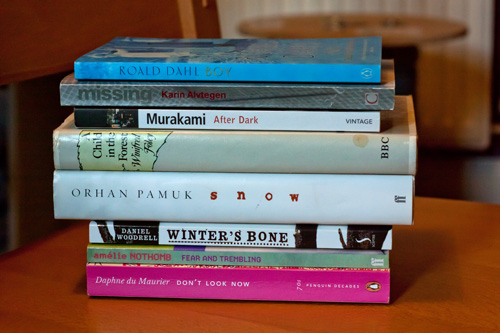
Poem one

Boy missing, after dark
A child in the forest
Snow, winter’s bone
Fear and trembling
Don’t look now
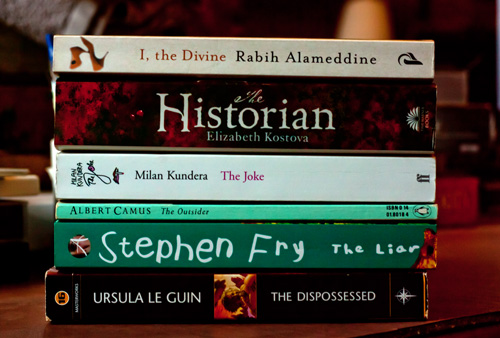
Poem two

I, the divine,
The historian, the joke,
The outsider, the liar,
The dispossessed
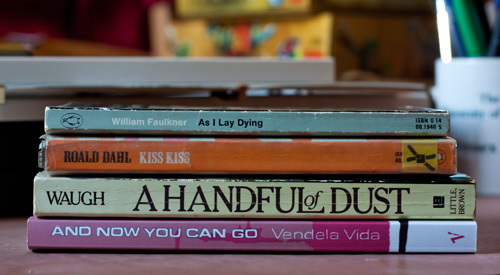
Poem three

As I lay dying
Kiss kiss
A handful of dust
And now you can go

So have you ever tried creating poetry from book titles? Please do share links to yours or your favourites from other people.
Kate Gardner Blog

Holiday reads in brief

September 13, 2012March 17, 2013

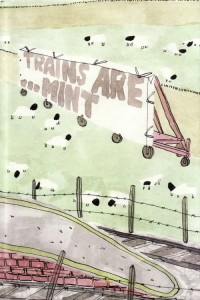
Trains Are Mint

I read quite a few books on holiday and it now feels like an age ago so I’m going to play catch-up with some shorter reviews of slightly unusual books I have read lately.

Trains are Mint
by Oliver East

This is a sweet but odd piece of graphic-novel-style journalism/travel writing. East took his notebook and pen on walks along railway lines from Manchester to Blackpool, drawing and taking notes on whatever grabbed his interest. Which sounds like a fascinating project. And both its niche appeal and its failure to grab me stem from exactly what it is that East finds interesting: rubbish, graffiti, kids hanging out, small railway stations and tumbleweed.

Published 2008 by Blank Slate.

Turning-Point
by Rainer Maria Rilke
Miscellaneous poems 1912–1926
Selected and translated by Michael Hamburger

I love Rilke. I don’t really understand a lot of it but I find it beautiful. In a different mood this might make me feel stupid or at least self-conscious but thankfully I read this book in the stately, studious surroundings of Cambridge and I just enjoyed floating on the words. And using the helpfully supplied German original texts opposite the English translations to remember how I once knew some German but have basically forgotten it all. It may take another read or three to get a little more from it. As Rilke says:

“Do not, do not, do not books for ever
hammer at people like perpetual bells?”

First published as An Unofficial Rilke in 1981. This edition published 2003 by Anvil Press Poetry.

The Hungry Ghost Festival
by Jen Campbell

This is a slim volume, which I have already read most of twice (see above for how this is a good thing with poetry), and I think it’s safe to say that these poems are right up my street. Campbell writes about growing up in north-east England, about being a teenager, the seaside, friendship, gossip, sex and illness. The poems tend to concentrate on the random details that give memories their surreal quality. They are both magical and grittily real.

Published 2012 by The Rialto.

The Beat Hotel: Ginsberg, Burroughs and Corso in Paris, 1957–1963
by Barry Miles

I started reading this book as part of my research for my dissertation at uni. I got halfway through it and then had to concentrate on finishing the dissertation so I put the book down and inevitably I had had enough of Bob Dylan and the Beat poets so I didn’t pick it up again…for eight years. I had forgotten how interesting a read it is. Miles uses lots of primary sources, plus his own interviews with many of the people involved, but slips them seamlessly into the narrative. He has a good grasp of what makes an interesting anecdote. If you have even a passing interest in the Beats I definitely recommend it and defy you to come away not wanting to go straight to Paris!

Published 2001 by Atlantic Books (UK) / Grove Press (US).

Kate Gardner Reviews

Rain poem

August 16, 2012August 23, 2012 2 Comments

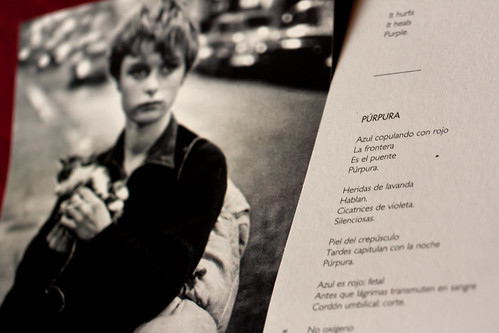
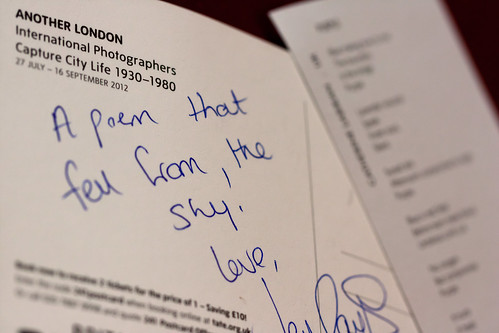
Three weeks ago, the very lovely poet and bookseller Jen Campbell blogged about a fantastic event in London called Raining Poems. She offered to send out some poems from the event and I was thrilled to be one of the lucky winners. My poem arrived today.

Beautiful post

The poem is “Purple” by Catherine Labiran (with a translation into Spanish by Andrés Anwandter).

A poem that fell from the sky

Huge thanks to Jen for the fun post and adding a beautiful poem to my life.

Kate Gardner Blog

Veils, shimmering like curtains

April 9, 2012April 14, 2012

Ariel
by Sylvia Plath

A still life for Easter

This was Plath’s final volume of poetry, published two years after her death, and I could not separate the knowledge of what shortly followed these writings from the words themselves. It was not an easy read.

Death is everywhere in these poems. I got shivers down my spine on almost every page. Yet these are not obvious musings on death but rather word collages. For the most part the poems are constructed of a series of images, with no clear story or scene, but there are a few exceptions. “Gulliver” describes Swift’s character in the scene in Lilliput when he is tied to the ground:

“You there on your back,
Eyes to the sky.
The spider-men have caught you,”

“Daddy” explores her feelings about her father, a complex relationship despite his death early in her life (“I was ten when they buried you”). And “Wintering” is actually the last part of a series of four poems about her new-found vocation of beekeeping:

“Now they ball in a mass,
Black
Mind against all that white.”

But these are exceptions in-between the darker poems (and even those were not entirely free from comment on death). Her depression is ever present:

“I am terrified by this dark thing
That sleeps in me;
All day I feel its soft, feathery turnings, its malignity.” [from “Elm”]

She refers to her previous suicide attempt many times over, making it clear her only regret about it is that she didn’t succeed:

“After all I am alive only by accident.
I would have killed myself gladly that time any possible way.
Now there are these veils, shimmering like curtains” [from “A birthday present”]

But the poem that moved me most was “Years”, where Plath’s pain and anger seem to be at their peak:

“O God, I am not like you
In your vacuous black,
Stars stuck all over, bright stupid confetti.
Eternity bores me,
I never wanted it.”

First published 1965 by Faber & Faber.

Kate Gardner Reviews

Memorised

February 18, 2012 1 Comment

One thing I envy my parents’ and grandparents’ generations is that they were taught, in fact required, to memorise poetry. For me, in the 1980s and 90s, we barely touched poetry at school.

There was one supply teacher who did the scissors poem from Please Mrs Butler by Allan Ahlberg (a collection I still love) and I have a vague memory of there being a “big cat poetry” element to my GCSE English course…and that’s it. Aside from on posters on the classroom walls (which, incidentally, is where I discovered this love of mine) and being encouraged to write our own, poetry was strangely absent.

I am lucky that my family spotted my interest and bought me plenty of poetry books to read at home, but I feel that I somehow lack something by not being able to reel off a dozen of my favourite poems by heart. I know bits of poems – from Night Mail by W H Auden (incidentally, I recently discovered you can buy that film from the BFI), The Second Coming by W B Yeats and the aforementioned Please Mrs Butler – and I think I was once able to recite Jabberwocky by Lewis Carroll and Leisure by W H Davies (which I was reminded of yesterday by this amazing piece in the Washington Post), but now in both cases I get lost.

Of course, I could remediate this; it’s hardly too late. I have all the books. And I should perhaps be grateful that I instead came out of school with computer skills and some knowledge of books written outside the UK (I discovered the Yeats poem mentioned above when I studied Chinua Achebe’s Things Fall Apart at A level). I think I need to go read some poetry now.

Kate Gardner Blog

What’s in a name

January 23, 2012 1 Comment

Possession
by AS Byatt

This was a re-read that I sadly ended up rushing through because it was for book club and I didn’t give myself enough time. It’s a wonderful book, as literary as they come yet immensely readable.

The story begins with Roland, a postgrad scholar of the eminent (and fictional) Victorian poet Randolph Henry Ash, discovering long-hidden drafts of a love letter from Ash to a mystery woman. This is a potentially huge discovery, Ash having been assumed to be a dull, happily married type.

Thus begins the unravelling of great secrets, but Roland is jealous of his discovery and does not tell his university supervisor or his girlfriend Val. Instead he turns to a complete stranger, fellow academic Maud, because he suspects that the subject of her studies, minor Victorian poet Christabel LaMotte, was also the subject of Ash’s letter.

Between letters, diaries, academic texts, poems and good old-fashioned third-person narrative, there are a lot of switches in style and voice in this book, yet it never feels as though that is the case. Similarly, like the poems being studied for clues, this text is packed full of allusions and references, but it doesn’t feel overly clever or difficult.

In some ways this book is very much a product of its time. It was written in the 1980s and Byatt gently satirises the times. Roland is emasculated by Val’s stronger earning power and neither of them ever says what they mean. Maud is surrounded by feminists who seem obsessed with lesbianism and anti-men sentiments. The shadow of AIDS looms large over thoughts of sex. But this is all subtly kept in the background.

At book club we discussed how you can read this book at many different levels. There is the surface level where it’s a romance/mystery/drama and is fun and enjoyable without requiring any background knowledge. There’s the satire on academia, particularly 1980s academia. And there’s the literary novel, referencing mainly Victorian poetry but also older texts such as Shakespeare and Ovid and I’m sure plenty more that I didn’t spot. The character names are carefully chosen for the literary allusions that they have. And at all these levels it works, works very well, without ever seeming to show off.

I’m told that The Children’s Book is another excellent Byatt read, and that just happens to be on my TBR (a kind Christmas present), so I expect to be breaking that out soon.

First published 1990 by Chatto & Windus.
Winner of the 1990 Booker Prize.

Kate Gardner Reviews

Words on women of the world

December 4, 2010March 11, 2012 1 Comment

Feminine Gospels
by Carol Ann Duffy

A lot of the poems in this collection by our esteemed Poet Laureate read like little short stories, which made them pleasingly accessible for someone like me who doesn’t read a whole lot of poetry.

The subject matter, as you might guess from the title, is women – the women of myth, of urban legend, of old wives tales – and womanhood, what that means. The tone ranges from meditations on love, beauty, identity to everyday rhythms and humour.

There’s “The Map-Woman” about a woman whose skin is a map of the town, from head to toe. There’s “Work” about a woman taking on increasingly tough jobs as she has more children to support, until she has a billion children and can no longer cope. There’s “Beautiful”, about some of history’s most famous women, from Helen of Troy to Princess Diana, drawing the parallels between their lives and the way they were treated.

I usually like love poems best and there are some of those here, but I think my favourite in this collection is “A Dreaming Week”, which uses repetition and clearer rhythm and rhyme than most of Duffy’s poems to create something that sounds really good spoken aloud. Its story, if it can be said to have one, is quite simply a person daydreaming/dreaming a week away. There’s idle playing with words, there’s evocative descriptions of bed and night-time.

I think I prefer Duffy’s most recent book, Rapture, but this is an excellent window into multiple characters/perspectives/ideas about femininity.

Published 2002 by Picador.

Kate Gardner Reviews

He wishes for the cloths of Heaven

May 26, 2010February 18, 2012 2 Comments

Thought I’d share my favourite poem with you, as the lovely weather has put me in a poetic sort of mood.

Had I the heavens’ embroidered cloths,
Enwrought with golden and silver light,
The blue and the dim and the dark cloths
Of night and light and the half-light,
I would spread the cloths under your feet:
But I, being poor, have only my dreams;
I have spread my dreams under your feet;
Tread softly because you tread on my dreams.

Written by William Butler Yeats (1865–1939).
First published in The Wind Among the Reeds (1899).

Kate Gardner Blog

The most ancient words can have the strongest effect

April 17, 2010March 11, 2012 1 Comment

Stung with Love: Poems and Fragments
by Sappho
translated by Aaron Poochigian

Sappho lived from 630 until 570 BCE on the island of Lesbos and has been renowned throughout the intervening centuries as one of the greatest poets who ever lived. Sadly, little of her material has survived and what we do have is largely in fragments.

Sappho wrote about love, family, marriage and war with wit and warmth. Her poetry had a huge influence on writers for centuries after she lived. All of the major ancient Greek and Roman writers are name-checked in the notes.

In this new (2009) translation, Poochigian provides a thorough introduction as well as notes on each fragment. I have a tendency to ignore these bits when I pick up a classic book but in this case the background is extremely interesting…so I skimread it. I did find it useful to glance at the notes where fragments mentioned a name or were particularly short.

Poochigian has tried to follow the metre of the original work but has added rhyme where there was none previously to make the fragments more songlike. Because this is a translation, and from an obscure ancient dialect at that (one of the many reasons why so much of Sappho’s work has been lost) it is hard to know how close reading these fragments comes to the original experience of hearing them sung. Probably not that close, but they are still worth reading.

For me not all of the fragments work as poetry. For instance, the shortest fragment included in this collection is the four words “A handkerchief / Dripping with…“, which has an intriguing air of mystery about it but hardly counts as a poem. However, the longer fragments (and indeed the two complete poems) are beautiful and emphasise what a loss we have suffered. Sappho fragments do continue to surface every so often but it seems unlikely that a great deal more will be found.

The book ends, neatly, with one of my favourite fragments:

I declare
That later on,
Even in an age unlike our own,
Someone will remember who we are.

How true.

Published 2009 by Penguin.
ISBN: 978-0-1404-5557-1

Kate Gardner Reviews

Posts pagination

1 2

Archives

RSS Nose in a book

  • Book review: Interstellar Megachef by Lavanya Lakshminarayan
  • May 2026 reading round-up
  • Book review: Passing by Nella Larsen

Me on the internets

  • @kate_in_a_book@mas.to (Mastodon)
  • Flickr/noseinabook
  • Instagram/kate_in_a_book
  • StoryGraph/kate_in_a_book

Categories

  • Blog
  • Reviews
  • Uncategorized
Proudly powered by WordPress | Theme: Dream by vsFish.