Nose in a book

Reviews and other ramblings

  • Home
  • Reviews archive
    • Book reviews
    • TV reviews
    • Theatre reviews
  • TBR
  • Challenges
    • The Classics Club
    • 2014 Popular-Science Reading Challenge
    • Cookery challenge
    • The Gilmore Girls Reading Challenge
    • 2013 TBR Pile Challenge
    • 2013 Translation Challenge
    • Crime and Punishment read-a-long
  • About
    • Cookie legal stuff
  • Home
  • Reviews archive
    • Book reviews
    • TV reviews
    • Theatre reviews
  • TBR
  • Challenges
    • The Classics Club
    • 2014 Popular-Science Reading Challenge
    • Cookery challenge
    • The Gilmore Girls Reading Challenge
    • 2013 TBR Pile Challenge
    • 2013 Translation Challenge
    • Crime and Punishment read-a-long
  • About
    • Cookie legal stuff

Tag: non-fiction

She had once been threadbare, with seven lives to weave from darkness
October 8, 2020October 3, 2020

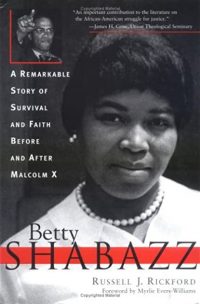
Betty Shabazz book coverBetty Shabazz: a Remarkable Story of Survival and Faith Before and After Malcolm X
by Russell J Rickford

A late-night read on my Kindle while trying to get the dog to sleep, I was starting to feel bad about how long it was taking me to read this autobiography until I saw on Goodreads that it’s over 600 pages. In fairness Dr Betty Shabazz lived a full and fascinating life that deserves every one of those pages. She was so much more than Mrs Malcolm X, though of course that marriage made her famous and opened the door for her to be an activist and ambassador.

Rickford says in his introduction that he will concentrate on Betty’s life before and after Malcolm, but inevitably their seven years of marriage form a lot of the narrative and at times this veers into being yet another Malcolm X or Nation of Islam biography. He also refers to her as “the widow” a lot, which somewhat undermines his stated mission to depict her as more than that role. Not that it was easy role to hold.

Continue reading “She had once been threadbare, with seven lives to weave from darkness”
Kate Gardner Reviews

If you grew up both black and poor in the UK you know more about the inner workings of British society than a slew of PhDs

July 20, 2020

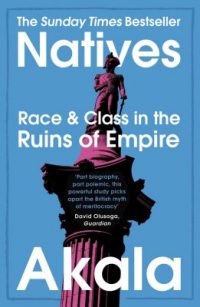
Natives book coverNatives: Race and Class in the Ruins of Empire
by Akala

This is a cross between a memoir and a history of black people in the UK. Akala is a hip-hop artist and a lecturer, who I must admit I only became aware of in recent months. He wrote this book a couple of years ago but it reads as though custom designed to speak to this current moment.

Akala begins with his own beginnings, including his mother’s efforts to ensure he was educated on race in the British Empire, and the history of Jamaica (where two of his grandparents moved to the UK from, as part of Windrush). He uses pop culture and news items from his own lifetime (which, as he’s only two years younger than me, were all familiar) to point out everyday racism and injustice.

In some ways his story sounds like a cliché. Despite early inclinations for academia, in his teens he looked to a career in football and then rap music. He was repeatedly harassed by police (and still is). He had friends and relatives who went to prison. Akala lays out the statistics at every juncture – how often black men (and boys) are stopped by police versus white men; how much more income a black family has to have to live in a “nice” neighbourhood than the white families around them. But by making it personal he can also include how it felt that first time he was stopped by the police for no reason other than being a young black man; how it felt to have a teacher so racist that they put him in the learning-difficulties group to stop him being “a smartypants”; what it was like the first time he witnessed street violence up close.

Continue reading “If you grew up both black and poor in the UK you know more about the inner workings of British society than a slew of PhDs”

Kate Gardner Reviews

We need to describe the invisible monolith

June 25, 2020June 24, 2020

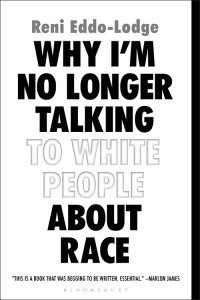
Reni Eddo-Lodge coverWhy I’m No Longer Talking to White People About Race

by Reni Eddo-Lodge

My favourite of the anti-racist books I have read so far (though they’re all good), this is an extension of Eddo-Lodge’s 2014 essay of the same title that pushed her to the forefront of British journalists asked to comment on issues around race and racism. Which isn’t quite as ironic as it sounds; the essay was after all a public statement about racism. She was (justifiably) tired of having the same conversations with white people who refuse to acknowledge racism; tired of racism being deemed a problem for black and brown people to solve; tired of racism and talking about it taking up so much of her time and emotions. She was giving herself permission to take a break, walk away, self-preserve.

This book expands on that essay by detailing the many ways in which racism exists in the UK that white people tend not to notice. From police bigotry to the language people use; from the largely erased history of black people in the UK to the systems and processes throughout our society that are racist, Eddo-Lodge lays it bare. She devotes a chapter to untangling arguments that confound race and class in Britain (“It’s really a class problem” is a common defence against the existence of racism here).

Continue reading “We need to describe the invisible monolith”

Kate Gardner Reviews

Wherever I go on the island, you’re with me

November 24, 2019

Letters from Tove coverLetters from Tove
by Tove Jansson
edited by Boel Westin and Helen Svensson
translated from Swedish by Sarah Death

This is a giant warm cuddle of a book. It took me a while to read as the letters are many and to some extent a little repetitive, but I loved effectively being able to hear Tove Jansson speak honestly to the people she was close to. The book only includes Tove’s letters, not the other half, so there is always part of the conversation missing, which also makes it a little bit of a mystery puzzle.

The correspondence is organised by addressee, beginning with letters that Tove sent to her family when she went to art school in Stockholm, and then two long trips to France and Italy to further her art education. Young Tove was very adventurous, sociable and passionate – about art and about people. I laughed out loud at her descriptions of the École des Beaux-Arts in Paris, where she was treated awfully and quickly left for a smaller school where she felt she was actually learning.

Her parents were both artists themselves and lived for part of every year in an artists’ colony – a lifestyle that Tove carried into her own adulthood, but it often clashed with her desire for solitude and peace, and this clash is something that is increasingly the focus of her letters. But her biggest fight is always with her own art.

Continue reading “Wherever I go on the island, you’re with me”

Kate Gardner Reviews

Women’s inventions have been neglected by evolutionary researchers

April 7, 2019

Inferior book coverInferior: the True Power of Women and the Science That Shows It
by Angela Saini

This is such an important book. It’s not the first on this topic but it’s the one that has managed to take off and get the message out there (partly thanks to the brilliant Jess Wade, who has been campaigning to get this book into school libraries).

Saini interrogates the claims of scientists about the differences between the sexes. She explains what we do and don’t know about whether men and women’s different positions in society are the result of physical biological differences, or hard-wired differences in ability, or if they’re the result of hundreds, if not thousands, of years of society and culture being skewed.

Are men’s and women’s brains really wired differently? It’s a very complicated area of science, and despite some excitable newspaper headlines, we don’t yet know for sure. It appears that there is more variety within each sex than there is between them. And importantly, even if there are physical differences, we have to be extremely careful about extrapolating reasons for those differences.

Can we learn about our ancestors from anthropologists’ studies of 20th-century hunter-gatherers? A limited amount, yes, but the surviving hunter-gatherer communities are all very different from each other. The only real conclusion we can reach is the variety of what human beings – and women particularly – are capable of.

But that hasn’t prevented more than a century of evolutionary research being skewed to ancient hunting habits (because men were presumed to have done most of the hunting) and often ignoring or downplaying other human activities such as gathering food and childcare (which were assumed to be wholly female activities). Which has knock-on effects including that theories about the development of human language are largely based around hunting and it is only recently that scientists have begun to question whether a more likely scenario for language development is the need to pass information from mother to child.

Continue reading “Women’s inventions have been neglected by evolutionary researchers”

Kate Gardner Reviews

The archaeological pace had grown feverish

February 13, 2019

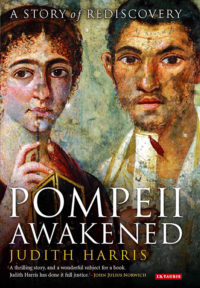
Pompeii AwakenedPompeii Awakened
by Judith Harris

When Tim and I visited Pompeii last year our one disappointment was the lack of information at the excavations site. Even armed with the official guide book, we were confused about what some buildings were and which bits had been reconstructed. Though don’t get me wrong: we still loved it so much that we spent a second day there rather than climbing Vesuvius as originally planned.

So when we got home I searched for a book not about Pompeii pre-AD 79, but about the rediscovery of the town since 1748. Harris tracks the uncovering of Herculaneum and Pompeii up to the present day – a story that encompasses much of the political history of Europe over the same years and the development of modern archaeology.

This book is really good and definitely helped me to understand more of what we had seen in Pompeii, though I must admit it didn’t answer every question. It is packed with fascinating tidbits that I kept storing up to tell Tim.

Continue reading “The archaeological pace had grown feverish”

Kate Gardner Reviews

Our complicated feelings about the privileged status of white women

August 13, 2018

Dead GirlsDead Girls
by Alice Bolin

When I read the description of this essay collection, I got pretty excited. The blurb describes it as an analysis of America’s cultural obsession with dead girls, which promised to be very fertile ground. Really my main criticism of this book is that it doesn’t just stick to this topic.

Alice Bolin starts out strong, with a piece on “dead girl” TV shows, from Twin Peaks to Pretty Little Liars and many others in between (it was inspired by her watching True Detective). I have watched a lot of these dramas and I agree with Bolin that the mere fact of their popularity, not to mention some of the specific tropes they all repeat, is a worrying facet of our culture. In these shows the victim is rarely given much of a character, and the leads are usually men who project their own ideas onto the dead girl. It’s an excellent essay.

Continue reading “Our complicated feelings about the privileged status of white women”

Kate Gardner Reviews

It made the girls themselves gleam

June 25, 2018June 25, 2018 2 Comments

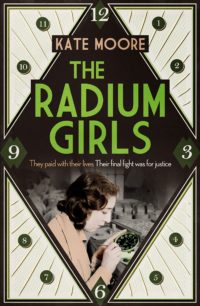
The Radium GirlsThe Radium Girls
by Kate Moore

I first heard about this book via work. It’s part of a current trend – one that I fully support – of identifying stories from history that are important but little known and giving them a boost. In this case, it’s the story of thousands of women who worked in the (mostly) early 20th century painting dials onto watch faces with radium-based paint, so that they glowed in the dark.

It sounds like a terrible idea and it was. But even though shortly after Marie and Pierre Curie discovered radium in 1898 they and their colleagues realised it could cause harm to humans, it became famous for its ability to destroy or reduce cancerous tumours, and was therefore widely considered to be health-giving. So when Dr Sabin von Sochocky, founder of the United States Radium Corporation (USRC), which mined and processed radium in New Jersey, figured out that it could be used to create a glow-in-the-dark paint, this seemed like a brilliant new commercial avenue for the company.

Continue reading “It made the girls themselves gleam”

Kate Gardner Reviews

Impossible to imagine the daily fear and precariousness of living in such a state

May 19, 2017May 20, 2017

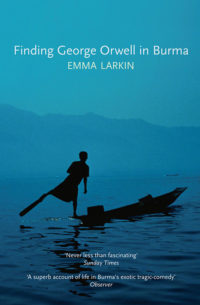
Finding George Orwell in Burma
by Emma Larkin

When I said I was reading Burmese Days by George Orwell a few people recommended I read this next. I started it almost immediately after the Orwell book, but it took me a while to get through. I agree that it’s a fantastic reference work, but is it a good read?

The title is a fairly good description of the book. Emma Larkin – the pseudonym of an American journalist living in Thailand who has travelled to Myanmar (which she tends to call Burma throughout) many times – used researching Orwell’s time in Burma as a structure (or perhaps an excuse) for her year-long travel across Myanmar, speaking to people there who remembered Orwell or British rule in general, but also to people willing to open up about life in Myanmar.

The first point that strikes me is that this book was first published (under a slightly different title) in 2004, and even this edition with an epilogue from 2011 is a little out of date already. While it’s extremely useful as a recent history, I was always aware while reading it that this probably isn’t the current state of affairs in Myanmar.

Continue reading “Impossible to imagine the daily fear and precariousness of living in such a state”

Kate Gardner Reviews

Do not allow your mind to be imprisoned by majority thinking

April 4, 2017 3 Comments

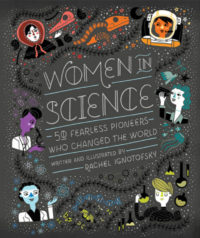
Women in Science: 50 Fearless Pioneers who Changed the World
by Rachel Ignotofsky

We tend to think that until the latter half of the 20th century, science was done by men. The history books and allocation of awards such as Nobel prizes strongly support that view. But in recent years a slew of books have begun to challenge that version of history. This is the first I’ve read but I’m keen to follow it up with Hidden Figures, The Glass Universe and others.

Ignotofsky both wrote and illustrated this beautiful book, profiling women scientists in a design-heavy layout that simply and effectively tells their stories.

From Hypatia (approx 350–415 AD) to Maryam Mirzakhani (1979–present), this book devotes a double-page spread each to women who have made significant advances in science, technology, engineering and mathematics (STEM). In each, the left-hand page is an illustration of the woman herself, with a few key facts floating around, while the right-hand page contains a bio of the woman and a few small, light-hearted illustrations. In every case there is a quote either by or about the woman, and these often reference being a woman in a man’s world.

Continue reading “Do not allow your mind to be imprisoned by majority thinking”

Kate Gardner Reviews

Posts pagination

1 2 3 … 5

Archives

RSS Nose in a book

  • Book review: Interstellar Megachef by Lavanya Lakshminarayan
  • May 2026 reading round-up
  • Book review: Passing by Nella Larsen

Me on the internets

  • @kate_in_a_book@mas.to (Mastodon)
  • Flickr/noseinabook
  • Instagram/kate_in_a_book
  • StoryGraph/kate_in_a_book

Categories

  • Blog
  • Reviews
  • Uncategorized
Proudly powered by WordPress | Theme: Dream by vsFish.