We seem to have strayed into a timeless moral vortex
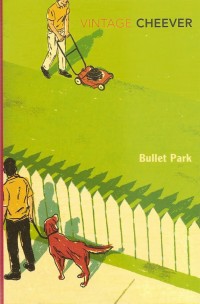
Bullet Park
by John Cheever
I wasn’t much aware of John Cheever until a year or two ago. And even then I lumped him together with the great big male American 20th-century greats, which made me feel that I should read him, but didn’t really feel much inclination to. So I might never have read this novel if my book club hadn’t chosen it. And I’m glad they did, as it was a more enjoyable read than I expected.
This is a comedy, poking fun at suburbia, but it’s a dark, subtle kind of comedy. I certainly didn’t laugh out loud. The story is that of Eliot Nailles, sensible middle-class long-term resident of Bullet Park, a New York suburb, and his recently arrived neighbour Paul Hammer. At first glance Nailles is hard working, happily married, blessed with a perfect teenage son and admired by all around him, while Hammer is somehow mysterious, with a wife who says things she shouldn’t after a few drinks.
The first half of the book, perhaps predictably, cuts through that façade of suburbia and looks behind the closed doors at the details of Nailles’ life. His love for his wife Nellie borders on obsession but does she feel anything like the same loyalty for him? And his son Tony seems to have been struck down suddenly with some form of bedridden depression, which Nailles is trying desperately to both understand and find a cure for.
What I found interesting was that Cheever doesn’t entirely subvert the prevalent view of suburbia, because overall the picture painted is one of dreariness and predictability. Not that the writing is at all dreary, but if this section had gone on much longer I think I would soon have become bored.
“There seemed to be some metric regulation to the pace of the talk. It was emotional, intimate, evocative and as random as poetry. They had come from other places and would go to other places but sitting against the light at four in the afternoon they seemed as permanent as the beer pulls.”
What saves this book is the switch at the start of part two to Hammer’s story. This part is narrated by Hammer and fills in his backstory, and I was immediately grinning and enjoying the ride that he takes you on. He has a wonderful turn of phrase and a calculated assessment of which facts to give. He is an archetypal unreliable narrator, which makes it all the harder to figure out what is coming in part three, when the narrative switches back to the two men in Bullet Park.
“We traditionally associate nakedness with judgments and eternity and so on those beaches where we are mostly naked the scene seems apocalyptic. Standing at the surf line we seem, quite innocently, to have strayed into a timeless moral vortex.”
Hammer and Nailles are very different people, both full of ambiguity, but neither came 100% to life for me. I think this comes down to the style of writing. We talked at book club about how this might be related to Cheever being for the most part a short-story writer, and how this novel in many ways feels like a long short story. This is a slight criticism, but only a slight one. And certainly I would be interested to read Cheever’s short fiction and see if his style is better suited to that.
The writing is often beautiful and the story includes some wonderful quirks, that completely thrilled me. For instance, Hammer has an obsession with yellow rooms – they have to be a specific shade of yellow and he has to find them already painted that colour. Hammer’s mother (a fairly minor character but an absolutely brilliant one) decides that her therapist is too expensive so she takes to analysing herself, aloud.
“Three times a week, I lie down on my bed and talk to myself for an hour. I’m very frank. I don’t spare myself any unpleasantness. The therapy seems to be quite effective and, of course, it doesn’t cost me a cent.”
In the end, I liked this book but I didn’t love it. This is partly related to the ending, which I won’t discuss here and I wasn’t necessarily disappointed by, but I did feel a certain…deflation at. But I also wonder if it’s related to the comedy not being that funny but also not that biting. Another thing we mentioned at book club was that this book reads like a satire without a clear target. Bullet Park is both a safe, happy place and a dull or even sinister place. But New York City gets lots of mentions and it isn’t painted as particularly better or worse than suburbia. And society itself is similarly both lampooned and forgiven. I think ultimately I would have enjoyed it more if it was either more sharp and biting, or if it had more relatable characters.
First published 1969 by Knopf.
Source: I bought this from Topping Books in Bath.