Nose in a book

Reviews and other ramblings

  • Home
  • Reviews archive
    • Book reviews
    • TV reviews
    • Theatre reviews
  • TBR
  • Challenges
    • The Classics Club
    • 2014 Popular-Science Reading Challenge
    • Cookery challenge
    • The Gilmore Girls Reading Challenge
    • 2013 TBR Pile Challenge
    • 2013 Translation Challenge
    • Crime and Punishment read-a-long
  • About
    • Cookie legal stuff
  • Home
  • Reviews archive
    • Book reviews
    • TV reviews
    • Theatre reviews
  • TBR
  • Challenges
    • The Classics Club
    • 2014 Popular-Science Reading Challenge
    • Cookery challenge
    • The Gilmore Girls Reading Challenge
    • 2013 TBR Pile Challenge
    • 2013 Translation Challenge
    • Crime and Punishment read-a-long
  • About
    • Cookie legal stuff

Tag: memoir

Our father refused to compromise, and live a life of silence in the face of oppression
September 12, 2019 2 Comments

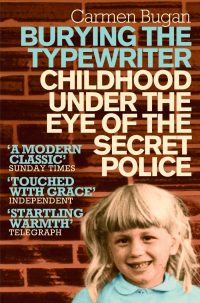
burying the typewriter coverBurying the Typewriter: Childhood Under the Eye of the Secret Police
by Carmen Bugan

This is my Romania selection for the EU Reading Challenge, and it’s so far my only book in this challenge that was originally written in English. I remember adding this to my wishlist when it was first published. Past me was smart.

It’s a memoir of the author’s first 18 years, when she lived in Romania. She and her family left Romania in late 1989 under threat of death and this is Bugan’s story of how they reached that point. It’s very much told from her own point of view, as the oldest child of Ion Bugan, who was twice imprisoned for protesting Nicolae Ceaușescu’s regime.

The book opens with Carmen’s early childhood, which was idyllically happy. Though her father was an activist long before his marriage and her birth, and never stopped secretly protesting, she was oblivious for many years. As the 1970s turn into the 1980s, the warning signs appear (with of course decades of hindsight). When Carmen turns 11 she begins to pay attention to the radio programmes her parents listen to; to the food shortages and fights over rationing on the streets; to the arguments her parents have about moving near to the border and becoming self-sufficient.
Continue reading “Our father refused to compromise, and live a life of silence in the face of oppression”

Kate Gardner Reviews

The chemistry and physics on which we fed were the antidote to Fascism

July 30, 2019July 31, 2019

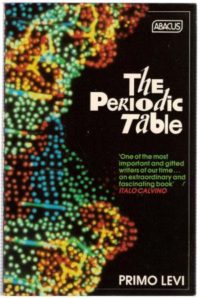
The Periodic Table book coverThe Periodic Table
by Primo Levi
translated from Italian by Raymond Rosenthal

This is my Italy book for my EU Reading Challenge and is also on my Classics Club list. It seemed appropriate right now in multiple ways. I’ve seen a few people recommending we all read Primo Levi this year to remind us what Fascism and Second World War concentration camps were like (to refute the argument that the US detainment camps aren’t really concentration camps). Plus, 2019 is the International Year of the Periodic Table of Chemical Elements, as designated by UNESCO.

This is a difficult book to describe. Not quite a memoir, but not quite popular-science either, and certainly more than just a loose collection of tales. Each of its 21 chapters is framed around one element – sometimes abstractly, sometimes very directly. Levi was a professional chemist and himself describes this book as “events, mine and otherwise…to convey to the layman the strong and bitter flavour of our trade…stories of the solitary chemistry…which with few exceptions has been mine: but it has also been the chemistry of our founders…who confronted matter without aids, with their brains and hands, reason and imagination.”

Levi begins with his ancestors and a dissection of the language he spoke as a child, a product of the Jewish community in the Piedmont region that combined Italian, Piedmontese and Hebrew. I’ll admit that the link is a little tenuous between the inert gas argon and Levi’s assessment of his ancestors’ general character, but I do love a bit of etymology and Levi has a knack for turning anything into a great story.

Continue reading “The chemistry and physics on which we fed were the antidote to Fascism”

Kate Gardner Reviews

I still find “Negro” a word of wonders, glorious and terrible

February 23, 2017

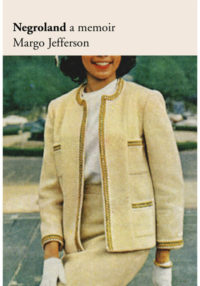
Negroland: a Memoir
by Margo Jefferson

This is an unusual memoir. It’s heavily stylised, experimental even, but it’s also rather scholarly in its approach to the historical context of Jefferson’s own life.

Margo Jefferson was born in 1947 and raised in a well-to-do black family in Chicago, part of a black elite society with its own specific rules, norms and challenges. And this is what she documents. It’s an unusual subject for a memoir, and in keeping with that, often doesn’t feel like a memoir at all. Jefferson doesn’t bare her soul, or reveal any shocking family secrets. She doesn’t even stick to first person, slipping in and out of referring to herself in the third person.

There is a lot of background information provided about the formation of America’s black elite, which at first felt a little excessive and/or dry until I realised how recent it all was, and in fact most of the people she refers to turn out to be family friends. There is also a lot about physical appearance – how people with different types of hair handled it, how nuances of skin colour and facial shape could affect your place in society. Usually I could not be less interested in hair and make-up, but of course its relevance to this story is rather different. Because even though Jefferson was and is rich, educated and well-connected, she and her friends and family cannot get away from the fact that they are black and therefore different.

Continue reading “I still find “Negro” a word of wonders, glorious and terrible”

Kate Gardner Reviews

Recent reads in brief

December 19, 2016

While I am slowly making my way through more than 600 pages of Sophie’s Choice, I am actually a little behind on book reviews, so here are some brief thoughts on recent reads.

Letters to a Young Poet
by Rainer Maria Rilke
translated from German by Stephen Mitchell

This small volume was written 1903–1908 but its advice still feels relevant and wise, which is presumably why it quickly became a classic.

Franz Xaver Kappus was put in touch with Rilke by the chaplain at his military academy, who had known Rilke when he too was a student at the school 15 years earlier. Kappus aspired to write and Rilke was a revered (rightly so) poet. These 10 letters constitute Rilke’s advice on how to look at life as well as how to write and some non-advice observations from Rilke such as his thoughts on Rome (he was not a fan) and other places he travelled to (all the letters seem to be written from a different location, and often include reference to months spent somewhere else in-between).

What most caught my attention was Rilke’s thoughts on gender equality. He was a feminist if ever I read one. He truly believed that the two sexes were created equal and that society still unfairly favoured men as a relic from a bygone age when man’s superiority of strength and size was relevant to everyday life. Rilke not only believes that the time will come when women will be considered equal in all respects to man, he also thinks that in time women will take their turn as the gender running the show.

Rilke is sweet, earnest, but also troubled. He’s also extremely eloquent. Because he’s Rilke.

“Things aren’t all so tangible and sayable as people would have us believe, most experiences are unsayable, they happen in a space that no word has ever entered, and more unsayable than all other things are works of art, those mysterious existences, whose life endures beside our own small, transitory life.”

Briefe an einen jungen Dichter published 1929 by Insel Verlag.

This translation first published 1984 by Random House.

Source: Shakespeare & Sons, Berlin.

Continue reading “Recent reads in brief”

Kate Gardner Reviews

Tell me, is she a genuine eccentric?

October 29, 2016October 29, 2016

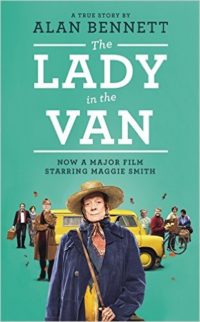
lady-in-the-vanThe Lady in the Van
by Alan Bennett

This is my third Alan Bennett and, honestly, my least favourite. It’s also the first of his non-fiction memoirs that I’ve read, which doesn’t bode well for completing his backlist as that’s the bulk of his work.

This particular story, made into a film last year starring Maggie Smith, is about the decidedly odd Miss Shepherd, who lived in a van on Bennett’s driveway from 1974 until 1989. First published in 1989, this is essentially annotated and edited excerpts from Bennett’s diaries in those years. He is fighting very hard not to judge the elderly “Miss S.” for her eccentricities, and he is certainly extremely tolerant in the face of her difficult temperament. And she is extremely difficult.

“October 1969. When she is not in the van Miss S. spends much of her day sitting on the pavement in Parkway…She sells tracts, entitled ‘True View: Mattering Things’, which she writes herself, though this isn’t something she will admit…She generally chalks the gist of the current pamphlet on the pavement, though with no attempt at artistry…She also makes a few coppers selling pencils. ‘A gentleman came the other day and said that the pencil he had bought from me was the best pencil on the market at the present time. It lasted him three months. He’ll be back for another one shortly.’ D., one of the more conventional neighbours…stops me and says, ‘Tell me, is she a genuine eccentric?’ ”

Continue reading “Tell me, is she a genuine eccentric?”

Kate Gardner Reviews

I began to wonder why Man had evolved at all

September 13, 2016

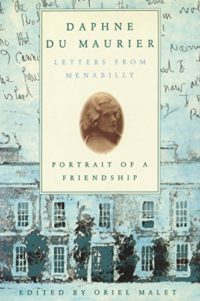
letters-from-menabillyLetters from Menabilly: Portrait of a Friendship
by Daphne du Maurier and Oriel Malet

I bought this book while we were on holiday in Fowey back in July. It’s described on the cover as written by Daphne du Maurier, edited by Oriel Malet, but Malet’s contribution is far more than editing du Maurier’s letters.

Malet was in some ways du Maurier’s opposite: a fellow writer, she was critically lauded but never sold well; where du Maurier was such a homebody she even resisted trips to London to do research, Malet moved to Paris to live out the dream of being a true artist. They first met at a publishing party in the early 1950s, when du Maurier was in her 40s and Malet in her 20s. Du Maurier took the younger author under her wing, inviting her to stay at Menabilly when she became unwell and needed to get out of London.

The book opens with a glossary of Daphne du Maurier “codewords” and the letters are indeed riddled with them, from “Tell-Him” for a long boring story, to “Silly Values” for anything selfish, superficial or materialistic, and most notably “Peg” for a person in real life who inspires a fictional character. Malet provides a fairly lengthy introduction to their friendship, including a detailed description of her first visit to Menabilly, but that isn’t her only interjection.

Continue reading “I began to wonder why Man had evolved at all”

Kate Gardner Reviews

Sometimes we don’t want to be tethered to yesterday

May 15, 2016

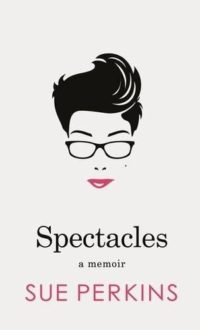
spectaclesSpectacles
by Sue Perkins

This memoir by beloved comedian and TV presenter Sue Perkins jumped out at me when browsing one of our local charity shops, as I was looking to add some comedy to my book shelves and this seemed like just the thing. One the one hand, I was right that it would be funny, on the other it also made me cry no less than three times. Damn it Sue with your sweet, touching moments. And dead pets.

I’d like to claim to be an early fan of Sue, having watched her first TV shows Light Lunch and Late Lunch, back in the 90s, but the truth is that they followed years of stand-up comedy that I of course knew nothing about. Sue is yet another alumnus of the Cambridge Footlights society, and gives a brilliant description of the drab, dingy basement that is the Footlights theatre. This is also where she met long-time comedy partner Mel Giedroyc, who in this book (and, I assume, in life) is the butt of many a joke, primarily about her being two years older than Sue.

Sue is a good writer, whether talking about her family, her career, her loves or her pets. Her timing is spot-on, knowing when to hit the sad button and when to lighten the mood with a joke with the canny judgement of Spielberg. She’s not afraid of sincerity about tough subjects and the chapter about her break-up with a long-term partner after getting back into TV work and running a bit wild is a little painful to read as it seems to betray lingering feelings.

Continue reading “Sometimes we don’t want to be tethered to yesterday”

Kate Gardner Reviews

We find ourselves through the process of escaping

February 3, 2016

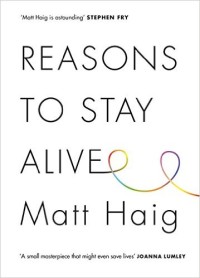
reasons-to-stay-aliveReasons to Stay Alive
by Matt Haig

I had come across some very smart, funny, insightful blog posts by Haig that had put him on my to-read list, so when I saw that he was going to be at Toppings bookshop in Bath, I suggested to Tim that he might want to buy me tickets to the event. I am a helpful gift-receiver that way.

This book is a few things at once – it’s part memoir, part essay, part self-help – with depression as its subject. Haig said that the reader he had in mind was himself aged 25 having his first terrifying experience of depression and anxiety. So the chapters are short, the factual bits are never condescending, the literary quotes on the topic are accessible; it’s all very readable.

But most importantly, the trajectory of the book is upward. There is no “before” – the story starts at Haig’s rock bottom, aged 25 and not understanding at all what was happening to him. From there it is largely, though not entirely, chronological so that we end with Haig’s current state, which is that of course he still has depression but he has lots of ways to deal with it, he knows the bad times pass, and he is even thankful in some ways for having depression – for one, it made him a writer.

Continue reading “We find ourselves through the process of escaping”

Kate Gardner Reviews

But I want to look like this

January 19, 2016

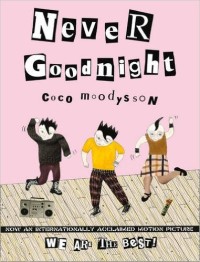
never goodnightNever Goodnight
by Coco Moodysson

This graphic novel is set in 1982 and tells the story of three young girls who start a punk band. If that sounds oddly familiar, it may be because Coco Moodysson’s husband, Lukas Moodysson, adapted it into his 2013 film We Are the Best! (It’s an excellent film, I highly recommend it.) Having seen the film first, I was initially confused by some of the differences I found in the book but I’m trying not to compare the two.

12-year-old Coco lives with her divorced mother and her 17-year-old sister Magda. Their mum’s a bit of a party animal and gives the girls a lot of freedom. Coco’s best friend since third grade is Klara. Klara’s big sister Matilda (her age is never given but it’s implied she’s very close in age) often hangs out with them, and the three of them have decided to start a punk band. None of them can play an instrument but it’s punk, so that doesn’t matter.

The story is about female friendship first and foremost, touching on a few coming-of-age moments such as trying alcohol and starting to see parents as human beings. These girls have turned to punk because they are outsiders by nature, and they’re proud of it. They’re scathing of mainstream music and they talk about politics and environmental issues. The day they first heard the Clash they all cut their hair into spikes and dyed it black. But they’re also a little socially awkward, reliant on each other because they can’t really talk to anyone else.

Continue reading “But I want to look like this”

Kate Gardner Reviews

Autumn reads in brief

November 27, 2015

These are some very brief reviews indeed because I have had so much else on this month, I’m frankly amazed I’ve found time to read at all. Before I zone out in front of another half-dozen episodes of The Big Bang Theory, here is what I’ve been reading.


pride of baghdad

Pride of Baghdad
by Brian K Vaughan (writer) and Niko Henrichon (artist)

This is a beautiful, moving and unusual perspective on war. It takes as inspiration the 2003 news story that four lions escaped Baghdad Zoo during a bombing raid in the Iraq War. Vaughan and Henrichon give the lions names and personalities, and this does result in some anthropomorphising, but that can be forgiven because the result is so good.

Continue reading “Autumn reads in brief”

Kate Gardner Reviews

Posts pagination

1 2 3

Archives

RSS Nose in a book

  • Book review: Interstellar Megachef by Lavanya Lakshminarayan
  • May 2026 reading round-up
  • Book review: Passing by Nella Larsen

Me on the internets

  • @kate_in_a_book@mas.to (Mastodon)
  • Flickr/noseinabook
  • Instagram/kate_in_a_book
  • StoryGraph/kate_in_a_book

Categories

  • Blog
  • Reviews
  • Uncategorized
Proudly powered by WordPress | Theme: Dream by vsFish.