Nose in a book

Reviews and other ramblings

  • Home
  • Reviews archive
    • Book reviews
    • TV reviews
    • Theatre reviews
  • TBR
  • Challenges
    • The Classics Club
    • 2014 Popular-Science Reading Challenge
    • Cookery challenge
    • The Gilmore Girls Reading Challenge
    • 2013 TBR Pile Challenge
    • 2013 Translation Challenge
    • Crime and Punishment read-a-long
  • About
    • Cookie legal stuff
  • Home
  • Reviews archive
    • Book reviews
    • TV reviews
    • Theatre reviews
  • TBR
  • Challenges
    • The Classics Club
    • 2014 Popular-Science Reading Challenge
    • Cookery challenge
    • The Gilmore Girls Reading Challenge
    • 2013 TBR Pile Challenge
    • 2013 Translation Challenge
    • Crime and Punishment read-a-long
  • About
    • Cookie legal stuff

Tag: marriage

Caught up to her among the luminous clouds of deity

September 26, 2012

A Handful of Dust
by Evelyn Waugh

After my recent discovery of Waugh’s genius, I was glad that this title was picked by my book group. I must say it didn’t bowl me over the way Vile Bodies did, and if it hadn’t been for the book group discussion I would have been left very confused by it.

By which I don’t mean that the style or storyline was confusing. I mean that it has an odd tone, one that I didn’t entirely like. It’s, as you might expect, a comedy, but always at people’s expense – the comedy is never about the circumstances or event, so it’s a painful comedy.

The story is that an apparently happy marriage – that of Tony and Brenda Last – very suddenly falls apart thanks to an unappealing interloper. But can it really have been as happy as it first appeared if it is able to fall apart so suddenly and apparently easily? There are clues that boredom may be setting in:

“Although they were both in good health and of unexceptional figure, Tony and Brenda were on a diet. It gave an interest to their meals…Under their present system they denied themselves the combination of protein and starch at the same meal…
‘I’m sure it does me a great deal of good.’
‘Yes, darling, and when we get tired of it we might try an alphabetical diet, having things beginning with a different letter every day.'”

This is a book absolutely loaded with irony (in a possibly very bitter, personal way) and crammed full of vicious attacks on high society and the people therein. It simultaneously deplores and is guilty of snobbery. And yet, if you cut through the irony, what you are left with is really a sad, painfully real story of a marriage falling apart.

“…opinion was greatly in favour of Brenda’s adventure. [She} was filling a want long felt by those whose simple, vicarious pleasure it was to discuss the subject in bed over the telephone. For them her circumstances shed peculiar glamour; for five years she had been a legendary, almost ghostly name, the imprisoned princess of fairy story, and now that she had emerged there was more enchantment in the occurrence, than in the mere change of habit of any other circumspect wife. Her very choice of partner gave the affair an appropriate touch of fantasy…the joke figure they had all known and despised, suddenly caught up to her among the luminous clouds of deity…”

If you asked most people when they were halfway through this book I imagine they would say they didn’t like and didn’t care about any of the characters. And yet when bad stuff happened to them, or threatened to, I found that I did care. (And according to my book group I was not alone in this.) I think Waugh’s real genius is in observing people so well, so minutely, that even his least appealing characters are genuinely believably real.

Which is not to say that there isn’t some element of send-up going on. Considering Waugh’s cleverness it can’t be accidental that the couple at the centre of it all are Mr and Mrs Last. But the last of what? At first, you might conclude that they are the last couple about who married for love rather than money/convenience. But actually there are other love matches in the background and Brenda’s love for Tony disappears so quickly you have to wonder whether it was ever really there.

Perhaps Tony is the last of his generation to care about his big country house; he is completely devoted to it where other families are all selling off their estates. But he’s not very good at being a country gentleman, so maybe that’s not it either.

Perhaps Tony is the last faithful man in high society. There are some painful sequences where various friends (including Brenda) try to throw women at Tony to make the break-up easier on him. And even when he tries to have an affair he just can’t do it. Which should be admirable but somehow makes him look pathetic. (I believe there are elements of Waugh’s own marriage break-up in this novel so it could be that his self-pity and self-hatred became part of Tony’s character. This might also explain the sudden switches in sympathy, sometimes abandoning a character mid-scene.)

There is a long section at the end set in South America that is markedly different from the rest. It was originally a short story, which explains some of the tonal difference, but it actually works well as a new way of looking at British society. It’s pretty racist, which is partly a product of its time but also, I suspect, a comment on the characters who are there for all the wrong reasons, as it’s through their eyes that the racism occurs.

Someone at book group pointed out that Waugh heavily references T S Eliot, and in particular The Waste Land in this novel, which I must admit I missed despite having studied (and enjoyed) The Waste Land at uni and a verse of the poem being the epigraph for it all (and indeed the origin of the novel’s title). Ah well; what was that conversation The Readers were having about not being literary enough…?

First published 1934 by Chapman & Hall.
Kate Gardner Reviews

The ridiculous is very deep in her, where she fights with phantoms

August 29, 2012September 10, 2012

My First Wife
by Jakob Wassermann
translated by Michael Hoffman

This “lost classic” deserves introduction because it’s really quite an odd story. First published in German in 1934, this story was just a small segment buried in a 2000-page trilogy, an autobiographical confession loosely disguised and hidden from view. When Michael Hoffman stumbled across it he was stunned by this powerful account of a marriage and knew he had to bring it to a wider audience and so set about translating it into English for the first time.

The story is that of Wassermann’s alter ego Alexander Herzog, a German-Jewish writer who lives on the kindness of friends and strangers in true Bohemian style until he is introduced to the bizarre character of Ganna Mevis. Claiming to have been misunderstood her whole life, Ganna enthuses gushingly about Herzog’s artistry, sure that he will become a star and that her generous dowry will help him to get there. It is not a comfortable union from the start. Herzog confesses to being cold with her and can never understand her, but he is also spellbound to a certain degree, whether by her constant flattery or sheer weirdness it’s hard to tell:

“You can find a woman lovable without loving her; that’s a dangerous grey area. When I gave her my hand, she could sit there charmed as though that moment was a singing eternity, then she would lean over and press her lips to my fingers with a reverence that sometimes made me say: oh, don’t do that, don’t bother.”

After a few years of uneasy truce the marriage begins to unravel and so begins the legal and financial tangle that make the rest of Herzog’s life hellish. He is made to see how his earlier leniency has cost him dearly, but not before he has spent years defending Ganna to everyone else, as they all see how dangerous she might be:

“One shouldn’t judge Ganna on the basis of single incidents, you need to see her in the round, as the wild nature she is. Her errors, her passions, her mistakes, they are all based on a splendid unity…The ridiculous is very deep in her, where she fights with phantoms…She doesn’t have a clue about reality.”

If this wasn’t autobiographical (with very few details changed, apparently) it might be hard to believe in the character of Ganna. She is utterly vindictive, but that’s not quite the word because she so thoroughly believes that she is in the right and that she has been wronged at every turn. And no wrong is ever forgotten.

Wassermann’s style is at once detached and chatty. He is analysing his own story and making a clear effort to separate himself from events, which is of course impossible even if he has given his story to Herzog, and leads to the occasional “unreliable narrator” moment when he lets slip a detail about himself that you realise explains an awful lot that has gone before.

There is a lot of glib talk about optimism and pessimism, which occasionally becomes profound:

“Even those moments of wanting to die come with a small flame that causes the heart to flicker into life…The least happiness is something so exquisitely precious in the lower depths.”

Wassermann writes movingly of love (albeit not for Ganna) but also of the Great War (“At the Somme a half-brother of mine died…No letter, no farewell, just a silent death.”), of misplaced trust but also of rabid inflation and other signs of political turmoil in Germany and Austria in the 1910s and 1920s. He tries hard to understand how he ended up where he did, a successful author dying in severe debt with his sweetly optimistic lover crushed by the weight of years of doing battle with her predecessor. And really the clues are all there, he is far from blameless.

This is such an interesting read, and eminently quotable at that, but it is not one to race through quickly. It demands of its reader some attempt at understanding this relationship that defies understanding. And I found myself trying to bestow empathy, or at least sympathy, on characters who pages later threw such an emotional response haughtily back at me. I have no doubt that Penguin is right to label this a classic on its first printing in English.

This book was kindly sent to me by the publisher in return for an honest review.

First published in German, within Joseph Kerkhovens dritte Existenz, by Queredo, Amsterdam, 1934.
This translation published in Penguin Classics, August 2012.

Kate Gardner Reviews

The person you thought you knew

July 23, 2012 4 Comments

The War of the Wives
by Tamar Cohen

I was intrigued by this book from the synopsis and I am left feeling very smug that I know myself well – because I loved it. It isn’t perfect but it is gripping and thought-provoking, and story and character are equally strong.

To save you even having to read the blurb, the tagline on the front of this book tells you all you need to know (when did books start having taglines? Is that a thing now?): “At your husband’s funeral you don’t expect to discover his other wife.” So it’s about grief, lies, family, bigamy, but also modern life in London and how change can make you realise what kind of person you are.

The storytelling is narrated alternately by the two wives, Selina and Lottie. Initially there’s a little bit of stereotyping. Selina is well off, uptight, a kept woman who keeps her very nice, very big house in Barnes in impeccable order and doesn’t check the price tag before buying yet another cashmere coat. She was married to Simon for 28 years, they have three children, aged 17 to 26, and while there’s not really any passion left she still loves her husband. She worries about ageing, her children’s choices of partner and why her youngest son insists on eating junk food.

Lottie is artistic, but illustrating children’s books isn’t making her a living so she also has a job she dislikes in a hotel. She lives in a flat in North London with her and Simon’s daughter Sadie, who is 16 and very difficult. She and Simon were married 17 years and they were still very passionate about each other, though they had money troubles and they fought a lot.

Cohen takes as her structure the five stages of grief. So the wives’ hatred of each other and what Simon did really comes to the fore in the “Anger” section. And the book inevitably wraps things up in the “Acceptance” section. Which was where, looking back, I feel a little disappointment. A lot of mysteries turn out to have been red herrings, which I should have seen coming when a potential major storyline just didn’t go anywhere. But what this does is keep the focus on the families, which is definitely Cohen’s strength. That and her fantastic turn of phrase that can combine urbanity and sentiment in clever, often comic, ways:

“I know how you can think you know someone, really know someone, only to find the person you thought you knew turns out to be a hollow timber structure with someone entirely different inside – a plastic wheelie bin of a someone.”

I liked the depiction of the children through their mothers’ eyes. I liked the way the women developed from the stereotypes they saw each other as being into complex, interesting characters. I liked the ultra-current setting – not just Twitter and Facebook but also preparations for the London 2012 Olympics – but I do worry that it will date the book quickly. I suppose that’s a decision the writer and her editor have already made.

The main flaw, I would say, are the prologue and epilogue, which is a shame because they are the first and last impressions. I found the epilogue especially jarring and completely lost my hold on the fictional world I had until then been enjoying thoroughly. But the rest of the book is good enough to forgive the slight lapse.

This book was kindly sent to me by the publisher in return for an honest review.

Published 2012 by Doubleday, an imprint of Transworld Publishers.

Kate Gardner Reviews

Why isn’t a standing order with Shelter enough?

July 8, 2012

How to be Good
by Nick Hornby

I was feeling a bit ill and not quite up to stretching my brains around the Asimov novel I’m in the middle of reading, so I picked this off the TBR. Somehow that sounds as if I’m disparaging it. I’m not. I really like Hornby. And he is easier to read than Asimov, it turns out.

But how did I like this Hornby novel? Well, it was better than Slam, which is a good start, and generally pretty funny and intelligent, but I do have some bones to pick. And I can’t tell if I’m mostly annoyed with the storyline or with the way it’s told. Some of each, probably.

Kate is struggling with her marriage. It’s not so much that the sex has become mechanical, or that she has started an affair, or that her husband David is constantly in a heightened, bordering-on-caricature, state of anger…but something is clearly wrong and only apathy has prevented the inevitable divorce. Then, out of the blue, David visits a faith healer (largely to spite Kate, who is a GP) and suddenly he is changed beyond all recognition, his whole aim in life is to do and be good, and he’s damn well going to make the whole family join him.

A certain suspension of disbelief is required for this story that, frankly, I didn’t quite manage. Despite the faith healer, DJ GoodNews, being unappealing and having no religion and no oratory skill, he is successful at healing doubters and believers alike. David changes from comically angry and judgemental to painfully earnest do-gooder with difficulty having any other topic of conversation than, well, doing good:
“[David’s] relentless quest for the gag in everything used to drive me potty…some elaborate and usually nasty witticism would come darting out of his mouth…and I would either laugh, or, more often, walk out of the room, slamming the door on the way. But every now and again – say, five per cent of the time – something would hit me right on the end of my funny bone…So now I very rarely walk out of the room and slam the door; on the other hand, I never laugh. And I would have to say that as a consequence I am slightly worse off.”

Kate is, for the most part, pretty believable. As the narrator, it is her head we are inside and her perspective we see. She believes herself to be a good person because she is a doctor, and that the number of pus-filled sores she tends to each day outweighs minor aberrations such as having an affair. She is initially outraged that her husband’s mid-life crisis appears to require her and her children to give up some of their middle class creature comforts but she tries to support David and even begins to see the point of his efforts.

There are brilliantly quotable lines on almost every page but I think this gives a particularly good flavour:
“What is the difference between offering spare bedrooms to evacuees in 1940 and offering spare bedrooms to the homeless in 2000?…do we have a moral right to keep a spare bedroom as a junk room, or a music room, or for overnight guests who never come, when it is February and freezing and wet and there are people on the pavements? Why isn’t a standing order with Shelter enough?…I wish David and GoodNews were interested in starting up an Internet company so that they could make millions of pounds to spend on Page Three girls and swimming pools and cocaine and designer suits. People would understand that. That wouldn’t upset the neighbours.”

The story of a failing marriage is told poignantly and well. It was achingly sad to read about Kate being happy to share a bed with David because they have learned to fit together, but at the same time growing to hate him. And the social issues that David and GoodNews touch on are real ones that people should care about and want to do something about.

But this is a gentle comedy, not a hard-hitting one, so of course it implies that Kate was right to not bother in the first place and David is made to look stupid for having tried. Which is a shame. Maybe I’m reading too much into it, but I think it’s easy to poke fun at middle-class left-leaning liberals. The tone of the book, for all its humour, is actually very bleak – there is no point, no hope. Which is depressing. And not true. There are good people out there who didn’t need a spiritual conversion to make them good and don’t make themselves ridiculous by doing good deeds. Guess I’m just an optimist.

As you can tell, the story does raise interesting questions about faith, “goodness”, charity and family, though it explores them from a fairly limited Christian perspective. There were some irritating non-sequiturs when Hornby switched between David being a hardnosed rational to a science-hating artist. And a GP who doesn’t know basic first aid and includes homeopathy in a list of “proper” treatments preferable to faith healing? Both equally terrifying though sadly the latter is at least believable.

So where does that leave me? I thoroughly enjoyed the read but it also frustrated me and continues to now as I mull it over. Is that a sign of good writing? Perhaps.

First published 2001 by Penguin Books.

Kate Gardner Reviews

Let our life stories become tragic art

June 5, 2012 3 Comments

Snow Flower and the Secret Fan
by Lisa See

This is the kind of book I went through a phase of reading several years ago – Asian country, female narrator, historical setting (often during a civil war) and generally following the daily life of poor(ish) folk. So I have some comparison. This one stood up well in terms of teaching me new stuff but less well as regards quality of story. Sadly.

Lily is born in 1830 to a modest farming family in the Chinese province of Hunan. As second daughter she has little worth and is just another mouth to feed until the Matchmaker delivers surprising news: if her feet are bound properly, she will have perfect feet, which will secure her both a good marriage (which her family will benefit from) and a laotong – a lifelong best friend (other girls must leave their childhood friends behind when they marry). But secrets, reversals of fortune and an attempted peasant rebellion all threaten both her happiness and her friendship.

The book is narrated by Lily, from her earliest memories aged five or so, and from the age of seven she is largely confined to the “women’s chamber” and discouraged from paying attention to the world of men, so we hear little about the history or politics of the time, but there is still plenty to tell. See did a lot of research into nu shu, the secret women’s writing, and frames her story around it, but she also details the horrors of foot binding, the rituals of daily life and special occasions to the point that I frequently felt I was learning a lesson rather than reading a story. It’s a fascinating lesson, and after years of research I understand why she wanted to use what she could, but it might have been nice to have a little more, I don’t know, insight?

Perhaps I wasn’t helped by my dislike of Lily. She and her laotong Snow Flower are matched at the age of seven, visit one another often and write to each other in-between, so they appear to be extremely close. Yet they almost always stick to formalised language that allows for misunderstandings and misinterpretations that cause them both pain and suffering:

“My writing is soaked with the tears of my heart,
An invisible rebellion that no man can see.
Let our life stories become tragic art.
Oh, Mama, oh, sisters, hear me, hear me.”

I can accept that their writing might have remained this rigid but in person too? They are often alone together – after they are married, when they visit they share a bed with each other and banish husbands to another room – so how come they never speak naturally even then? The insinuation of Lily’s narrative is that she insisted on this formality and in that way caused all the ensuing problems. But really?

Maybe I am struggling with suspension of disbelief. I’m not saying it’s a bad book. I was very interested and entertained but I did not feel absorbed.

First published 2006 by Bloomsbury Publishing.

Kate Gardner Reviews

The silence that anaesthetises shame

April 26, 2012 4 Comments

The Light Between Oceans
by M L Stedman

This is a beautifully written account of people facing terrible circumstances and decisions. It didn’t move me the way I thought it would (or should) but it got me thinking about love, in all its forms. I can see why this debut novel has already attracted a lot of interest.

The story is set in Western Australia in the 1920s, primarily on a tiny island far off the coast occupied only by the lighthouse keeper and his family. After serving in World War I, Tom is looking for a quiet, useful life when he signs up to “the lights”. He expects to live out his days alone and has accepted that when, on shore leave in the small town of Partageuse, he meets Isabel. She is young, sparkling, headstrong and quick to fall in love.

Izzy has to persuade Tom that she can deal with the life on the island. Shore leave is every three years, with the only other contact with people being a quarterly supply boat. In emergencies a signal can be sent out but otherwise they are quite alone with the lighthouse, cottage, vegetable patch, chickens and goats, at the forefront of every weather front and surrounded by the tempestuous meeting point of two oceans. It is a tough life but Izzy seems up to the task.

The novel begins with the pivotal event before going back to fill in all these details. One day a boat washes up on the island containing a dead body and a crying baby. Izzy has just lost her third child in stillbirth and is out of her mind with grief. The baby appears like a gift from God. But they can’t possibly keep it and not report it, can they?

The story explores grief, truth, lies and choices, sometimes slightly too obviously but at other times very effectively: “History is that which is agreed upon by mutual consent. That’s how life goes on – protected by the silence that anaesthetises shame.”

It’s a hugely emotional story quietly told. I actually thought it was written by a man until I read Stedman’s bio because it is largely viewed from Tom’s perspective. He is stoic, dependable and brave – essentially a good man – where Izzy is impetuous, subject to mood swings and bears grudges. Perhaps this perspective prevented the story from becoming melodramatic or schmaltzy, which is some achievement considering the subject matter, but it also distanced me enough from events that I was not moved by things that I think should have moved me. I should have cried reading this story, or at least come close, but I did not. In fact at times I found it too slow, though it picked up a lot in the third act.

The characters are very well created and I was eager to know what would happen to them. I liked how Tom turned to his duty, becoming more efficient, more clean and tidy, when life got hard. But the best part was the setting. The descriptions of the sea and the weather are stunning: “There are times when the ocean is not the ocean – not blue, not even water, but some violent explosion of energy and danger”. Beautiful.

This book was sent to me by the publisher in return for an honest review.

Published 26 April 2012 by Doubleday, an imprint of Transworld Books.

Kate Gardner Reviews

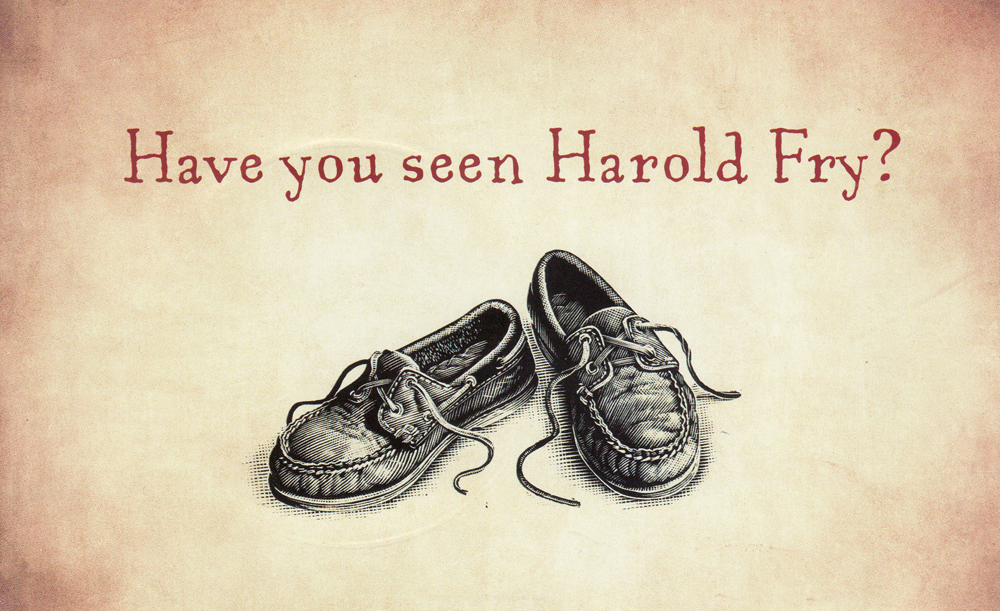
Have you seen Harold Fry?

February 11, 2012 3 Comments

The Unlikely Pilgrimage of Harold Fry
by Rachel Joyce

This is a very sweet novel about old age and regret and Englishness. It takes a simple but interesting idea and keeps it engaging throughout. The author’s inclusion of social media such as Facebook and Twitter in the storyline was of course a gift to the publisher’s marketing department (as you may have started to notice) but do not be put off – it’s worth a chance.

Have you seen Harold Fry?

Harold Fry has been retired for six months and spends his days with his wife Maureen keeping boredom at bay, when he receives a letter from an old friend, Queenie, telling him that she is dying of cancer. He goes out to post a reply and keeps on walking. He resolves to walk all the way from his home in Kingsbridge, South Devon, to Berwick Upon Tweed (so almost the whole length of England), having some idea that this is an act of faith that will save her life.

There are a few secrets at the heart of this story that are revealed slowly, with clues and partial memories dropped in between the story of Harold’s trek. Some I guessed and some I didn’t, but I don’t think it matters hugely either way; there is plenty enough story to keep you engaged even if you think you have figured the secrets out.

There are quite a few “issues” dealt with, including how it can be difficult to adapt to retirement, and how parents affect their child’s life, but the one that got to me the most was Harold and Maureen’s marriage. For 20 years they have lived at a polite distance, never really talking about what they want to say, to the point that when Harold starts his walk neither can understand the other. Maureen is bemused by the walk and the rules Harold has set himself (which change a few times anyway) and thinks that maybe Harold is doing it because he was once in love with Queenie. Harold thinks his wife will not miss him, that she will not be affected at all by his absence. During his walk, they both have time to think about the past, their marriage, what they once meant to each other and how things have changed. They both come to life, in their own ways, waking up from the monotony they had got stuck in.

The chapters alternate between Harold and Maureen, and they are both lovely characters, though both are also a little difficult and frosty at times. They are old-fashioned, in both good and bad ways. For instance, when a stranger confesses to Harold that he is cheating on his wife with a young man, Harold is appalled and repulsed but continues to listen politely.

There is a lot of detail about the landscape and route of Harold’s walk, sometimes lovingly admiring of England, sometimes less than complimentary, but this tends to reflect Harold’s mood mostly. He has realistic problems, mostly to do with his feet, and his perseverance in the face of pain is inspiring, though I couldn’t help but wonder at times if it was going to be worth it.

This book deals with some big issues in a quiet, understated way. It never gets gritty or deep into a subject, but it also doesn’t gloss over problems. A very sweet read.

This advance proof was sent to me by the publisher in exchange for a review.

Published March 2012 by Transworld Publishers.

Kate Gardner Reviews

Time-travelling horrors

October 16, 2011March 11, 2012 2 Comments

The House on the Strand
by Daphne du Maurier

I read this book as part of Discovering Daphne, an event/readalong run by Savidge Reads and Novel Insights. I seem to have skipped the book that they both raved about (Mary Anne) and chosen to join in with another that didn’t entirely bowl me over.

This is one of du Maurier’s stabs at science fiction (though Tim and I are still debating whether Rule Britannia counts as SF or even speculative fiction). In this instance she’s looking at time travel, but with a curious twist, and really it’s a book about a marriage in trouble and the effects of addiction. Intrigued? I was.

First off, I was thrown to have a male narrator. I don’t think du Maurier does a bad job of giving Dick Young a realistic male voice, but I never warmed to him. He’s middle aged, has just quit a publishing job he disliked in London and is trying to find an alternative to the future his American wife has planned, which is to work for her brother’s publishing firm in New York. To give him some breathing space, his good friend Magnus (or, “the Professor”) has loaned Dick his cottage in Cornwall for the summer rent-free. The only catch is that Magnus has persuaded Dick to try an experimental drug he has produced – a drug that takes the mind back six centuries in time while the body remains in the present.

It’s an unusual idea and du Maurier has thought through the practicalities. Each “trip” lasts a few hours so Dick can sneak them in when his wife and stepsons are not around, though he cannot hide the side-effects from them. It being a small community – and indeed an even smaller one in the 14th century – Dick quickly gets to know the characters that he sees on his trips and is increasingly fascinated by their lives – who is sleeping with who, who is loyal to who – in a way that he would never care about gossip in his own world. He is particularly intrigued by the beautiful Isolda, who he learns early on is married but does not care for her husband.

There are drawbacks to this method of escaping from reality. Dick is seen wandering aimlessly through field and marsh after his invisible cast. He starts to conflate past and present, confused about what has happened in reality. He gets bad tempered with his family and his wife’s friends, constantly distracted by where this or that particular manor house from the 14th century must have stood. He looks up the people from the past in local archives, obsessing about every detail of their lives. He starts to need more of the drug for it to work and suffer worse side-effects.

All of which is gripping and well written and a believable picture of dangerous drug addiction. The problem is, all of the stuff in the past I found deadly dull. The relations between people and their allegiances I found confusing; for the first half very little happens in the past; and I just didn’t care about any of the historical characters. Which is a problem when we are supposed to believe that they are fascinating enough for Dick to become obsessed. The thing is, this is another case where du Maurier has been doing her historical research and has used genuine historical figures of significance to her (in this case the people who lived in and near her beloved Fowey) to build a story around. But she has put in too much of the dull stuff you can learn from archives – names, dates, facts – and not enough character and storyline. It’s a shame when she has used her research so well in other books (e.g. The Glass-Blowers).

It’s fascinating and shows that du Maurier had many strings to her bow, but it’s not her best. Next up in Discovering Daphne? Don’t Look Now and other stories, to be discussed next Sunday.

First published in 1969 by Victor Gollancz.

Kate Gardner Reviews

Humour in the darkest places

April 21, 2011March 11, 2012 1 Comment

Our Spoons Came from Woolworths
by Barbara Comyns

This partially fictionalised autobiography has me torn. On the one hand it was entertaining, funny and moving; on the other the author’s lack of education resulted in writing that was at times stilted or phrased in ways that I felt could have been improved by better editing.

“Sophia” lives in London, eking a meagre living as an artist in a commercial studio. Aged just 21 she and her artist lover Charles decide to marry. He is from a middle class family who disapprove mildly of his bohemian lifestyle but disapprove far more vehemently of Sophia marrying him and becoming a drain on his scant resources. Given the choice between his allowance and his marriage Charles chooses Sophia, which sounds romantic and indeed at first it seems that way. Comyns wittily describes making do with the little they have, the joy of rare treats, the shared humour of learning to cook and keep house. But when she falls pregnant life goes from bad to worse and abject poverty destroys the marriage and threatens her life multiple times.

It seems amazing, given the content (poverty, abortion, serious illness, the threat of having a child taken away) that I could say this, but this is a fairly light read. Comyns is great fun, with an original turn of phrase and genuine warmth, always trying to see the world in a positive light (or almost always; she has her dark times). In some ways book this functions as a brilliantly strong argument for the changes that society has made since the 1930s setting – maternity leave, child support, access to and information about contraception, and free healthcare would have helped her a lot, obviously, but I also mean the general attitude of the book’s characters that Charles has the right to his lifestyle and she has failed him by becoming pregnant, that he has no obligation to the family he has created.

The section about Sophia’s first pregnancy is the part that has stayed with me most strongly. She is summarily dismissed from her job on announcing the news (which her co-workers had all guessed before her because she has shockingly little knowledge on this front). She relies on charity to get to see a doctor, because she and Charles cannot afford it themselves, which means that her labour takes place in a hideous charitable hospital where she is treated like a wicked schoolgirl and given no explanation of anything. For instance, a bath is run for her and she is left alone to take it, but she is too doubled up in pain from a contraction to get in. When the nurse returns and sees this, she shouts at Sophia for being a “horrid, dirty girl” rather than lending her a hand.

For all of the awfulness that she goes through, I could not call Sophia entirely blameless. I know that she is to an extent a result of a certain culture but she so rarely speaks her mind. She never once berates Charles for not getting a job or for spending money unnecessarily when the family is literally starving. And she does let pride stop her from getting a little help sometimes, despite the extreme poverty she endures. There were a few such moments that reminded me of Knut Hamsun’s Hunger, though in other respects the two books could not be much more different.

I am certainly intrigued by Comyns, who wrote further volumes of autobiography disguised to varying degrees, as well as some true fiction, but I do not think, on the basis of this book at least, that she was a great writer.

First published in Great Britain by Eyre & Spottiswoode 1950.

I picked this up after reading this intriguing review on Novel Insights.

Kate Gardner Reviews

Quietly getting on with being human

March 31, 2011March 11, 2012

Ladder of Years
by Anne Tyler

Until a few months ago I hadn’t really heard of Anne Tyler. While we were visiting Tim’s parents his mum recommended this book to me and since then I keep seeing her everywhere. This week she was nominated for the Man Booker International Prize for her lifetime body of work. This is an intriguing book, a study of human character, and I suspect that the way a reader reacts to it is very telling. In some ways it’s a very sad story, and it definitely got me thinking.

“Baltimore woman disappears during family vacation” begins the book, or more accurately the newspaper article that precedes chapter one. The description of the missing woman, 40-year-old Cordelia Grinstead, is so vague, so comical that I thought this was some kind of ironic take on the actual news story, a character’s bitter retelling – “Her eyes are blue or gray or perhaps green”, she “avoided swimming wherever possible and…may have been a cat in her most recent incarnation”. It’s a slightly bizarre introduction to a not-at-all comic novel about the Grinstead family, with all its quirks and pecularities.

I had assumed, from that beginning and the brief description I’d been given by Tim’s mum, that that would be where the story began – with the woman walking away from her family – and that the bulk of the novel would alternate between them looking for her and whatever she was doing, in a slightly detached, psychological study type of way.

Instead, the book begins weeks before the family holiday, with Cordelia, or Delia as she’s known to everyone, getting into a bizarre situation while at the supermarket – a younger man spots his estranged wife with another man and begs Delia, a complete stranger, to pose as his lover. It’s a brilliant opening – the comedy of the dichotomy between what Delia wants to buy for her family and what the young man throws into the basket, what he hisses at her not to buy because it will reveal that she has children or simply isn’t glamorous enough – and gives lots of room for Delia’s thoughts to reflect on her life, on how exciting this situation is compared with the humdrum of her usual existence, on what type of person she must be to go along with this, to drive away without half of the things she needs just to please a complete stranger.

Delia isn’t unhappy, but the more she reflects on that scene at the supermarket and other circumstances that come up in the run-up to the annual family holiday (Delia, her husband Sam, their three mostly grown-up children, both Delia’s sisters and her two nieces) she becomes, not exactly dissatisfied, but aware of herself and how other people see her and how little she appears to matter in anyone else’s life.

The book follows Delia all along, revealing every thought, every indecision, every awareness, every doubt. It is fascinating to watch as she walks away from her family aimlessly, catches a lift with no particular destination in mind, and creates a whole new life for herself. She dresses differently, interacts differently with people, reads a different type of book and, importantly, is delighted whenever anyone comments on her independence. From then on the question is: will she stay here? Will she take this new Delia back home to her family? Will she move on again when this new life becomes humdrum?

I wasn’t altogether satisfied by the ending, but then I don’t think I ever quite empathised with Delia. I understand the need for a change, to search herself for a while, but it seems such a cold, cruel way of going about it. And she does spend a lot of the book seeming a little empty, distracted, not quite there, so when she is moved by events toward the end of the book it is clear that she has finally figured out where she belongs, what and who she cares about. But again she goes about it in such a cold way.

Despite my difficulty with Delia, I really enjoyed this book. I may not empathise, but hers is still a fascinating head to get inside. It really did get me thinking about that common complaint of being unappreciated, trapped in a marriage that has lost all the spark and with the children about to leave home – what’s left? Everybody wants to feel needed, right?

First published in 1982.

Kate Gardner Reviews

Posts pagination

1 2 3 4

Archives

RSS Nose in a book

  • Book review: Interstellar Megachef by Lavanya Lakshminarayan
  • May 2026 reading round-up
  • Book review: Passing by Nella Larsen

Me on the internets

  • @kate_in_a_book@mas.to (Mastodon)
  • Flickr/noseinabook
  • Instagram/kate_in_a_book
  • StoryGraph/kate_in_a_book

Categories

  • Blog
  • Reviews
  • Uncategorized
Proudly powered by WordPress | Theme: Dream by vsFish.