Nose in a book

Reviews and other ramblings

  • Home
  • Reviews archive
    • Book reviews
    • TV reviews
    • Theatre reviews
  • TBR
  • Challenges
    • The Classics Club
    • 2014 Popular-Science Reading Challenge
    • Cookery challenge
    • The Gilmore Girls Reading Challenge
    • 2013 TBR Pile Challenge
    • 2013 Translation Challenge
    • Crime and Punishment read-a-long
  • About
    • Cookie legal stuff
  • Home
  • Reviews archive
    • Book reviews
    • TV reviews
    • Theatre reviews
  • TBR
  • Challenges
    • The Classics Club
    • 2014 Popular-Science Reading Challenge
    • Cookery challenge
    • The Gilmore Girls Reading Challenge
    • 2013 TBR Pile Challenge
    • 2013 Translation Challenge
    • Crime and Punishment read-a-long
  • About
    • Cookie legal stuff

Tag: feminism

Sunday Salon: International Women’s Day

March 8, 2015March 25, 2015 5 Comments

The Sunday SalonHappy International Women’s Day, folks! While I can only remember hearing about it for the past couple of years, this day was created in 1909 as a national day in the US and went international in 1911. There’s all sorts of fun facts about this day on the official website, but my favourite one is that International Women’s Day is now an official holiday in Afghanistan, Armenia, Azerbaijan, Belarus, Burkina Faso, Cambodia, China (for women only), Cuba, Georgia, Guinea-Bissau, Eritrea, Kazakhstan, Kyrgyzstan, Laos, Madagascar (for women only), Moldova, Mongolia, Montenegro, Nepal (for women only), Russia, Tajikistan, Turkmenistan, Uganda, Ukraine, Uzbekistan, Vietnam and Zambia.

I am mostly celebrating by listening to 6 Music, which seems to have dedicated its whole day of programming to International Women’s Day, but when I do find some time to read I’ll be continuing my way through Aurora Leigh by Elizabeth Barrett Browning. Her birthday was 6 March and to celebrate I wrote a piece for the Redhead Reads micro newsletter. Aurora Leigh is an appropriate read for today not only because it was written by a woman but also because it’s about a woman trying to break free of the social constraints placed on her by her sex. And it’s really good.

Continue reading “Sunday Salon: International Women’s Day”
Kate Gardner Blog

The broken branch was a symbol of my too-much

October 16, 2014 2 Comments

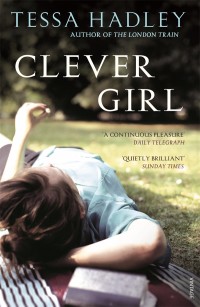
clever girl

Clever Girl
by Tessa Hadley

I bought this book for two reasons – it’s set in Bristol and it was a staff recommendation at the very lovely Mr B’s Reading Emporium in Bath. Why buy one of the hundreds of books on my wishlist when I can pick up something new and random?

Stella tells us her life story, from working-class single-parent 1950s origins, to gaining a stepfather and moving to a fancy new estate and fancy new school in the 1960s. Stella is smart and suddenly she has the opportunity to do something with her abilities. But a life that could have been predictable is made unpredictable by choices she makes when she is 17.

“He broke off a whole branch of wet, scented apple blossom and gave it to me. It was a criminal thing; bees were still dangling, desirous, around the flowers’ stamen and stigma and their bulges of ovary which would never now grow into apples. The broken branch was a symbol of my too-much; it seemed more lordly not to refuse such bounty if offered. What it was impossible to have without harm was also most to be desired.”

For a lot of the book, Stella is a window into the youth cultures of the time, from the late 1960s on through the 70s and 80s. She is attracted to the political and the alternative, but somehow the book is never about politics itself, only about political ideologies. Stella is never wholly happy or satisfied or confident in herself, which makes her a sympathetic, if occasionally frustrating, character. She certainly doesn’t let her lack of direction stop her from living a varied and interesting life.

“I tried to prolong this happiness, or find a code I could store it in, so that it meant something even when I wasn’t feeling it. I imagined it as resembling the filmy skin of a bubble enclosing its sphere of ordinary air; impermanent yet also, for as long as it existed, flexible and resilient – real, a revelation.”

In some ways, this book could have been set anywhere, or at least in any British city outside London, but on the other hand, Bristol does have a certain mix of people and neighbourhoods that allows Stella to see and meet all sorts without ever living anywhere else. For those familiar with Bristol, you can nod along when Hadley mentions a specific area, knowing what relevance it has, but Hadley gives enough information for non-Bristolians to get it too (e.g. Totterdown in the 1970s = working class; Totterdown in the 2000s = working and middle class, arty types and professionals – I can attest to this one!). I don’t know any other city as well as Bristol but I can firmly believe in this story happening here. I can believe in people getting lost in politics/drugs/ideals while all around them friends and family plod on with boring ordinary lives.

“The land’s fabric seemed dragged down and tearing under the sheer weight of the built environment, which never ended and could surely never be undone and wasn’t even thriving: the monster machine was stalling, it had poisoned itself and now it had fallen into enemy hands.”

Stella’s story is very readable and absorbing, with some gorgeous language, but somehow not quite what I hoped for. She’s smart and loves books, which is usually a winner for me, but the story doesn’t linger on her bookishness, lingering instead on the men in her life, who are admittedly key, but for a character who calls herself feminist I struggled with how much she is defined by her role or by her man and not by her self.

Published 2013 by Jonathan Cape.

Source: Mr B’s Reading Emporium, Bath.

Kate Gardner Reviews

I like it here precisely because it is dull

July 4, 2014

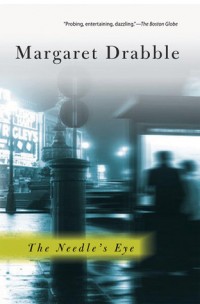
The Needle's Eye

The Needle’s Eye
by Margaret Drabble

I liked this book, but it was only while discussing it at book club that I realised how much. And why. It’s certainly the kind of book that benefits from taking time to think about it afterward.

Before this was suggested for book club I had never read any Margaret Drabble and had no particular plans to read her. I think I had an idea that her books would be old-fashioned and middle-of-the-road. Well this novel is certainly in many ways of its time, but that doesn’t stop it from being a great read with fascinating psychological complexity and insight.

The story – as far as there is one – begins at a London dinner party where unhappily married Simon Camish meets Rose Vassiliou, notorious for a scandal Simon can’t quite remember. They strike up an uneasy friendship, based on her asking Simon for gradually increasing favours, many of them related to the fact her ex-husband is sueing her for custody of their three children.

“He looked dreadful tonight, did Simon…She wondered whether he knew how miserable he looked – how offensively bored…it was pointless, worrying about someone like him, he would never tell anyone anything; in a way she rather resented the obduracy of his silence. Why didn’t he forget about it one day and just complain? Everyone else did.”

For a novel where not much happens, custody battle notwithstanding, there are lots of interesting ideas about feminism, class, charity, parenting; but most of all this novel has wonderfully complex characters. Simon and Rose in particular are sometimes lovable, sometimes dull, often frustrating and frequently contradictory – very realistically. However, this isn’t entirely a realistic novel. There’s a lot of symbolism and patterns of structure, not least references to the needle’s eye of the title.

“Impossible, really, to make one’s mind up about any other human person, even one’s own children, whose whole life had unrolled before one’s eyes, whose every influence was known: they were so contradictory, so inconstant, so confusing a mass of shifting characteristics.”

For instance, Simon and Rose’s lives have followed opposite trajectories. Born to a struggling working class family, Simon is the scholarship kid made good – he’s now a lawyer married to a rich woman, Julie – and he wears his background with both pride and shame. He wants to fit in and yet he despises the people he socialises with. Until Rose. She was born to a rich country estate and hit the headlines when she gave up her inheritance to marry a man her parents disapproved of, her ex-husband Christopher. She has a strong distaste for unearned money and so she chooses to live in a shabby working class neighbourhood, counting pennies to make ends meet and taking great pleasure in getting to know her genuinely poor neighbours. Yet it’s all a game of sorts, because she could easily earn more money, or get it from Christopher or her parents, and she has a second lump of inheritance due to her. Her poverty isn’t real and her reasons for choosing that life are stretched quite far from their honourable origin.

“I like it here precisely because it is dull…Oh, I know, people think it’s not real, they think it’s nonsense for me to sit here like I do, they think I’m playing. They tell me that everyone else round here is miserable…But they don’t know because they’ve never tried it.”

Simon shares this slightly misguided belief in sticking to a principle. His legal speciality is trade unions and he steadfastly stands by the union every time, even when he can clearly see that the union is in the wrong. Like Rose, he cannot separate the theoretical black-and-white ideal from the shades of grey of real life. Similarly, he cannot see the world through anyone else’s eyes, and finds it hard to marry his assumption that everyone is as bored and depressed as he is with the evidence before him. Rose seems to be the first person who manages to at least begin to break through to him just how different people can be.

“He sat there…and wondered whose fault it was, that he should spend so much time like this, with people he really deeply disliked, talking about things that bored him rigid. It would have been better if he could have felt that the others were enjoying themselves, but from every soul there seemed to him to rise a cry of mute anguish and lonely fear.”

Inevitably Simon begins to fall in love with Rose, but this isn’t the story of a torrid affair. If anything, it is the story of a friendship that awakens two people to some, though certainly not all, of their faults.

First published 1972 by Weidenfeld and Nicolson.

Source: Borrowed from the library.

See also: “10 reasons to love Margaret Drabble” on For Books’ Sake

Kate Gardner Reviews

The women writing pop science

July 2, 2014

Just a quick note to say that today you can read my thoughts about women writing popular science over at For Books’ Sake. Inspired by my 2014 Popular-Science Reading Challenge and the feminist focus of For Books’ Sake, I picked out my top five pop-sci books by women. Please do go take a look and leave a comment with your own favourites, or your thoughts on the ones I picked.

Kate Gardner Blog

Bristol Old Vic Ferment Fortnight

January 26, 2014 2 Comments
Bristol Old Vic
(CC-BY NotFromUtrecht)

Bristol Ferment is the community of theatre-makers from Bristol and the South West that Bristol Old Vic supports and helps to develop exciting and adventurous new work. Twice a year, we can get a glimpse behind the scenes of the artistic process during Ferment Fortnight, when work in progress is performed and discussed directly with the audience.

The current Ferment Fortnight runs until 31 January, so there’s still time to check it out for yourself.

The Stillness of the Storm That Never Came at All
by Clerke and Joy
Bristol Old Vic, Friday 24 January 2014

I arrived in the Studio Theatre to the powerful smell of garam masala, coming from a large pool of it spread on the theatre floor. Josephine Joy created sound effects using a laptop, a microphone and an array of electrical goods, while Rachael Clerke delivered a monologue about an Indian girl who has just moved to Mumbai after studying abroad in London. The sounds were a combination of traffic, voices, weather and domestic appliances, occasionally ratcheted up so that they threatened to drown out the monologue. Combined with the spice smell this gave a powerful sense of place to the story, especially considering there were no visual cues to place it anywhere particular. The story is currently only a snippet but it was absorbing and well written, and I definitely felt that a whole character had been created in this brief snatch of a play.

After the performance we had a Q&A in which Clerke and Joy explained the roots of the show and where they hope to take it (as well as encouraging lots of feedback, which is after all the whole point of Ferment Fortnight). Their plan is to write three monologues for three actors, each set in a different city. They will have a musician or DJ on stage and do a lot of their scene-setting with soundscapes. They have themes they want to explore but no firm story as yet. (To be fair, I should mention that they have only been writing this for a few days, having not long been back in the UK after spending three weeks in Mumbai running theatre workshops and developing the concept for this show.) Their themes include weather, feminism, decline in industry, reclaimed land, migration and oral storytelling – which is quite an eclectic bag, yet I can see it working. All of those are already present to some extent and the choice of the other two cities (one of which is likely to be Belfast, but the third is completely unknown right now) will no doubt both be informed by and have an effect on that list of themes.

The monologue text came from the workshops and some other conversations that Clerke and Joy held in Mumbai. I thought they demonstrated a gift for picking out the thoughts and observations that got to the heart of what this one lonely girl’s experience of Mumbai would be like. This play has the potential to turn into a really fascinating glimpse of some very different locations and lives.

I loved this opportunity to see something so raw and new, something unformed but brimming with potential. I’ll definitely be checking out future Ferment performances.

Disclaimer: A free ticket was kindly supplied to me by the theatre in return for contributing a review to Theatre Bristol Writers.

Kate Gardner Reviews

I had to crack every word one by one

January 19, 2014 2 Comments

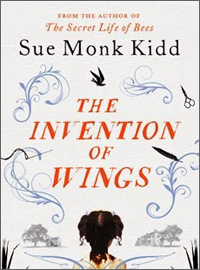
The Invention of Wings

The Invention of Wings
by Sue Monk Kidd

It is a while since I have been so thoroughly engrossed by a book, to the point where no matter where I was, day or night, I wanted nothing more than to be reading this book. Which of course means that it was over far too soon. So this definitely comes under the category of A Good Read.

It’s the fictionalised story of real-life anti-slavery campaigner Sarah Grimké, who was raised in Charleston, South Carolina, in a slave-owning family. But it’s also the story of the (almost entirely fictional) slave girl Hetty who was given to Sarah as a birthday present when she turned 11. The two girls take turns at telling the story, painting two lives closely linked and yet starkly different.

“The skies were bright cerulean, teeming with ferocious winds, spilling mallards and wood drakes from the clouds. Up and down the lanes, the fences were bright with yellow jasmine, its musk a sweet, choking smoke. I rode with the same drunk sensuality with which I had reclined in the copper tub, riding till the light smeared, returning with the falling dark.”

Sarah is the middle daughter (there are also several brothers – her mother is…prolific) and while considered a little plain and too intelligent for her own good, it is her wilfulness and ambition that get her in trouble. As a child she dreams of becoming the first female lawyer and devours the books that her father (a powerful legislator) secretly allows her until he realises that she is taking her dream seriously. When he shoots down that dream, it takes her many years to find another way to do something about the issue nearest to her heart – abolition of slavery.

Hetty, or Handful as she is known among the slaves, might have been happy with her lot – the cruelties of Mrs Grimké, or Missus, notwithstanding – were it not for her mother Charlotte who harbours such hatred of her lot that she devises small revenges against her owners and plots their eventual escape. Handful is practical and in many ways protected by Sarah, but between Charlotte’s unhappiness and Sarah’s abolitionist leanings, she catches the bug – the yearning for freedom.

“The man’s writing looked like scribble. I had to crack every word one by one and pick out the sound the way we cracked blue crabs in the fall and picked out the meat till our fingers bled. The words came lumps at a time.”

The other major character is Nina, Sarah’s youngest sister, who is in many ways a daughter to her. They are so close that it is never clear whether Nina’s small revolutions – from refusing baptism to writing anti-slavery pamphlets – are entirely her own, or the influence of Sarah. She’s an interesting character because she is more beautiful, more determined, more confident than Sarah, and yet it is Sarah’s lead that she follows.

I think it’s important that Kidd chose Sarah to narrate the story, not Nina, because Sarah is undoubtedly more troubled. She suffers from a stammer and, after the dream to become a lawyer is snatched away, never again feels that confidence in her abilities. She fervently feels that slavery is wrong (in fact, the day that she is given Handful she tries to grant her freedom, but of course that isn’t allowed) and more than that, she feels that women and coloured people are equal to white men in the eyes of God, but for much of her life she feels helpless to do anything about those beliefs.

“They say in extreme moments time will slow, returning to its unmoving core, and standing there, it seemed as if everything stopped. Within the stillness, I felt the old, irrepressible ache to know what my point in the world might be. I felt the longing more solemnly than anything I’d ever felt.”

What I thought was wonderful about this book was that it isn’t an anti-slavery treatise (after all, I think we all know these days that slavery is bad, we don’t need persuading), it’s a warm engaging story full of characters painted in all sorts of shades of grey. And there’s action and adventure too, from the terrible punishments meted out to slaves to a planned slave revolution. But there’s also romance, broken hearts, social faux pas and outright castigation. There are complicated relationships between people and there are terrible decisions that have to be made.

I also appreciated that the publishers have included quite a long author’s note at the end detailing Kidd’s historical research, including where she did and didn’t deviate from history in her fiction.

Clearly, I outright loved this book. I now plan to look out all Kidd’s previous works and hope that it all lives up to this high standard.

Published January 2014 by Tinder Press, an imprint of Headline.

Source: This book was kindly sent to me by the publisher in return for an honest review.

Kate Gardner Reviews

Life had once been normal but it was so hard to recall

December 13, 2013

I thoroughly enjoyed the Split Worlds trilogy by Emma Newman and heartily recommend it to absolutely everyone, but I feel there’s a limited amount I can say about books 2 and 3 without spoiling the plot of the first in the series, so here are my very brief reviews.

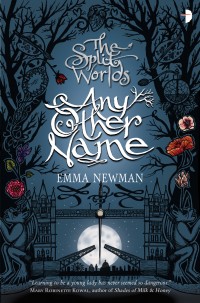
Any Other Name

Any Other Name
The Split Worlds book 2
by Emma Newman

The series continues with another excellent adventure featuring Cathy, the reluctant member of fae-touched society, and Max, the investigator whose soul is trapped in a gargoyle. I worried this would be the toughest of the trilogy – to set up the final part the characters most likely have to both start and end in a bad place. But of course I needn’t have worried. There were just enough new twists and reveals while continuing and building on the set-up of book 1 (Between Two Thorns). I still love both the lead characters and I really appreciate the wonderful plot contrivance that allows Cathy (and others) to be aware of the essentially historical setting they live in and the inequalities of their society. It’s tough to say much about the plot without giving away what happened in book 1, so suffice to say that both Max and Cathy find themselves embroiled in much bigger problems than they thought they were getting into. So much fun, and thoroughly absorbing.

“I would like it if once, just once, a man would not decide what’s best for me without seeing how I feel about it first.”

Published 2013 by Angry Robot.

Source: Forbidden Planet Bristol.

All is Fair
The Split Worlds book 3
by Emma Newman

Ooh, it’s all kicking off now! That was pretty much my feeling throughout this final(?) instalment. It had become clear in book 2 that the problems in the Split Worlds ran deep and involved all sorts of deep corruptions that it seemed impossible would be fully cleared up by the end of this book. In fact I worried a few times that too much was happening at once and it would be too neat to resolve it all so quickly. I hope it’s not giving too much away to say that, while some threads were wrapped up, others are left loose so there is certainly potential for the story of the Split Worlds to continue, though whether future books would centre on Cathy and Max I am not sure of. I’ll admit there were moments where the story went in a direction I didn’t want it to, but I always ended up persuaded that that was the right decision. Because no-one’s perfect, and no solution is neat and tidy for everyone. I loved the new character Rupert, the Sorcerer of Mercia; he was brilliantly eccentric in a completely different way from Ekstrand, the Sorcerer of Wessex (who you may remember is completely useless on certain days of the week). Also, big thumbs up for the appearance of the excellent Bath bookshop Mr B’s Emporium of Reading Delights (which I realise now may have had some influence on the naming of the magic shop that plays a major role in the trilogy, The Emporium of Things in Between and Besides). I really did love this book and hope that Newman does have some more Split Worlds tales up her sleeves!

“He knew, intellectually, that his life had once been normal but it was so hard to recall. The bereavement was like the camphor in his grandmother’s clothes; it perfused everything and the smell just lingered on and on after the mothballs were gone.”

Published 2013 by Angry Robot Books.

Source: Forbidden Planet Bristol.

Kate Gardner Reviews

Kate Adie on women in World War I

December 11, 2013
Kate Adie
(CC-BY Joanna Penn)

A Topping & Co author event
Christ Church, Bath, 10 December

As I mentioned a while back, one of my heroes in life is Kate Adie, so when Topping Bookshop sent me its list of upcoming events I got very excited about this one. Adie is a proper serious broadcast journalist. She was a rare female face on TV news outside of the studio back in my childhood and when I aspired to be a journalist she was a natural role model. But my failure to become a journalist hasn’t stopped me from admiring her, so I willingly braved the cold, dark and steep hills of Bath last night to see her in the flesh.

Unlike the other author events I’ve been to this year, Adie wasn’t interviewed for the crowd, she simply stood at the front of the big old church and spoke to us. She was lively, engaging and full of enthusiasm for her subject. Essentially her talk was background to and highlights from her new book Fighting on the Home Front: the Legacy of Women in World War One.

Adie held forth knowledgeably about the legal status of women 100 years ago and how World War I changed everything. She consummately related the points she was making to Bath and Bristol, as well as dropping in some related anecdotes from her own life. But most of all she exuded passion for her subject and admiration for the women who stepped up, not only those who filled the gaps left behind by men who had gone to war, but also the women who went to war themselves and those women who had to fight hard for the right to fill those gaps, even as Britain was creaking desperately with need of them.

Adie also spoke a little about her own career, about how her school teacher was so eager to get at least one pupil into university that Adie found herself “shunted into university via the catflap”, and how a reporter has to have an ordinary life to go back to between assignments: “You have to live an ordinary life in order to understand disorder.” She also had a lot to say about the strength and resilience of human beings.

I enjoyed Adie’s autobiography The Kindness of Strangers back when it came out and greatly look forward to reading my autographed copy of her new book.

Kate Gardner Blog

The dark afterlight of accomplished tragedy

October 20, 2013 2 Comments

the-infernal-desire-machines-of-doctor-hoffman

The Infernal Desire Machines of Doctor Hoffman
by Angela Carter

I have wanted to read more Angela Carter since I fell completely in love with Nights at the Circus a couple of years ago. So I enthusiastically added my vote when this was suggested for book club. It didn’t win me over quite in the same way but I still think it’s an amazing piece of writing.

This book can be pretty disorienting. It begins with a set-up so completely strange that it takes a while to understand what is happening. And throughout the book there are themes and incidents that are so shocking they disorient you all over again.

“I think I must have been one of the first people in the city to notice how the shadows began to fall subtly awry and a curious sense of strangeness invaded everything…Sugar tasted a little salty, sometimes. A door one had always seen to be blue modulated by scarcely perceptible stages until, suddenly, it was a green door.”

The story is narrated by Desiderio, a civil servant in the great unnamed capital city, and he describes the ongoing war with Doctor Hoffman, a physicist/magician who has declared a reality attack on the city. Apparitions and mirages fill the city, often with terrible consequences. Desiderio’s minister tries to stand up to this attack by becoming the Minister of Determination, his department responsible for figuring out what is real and what isn’t. But the real story begins when Desiderio leaves the city on a quest to find someone the minister believes will lead them to Doctor Hoffman.

So begins a journey with more than a touch of Gulliver’s Travels about it (in fact, Gulliver’s Travels is referenced multiple times) – in each chapter a new distinct territory is travelled to, with distinct people, always ending in near-misadventure for Desiderio, and of course for the reader there’s some serious political points being made.

“I must admit that all my guests enchanted me and I, in turn, enchanted them for, here, I had the unique allure of the norm. I was exotic precisely to the extent of my mundanity…They wondered at the masterpiece of sterility I remembered for them.”

The recurring theme, as the title suggests, is sex/desire. But sex in this book is never sexy, it is extreme, varied and frequently shocking in how matter-of-factly it is described, covering all manner of proclivites including paedophilia, rape, bestiality, violent sex, pornography and voyeurism. The sex, like the rest of the story, gets more fantastical as the book goes on, so although shocking things still happen, it gets less shocking because it’s less “real”.

“I see them all haloed in the dark afterlight of accomplished tragedy, moving with the inexorability of the doomed towards a violent death.”

Tied up with but some extent separate from the sex/desire theme is that of gender. This is definitely a feminist book but it makes its point in an odd way. Gender differences are made much of in every group of people/beasts encountered and women are always subjugated in some way. The satire is so stylised that some sections could be construed as hideously racist or sexist if you didn’t see the point being made (for instance, the “river people”, natives of this unnamed South American country, are eager to marry off their nine-year-old daughter and also suffer from the effects of in-breeding).

The 19th century travelogue style means that there is a certain distance maintained from all the characters, even the narrator, so that there is little psychological insight into the characters, but conversely there is plenty of psychological insight into human nature in general, albeit mostly about the nature of desire.

“None of these gobbets and scraps issuing from a mind blunted by age and misfortune made much sense to me. Sometimes a whole hour of discourse plashed down on me like rain and I would jot down from it only a single phrase that struck me. Perhaps: ‘Things cannot be exhausted’; or ‘In the imagination, nothing is past, nothing can be forgotten’.”

I know some at book group didn’t take to the florid language (which I’ll admit I love) but also pointed out what I hadn’t really noticed – the text is crammed full of references and could be analysed endlessly. It’s a cracking good adventure, but not a fast read thanks to all that detail in the language. It also describes itself as a love story, but I must admit I struggled to see the love buried under all the lust. Perhaps that was, after all, the point.

“We pursued one another across the barriers of time and space; we dared every vicissitude of fortune for a single kiss before we were torn apart again and we saw the events of the war in which we were enlisted on opposite sides only by the light of one another’s faces.”

There is so much more that could be discussed – the treatment of different languages and cultures; foreshadowing and even outright stating how things will turn out (on reflection the opening chapter tells the whole story, but it all seems so strange at that point that I had completely forgotten by the end of the book). I am definitely enthused to read more Carter but I’ll admit the disturbing nature of much of this one means I didn’t love it.

First published 1972 by Rupert Hart-Davis.

Source: I bought this from Foyles Bristol.

Kate Gardner Reviews

He doesn’t have the sense of a billy goat

December 14, 2012December 14, 2012

Fried Green Tomatoes at the Whistle Stop Cafe
by Fannie Flagg

This was a book club pick and I thought somehow that it would be light and fluffy and girly, possibly because that’s how I remember the film (though on rewatching the film this week I discovered it’s not really those things either). It’s certainly an easy, enjoyable read, but it covers a lot of issues without labouring the point and has some very interesting things to say.

In the 1980s middle-aged Alabama housewife Evelyn Couch is visiting a nursing home and gets talking to a resident there, Mrs Ninny Threadgoode. Ninny is old and a little forgetful but also charming and immediately launches into stories about her early life in a small town called Whistle Stop. At the heart of these stories are Idgie and Ruth, the two women who ran the Whistle Stop Cafe from 1929 until it closed. However, inbetween there are snippets about other characters from the town and their lives, all told with a wonderful sense of humour.

“This skinny little man, so black he was a deep royal blue, had caused a lot of trouble for the opposite sex. One gal drank a can of floor wax and topped it off with a cup of Clorox, trying to separate herself from the same world he was in. When she survived, claiming that the liquids had ruined her complexion for life, he became continually uneasy after dark, because she had snuck up behind him more than once and cracked him in the head with a purseful of rocks.”

And at that level it all sounds a bit twee. But this book covers racist violence, domestic abuse, homosexuality, prostitution, extreme poverty and death, which is some pretty dark stuff for a story that’s so nice and chirpy on the surface. I know some at book group felt that this meant none of the themes were really explored, but were just thrown in there, and certainly the only subjects really talked about are female empowerment and death.

But then one of the running themes in this book is not talking about important things. Idgie and Ruth are a couple, which you would think was a big no-no in a small southern US town in the 1930s, but the whole town seems to know and just accept the situation. I wondered if this was because they all consider Idgie an honorary man. She certainly not only joins in with but often takes lead in hunting, fishing, gambling, drinking and the other manly pursuits of the town. But she’s far from being the only strong woman in town.

“Cleo, Idgie’s brother, was concerned…
‘Idgie, I’m telling you, you don’t need to feed every [hobo] that shows up at your door. You’ve got a business to run here. Julian…says he thinks you’d let Ruth and the baby go without to feed those bums.’
…’What does Julian know? He’d starve to death himself if Opal didn’t have the beauty shop. What are you listening to him for? He doesn’t have the sense of a billy goat.’
Cleo couldn’t disagree with her on that point.”

Each chapter takes a different source or viewpoint, so there’s Evelyn’s daily life, Ninny’s reminiscences, the Whistle Stop newsletter and other newspaper articles, and occasionally a plain old omniscient narrator. There’s also lots of jumping back and forth in time, which was confusing at first because there seemed to be sections that were unrelated, but by the end it all ties together. And also, in the end there is no single character who knows everything that the reader does, which I quite liked.

Generally, I found what could have been a heavy-handed moral tale a much more subtle look at life in the southern US. The one unsubtle message was about strong women. Really, it’s Evelyn’s story, and she is discovering through Ninny’s stories how unhappy she is with her life, downtrodden and ignored by her husband.

“After the boy at the supermarket had called her those names, Evelyn Couch had felt violated. Raped by words. Stripped of everything. She had…always been terrified of displeasing men…She had spent her life tiptoeing around them like someone lifting her skirt stepping through a cow pasture.”

As someone at book club pointed out, at the novel’s heart is the power of storytelling. Ninny’s stories have to be good for us to believe they would have such a profound effect on Evelyn. And it is all a rollicking good yarn, with a running theme of tall tales.

I seem to be saying this of every other book at the moment, but I think I would get a lot out of re-reading this.

First published 1987 by Random House.

Kate Gardner Reviews

Posts pagination

1 2 3 4

Archives

RSS Nose in a book

  • Book review: Interstellar Megachef by Lavanya Lakshminarayan
  • May 2026 reading round-up
  • Book review: Passing by Nella Larsen

Me on the internets

  • @kate_in_a_book@mas.to (Mastodon)
  • Flickr/noseinabook
  • Instagram/kate_in_a_book
  • StoryGraph/kate_in_a_book

Categories

  • Blog
  • Reviews
  • Uncategorized
Proudly powered by WordPress | Theme: Dream by vsFish.