Nose in a book

Reviews and other ramblings

  • Home
  • Reviews archive
    • Book reviews
    • TV reviews
    • Theatre reviews
  • TBR
  • Challenges
    • The Classics Club
    • 2014 Popular-Science Reading Challenge
    • Cookery challenge
    • The Gilmore Girls Reading Challenge
    • 2013 TBR Pile Challenge
    • 2013 Translation Challenge
    • Crime and Punishment read-a-long
  • About
    • Cookie legal stuff
  • Home
  • Reviews archive
    • Book reviews
    • TV reviews
    • Theatre reviews
  • TBR
  • Challenges
    • The Classics Club
    • 2014 Popular-Science Reading Challenge
    • Cookery challenge
    • The Gilmore Girls Reading Challenge
    • 2013 TBR Pile Challenge
    • 2013 Translation Challenge
    • Crime and Punishment read-a-long
  • About
    • Cookie legal stuff

Tag: England

The snarling cries of a wind eating its way
January 4, 2014January 4, 2014 3 Comments

cold comfort farm book cover

Cold Comfort Farm
by Stella Gibbons

I read this novel as the Guardian Reading Group picked it as the book for December and it had already sat for too long on the TBR. It’s one of those books so beloved, and described so often in hyperbolic terms, that I worried I would be disappointed. It turns out, I was not.

I suppose my biggest fear was that I wouldn’t find it funny, that the comedy would have dated. And there are aspects of the book that show their age (some racism/antisemitism and homophobia) but the comedy is still very funny.

The story is that of Flora Poste, who is well brought up, highly educated and suddenly orphaned, therefore in need of somewhere to live. Eschewing all the easy options available from her various friends in London, she writes to all her distant relatives and accepts the offer that sounds the strangest and least appealing – Cold Comfort Farm near Howling in Sussex, with the wonderfully named Aunt Ada Doom and her large family.

Flora is a busybody and immediately decides that these strange parochial relatives, with their gloomy demeanour and dislike of cleaning, need straightening up, so she sets herself the challenge of sorting them all out. And it’s a big challenge. From the lustful young man Seth, who gets the serving girl pregnant every spring, to doddering old farmhand Adam, who fails to notice when hoofs and horns fall off his beloved cows, to raving old Ada Doom herself, who never leaves her room yet wields a strange power over the farm, which may or may not be related to that fateful night when she saw something nasty in the woodshed.

“Aunt Ada Doom sat in her room upstairs…alone. There was something almost symbolic in her solitude. She was the core, the matrix; the focusing-point of the house—and she was, like all cores, utterly alone. You never heard of two cores to a thing, did you? Well, then”

Oh, and I should also mention that this is set in a near future (or what was near future at the time it was written), so it has a touch of SF mixed in there. It’s quite subtle but there are small details, especially toward the end – video phones, airmail literally dropped at the front door, personal planes to the nearest field – which add an extra level of strangeness. I’m not quite sure what the purpose of the future setting was – perhaps to make the strong female lead and satire excusable in some way?

“‘She – she’s mad.’
The word lay between them in the indifferent air. Time, which had been behaving normally lately, suddenly began to spin upon a bright point in endless space.”

If there’s one thing this book has in spades, it’s satire. Right from the author’s foreword when Gibbons tells her friend Tony that she has “marked what I consider the finer passages with one, two or three stars”, which “ought to help the reviewers” and indeed there are passages so marked throughout the book, all particularly overblown examples of satirising the prose of “country” novels such as those by George Eliot.

“**Dawn crept over the Downs like a sinister white animal, followed by the snarling cries of a wind eating its way between the black boughs of the thorns. The wind was the furious voice that was baring the dormers and mullions and scullions of Cold Comfort Farm.”

One of the questions raised on the Guardian Reading Group was whether or not we are supposed to admire Flora. She is an interfering city girl who decides that these country folk aren’t up to scratch and sets out to change them into a more acceptable “normality”. Or is that also part of the satire? She is after all in love with her cousin back in London, who happens to be a vicar, so her own story is pretty much a satire of a Jane Austen plot.

“The brittle air, on which the fans of the trees were etched like ageing skeletons, seemed thronged by the bright, invisible ghosts of a million dead summers. The cold beat in glassy waves against the eyelids of anybody who happened to be out in it.”

I like that the satire is of literary styles, rather than any people or ways of life (or at least that’s how I read it). And I must say I found Flora adorable, which is surprising because it’s in a way irritating that she is so capable and right about everything, but then that also makes her a brilliant strong female character. And she wasn’t the only surprise for me. Most of the characters begin as almost surreal fairytale types but become human as you get to know them (or should that be as Flora works her magic?).

I really enjoyed this book and can definitely see myself returning to it. The question now is do I seek out the sequels that Gibbons wrote, which are by most accounts good but not as good, or leave it at this, the pinnacle of her ability?

First published 1938 by Penguin Books.

Source: I bought it secondhand, probably from a charity shop.
Kate Gardner Reviews

That strangers may not loose their road and have it to goe back againe

August 2, 2012September 10, 2012 2 Comments

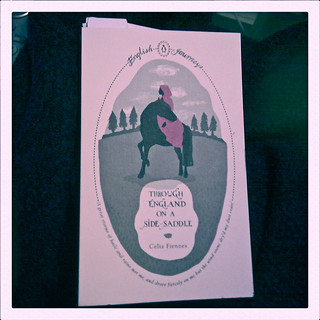
Through England on a Side-Saddle
by Celia Fiennes

I picked this up in a rare glow of national pride, what with certain sporting stuff going on. It’s an odd little book. Published as part of Penguin’s “English Journeys” series, it’s an extract from the 1698 travelogue of a rich Englishwoman travelling on horseback up to Newcastle and down to Cornwall. Intrepid, I think the word is.

Through England on a Side-Saddle

The language takes a little getting used to. Not that the words are unfamiliar, but Penguin has left the original spelling and grammar in place, with only the occasional translation in square brackets. It’s jarring but once in the flow I found myself surprisingly able to cope with the same word being spelled three different ways within a paragraph!

This travelogue was written up later from a detailed journal that Fiennes kept on the road, and it suffers a little bit from listing the same few facts about each place: number of churches (I love that this was a reasonably reliable indicator of population!), distance in miles, quality of roads, major trade. But even these facts were sometimes fascinating: in 1698 Liverpool was so small it had only one church! Compare that with Newcastle-upon-Tyne (5 churches) and Bristol (19 churches and a cathedral) – even Wells, now England’s smallest city, had 2 churches and a cathedral! Also, roadsigns were a brand new idea:

“they have one good thing in most parts off this principality [Lancashire] that at all cross wayes there are Posts with Hands pointing to each road with the names of the great town or market towns that it leads to, which does make up for the length of the miles that strangers may not loose their road and have it to goe back againe”

(I so badly want to take a red pen to that now!)

More importantly, Fiennes has occasional flashes of wit and humour that make the drier sections worthwhile. Take, for instance, her comments on St Winfreds Well:

“its a cold water and cleare and runs off very quick so that it would be a pleasant refreshment in the sumer to washe ones self in it, but its shallow not up to the waste so its not easye to dive and washe in; but I thinke I could not have been persuaded to have gone in unless might have had curtains to have drawn about some part of it to have shelter’d from the streete, for the wett garments are no covering to the body; but there I saw abundance of the devout papists on their knees all around the Well; poor people are deluded into an ignorant blind zeale and to be pity’d by us that have the advantage of knowing better”

Fiennes is travelling alone, with local guides (and, I suspect, luggage carriers) in each region. She at no point refers to being a woman travelling without husband or other family, which perhaps is a product of her being rich and well-connected enough that she knows people all over the country (and often describes their houses and gardens lengthily, another bit I found tedious). She makes a point of learning about local trades and industries, going into surprising detail about methods of coal mining, for example. She does, however, show a certain snobbery and prejudice, particularly towards the Scots when she briefly crosses the border:

“those houses are all kinds of Castles and they live great, tho’ in so nasty a way…one has little stomach to eate or use any thing as I have been told by some that has travell’d there; and I am sure I mett with a sample of it enough to discourage my progress farther in Scotland; I attribute it wholly to their sloth for I see they sitt and do little”

Overall I would say this is a fascinating historical document more than a good piece of writing but I am still interested in seeing what else is included in the “English Journeys” series.

The Journals of Celia Fiennes first published 1947 by the Cresset Press.
This selection published 2009 by Penguin Books.

Kate Gardner Reviews

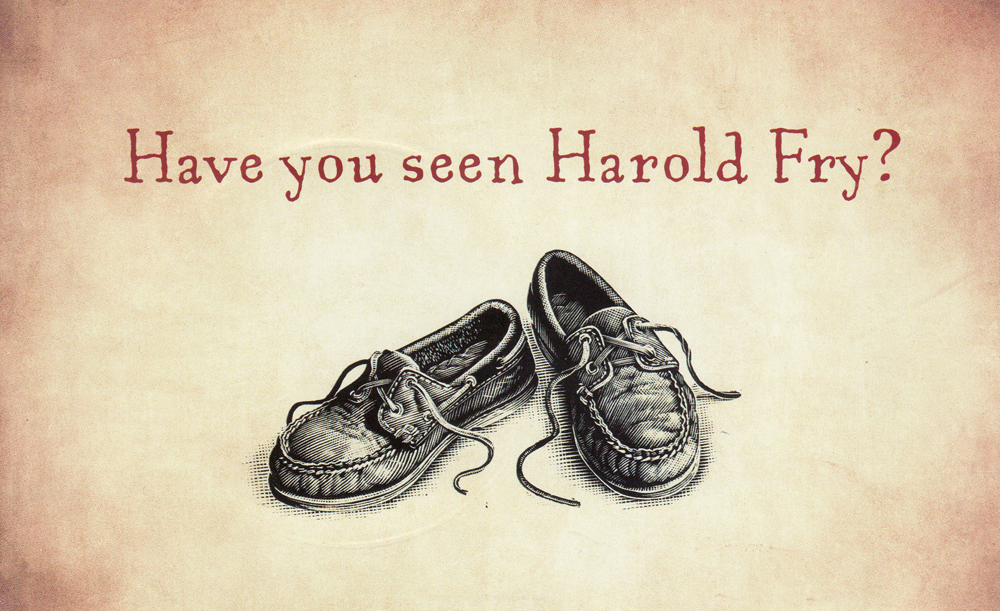
Have you seen Harold Fry?

February 11, 2012 3 Comments

The Unlikely Pilgrimage of Harold Fry
by Rachel Joyce

This is a very sweet novel about old age and regret and Englishness. It takes a simple but interesting idea and keeps it engaging throughout. The author’s inclusion of social media such as Facebook and Twitter in the storyline was of course a gift to the publisher’s marketing department (as you may have started to notice) but do not be put off – it’s worth a chance.

Have you seen Harold Fry?

Harold Fry has been retired for six months and spends his days with his wife Maureen keeping boredom at bay, when he receives a letter from an old friend, Queenie, telling him that she is dying of cancer. He goes out to post a reply and keeps on walking. He resolves to walk all the way from his home in Kingsbridge, South Devon, to Berwick Upon Tweed (so almost the whole length of England), having some idea that this is an act of faith that will save her life.

There are a few secrets at the heart of this story that are revealed slowly, with clues and partial memories dropped in between the story of Harold’s trek. Some I guessed and some I didn’t, but I don’t think it matters hugely either way; there is plenty enough story to keep you engaged even if you think you have figured the secrets out.

There are quite a few “issues” dealt with, including how it can be difficult to adapt to retirement, and how parents affect their child’s life, but the one that got to me the most was Harold and Maureen’s marriage. For 20 years they have lived at a polite distance, never really talking about what they want to say, to the point that when Harold starts his walk neither can understand the other. Maureen is bemused by the walk and the rules Harold has set himself (which change a few times anyway) and thinks that maybe Harold is doing it because he was once in love with Queenie. Harold thinks his wife will not miss him, that she will not be affected at all by his absence. During his walk, they both have time to think about the past, their marriage, what they once meant to each other and how things have changed. They both come to life, in their own ways, waking up from the monotony they had got stuck in.

The chapters alternate between Harold and Maureen, and they are both lovely characters, though both are also a little difficult and frosty at times. They are old-fashioned, in both good and bad ways. For instance, when a stranger confesses to Harold that he is cheating on his wife with a young man, Harold is appalled and repulsed but continues to listen politely.

There is a lot of detail about the landscape and route of Harold’s walk, sometimes lovingly admiring of England, sometimes less than complimentary, but this tends to reflect Harold’s mood mostly. He has realistic problems, mostly to do with his feet, and his perseverance in the face of pain is inspiring, though I couldn’t help but wonder at times if it was going to be worth it.

This book deals with some big issues in a quiet, understated way. It never gets gritty or deep into a subject, but it also doesn’t gloss over problems. A very sweet read.

This advance proof was sent to me by the publisher in exchange for a review.

Published March 2012 by Transworld Publishers.

Kate Gardner Reviews

Archives

RSS Nose in a book

  • Book review: Interstellar Megachef by Lavanya Lakshminarayan
  • May 2026 reading round-up
  • Book review: Passing by Nella Larsen

Me on the internets

  • @kate_in_a_book@mas.to (Mastodon)
  • Flickr/noseinabook
  • Instagram/kate_in_a_book
  • StoryGraph/kate_in_a_book

Categories

  • Blog
  • Reviews
  • Uncategorized
Proudly powered by WordPress | Theme: Dream by vsFish.