Nose in a book

Reviews and other ramblings

  • Home
  • Reviews archive
    • Book reviews
    • TV reviews
    • Theatre reviews
  • TBR
  • Challenges
    • The Classics Club
    • 2014 Popular-Science Reading Challenge
    • Cookery challenge
    • The Gilmore Girls Reading Challenge
    • 2013 TBR Pile Challenge
    • 2013 Translation Challenge
    • Crime and Punishment read-a-long
  • About
    • Cookie legal stuff
  • Home
  • Reviews archive
    • Book reviews
    • TV reviews
    • Theatre reviews
  • TBR
  • Challenges
    • The Classics Club
    • 2014 Popular-Science Reading Challenge
    • Cookery challenge
    • The Gilmore Girls Reading Challenge
    • 2013 TBR Pile Challenge
    • 2013 Translation Challenge
    • Crime and Punishment read-a-long
  • About
    • Cookie legal stuff

Tag: depression

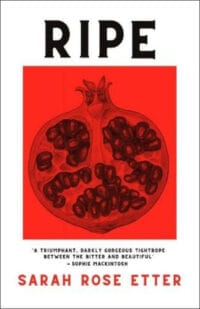
Book review: Ripe by Sarah Rose Etter
March 8, 2026 1 Comment

Ripe book cover

A few years ago I joined an online book club run by a local bookshop. I struggled to keep on top of the reading and had to cancel my membership, guiltily putting aside the last few books to read later. Every book choice was thought provoking and came from a small publisher so it was totally up my street; it was just the wrong timing for me.

Ripe by Sarah Rose Etter was one of those book club picks, which I’ve now finally read. It’s an intense satire of Silicon Valley. I both loved it and found it stressful to read.

On paper, Cassie is living the dream, with an apartment in a nice San Francisco neighbourhood and an impressive-sounding job at a unicorn start-up. But her depression is a black hole that threatens to overwhelm her; work hours and pressure are overwhelming; and her finances are precarious. She’s taking a lot of coke and plastering on a fake smile to survive.

Continue reading “Book review: Ripe by Sarah Rose Etter”

Kate Gardner Reviews

You start off as coal and you end up as coal

March 15, 2021

Midnight LibraryThe Midnight Library
by Matt Haig

This novel was selected by my work book club, and it was a classic example of my having loved a book until I started to talk about it with other people, at which point I found many flaws. I love Matt Haig and his style is very readable, so I think I probably did notice some of this book’s problems while I read, but skimmed over them. And I would still recommend this book, just with a little commentary about my reservations.

The problems begin with the premise itself. Nora is having a terrible day and as midnight approaches, she attempts suicide. But instead of leading her to death or a hospital bed, she finds herself in a magical library where every book represents a version of her life. The librarian tells her that she can try on these variants of her life to see if any of them fits her better than the life she just tried to leave. If she isn’t happy there, she will return to the library.

The librarian explains that these lives are based on decisions that Nora made, so she can’t choose a life where someone else’s decision was different, only those where she opted for something else. To help guide her choices, Nora is given a book of regrets. She has many regrets, but if she can undo all those decisions will it make her life a happier one?

Continue reading “You start off as coal and you end up as coal”

Kate Gardner Reviews

Someday, everyone will disappear, scattered into the blackness of time

February 10, 2020February 10, 2020

Kitchen book coverKitchen
by Banana Yoshimoto
translated from Japanese by Megan Backus

This novella and short story about grief are an excellent demonstration that you can depict dark, devastating emotion without being hyperbolic or overwrought.

“Kitchen part 1”, “Kitchen part 2” and “Moonlight shadow” each follows a young person (college age ish) who has lost a significant person from their lives. The relationship to the deceased is different and on the surface the reactions are different, but at heart the grief is similar.

One of the keys that Yoshimoto taps into is the comfort of specific places, for example a kitchen or a bridge in a park, in helping the process of grief. In “Kitchen”, Mikage doesn’t even need a specific kitchen to help her feel better – any kitchen will do, though she is particularly enamoured by the kitchen of her friend Yuichi, a young man she barely knew before her recent bereavement.

Continue reading “Someday, everyone will disappear, scattered into the blackness of time”

Kate Gardner Reviews

Computing the amount of precious time that had been lost to him for ever

April 28, 2019April 28, 2019

Last of Cheri book coverThe Last of Chéri
by Colette
translated from French by Roger Senhouse

Ah, Chéri, the spoiled beautiful boy who thought he was being terribly grown up by getting married to the first girl he liked who was his own age. Thankfully Colette revisited that scenario and reassured us that no, Chéri is not happy living a respectable life.

Since his introduction in Chéri, Chéri has fought in the First World War and returned to a Paris changed irrevocably. His wife has found purpose running a hospital for war veterans, which holds zero interest for Chéri. There is no longer a glittering whirl of parties to occupy his time. He’s depressed, but he doesn’t understand that.

“The apparition of the large, flat, half-veiled moon among the scuppering vaporous clouds, which she seemed to be pursuing and tearing asunder, did not divert him from working out an arithmetical fantasy: he was computing – in years, months, hours and days – the amount of precious time that had been lost to him for ever.”

Continue reading “Computing the amount of precious time that had been lost to him for ever”

Kate Gardner Reviews

The fundamental sadness of humans

March 17, 2019March 17, 2019

The last family in england book coverThe Last Family in England
by Matt Haig

I’ve put off reviewing this novel for a while now. I love Matt Haig and this is a lovely book, but I feel like maybe the author – who has spoken publicly about his anxiety and depression – was in a bad place when he wrote it. It’s sad and bleak and I think the ending broke me a little bit.

It’s the story of the Hunters – an ordinary family in an ordinary British suburb, but who are on the brink of disintegrating. And it’s narrated by Prince, the family dog, which sounds like a terrible idea but actually works really well.

Adam and Kate are happily married, their children Hal and Charlotte are typical teenagers. On the surface. But the marriage is brittle. Hal is fragile. Charlotte is always angry. One small spark is all it will take to destroy them.

Continue reading “The fundamental sadness of humans”

Kate Gardner Reviews

We find ourselves through the process of escaping

February 3, 2016

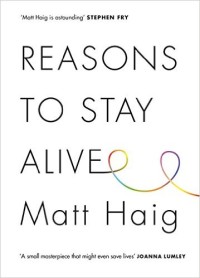
reasons-to-stay-aliveReasons to Stay Alive
by Matt Haig

I had come across some very smart, funny, insightful blog posts by Haig that had put him on my to-read list, so when I saw that he was going to be at Toppings bookshop in Bath, I suggested to Tim that he might want to buy me tickets to the event. I am a helpful gift-receiver that way.

This book is a few things at once – it’s part memoir, part essay, part self-help – with depression as its subject. Haig said that the reader he had in mind was himself aged 25 having his first terrifying experience of depression and anxiety. So the chapters are short, the factual bits are never condescending, the literary quotes on the topic are accessible; it’s all very readable.

But most importantly, the trajectory of the book is upward. There is no “before” – the story starts at Haig’s rock bottom, aged 25 and not understanding at all what was happening to him. From there it is largely, though not entirely, chronological so that we end with Haig’s current state, which is that of course he still has depression but he has lots of ways to deal with it, he knows the bad times pass, and he is even thankful in some ways for having depression – for one, it made him a writer.

Continue reading “We find ourselves through the process of escaping”

Kate Gardner Reviews

World Mental Health Day

October 10, 2015October 10, 2015 4 Comments

Today, 10 October, is World Mental Health Day. I write about this both because it’s an important cause that affects many many people, and because books and reading have a major part to play in helping improve mental health.

This year World Mental Health Day has the theme “dignity in mental health” – dealing with stigma and discrimination, changing social attitudes and spreading public awareness of the nature of mental illness. These are all major aims of Bristol Mind, among others, and many people are holding coffee mornings and other events around the city – and the world – today.

As author Matt Haig discussed in his excellent article for the Telegraph yesterday, books can genuinely help those with depression and other mental-health issues. The Reading Agency works with GPs to prescribe books to alleviate mental-health problems through its Reading Well scheme. And this actually works. Reading reduces stress; it also improves empathy, memory and cognition – perhaps we should all be prescribed books!

Continue reading “World Mental Health Day”

Kate Gardner Blog

Paused in an atmosphere of extraordinary pallor and thickness

May 22, 2015

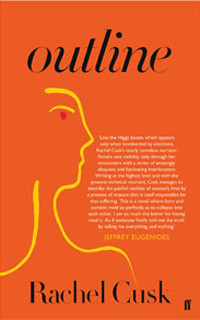
outlineOutline
by Rachel Cusk

Though Cusk has written eight other books in-between, this new novel shares a lot in common with her first two books. There is a vagueness about it and a distinct lack of story, but there is also some beautiful writing.

The narrator is an English divorcee writer (a little autobiography peeking through perhaps?) who goes to Greece to teach a writing class for a week. That’s pretty much the whole story. She speaks with a series of people, some friends, some random strangers, and recounts their stories. She has a knack of getting people to open up to her but reveals very little about herself. And yet she does seem concerned with the truth and questions the honesty of those she speaks to.

The title appears to refer to the series of sketches of people’s lives that the narrator presents, but a quote from towards the end of the book suggests another reason:

“She began to see herself as a shape, an outline, with all the detail filled in around it while the shape itself remained blank. Yet this shape, even while its content remained unknown, gave her…a sense of who she now was.”

Continue reading “Paused in an atmosphere of extraordinary pallor and thickness”

Kate Gardner Reviews

I am too diffused

September 10, 2014 2 Comments

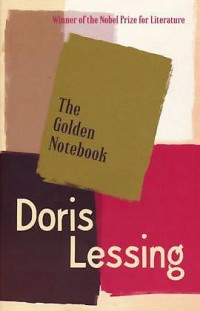
The Golden Notebook

The Golden Notebook
by Doris Lessing

This book is more of an intellectual exercise than a novel, which has its rewards and makes it good fodder for discussion, but doesn’t make it the most enjoyable book I’ve read lately. Not that I hated it by any means, I’m glad I’ve read it, but I’m not convinced of Lessing’s skill as a writer so much as her intellect.

Having said there’s plenty to discuss, I’m not sure some of the more interesting things I got from it can go into this review as they reveal too much about the end of the book, but I’ll try to say what I can without spoilers and without sounding like a study guide (which, incidentally, there are plenty of for this book, because it’s that kind of book).

This is the story of two women, Anna and Molly, in 1950s London. (There are some flashbacks to earlier in their lives, particularly Anna’s, but the bulk of the story is in the 50s.) Molly is an actress, with a steady stream of small parts, or sometimes big parts in small shows. She has a grown son, Tommy, who lives with her and a fraught relationship with her ex-husband Richard. Anna is a writer who wrote one very successful book early in her life and has been living off the proceeds since. She is also a single mother, though the story of the child’s father is only gradually revealed. Both women have been communists, which proved a major influence on their lives.

“Looking back at those week-ends they seem like beads on a string, two big glittering ones to start with, then a succession of small, unimportant ones, then another brilliant one to end. But that is just the lazy memory.”

Essentially, the book is split into sections: there’s the “wraparound novel”, a seemingly straightforward narrative about Anna and Molly, titled Free Women. Then there are four notebooks kept by Anna, in which she writes about different aspects of her life, splitting herself and the way she observes the world. Anna writes multiple times that she can’t help fictionalising her own life, indeed it is never wholly clear whether Free Women is written by her, and therefore yet another fictionalised account, or if it is the supposedly objective “truthful” account.

“I was going to say disaster. That word is ridiculous. Because what is so painful about that time is that nothing was disastrous. It was all wrong, ugly, unhappy and coloured with cynicism, but nothing was tragic, there were no moments that could change anything or anybody.”

Anna’s previously published novel that she is living off was loosely based on her own experience in colonial Africa during the Second World War, and she writes several accounts of her time there in the notebooks, but they don’t entirely match up – sometimes she changes names, sometimes she refers to the version of the story told in her novel. When you add to this that Anna shares an awful lot in common with Doris Lessing, it all starts getting rather meta. Lessing’s own explanation of the book is that it’s a novel plus the notes an author makes surrounding it, which either demonstrates how much is discarded from the full “fictional” idea, or demonstrates how differently the same “true” story can be told, even by the same person.

“I am incapable of writing the only kind of novel which interests me: a book powered with an intellectual or moral passion strong enough to create order, to create a new way of looking at life. It is because I am too diffused.”

Which all sounds more complicated than it is to read. The writing style is pretty straightforward, though I found my interest wavered with the subject matter. The overriding theme of the notebooks is to analyse over and over, which I tended to find an interruption to the story rather than an enhancement, but arguably it was the whole point. Though Lessing claims in her introduction that the novel isn’t “about” anything except a person falling apart, it certainly has a lot to say about communism, feminism, friendship, writing, love, sex, relationships, parenthood, psychoanalysis and truth. I suppose you could try to read it as a straightforward narrative without trying to piece together the different versions of the same story, but for me that was part of the fun. I like that when I got to the end there were several ways to interpret it, both in terms of what “happened” and in what the “real” structure is.

“It’s a question of form. People don’t mind immoral messages. They don’t mind art which says that murder is good, cruelty is good, sex for sex’s sake is good. They like it, provided the message is wrapped up a little. And they like the messages saying that murder is bad, cruelty is bad, and love is love is love is love. What they can’t stand is to be told it all doesn’t matter, they can’t stand formlessness.”

However, I only fully engaged with relatively short sections (bearing in mind this is 550 pages of small print), when the story got under flow, in-between lists, newspaper cuttings, diary-style brief notes and the like. I didn’t warm to Anna, which is in some ways surprising as a writer struggling with anxiety and depression, contemplating motherhood and politics, full of concern about the world, should be right up my street! But I mostly found her cold and unemotional, even listless, making odd decisions about life, which I suppose might arguably be a better depiction of depression than many I’ve read.

Maybe it was just far too long. I certainly highlighted dozens of passages that I admired, either for the language or for the idea. I really liked learning more about communism in Britain in the 1950s, and about war-time in a British colony in Africa, but despite her Nobel Prize in Literature I don’t think I’ll be rushing back to Lessing.

First published 1962 by Michael Joseph.

Source: Paper copy bought from Toppings in Bath, e-book from Amazon. (I have both as I was going on holiday just before the book club and I only take my Kindle on holidays.)

Kate Gardner Reviews

I was a furious pinpoint

May 28, 2013May 28, 2013

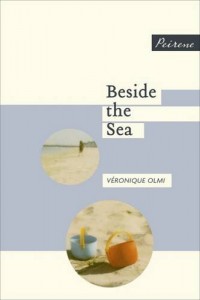
Beside the Sea

Beside the Sea
by Véronique Olmi
translated from French by Adriana Hunter

This was the first book published by small publisher Peirene Press and since I began blogging I have been hearing how wonderful this book is, so earlier this year I bought it. But the thing is that the premise of the book is so dark, so sad, that it took me a while to pick it up and to be honest even though I think it brilliant I am not sure I would ever want to put myself through it again.

The story is that of a single mother who takes her two boys to the seaside for a holiday she has planned and dreamed of for a long long time, but she is poor and suffers from depression so nothing is as she had hoped. And to add to the bleakness she has a plan to protect her boys from the world at the end of this holiday, a plan that is not explained but is nevertheless clear from page one.

“It felt really strange driving away from the city, leaving it for this unknown plane, specially as it wasn’t the holidays and that’s what the boys kept thinking, I know they did. We’d never been away for a holiday, never left the city, and suddenly life felt new, my stomach was in knots, I was thirsty the whole time and everything was irritating, but I did my best, yes really my best, so the kids didn’t notice anything. I wanted us to set off totally believing in it.”

I found this book extremely disturbing. Olmi does an amazing job of bringing to life a mother juggling money troubles and hunger and some form of depression, getting right inside her mind, which is not a comfortable place to be. Her four and eight year old sons are more au fait with the world than she is, and she feels this keenly. She has such a disturbed view of world, full of paranoia and fear, that she frequently hides from it all by trying to sleep, and her sons are familiar with this and accept it, even when they’ve skipped multiple meals and promise after promise has been broken.

“Lights mingled with the sound system, becoming as depressing as the songs, you couldn’t see the rain but it was following us all…the bells wouldn’t stop ringing, people were hurrying onto rides in every direction, where did all that money come from, everyone could afford everything, there was too much of everything everywhere, too much noise, too much rain, too many lights, all reeling past me.”

Olmi’s real skill is to show that this mother, struggling and under suspicion of social services and indeed most people they meet, truly loves her children and is trying as hard as she humanly can to do what’s right by them, it just isn’t enough. It’s unbearably sad. Doubly so as it’s so clear where this is going but you’re willing it not to go there, to find a way out.

“I was a furious pinpoint, with darkness all around, I was a star, old and always there, old and full of fire. I’d been thrown up into the sky, I wasn’t holding on to anything but everything around me hung on, like I was cradled by arms.”

I was left in a black mood for a couple of days after reading this book. I salute Olmi’s skill and achievement but I really do not want to enter that world again.

Bord de mer published 2001 by Actes Sud.
Translation published 2010 by Peirene Press.

Source: Bought direct from the publisher.

Challenges: This counts towards the 2013 Translation Challenge.

Kate Gardner Reviews

Posts pagination

1 2

Archives

RSS Nose in a book

  • Book review: Interstellar Megachef by Lavanya Lakshminarayan
  • May 2026 reading round-up
  • Book review: Passing by Nella Larsen

Me on the internets

  • @kate_in_a_book@mas.to (Mastodon)
  • Flickr/noseinabook
  • Instagram/kate_in_a_book
  • StoryGraph/kate_in_a_book

Categories

  • Blog
  • Reviews
  • Uncategorized
Proudly powered by WordPress | Theme: Dream by vsFish.