Nose in a book

Reviews and other ramblings

  • Home
  • Reviews archive
    • Book reviews
    • TV reviews
    • Theatre reviews
  • TBR
  • Challenges
    • The Classics Club
    • 2014 Popular-Science Reading Challenge
    • Cookery challenge
    • The Gilmore Girls Reading Challenge
    • 2013 TBR Pile Challenge
    • 2013 Translation Challenge
    • Crime and Punishment read-a-long
  • About
    • Cookie legal stuff
  • Home
  • Reviews archive
    • Book reviews
    • TV reviews
    • Theatre reviews
  • TBR
  • Challenges
    • The Classics Club
    • 2014 Popular-Science Reading Challenge
    • Cookery challenge
    • The Gilmore Girls Reading Challenge
    • 2013 TBR Pile Challenge
    • 2013 Translation Challenge
    • Crime and Punishment read-a-long
  • About
    • Cookie legal stuff

Tag: comic

Nightmares sneak out into the daylight
January 28, 2013July 9, 2015 2 Comments

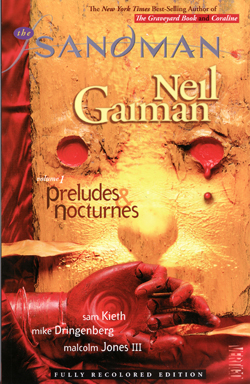
The Sandman

The Sandman Vol. 1 Preludes & Nocturnes
by Neil Gaiman (writer), Sam Keith, Mike Dringenberg and Malcolm Jones III (artists)

I have been told so many times that I should read The Sandman that I just assumed it would be wonderful. It’s Neil Gaiman, it’s a highly acclaimed comic-book series, it’s about dreams and nightmares – it sounded perfect. And it is pretty good, but I think my expectations were too high.

This is the first of 12 volumes, republishing the full original run of The Sandman. The artwork is beautiful in a dark, gothic style. The concept is fascinating and open-ended. Quite simply, the Sandman is the lord of the world of dreams, both good and bad. He can move in and out of the real world, magical realms and dreams themselves.

This volume has a clear complete storyline – in 1916 a magic circle tries to summon Death and instead gets the Sandman, whom they imprison for many decades. This has a terrible effect on the world – with no-one controlling the dream world, some people go mad, others just stay asleep for years. The Sandman must escape and regain control, but it won’t be an easy task.

“Daniel Bustamonte returns to his best dream. But this time the clouds are flimsy, frail, less real. And then the clouds aren’t there at all. Too scared to sleep, he sobs to keep himself awake until dawn.”

“Stefan’s case is new to the doctors. They thought they’d seen every form of shellshock. How long can a boy go without sleeping? When do the nightmares sneak out into the daylight? The morphine is proving useless. It’s sad.”

“Unity Kinkaid finds it harder and harder to stay awake. She now sleeps for almost 20 hours a day. She used to dream; to shift in her sleep, muttering and sighing, locked in half-remembered fantasies. Now she lies unmoving, breath shallow and silent, lost to the world. Unity sleeps.”

I liked the concept, I liked the story and the artwork, I like that it’s dark (even a bit grisly in places) but…I’m not sure exactly what was wrong but it didn’t grab me. The stuff about the world going mad without the Sandman was brilliant but over a little too quickly, I felt a lot more could have been made of it. And there was surprisingly little of the dream world depicted, but I’m sure that’s still to come. Only, I’m not all that bothered about reading the remaining volumes.

Maybe I was in the wrong mood. Maybe I should treat it as much as a work of art as a work of fiction. I’m not sure. I had half a plan to try The Books of Magic next. Perhaps I should lower my expectations first?

First published as The Sandman issues 1–8, 1988–1989, by DC Comics.
This edition published 2010 by Vertigo, DC Comics.

Source: I bought this from my local comic-book shop.

Kate Gardner Reviews

Girls and guns and science

December 22, 2011 3 Comments

Echo: the Complete Edition
by Terry Moore

So I quite liked this graphic novel, then Tim said that the maths that the whole storyline is based around is complete rubbish and now I’m not sure if that makes a difference or not. I think I still like it.

It’s almost a superhero story, but not quite. Super-clever scientist lady invents a new element and makes herself a suit out of it, then gets blown up by her superiors while wearing it and the suit attaches itself to two unlucky bystanders. That’s the first couple of scenes. The rest of the story follows those two bystanders as they discover what the suit can do and have very different reactions to it. And both get chased by various government agencies and scientists who want their tech back.

This is one of those beautifully drawn graphic novels that includes a lot of panes with no words, so despite this being a huge tome (this was previously published as six trade paperbacks) I tore through it in one day. I probably didn’t pay enough attention to the detail.

The main character is Julie, one of those two bystanders in the desert. She is an artist struggling to pay her bills and resisting signing the divorce papers that her husband has sent. There’s a large supporting cast, but foremost among them are Dillon, who was the boyfriend of the dead scientist lady, and Ivy, a kickass agent for a mysterious organisation. The first time we meet Ivy she is picking flowers with her daughter. In the next scene she is flying a plane on her own and puts it into autopilot while she changes her clothes. Awesome.

The maths/science stuff is complete rubbish and I did get a bit annoyed by it, even before discussing it with Tim. And there’s also a religious storyline that I found a bit questionable, to say the least. But the main characters and their lives on the run are engaging, funny, upsetting, sad and touching in all the right places. A main character appearing to be offended by the suggestion she might be gay is made up for by there being other characters who just happen to gay, without it being a thing.

Throughout the book there are quotes from writers and scientists about man and science, especially the destructive nature of man. Really it’s quite a negative view of science. There are plenty of scientists in the book who are trying to do good, but the suggestion is that it’s futile, that there will always be someone who wants to do something terrible with any new scientific discovery and that someone will always get their way. I prefer not to be that pessimistic.

There’s also a lot of excuses come up with for drawing women wearing very little. In fact, flicking through the gallery of cover art at the end of this collected edition, the majority of them concentrate on Julie and her large chest.

But dodgy science and fan service aside, I really did enjoy this read. I was interested in and cared about the characters, even some we only meet very briefly, and the bikers were very cool. But not as cool as Ivy.

Published 2011 by Robyn Moore.

Kate Gardner Reviews

Comics are for grown-ups

September 17, 2011September 20, 2011

Skellington

Skellington
Scary Go Round book 3
by John Allison

As the title intimates, this is the third collection of Allison’s Scary Go Round web comic strips in print, in this case taken from May 2004 to March 2005. All of those comics are still available, for free, on the Scary Go Round website so why would I (well, okay, Tim) buy this in book form?

First of all, it’s a book! And we like books. They are good. Slightly more seriously, I struggle a little to follow a storyline of any length in a webcomic. Too much clicking, too much waiting. I am impatient like that. Also, Allison has thrown in some bonus features – rewritten bits, introductions to each story and some sketches he did for character development. I really like the extra insight that this gives. And last but not least, we buy his books to support an author who is creating great work.

But what is Scary Go Round? Well, previous to this book I had only read snatches of it over the years so I am almost a newcomer myself. As far as I can tell, it is a comic that follows the lives of a group of mostly 20-somethings living in Yorkshire, to whom insane things happen often. But there’s the occasional story that doesn’t involve the regular characters at all, which is either to confuse the reader or to give Allison a break/change/fun new experiment.

In this volume, most stories centre around housemates Amy and Shelley. Shelley is sensible, responsible and works as the mayor’s assistant. Amy is ditsy, haphazard and works for a crazy inventor guy who she may or may not have a crush on. There’s a fairly large cast of regular/recurring characters, including Shelley’s former housemate Fallon who is some kind of kickass secret agent (in fact, she has her own book, titled Girl Spy).

Storylines include Shelley and Amy going to a death metal concert, and a teapot time machine. From mundane daily life to extraordinary oddness, the dialogue is funny and the interaction between characters warm and realistic.

According to Tim, who knows about these things, Scary Go Round and its predecessor Bobbins (from which several characters survived) were some of the earliest webcomics and are important in terms of carving a new genre and format. Scary Go Round itself has now ended, but Allison’s new webcomic Bad Machinery is going strong.

Published 2005. Print version no longer available but I’m hoping the e-book will be added to the Scary Go Round store soon.

Kate Gardner Reviews

Finding my inner geek

April 30, 2011April 30, 2011 2 Comments

The Guild volume 1
story by Felicia Day, artwork by Jim Rugg

This is a comic prequel to the web show The Guild created by and starring Felicia Day, a series I haven’t watched by the way. I guess that makes me an atypical reader, but I loved her in Dr Horrible’s Sing-Along Blog and the comic was in the car with me on a long drive so, what else was I going to do?

It’s the story of Cyd, a violinist with a loser boyfriend and therapy sessions that are failing to help her depression at all, thanks to a particularly awful psychiatrist. On a whim she buys a computer game, an online RPG that allows her to create a whole new character for herself called Codex, make friends and follow structured rules that make sense.

So yeah, it’s geeky, but don’t let that put the non-geeks among you off. It’s a human story with a lovably flawed character at its centre. Cyd’s mistakes are harder to correct than Codex’s, but by being Codex and interacting with lots of new people, people who for the most part are positive and want to help her, Cyd learns to deal better with her real life.

The important message is, of course, that online friends can be “real” friends even if you never meet them in person. The beauty of the Internet is that it gives you access to the whole world, to find others who share your interests, who lift you up and make you smile. You don’t need to be in a physical bar with someone to swap stories of drunken exploits, or share your baby’s first words, or open your heart.

Which all sounds a little cheesy. Sorry, that’s only my interpretation. The comic is not cheesy, it’s awesome. Day hits just the right balance between sentiment and straight-talking. It helps that her main character is struggling to figure out how she feels, or whether it’s okay to feel a certain way, and her sense of loneliness translates well in comic form.

Well, I’m off to check out the web series. I can feel my geekiness increasing already.

First published as three comics in 2010 by Dark Horse Comics. This edition published December 2010.

Kate Gardner Reviews

Learning from history

September 10, 2010March 11, 2012

Dignifying Science: Stories About Women Scientists
by Jim Ottaviani

This book greatly appealed to me from the get-go: it’s a graphic novel about women scientists, concentrating on five examples: Hedy Lamarr, Lise Meitner, Rosalind Franklin, Barbara McLintock and Biruté Galdikas. I am ashamed to say that I had no idea what any of those women should be famous for, in fact I’d not heard of two of them at all, and even now I feel that I only know a little about each one. My curiosity has definitely been piqued and I will be adding some books from the extensive references section to my wishlist.

A lot of different artists worked on this and I found the changes in style quite disconcerting, though at times it was used to good effect. For example, in the story of Rosalind Franklin there were pages supposedly narrated by James Watson, Francis Crick and Maurice Wilkins in turn, and the different drawing styles definitely helped prevent the change in voice from being confusing (and hopefully those names have told you what Rosalind Franklin is famous for, if you didn’t know before!).

This book definitely makes more sense if you read all the notes and references. The comic sections don’t always make it clear what the scientific achievement of each person is, and the inclusion of Hedy Lamarr (more of an engineer and, oh yes – actress) may seem a little odd when so many women scientists have been omitted, but as the notes explain – this is really just a taster and therefore concentrates on interesting stories rather than universal coverage. Marie Curie stars in a brief epilogue and prologue, apparently because her letters to her daughter Irene were too fascinating not to use!

There’s a definite sense of humour at work, as you might expect in a graphic novel, and the stories are mostly accessible to the layman. I’m not sure this would get any very young girls enthusing about a science career because the language, historical contexts and science depicted are too dense for that, but it could certainly be a good book to give a teenage girl with a modicum of interest in science or history. And there’s no reason not to give it to boys either because there’s no particular feminist slant aside from the choice of protagonists.

I liked the different levels of success of the women depicted, and the different reasons for it. Lamarr was treated as a pretty girl playing at science (though she wasn’t exactly pushed into acting – she broke off two engagements because the men wouldn’t let her continue acting), Meitner missed out a Nobel prize that she deserved part of (for nuclear fission, on the back of the evidence here anyway, I will read more before I give a definitive view on that), Franklin’s abrupt personality made her difficult to work with and she was snide about Francis and Crick’s model work but she did get an acknowledgement in their paper and in the Nobel acceptance speech (she was dead by then so could not have received the award, which is not given posthumously), McLintock did get a Nobel prize and Galdikas is apparently internationally renowned and respected for her work with orangutans, which continues to this day.

I will admit that I found the story of McLintock pretty dull. I understand the desire to include someone who chose an unusual thing to research (corn genetics) and stuck with that for life, leading to notable advances in the field, but it’s pretty dull and the one interesting thing about her life – that she struggled for years to get a faculty position because of her gender and her chosen area of research and the one position she did get early on was in Germany in 1933, which she had to leave pretty quickly because of the political situation – is not made at all clear in the comic section, only in the later notes.

However, the rest of the book was very interesting indeed. Incidentally, the title Dignifying Science comes from one of Marie Curie’s letters, where she is talking about the problems of being a famous scientist. She continues: “What is not deniable is the sincerity of all the people who do this kind of thing and the necessity of doing it.”

Published 2003 by GT Labs
ISBN 978-0-9660-1064-0

Kate Gardner Reviews

Posts pagination

1 2

Archives

RSS Nose in a book

  • Book review: Interstellar Megachef by Lavanya Lakshminarayan
  • May 2026 reading round-up
  • Book review: Passing by Nella Larsen

Me on the internets

  • @kate_in_a_book@mas.to (Mastodon)
  • Flickr/noseinabook
  • Instagram/kate_in_a_book
  • StoryGraph/kate_in_a_book

Categories

  • Blog
  • Reviews
  • Uncategorized
Proudly powered by WordPress | Theme: Dream by vsFish.