Nose in a book

Reviews and other ramblings

  • Home
  • Reviews archive
    • Book reviews
    • TV reviews
    • Theatre reviews
  • TBR
  • Challenges
    • The Classics Club
    • 2014 Popular-Science Reading Challenge
    • Cookery challenge
    • The Gilmore Girls Reading Challenge
    • 2013 TBR Pile Challenge
    • 2013 Translation Challenge
    • Crime and Punishment read-a-long
  • About
    • Cookie legal stuff
  • Home
  • Reviews archive
    • Book reviews
    • TV reviews
    • Theatre reviews
  • TBR
  • Challenges
    • The Classics Club
    • 2014 Popular-Science Reading Challenge
    • Cookery challenge
    • The Gilmore Girls Reading Challenge
    • 2013 TBR Pile Challenge
    • 2013 Translation Challenge
    • Crime and Punishment read-a-long
  • About
    • Cookie legal stuff

Tag: comedy

Instability is a permanent condition that adapts with the times
January 15, 2014February 9, 2020

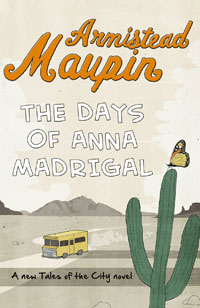
The Days of Anna Madrigal

The Days of Anna Madrigal
by Armistead Maupin

I thought quite hard about what should be my first book of the new year and this felt like a really good choice. I was really excited to be sent a copy of this, the latest Tales of the City novel, having loved the first book in the series. And this ninth instalment is just as funny, touching, well observed and eye-opening as that first one was for me. Those who haven’t read the whole series might find spoilers in this review.

Anna Madrigal was the eccentric but beloved landlady of the legendary 28 Barbary Lane. Now she is very old and, feeling that her time is near, takes a trip to her childhood home in Nevada, hoping to come to peace with the actions of the boy she once was. At the same time, several of her dearest friends are heading for the annual Burning Man festival, also in Nevada, and they have their own gremlins to deal with. Will Shawna take the biggest step of her life and become a mother? Will Michael find peace with his younger, hipper husband? Will Jake’s painstaking plan to honour Anna come to fruition or fall apart in the desert dust?

“‘Chillax? You don’t say chillax.’
‘I’m saying it now. Because you’re acting like you’re twelve and hormonal.’
If only he knew, thought Michael. Sixty-two was a lot like twelve and hormonal. Teenagers rage against the end of childhood, old people against the end of everything. Instability is a permanent condition that adapts with the times.”

This book was, perhaps inevitably, a little more serious than the start of the series was. It’s certainly not without humour, or lighter moments, but the overarching themes include ageing, death and betrayal, and when the death that’s most imminent is that of a character who has been beloved through eight previous books over 35 years, well, you can’t be flippant about it.

There are also more positive themes such as renewal and acceptance. Which all sounds remarkably worthy, and that’s one thing this book isn’t. It’s touching, moving even, but never overly sentimental. In fact, I found Anna just as hard to get inside the head of as ever. But then the other characters have the same problem with her so I guess that’s just how she is.

“Summer had been warmer than usual this year, but the heat that throbbed in the East Bay was already coaxing pale fingers of fog into the city. Anna could feel this on her skin, the chilly caress she had come to think of as ‘candle weather’.”

There’s quite a broad cast of characters here, most of whom (though not all) are LGBT, and I like how the sheer number of people he’s created allows Maupin to not stereotype or pigeonhole any one character. They are all human and interesting. They have realistically complicated relationships with one another, which I know is partly a result of having several previous books about most of these people. But it’s also an accurate reflection of how the world is. Couples break up and move on but often still have mutual friends. Sometimes if you examine how you met your best friend you realise that to begin with they were your ex-boyfriend’s boss’s landlady, and you’re no longer in touch with your ex but that tenuous connection became the most important friendship of your life.

It’s hard to write much more about this book without giving away the events in it, but I really did find it charming and enjoyable, and I am glad to have been reminded to go back to this wonderful series.

Published January 2014 by Doubleday, an imprint of Transworld.

Source: This book was kindly sent to me by the publisher in return for an honest review.
Kate Gardner Reviews

The snarling cries of a wind eating its way

January 4, 2014January 4, 2014 3 Comments

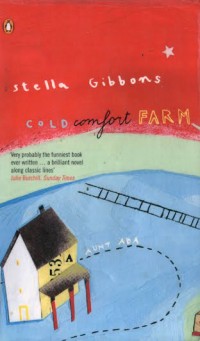
cold comfort farm book cover

Cold Comfort Farm
by Stella Gibbons

I read this novel as the Guardian Reading Group picked it as the book for December and it had already sat for too long on the TBR. It’s one of those books so beloved, and described so often in hyperbolic terms, that I worried I would be disappointed. It turns out, I was not.

I suppose my biggest fear was that I wouldn’t find it funny, that the comedy would have dated. And there are aspects of the book that show their age (some racism/antisemitism and homophobia) but the comedy is still very funny.

The story is that of Flora Poste, who is well brought up, highly educated and suddenly orphaned, therefore in need of somewhere to live. Eschewing all the easy options available from her various friends in London, she writes to all her distant relatives and accepts the offer that sounds the strangest and least appealing – Cold Comfort Farm near Howling in Sussex, with the wonderfully named Aunt Ada Doom and her large family.

Flora is a busybody and immediately decides that these strange parochial relatives, with their gloomy demeanour and dislike of cleaning, need straightening up, so she sets herself the challenge of sorting them all out. And it’s a big challenge. From the lustful young man Seth, who gets the serving girl pregnant every spring, to doddering old farmhand Adam, who fails to notice when hoofs and horns fall off his beloved cows, to raving old Ada Doom herself, who never leaves her room yet wields a strange power over the farm, which may or may not be related to that fateful night when she saw something nasty in the woodshed.

“Aunt Ada Doom sat in her room upstairs…alone. There was something almost symbolic in her solitude. She was the core, the matrix; the focusing-point of the house—and she was, like all cores, utterly alone. You never heard of two cores to a thing, did you? Well, then”

Oh, and I should also mention that this is set in a near future (or what was near future at the time it was written), so it has a touch of SF mixed in there. It’s quite subtle but there are small details, especially toward the end – video phones, airmail literally dropped at the front door, personal planes to the nearest field – which add an extra level of strangeness. I’m not quite sure what the purpose of the future setting was – perhaps to make the strong female lead and satire excusable in some way?

“‘She – she’s mad.’
The word lay between them in the indifferent air. Time, which had been behaving normally lately, suddenly began to spin upon a bright point in endless space.”

If there’s one thing this book has in spades, it’s satire. Right from the author’s foreword when Gibbons tells her friend Tony that she has “marked what I consider the finer passages with one, two or three stars”, which “ought to help the reviewers” and indeed there are passages so marked throughout the book, all particularly overblown examples of satirising the prose of “country” novels such as those by George Eliot.

“**Dawn crept over the Downs like a sinister white animal, followed by the snarling cries of a wind eating its way between the black boughs of the thorns. The wind was the furious voice that was baring the dormers and mullions and scullions of Cold Comfort Farm.”

One of the questions raised on the Guardian Reading Group was whether or not we are supposed to admire Flora. She is an interfering city girl who decides that these country folk aren’t up to scratch and sets out to change them into a more acceptable “normality”. Or is that also part of the satire? She is after all in love with her cousin back in London, who happens to be a vicar, so her own story is pretty much a satire of a Jane Austen plot.

“The brittle air, on which the fans of the trees were etched like ageing skeletons, seemed thronged by the bright, invisible ghosts of a million dead summers. The cold beat in glassy waves against the eyelids of anybody who happened to be out in it.”

I like that the satire is of literary styles, rather than any people or ways of life (or at least that’s how I read it). And I must say I found Flora adorable, which is surprising because it’s in a way irritating that she is so capable and right about everything, but then that also makes her a brilliant strong female character. And she wasn’t the only surprise for me. Most of the characters begin as almost surreal fairytale types but become human as you get to know them (or should that be as Flora works her magic?).

I really enjoyed this book and can definitely see myself returning to it. The question now is do I seek out the sequels that Gibbons wrote, which are by most accounts good but not as good, or leave it at this, the pinnacle of her ability?

First published 1938 by Penguin Books.

Source: I bought it secondhand, probably from a charity shop.

Kate Gardner Reviews

Watching the vanishing sunset against the deepening blue

October 6, 2013

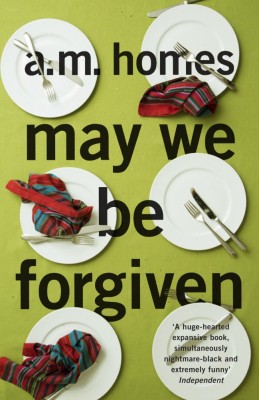
May We Be Forgiven

May We Be Forgiven
by A M Homes

This is a strange book that at first I – not exactly struggled with, but I did wonder if I should be engaging with it more. A lot happens and it covers quite a range of issues, but with a sense of humour and fun that kept me reading on.

It’s the story of a year in the life of Harry, a middle-aged history professor who has an obsession with Richard Nixon and, at the start of the book, a wife he seems to have no emotional engagement with. After Harry’s brother George has a car accident that leaves him mentally unbalanced and a young boy orphaned, Harry’s life changes out of all recognition, as does he.

“Was there ever a time when you thought – I am doing this on purpose, I am fucking up and I don’t know why.”

The book is very fast-moving to begin with, in fact I realised on page 20 I’d missed something huge even as another huge event was happening, but the bulk of the book is about the fallout from those events and the pace settles down.

Similarly, to begin with Harry’s narration is odd and unengaging but he gradually becomes a warmer character. If I were to summarise his story arc it would probably sound trite or possibly even soap-opera-like, but it’s actually funny and nuanced and, for the most part, feels real. The book deals with death and grieving, mental illness, loneliness, third world aid and the vulnerability of both children and old people. But it’s a pretty chunky book so there’s plenty of room to explore those issues without it getting too heavy.

“‘Were we always Jewish?’ Ashley asks.
‘Yes.’
The ceremony concludes, and one of the guests turns to me and says, ‘Given the circumstances, I think the rabbi did a very good job. What did you think?’
‘It’s my policy not to review funerals.'”

The humour grew on me as I got used to Harry, and was sometimes surreal, though it was also sometimes crude. And while Harry became a warmer character, I’m still not sure I really liked him by the end. I certainly cared how things turned out for him, which I guess is what matters.

“There’s something wonderfully melancholic about being outside on a spring evening watching the vanishing sunset against the deepening blue; the outlines of the old thick trees, full of bright fresh leaves, the surprising, gentle tickle of a breeze, and it somehow feels so good to be alive.”

Published 2012 by Granta Books.
Winner of the Women’s Prize for Fiction 2013.

Source: Amazon.

Kate Gardner Reviews

All that succession and repetition of massed humanity

August 23, 2012September 10, 2012 4 Comments

Vile Bodies
by Evelyn Waugh

Why oh why have I never read Waugh before? How has this happened? He was clever and funny and acerbic and fun and catty. Can you tell I enjoyed this book?

The novel follows a short time in the lives of the “bright young things”, the high, fast-paced society of 1920s London. From the first page the caustic comic tone is set. No-one escapes a vicious lashing. There are no real heroes, though a case might be made for Adam Fenwick-Symes being the centrepiece. He is certainly the butt of the longest joke: his relationship with lovely but frankly flighty Nina.

The story is really a series of parties and other social engagements. As Adam remarks at one point:

“…’Oh, Nina, what a lot of parties.‘
(Masked parties, Savage parties, Russian parties, Circus parties…parties in flats and studios and houses and ships and hotels and nightclubs, in windmills and swimming baths…all that succession and repetition of massed humanity. Those vile bodies…)”

For all the wit and the lack of getting inside anyone’s head, the characters are not entirely caricatures. There is an element of that certainly, but there are complexities too. When at one point Adam encounters a dressmaker’s dummy, the narration adds:

“…there had been one of these in Adam’s home which they used to call ‘Jemima’ – one day he stabbed ‘Jemima’ with a chisel and scattered stuffing over the nursery floor and was punished. A more enlightened age would have seen a complex in this action and worried accordingly…”

While the goings-on are quite lighthearted and romping, there is the occasional event that you feel ought to be being taken more seriously. But then when I got to the ironically titled final chapter “Happy ending”, I realised that that was the whole point. Without wishing to give anything away, Waugh neatly provides the excuse for all this living to excess, while maintaining his pessimistic tone.

The satire of society does come at a price. Emotion is limited or absent completely, despite the central love story of Adam and Nina, not to mention some other serious goings-on that might demand an emotional response. And politicians are present and roundly mocked but their politics not dealt with at all. I suppose it is quite a small book and to keep its momentum it had to have a narrow focus.

One subject that does muscle its way into the narrative is tabloid journalism, in particular the gossip columns. This was handled so amusingly that I particularly want to read Waugh’s novel Scoop soon.

First published 1930 by Chapman & Hall.

Kate Gardner Reviews

These are some of the things I know

July 18, 2012 2 Comments

I Remember Nothing and other reflections
by Nora Ephron

I wasn’t planning to read this. I visited my good friend H last weekend and saw it on her shelf and remembered H had said good things about it. So I read it.

In the light of Ephron’s very recent death, it was horribly poignant to read her memoir that begins with thoughts on memory loss and ends with thoughts on cancer, but in-between there is a charming, funny story of a life lived fully and happily.

Not one to be entirely conventional, Ephron tells her story in a series of essays. Some are very much memoir – how she began her career in journalism, for instance, an intriguing study in the sexism of the 1960s – while some are more rants on a topic – online Scrabble, the pointlessness of certain diets, e-mail – and others are really anecdotes. Which were perhaps my favourite bits:

“This is one of the things that drives me absolutely crazy when I see movies that take place in the fifties and early sixties: people are always saying ‘fuck’ in them. Trust me, no-one threw that word around then the way they do now. I’ll tell you something else: they didn’t drink wine then. Nobody knew about wine then. I mean, someone did obviously, but most people drank hard liquor all the way through dinner…These are some of the things I know, and they’re entirely useless and take up way too much space in my brain.”

Ephron’s writing style belies her early days in magazine feature writing. It’s a friendly, chatty style that drops in facts and cleverness without appearing to do so. Not that she hadn’t moved with the times. It did not feel like the writing of an “old person” at all:

“Alcoholic parents are so confusing. They’re your parents, so you love them; but they’re drunks, so you hate them. But you love them. But you hate them.”

There are some sweet quirks of the book. Three or four recipes are included, for example. Though after the chapter about how her friends don’t like her cooking it may or may not be worth following said recipes. There are also some lists. Mostly very funny ones but, on a bittersweet note, the book ends with “What I won’t miss” and “What I will miss”. However, my favourite part was the essay on journalism:

“It was exciting in its own self-absorbed way, which is very much the essence of journalism: you truly come to believe that you are living in the center of the universe and that the world out there is on tenterhooks waiting for the next copy of whatever publication you work at.”

Ephron comes across as a wonderful, astute, funny woman who was well loved and had lived well. What more could anyone want?

First published in the US in 2010 by Alfred A Knopf, an imprint of Transworld Publishers.

Kate Gardner Reviews

You’re gonna get screwed but good in this town

April 6, 2012April 28, 2012

Tales of the City
by Armistead Maupin

After hearing this book praised left, right and centre since I started book blogging I figured I had to give it a go. And what a joy it is!

This is the first in what has turned out to be a very long-running series about a large cast of characters in San Francisco. In this book (I don’t know if this is true of any of the rest) the focus is on a boarding house on Russian Hill run by the inimitable Anna Madrigal (who grows her own weed and claims to have been raised in a whorehouse), and in particular her tenant Mary Ann Singleton. Mary Ann has newly arrived in the city from Cleveland and her sweet naivety is in for a shock. Or several shocks.

According to something I heard on Radio 4 (I think it was on A Good Read) the editors of the San Francisco Chronicle, in which this started life as a serial, kept a tally of straight versus gay sex scenes because there was a concern about it being “too gay”. Which tells you a little about the book. It is outrageous and wickedly funny but also intelligent and insightful. The characters lean very slightly into the larger-than-life category but they are not stereotypical or predictable. It really is an achievement that so much silliness can be so lovable.

There are dozens of storylines at work, only a couple of which are wrapped up by the end of the novel. The characters are introduced separately but their lives quickly overlap to the point where I was hard-pressed to remember who knew who from where. I’ll just have to read it again!

The extra character is, of course, the city of San Francisco. Maupin lovingly describes its streets and views and bars and people with all the little details of someone who calls it home. It is very much a tale of 1978, with an undercurrent of the politics and social nuances of the time. I was (perhaps naively) surprised by how much of the “pretentious” of middle-class life today (organic food, over-earnest attempts to appear not racist or homophobic, caring about global warming) was considered pretentious back then too. It is satirical but somehow firmly on the side of the people it satirises. Both prudish innocent (Mary Ann) and sexaholic (most everyone else) are celebrated in their own way.

I can see why it has been called a literary soap opera and it is indeed both those things. It isn’t literary in floweriness but rather in insight and cleverly spare language that gives you just enough, while finding room for some fantastic little jokes with words and meanings. So that’s six more books to add to the wishlist then, I guess!

First published in 1978 in the San Francisco Chronicle.
Published in book form in 1980 by Corgi Books.

Kate Gardner Reviews

The power of a great title

March 27, 2012March 21, 2012

Clash of Civilizations Over an Elevator in Piazza Vittorio
by Amara Lakhous
translated from Italian by Ann Goldstein

This book is clever, funny, insightful, serious and lighthearted all at once. I bought it on the back of a glowing review I read somewhere (possibly Eva of A Striped Armchair? Sorry I’m not sure on that) and am so glad that I discovered both an excellent book and a very interesting new publisher to me.

This book blends together a tried and tested format with a very modern story and characters. It’s a murder mystery, with alternate chapters made up of diary entries by the now missing – and therefore prime suspect – Amedeo, and the chapters in-between each narrated by a different character involved in the story.

They all live in an apartment building on Piazza Vittorio in Rome managed by the redoubtable Benedetta, or “the Neapolitan”. In fact, the residents come from all over – elsewhere in Italy, in Europe and the whole world. Immigration, racism and racial stereotypes are the central theme here. This one building is home to people from different parts of society, including a university professor, a travel agent, a cafe owner, a film student and an unemployed former chef. Each has their own view of the world and their own limits on what they observe or question.

The humour is evident right from the start, with Iranian immigrant Parviz despairing at his inability to hold down a job, convinced that he keeps getting fired because he doesn’t like pizza; despairing at the concierge Benedetta’s persistent use of a word he thinks (wrongly) is a swear word; despairing at the police repeatedly arresting him for feeding the pigeons, which he cannot comprehend being a crime. It is clear that this is a series of misunderstandings, largely based on his almost non-existent Italian. But he is not being mocked. Rather, Lakhous is pointing out how easy it is for people to choose anger and resentment rather than try to understand and be understood.

And the misunderstandings continue, get worse even, among people who do (or can) speak the same language but fail to listen to each other. Or prefer to believe their own prejudices and stereotypes rather the evidence before them. This can lead to some horrifying assumptions, but the humour – often revolving around the apartment’s elevator, which is central to many a row between residents – keeps the tone from getting too serious.

This is a short, fun read that has a lot to say and does it supremely elegantly. I will be on the lookout for more from this author and this publisher.

First published as Scontro di civiltà per un ascensore a piazza Vittorio in 2006 by Edizioni.
This translation published 2008 by Europa Editions.

Kate Gardner Reviews

The joy of reading

March 18, 2012 2 Comments

The Complete Polysyllabic Spree
by Nick Hornby

This book looked and sounded like fun with a literary bent, which was exactly what I needed after a few non-absorbing reads in a row.

This is a compilation of Hornby’s “Stuff I’ve Been Reading” columns that he wrote for the literary magazine Believer from 2003 to 2006. Hornby is funny and the magazine had a policy of positivity so the result is a real delight to read.

Hornby’s novels probably fall into the more readable end of literary fiction so it is perhaps no surprise that that is where his own reading tastes lie. He loves Dickens but has little patience for the vaguer, plotless end of literary fiction so to keep in line with the Believer‘s no-negativity clause he creates the mythical Polysyllabic Spree, the “twelve [or 100, or 64, depending on the column] rather eerie young men and women…all dressed in white robes and smiling maniacally” who he claims berate him for any bad reviews, which makes for some hilarity.

But most of the pleasure comes from Hornby’s frank discussions of how he chooses what he reads, how life intrudes on his reading, and sharing his great joy in reading what he wants to read. He despairs of literary snobbery, of those who look down on others for reading Dan Brown or Mills & Boon. He wisely and wittily describes his reads, mostly biographies, comedy and history. He is open about the sources of his books – his publisher, friends and family send him proof copies, but he is also an insatiable book buyer, frequenting book shops, new and used, whenever he can.

Believer is published by McSweeney’s, so a lot of the names involved are writers who are familiar to me – Vendela Vida, for instance – and, brilliantly, the internet tells me that Hornby’s column was recently reinstated. I might just have to become a subscriber!

First published by Viking 2006.

Kate Gardner Reviews

Steampunk spy action

February 4, 2012 2 Comments

The Vesuvius Club
by Mark Gatiss

A friend passed this book on to me describing it as a “romp”. I think that’s an excellent assessment. All very silly and over-the-top but undeniably fun.

This is the first book in the Lucifer Box series, that being the name of their outlandish hero. Box inherited wealth and a property on Downing Street and as far as most of the world is concerned he’s a dandy and a so-so artist with a big ego. But he has a secret life as a spy for the British government. Throw in an Edwardian setting with a touch of steampunk, some rather open sexuality and a black sense of humour and you get the gist.

The story in this case is that two prominent scientists have recently died and a British secret agent who reported having suspicions about their deaths has gone missing. Box is asked to investigate and looks forward to the necessary trip to Italy, but first he has to get his best friend Christopher Miracle out of a spot of bother and he’d quite like to close the deal with the beautiful Bella Pok. And what’s with the suspiciously un-businesslike undertaker Tom Bowler?

As you can see, the names are fantastic. Dickensian, or perhaps sillier than that. And Box is deliciously twisted, initially seeming quite unfeeling and cruel, though his concern for his friend Miracle proves that assumption wrong. The story powers along at full speed, with multiple attempts on his life, including a horse and carriage chase through a cemetery. Like Sherlock Holmes, Box has his London low-life helpers, who are a brilliant touch even if the attempt to write in their Cockney accents did grate a little.

Box narrates the story as a cross between a memoir and a casebook. He delights in the religious connotations of his name and plays on this often. As he does in misleading the reader. And there were some nice touches. The “office” he goes to receive his spy missions is a men’s toilet, because the government can’t afford better. And the scattered illustrations by Ian Bass add a certain stylishness.

To be honest, this was fun but it wasn’t great. The characters are all absurdly over the top, which is I’m sure deliberate but not my taste. The attempts to surprise or gross out the reader are blatant, the science/technology stuff is ridiculous and the action got a bit hard to follow. Not that you need to follow it closely, the detail isn’t hugely important, but considering I read this in one day it’s pretty bad that I still got a bit lost whenever I put it down and picked it up again.

I should probably add that I am not a fan of the League of Gentlemen, Gatiss’s most famous writing credit, though I do really like the new BBC Sherlock Holmes series, which he co-writes. I generally dislike caricatures and gross-out comedy. If you like League of Gentlemen you will probably like this book a lot. I think it says something about the skill of the writer that I didn’t dislike it and I did laugh at times. But I won’t be rushing to pick up the sequels.

First published 2004 by Simon and Schuster.

Kate Gardner Reviews

The right kind of quirky

January 26, 2012 2 Comments

Submarine
by Joe Dunthorne

I have heard a lot about this book over the past couple of years, including some fascinating interviews with the author about his second book, released last year. So I was very pleased when a friend offered to lend me both book and film.

It’s the story of Oliver, a teenage boy in Swansea with an overactive imagination and slightly detached emotions who somehow managed to draw me in without being an entirely sympathetic character. The book is set in 1997 and 1998, making Oliver’s world not very far removed from my own teenage years. Like a lot of 15 year olds, he has a lot on his plate. There’s mock GCSEs, girls, staying on the right side of the school bullies, his dad’s depression and his mum’s flirtation with her hippy ex-boyfriend. It’s a lot for one year, even without Oliver’s slightly unusual coping methods.

His way of dealing school bullies? Become one himself. Not that he’s ever the leader, but he hangs around with the bullies and views himself as one of them, though others don’t see him as a bully, which is just one of the clues that he is not an altogether reliable narrator. Another clue is his early visit to a physiotherapist, which Oliver arranges so that he can tell his parents he is seeing a therapist, which he hopes will make them open up to him. When he realises he recognises the doctor from his neighbourhood he starts to discuss various neighbours and is perturbed to be told that all his invented theories about them are wrong. So he decides that the doctor must be a compulsive liar.

There are two girls in Oliver’s life – Zoe, also known as Fat, and Jordana, another of the group who hang out with the bullies. Zoe is the prime subject of their bullying but Oliver can’t help noticing her perfect skin and thinks about ways to help her become a stronger person and not a victim. Jordana caught Oliver’s eye with her love for pyromania but since her mother was diagnosed with a brain tumour she is getting softer, which Oliver dislikes.

Oliver’s narration is pitch perfect. He is intelligent, with a love of words and meanings, but his skewed view of the world produces a lot of humour. He does not see the ridiculousness of some of the situations he creates for himself. His attempts to save his parents’ marriage are at times extreme, but the fact that he is trying so hard for them is undeniably sweet. And it’s reassuring to see that he is not as cold as he can sometimes appear.

I did not laugh out loud but I did find this funny and very real. I am definitely interested in Dunthorne’s second book.

As an aside, the film of Submarine, directed by the excellent Richard Ayoade, is also very good. Though some details have been changed and for some reason Ayoade has chosen to not give the action a firm setting in time, he captures the mood of the book perfectly. How unusual: a book and film adaptation of it where I rate both highly!

First published by Hamish Hamilton 2008.

Kate Gardner Reviews

Posts pagination

1 2 3 4 5

Archives

RSS Nose in a book

  • Book review: Interstellar Megachef by Lavanya Lakshminarayan
  • May 2026 reading round-up
  • Book review: Passing by Nella Larsen

Me on the internets

  • @kate_in_a_book@mas.to (Mastodon)
  • Flickr/noseinabook
  • Instagram/kate_in_a_book
  • StoryGraph/kate_in_a_book

Categories

  • Blog
  • Reviews
  • Uncategorized
Proudly powered by WordPress | Theme: Dream by vsFish.