Nose in a book

Reviews and other ramblings

  • Home
  • Reviews archive
    • Book reviews
    • TV reviews
    • Theatre reviews
  • TBR
  • Challenges
    • The Classics Club
    • 2014 Popular-Science Reading Challenge
    • Cookery challenge
    • The Gilmore Girls Reading Challenge
    • 2013 TBR Pile Challenge
    • 2013 Translation Challenge
    • Crime and Punishment read-a-long
  • About
    • Cookie legal stuff
  • Home
  • Reviews archive
    • Book reviews
    • TV reviews
    • Theatre reviews
  • TBR
  • Challenges
    • The Classics Club
    • 2014 Popular-Science Reading Challenge
    • Cookery challenge
    • The Gilmore Girls Reading Challenge
    • 2013 TBR Pile Challenge
    • 2013 Translation Challenge
    • Crime and Punishment read-a-long
  • About
    • Cookie legal stuff

Tag: books

Happy New Year

January 4, 2015 7 Comments

How were your Christmas and New Years, folks? I didn’t do very much reading, considering I had two whole weeks off work, but I did do plenty of relaxing, catching up with friends and family, and even some useful stuff. Not bad for someone who’s been gorging on cold and flu drugs for a week and a half. But then I love Christmas and birthdays (which I also had one of this week) so maybe I’ve been running on a bit of a high.

More relevant to this blog than my sinuses or holiday cheer is all the many lovely books I have gained in the past fortnight. Not that I need more, but they’re still the best present ever. I can’t wait to break into these piles of deliciousness (actually, I’ve already read two of them, but one’s a joke book so that doesn’t really count).
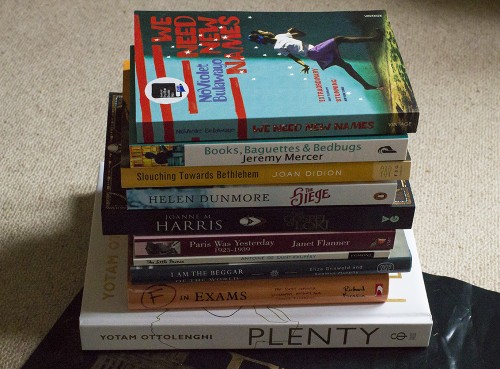
christmas-books-2014

Christmas presents:

We Need New Names by NoViolet Bulawayo
Books, Baguettes and Bedbugs by Jeremy Mercer
Slouching Towards Bethlehem by Joan Didion
The Siege by Helen Dunmore
The Gospel of Loki by Joanne M Harris
Paris Was Yesterday by Janet Flanner
The Little Prince by Antoine de Saint-Exupéry
I am the Beggar of the World edited by Eliza Grimwald and Seamus Murphy
F in Exams by Richard Benson (joke book that made me cry with laughter)
Plenty by Yotam Ottolenghi (recipe book of great great beauty)
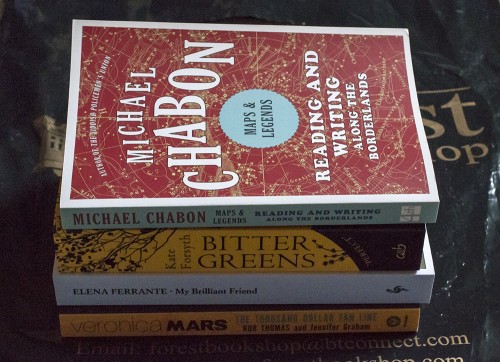
birthday-books-2015

Birthday presents:

Maps and Legends: Reading and Writing Along the Borderlands by Michael Chabon
Bitter Greens by Kate Forsyth
My Brilliant Friend by Elena Ferrante
Veronica Mars: The Thousand Dollar Tan Line by Rob Thomas and Jennifer Graham
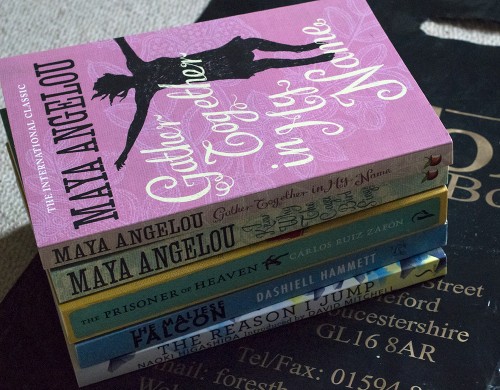
bought-books-2014

And as if that wasn’t enough, I treated myself (thoroughly encouraged by Tim, I might add) to not one but three forays into tiny but brilliant bookshops – the Melton Bookshop, the Forest Bookshop and Durdham Down Bookshop, all of which deserve blog posts dedicated to them that I will eventually get round to. I restricted myself to one or two books from each because I do have some guilt about the TBR being at its biggest point ever since I started keeping track, but I also want to support every great bookshop I pass. My purchases were:

The Reason I Jump by Naoki Higashida (which I read within 48 hours of buying it; I’ll review it soon)
The Maltese Falcon by Dashiell Hammett (book club for February, so it’s a totally sensible purchase)
The Prisoner of Heaven by Carlos Ruiz Zafón (because Cemetery of Forgotten Books!)
I Know Why the Caged Bird Sings by Maya Angelou (I think I read this years ago but didn’t own a copy so while I was picking up the next volume, I figured I should start a matching set)
Gather Together in My Name by Maya Angelou (look: it’s so pretty!)

Kate Gardner Blog

Sunday Salon: Christmassy book thoughts

December 14, 2014December 14, 2014 4 Comments

The Sunday SalonIt’s the last weekend before the Christmas holiday starts in the Nose in a book household, so I was expecting to be madly Christmas shopping or present wrapping, but I seem to have already bought everything I can until certain family members respond to my questions, so instead the weekend has been spent hanging out with friends, reading and binge-watching a TV box set that I’m not going to name because we’re about five episodes from the end and I really don’t want it spoiled for me!
One thing I did spot while doing my Christmas shopping was this rather lovely charitable giving project from Blackwells bookshops: the Giving Tree, donating books to less fortunate children. If I can get to a Blackwells in person I’d love to help pick out a book myself but if I can’t I’ll entrust the choice to their booksellers who, let’s face it, know what they’re doing.

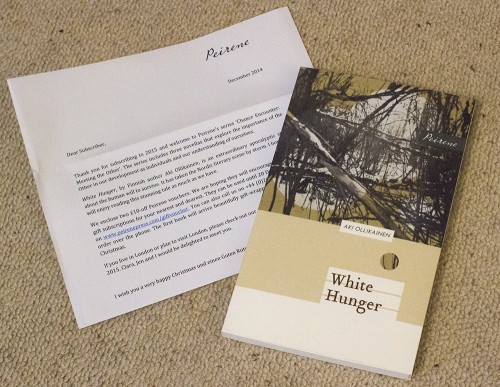
It’s a timely reminder that not everyone is in the fortunate position I’m in where I have more books than I can read in a year already piled up invitingly. And I keep buying more for myself! Though I try not to do too much of that around Christmas, this week I did receive my first book from my Peirene Press subscription, which I bought as a present to myself last month. Because I just couldn’t keep resisting these beauties.

peirene

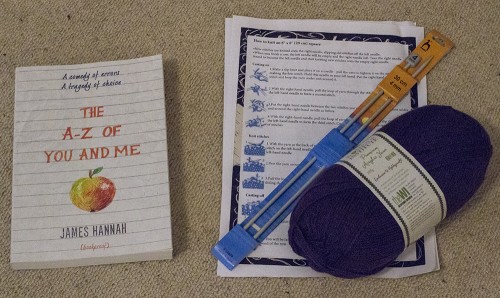
And last week I also received this rather fun advance reading copy of a book being published early next year, along with a kit for knitting a square of a blanket that I can only assume will be gigantic if every reviewer does that part as well. As an enthusiastic amateur knitter how could I not join in this project? They judged me well when they sent that invite! Keep an eye out early next year for my knitting and my review.

a to z of me and you proof

Kate Gardner Blog

Holiday in France: books, books, books

October 12, 2014 1 Comment

As I’ve mentioned, on holiday last month I didn’t get much reading done, but being a booklover that in no way diminished my desire to buy more books. It’s not a problem, it’s just who I am. Anyway, my book acquisitiveness was largely kept in check by us staying in the middle of nowhere without any bookshops accessible. However, I did have two major temptations.

Untitled The bluest sky

Like their British counterparts, most French supermarkets have a book section stuffed with bestsellers, both French and international. This is not the place to find English-language books so the temptation here came down to my confidence in my French reading ability. Once upon a time my French was pretty good. I worked for a summer in Burgundy as an au pair and then when I came home I got a couple of jobs in a row that needed a little French and German. However, that was 14 years ago and I really haven’t kept my hand in. Every time we went to a supermarket on holiday I had a quick browse of the books and tried to decide whether I wanted the new Amélie Nothomb book in French. But the one time I was seriously honestly tempted was when I found an older Amélie Nothomb book, Stupeurs et Tremblements, which I own and have read in English and I figured I could refer to the translation whenever I struggled with it in French. After a lot of dithering, though, I decided that sounded more like work than fun.

The second temptation was harder to resist. Tim’s parents took us to an English tea room and bookshop. We enjoyed tea and scones and browsed the books. It was an interesting selection, clearly influenced by the reading tastes of the local English-speaking ex-pats. I skipped right past the large military history section but there was plenty to excite my bibliophilia in the fiction section. What prevented me from leaving with an armful of books, or even just one, is that I didn’t have any steer as to what to buy. I didn’t see any authors I already love or books already on my wishlist; there were no staff recommendations; I didn’t even see books I have heard praised in the numerous blogs I follow, podcasts I listen to or newspapers and magazines I read. Is this what it’s like for less bookish people every time they walk into a bookshop? A feeling of vague directionless desire? Weird.

At this point I should come clean. What made it easier to resist both of these temptations was that when we arrived at Tim’s parents’ house, his mum told me that she is thinning out her vast book collection and that I should help myself to as many as I liked of the ones she was discarding. In fact, she was even going to make it easier for me by picking out books she thought I would like. And that is the best kind of recommendation: from someone who has not only read and enjoyed a book, but also overlaps your reading taste and knows where that overlap is. Really, it’s amazing I only picked out six books!

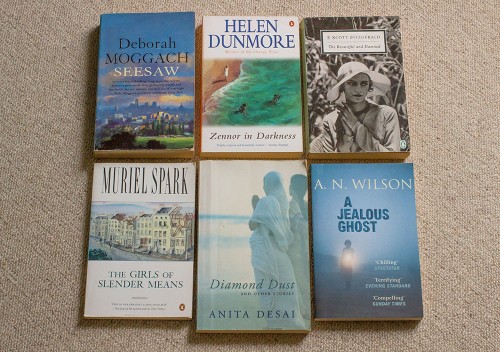
france-books-web

Maybe one day I’ll get that TBR down to a small bookcase, rather than overflowing a large one, but I can’t imagine ever not going out and looking for new books!

Kate Gardner Blog

You had to have a lot of time left if you were going to start reading Bolaño

September 21, 2014 2 Comments

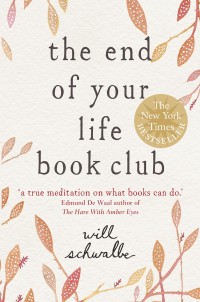
The End of Your Life Book Club

The End of Your Life Book Club
by Will Schwalbe

After this book received universally good reviews from people I trust/have similar taste to (there’s a strong correlation there; I should probably investigate that sometime) I knew I would read it eventually, but I worried it would be super depressing. The “end of your life” part of the title is not euphemistic; it really is about the end of someone’s life. But it was a surprisingly entertaining, easy read. I’m not saying I didn’t get sad at all; I’m not that cold-hearted.

This is a memoir written by American publisher-turned-journalist Schwalbe about the books he and his mother Mary Anne read together when she was dying of cancer. They knew from her first diagnosis that the cancer was terminal, so there is no question how the book will end. This gives the book a largely matter-of-fact background of chemotherapy, pain relief and other palliative care, but also the emotional side of dealing with and preparing for death.

“I was fine until right after I fastened my seat belt. For me, there’s something about planes that isolates and intensifies sadness, the way a looking glass can magnify the sun until it grows unbearably hot and burns.”

The gradual change (for both Will and Mary Anne) from denial to anger to acceptance is clear without being overtly discussed. By which I don’t mean that they ever deny her diagnosis or expect a magical turnaround, but initially they don’t discuss death at all, they just get on with the surgery and trying out different chemo drugs. However, it is of course there the whole time. In fact, when Mary Anne is diagnosed, her daughter, Will’s sister Nina, is about to move to Switzerland with her family and must make the decision whether or not to go, which of course boils down to: does Mary Anne have weeks left or years?

This uncertainty is something I haven’t really read about before, though I know (and have known) people for whom it is true, and it is in some ways harder on the family than the fact of death itself. How far ahead do you allow yourself to plan? Do you book holidays? Do you throw great big birthday and other celebratory parties because they might be the last one with her? Following Mary Anne’s lead, the family slowly figure all these things out – while she can, she wants to do everything she can, including continuing to work and travelling abroad. As her health worsens and her energy levels drop, plans simplify and are built around what she can and can’t do.

“Those extraordinary chemicals, with their remarkable names, now sound totally different: Gemcitabine. Xeloda. Before they sounded like harsh detergents. Now they sound cool and magical, like a new rock band you’ve come to love.”

Mary Anne was a wonderful, inspiring woman. In fact, the whole family are and made me feel quite inadequate at times, but Mary Anne especially. After responding to an unsolicited begging letter from a nun, she quit a very good, secure job as the head of a New York girls’ school to start a charity for women refugees. She travelled to many of the least desirable parts of the world to meet for herself the people she was helping. The danger that she had put herself in time and again is brought home by the fact that during the timeline of this book, a friend and colleague of hers is held hostage by the Taliban in Afghanistan.

But most importantly, of course, at least for this to be the book that it is, Mary Anne and Will share a deeply ingrained love for books. They discuss the books they read in depth, which appears to be something they have always done, but the difference now is twofold – they are choosing to read the same books, even calling it a book club, and they are spending more time alone together than perhaps ever (Will is the middle of three children, after all) as Will accompanies Mary Anne to the doctor, to chemo and spends more time with her at home. (I should add here that so too do Will’s father, brother and sister and all their partners, but this book is about Will and his mother and their time together.)

“In the summer, Mom and I had read slender books. Now we were reading one long book after another. Maybe that was one way of expressing hopefulness—you had to have a lot of time left if you were going to start reading Bolaño, or Thomas, or Halberstam…I remarked to Mom how all the books we were reading then shared not just length but a certain theme: fate and the effects of the choices people make.”

The books they read are many and varied, though fairly firmly literary. Each chapter is named after a book that was of particular significance but the full list of books discussed is provided as an appendix and is six full pages long. You don’t need to have the books to follow the discussions of them but when it was a book I’ve read, I did feel a little glow of “I’ve read that! I could join this conversation!” The book discussions tend not to be so much about the style or quality of writing, but more about the subject matter. Often Will uses a book as a jumping-off point to tell us about Mary Anne’s life or anecdotes from earlier in their life together.

Ridiculously, considering the situation, I found myself at times jealous of the relationship Will and Mary Anne have through books. Not that I’m not close to my Mum. In fact, she gave me this book, which at the time I didn’t twig was especially significant. But currently we have very different taste in books. She likes memoirs/biographies to the exclusion of all else, so I don’t think we could come up with a very long list of books to share. Then again, this is of course a memoir and I really liked it, so perhaps I should lend it to her and have a mini book club next time we see each other. Hmm… But back to the review…

This feels like a very honest book. We learn about Will’s life, about the books he didn’t finish reading even though Mary Anne was eager to discuss them, about the blog that Mary Anne wrote in Will’s name to keep their extended family and friends up to date with her health (she felt it wouldn’t be suitable for it to written by her!) and about Will and Mary Anne’s different attitudes toward religion, plus of course about the long slow decline of terminal cancer. In the end, it was sad but not heartbreaking. I’m not sure if this is because Mary Anne was in her 70s and had lived a rich and full life, or if it is down to the way Will writes about her, about how intellectually sharp and full of hope and kindness she remained to the end.

I think Schwalbe found the right combination of topics here, so that it isn’t all about pain and suffering, or sorrow and self-reflection, or a biography of a great and inspiring woman, or even just about great books, but instead it’s a book that pays tribute to Mary Anne and appeals to the intellectual and emotional draw of books, while also dealing with a tough subject that we will all have to face up to at some point. He also found the right balance between writing about the pain and difficulty of his mother’s slow death and the positive side of the situation: he had the warning to start spending more time with his mother, and had rich, rewarding times with her at the end of her life.

I don’t think Schwalbe is himself a great literary writer, so this doesn’t have the writerly quality of Joan Didion’s memoir The Year of Magical Thinking, say (which in fact is one of the books discussed), but I suppose that makes this book more accessible and serves as a reminder that not every avid reader is also a great writer. I can’t see myself checking out Schwalbe’s book about e-mail, but I do think that if I read books covered in The End of Your Life Book Club I might well come back to it to remind myself what Will and Mary Anne had to say!

First published 2012 by Hodder & Stoughton.

Source: A Christmas present from my Mum.

Kate Gardner Reviews

August reading round-up

August 31, 2013September 2, 2013 2 Comments

Doesn’t summer speed by? Though I’m hoping for a few more weeks of sunshine, and though it’s many many years since I left school, I still tend to think of 31 August as the last day of summer. I will be picking out some autumnal reads for September, whatever the weather. Maybe a murder mystery.

This month I got back on track with short stories, though I didn’t finish all the novels I’d planned to. I saw Margaret Atwood talking about her new book, which was pretty darned great. And Tim and I celebrated 11 years together. A third of our lives. That’s kinda crazy. We were so young back then!

2002 was a long time ago

Books read

White Tiger by Aravind Adiga (review here)

The Ministry of Fear by Graham Greene (review here)

The Year of the Flood by Margaret Atwood (review here)

All Dogs Are Blue by Rodrigo de Souza Leão (review here)

Smoke and Mirrors by Neil Gaiman (review to follow)

Short stories read

“An inch and a half of glory” by Dashiell Hammett (New Yorker, June 10 & 17, 2013)

“From the diaries of pussy-cake” by Gary Shteyngart (New Yorker, June 10 & 17, 2013)

“Twisted” by George Pelecanos (New Yorker, June 10 & 17, 2013)

“Rough deeds” by Annie Proulx (New Yorker, June 10 & 17, 2013)

“Slide to unlock” by Ed Park (New Yorker, June 10 & 17, 2013)

“A & P” by John Updike (New Yorker Fiction Podcast)

“The twain” by Fabian Acker (Popshot Magazine, Issue 9)

“How to be a writer” by Kirsty Logan (Popshot Magazine, Issue 9)

“Together and parting” by Elahzar Rao (Popshot Magazine, Issue 9)

“Spine” by Patrick Griffiths (Popshot Magazine, Issue 9)

“The ingenium” by Kirstie Smith (Popshot Magazine, Issue 9)


So how has your August been? Any plans for September?

Kate Gardner Blog

Book spine poetry

August 20, 2013 2 Comments

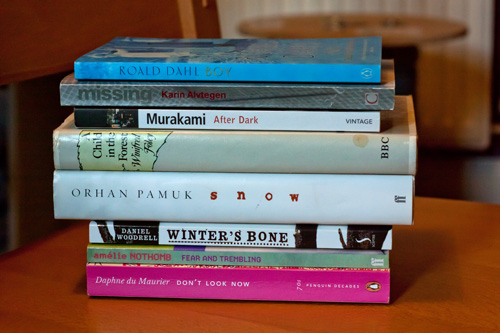
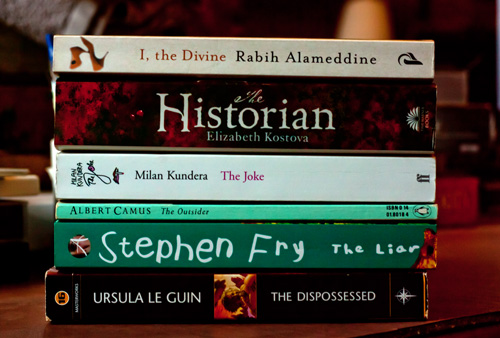
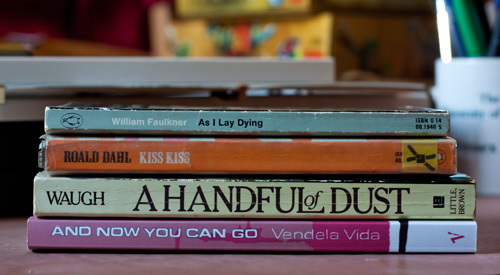
I know, I know, book spine poetry was big back in 2011. But I didn’t get round to it back then and I had a sudden urge to have a go, so here are my rudimentary attempts.

Poem one

Boy missing, after dark
A child in the forest
Snow, winter’s bone
Fear and trembling
Don’t look now

Poem two

I, the divine,
The historian, the joke,
The outsider, the liar,
The dispossessed

Poem three

As I lay dying
Kiss kiss
A handful of dust
And now you can go

So have you ever tried creating poetry from book titles? Please do share links to yours or your favourites from other people.

Kate Gardner Blog

Featured today on Savidge Reads: me

January 17, 2013 1 Comment

Just a quick post to say that if you want to learn a little about me and my books, take a look over at Simon’s blog Savidge Reads where I’m today’s featured blogger in his series Other People’s Bookshelves.

I can also recommend checking out the rest of the series, because who doesn’t like having a nosy of other people’s bookshelves?

Kate Gardner Blog

Sunday Salon: Keeping track

January 13, 2013January 13, 2013 6 Comments

The Sunday Salon

I spotted an open invite recently to complete a survey about book blogging and it highlighted something that had already begun to concern me – I don’t keep track of where my books come from.

I would guess that the majority (or at least a large proportion) of my books were given to me as presents but if the giver didn’t write a note on the inside cover (which they rarely do), I have no record of this and when I come to read the book a year or more later I have invariably forgotten whose kind present it was. This is sad both in terms of me being able to show full appreciation and in terms of the lost memory.

So I have decided to tackle this in two ways. One, all new books added to the TBR shelves get a little note written in them about where they came from. And all my reviews this year will include a mention of the source of the book.

If I can, that is. Where I have happened to blog about book buying I should have a reminder of when I bought books for myself, so with a little bit of memory power more recent additions should be easy to identify, but what about those books that have sat unread for four, five or more years? I’ll have to get delving through all the old photographs of birthdays and Christmases to see what I can deduce!

Do you keep note of where your books came from? Do you write anything in the books themselves? What about when you’re the one giving books as presents?

Kate Gardner Blog

Sunday Salon: New year, new books

January 6, 2013January 6, 2013 11 Comments

The Sunday Salon

Every year when my family asks what I want for Christmas and my birthday (they’re pretty close together) I give them a wishlist that is 90% books and every time I have to reassure them that yes, books really really are what I want. You’d think they’d learn. Thankfully, they know me well enough to buy me said books, in addition to a few useful things.

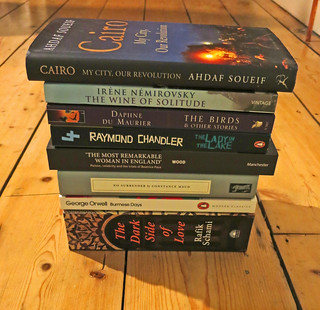
Even though I already own 120 or so unread books and a couple of thousand read books that I have kept because I want to re-read them some day, it makes me super happy to see this stack of new books.

Christmas books

If you can’t quite read those spines, the books are:

Cairo: My City, Our Revolution by Ahdaf Soueif
The Wine of Solitude by Irène Némirovsky
The Birds and other stories by Daphne du Maurier
The Lady in the Lake by Raymond Chandler
The Most Remarkable Woman in England by John Carter Wood
No Surrender by Constance Maud (that’s the pretty Persephone edition)
Burmese Days by George Orwell
The Dark Side of Love by Rafik Schami

And despite already having all of those lovely new books, I tripped and bought a book yesterday – the first trade paperback volume of Sandman by Neil Gaiman (and if I like it there’s 11 further volumes to buy!) – while Tim was picking up his latest comics and earlier this week I ordered a book from Abe Books to complete my collection of the Claudine series by Colette. Can I help wanting to give a loving home to all the books?

Oh, and I also received a belated Christmas card via the Book Bloggers Holiday Card Exchange. This one is from Vasilly and came in a very pretty shiny envelope and contains a great quote about reading.

Card exchange prettiness

Yay, I love Christmas and birthdays! Just eleven and a half months to go to the next time. Did you get any great books lately?

Kate Gardner Blog

It is the ideas and stories that count

December 9, 2012 4 Comments

Stop What You’re Doing and Read This!
by various authors

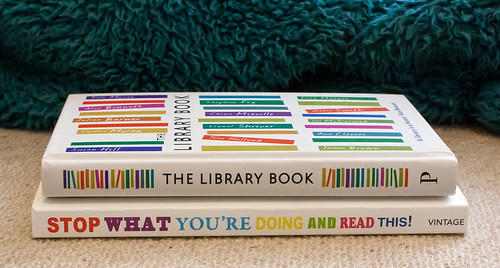
Slightly meanly, I think, the publisher has not credited anyone as the editor of this collection of essays on the topic of reading. Even the introduction is simply signed “Vintage Books, 2011”. I bought this book on a whim at the same time as The Library Book, as they were both pretty and colourful and contained essays by interesting people.

Foyles haul

I think it’s probably not surprising, then, that my reaction to this book is very similar to my reaction to The Library Book. Hit and miss. But perhaps to more of an extreme in this case. The hits had me nodding my head furiously, while the misses in some cases had me furious.

I like that the 10 essays are not only written by big names. They include novelists, poets, publishers, journalists, academics and the founder of a charity, the Reader Organisation. And the wide topic allowed them to take very different angles. Blake Morrison writes intelligently and profoundly about the pleasures and benefits of reading, including why poetry matters:

“It takes courage to own up to dark thoughts and dangerous feelings. But poetry – the most intimate yet public of forums – is the ideal place. Ted Hughes is one writer who recognised this. Writing, he said, was about facing up to what we were too scared to face – about saying what we would prefer not to say, but desperately need to share.”

This illustrates what my favourite of these essays do well – they quote widely, creating a whole reading list for me within their few pages of eloquent argument. Carmen Callil writes interestingly about books in her life and how being a woman in a man’s world led her to found Virago. She shows a great, warm love for books. Tim Parks, in contrast, goes negative. He generalises the average westerner as someone who either doesn’t read or only reads the latest big title:

“If we read fast, superficially, for plot, to get through, so as to congratulate ourselves…we’re not only missing out on certain pleasures, we’re actually putting ourselves at risk, leaving ourselves open to messages and attitudes we haven’t weighed up…”

Not only is this quite ungenerous, not to say judgemental, but I also think it’s wrong. Different books have different effects on us and who is he or I to tell someone that they shouldn’t read a certain book because we didn’t get anything from it? Thankfully Mark Haddon says entirely the opposite:

“This, I think, does a disservice both to readers and to the books themselves…because it’s not true. Visit a prison library and you’ll meet good people whose lives have been saved by potboilers, and psychopaths reading Jane Austen.”

But Haddon also writes intuitively about the act of reading itself:

“Stop reading right now. Look around you…The sense of being inside looking out, of seeing a world that belongs to everyone, but is nevertheless yours alone. It is this uncrossable gulf between me and not-me, between my private experiences and yours, which lies at the heart of being human and which no other medium can touch, and this border is where the novel lives and moves and has its being.”

And then Jeanette Winterson went and ruined it by returning to Parks’ snobbery and turning it up to 11. She goes from praising the King James Bible and Shakespeare to:

“We live under 24/7 saturation bombing from an enervated mass media and a bogus manufactured popular culture. If you don’t read you will likely be watching telly, or on the computer, or listening to fake music from puppet-show bands…The consequences of homogenised mass culture plus the failure of our education system and our contempt for books and art (it’s either entertainment or elitist, never vital and democratic), mean that not reading cuts off the possibility of private thinking, or of a trained mind, or of a sense of self not dependent on external factors…Attention Deficit Disorder is not a disease; it is a consequence of not reading.”

What?!! There is so much wrong with these statements. That last sentence…whooah! Has she ever expounded her theory to a doctor or ADHD specialist? I’d be interested to hear their response! I mean, I think reading is important and rewarding, but that really is taking it too far. And as for her comments on modern pop culture, well that’s her own personal taste and to extrapolate from her dislike to such disparagement is unkind and even ignorant. Music can transport me, make my heart race and my emotions surge – and I don’t mean classical music here, I mean rock, folk, dance and pop music. Not every song, or course, but plenty that I am sure Winterson would turn her nose up at. And let’s not forget that Shakespeare was the pop culture of his day.

I think in general it is a stubborn clinging to the past that frustrated me. A few of the essayists write about how the physical printed book is intrinsically better than ebooks, and how new technology and mass media threaten today’s youth and therefore the entire world. Personal preference is one thing, but I think we have to face up to the fact that we live in an age of transition and be positive about the possibilities the future offers. The final essay by Maryanne Wolf and Mirit Barzillai addresses this well:

“The Greek transition from an oral culture to a literacy-based culture provides a valuable analogue…Socrates argued that the seeming permanence of the printed word would delude the young into thinking they had accessed the essence of some aspect of knowledge, rather than simply decoded it…Will [today’s] young people immersed in technological innovation become adept at prioritising, sorting and critically evaluating information, adapting different types of reading styles based upon their purpose…Will the flexibility of digital text actually enhance the reading experience for many readers, propelling them into a deeper engagement with text, or will such enhancements serve as further distraction?”

I accept that my own preference for reading novels in hard copy is a product of my life to date, but I didn’t exactly dislike my brief dalliances with a borrowed Kindle and I absorb most of my journalistic writing via computer these days. I think a love of music, film, TV, comedy and theatre complements my love of reading, rather than detracting from it (though I won’t deny that they are all competing for my time). I think reading is important, valuable and worth encouraging in others but it is not about to disappear. As Callil says in her essay:

“The human race has been telling stories, and trying to record them on papyrus, on manuscripts, on stones, since the beginning of time. Whether we read on the printed page or on a machine is beside the point. It is the ideas and stories that count.”

Published 2011 by Vintage.

Kate Gardner Reviews

Posts pagination

1 … 7 8 9 10

Archives

RSS Nose in a book

  • Book review: Interstellar Megachef by Lavanya Lakshminarayan
  • May 2026 reading round-up
  • Book review: Passing by Nella Larsen

Me on the internets

  • @kate_in_a_book@mas.to (Mastodon)
  • Flickr/noseinabook
  • Instagram/kate_in_a_book
  • StoryGraph/kate_in_a_book

Categories

  • Blog
  • Reviews
  • Uncategorized
Proudly powered by WordPress | Theme: Dream by vsFish.