Nose in a book

Reviews and other ramblings

  • Home
  • Reviews archive
    • Book reviews
    • TV reviews
    • Theatre reviews
  • TBR
  • Challenges
    • The Classics Club
    • 2014 Popular-Science Reading Challenge
    • Cookery challenge
    • The Gilmore Girls Reading Challenge
    • 2013 TBR Pile Challenge
    • 2013 Translation Challenge
    • Crime and Punishment read-a-long
  • About
    • Cookie legal stuff
  • Home
  • Reviews archive
    • Book reviews
    • TV reviews
    • Theatre reviews
  • TBR
  • Challenges
    • The Classics Club
    • 2014 Popular-Science Reading Challenge
    • Cookery challenge
    • The Gilmore Girls Reading Challenge
    • 2013 TBR Pile Challenge
    • 2013 Translation Challenge
    • Crime and Punishment read-a-long
  • About
    • Cookie legal stuff

Tag: biography

Book review: A Hope More Powerful Than the Sea: the Journey of Doaa Al Zamel by Melissa Fleming
March 15, 2023 1 Comment

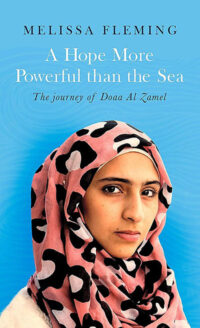
A Hope More Powerful Than the Sea book coverI’m a little unsure how to feel about this book. Melissa Fleming is a UNHCR bigwig and she wanted to draw attention to the plight of refugees by highlighting one true story. The one she chose is a doozy. A Hope More Powerful Than the Sea: the Journey of Doaa Al Zamel is an action-packed and informative tale. But right from the start I had some concerns.

Doaa Al Zamel had certainly been through the wringer by the time Fleming met her. She is Syrian, an educated young woman from a middle-class family. She had a place waiting for her at university in Damascus and took place in anti-government demonstrations during the Arab Spring, until the civil war made life intolerable in her home city Daraa.

The Al Zamel family fled to Egypt, where they were initially well looked after, before the sheer number of refugees turned the tide of public opinion and national policy. Doaa and her fiance – a fellow Syrian refugee she met in Egypt – tried to escape across the Mediterranean via people smugglers no less than three times before her final horrific journey ended in one of the worst shipwrecks in the Mediterranean. Doaa became a minor celebrity as the Italian press lauded her role in saving a baby.


Continue reading “Book review: A Hope More Powerful Than the Sea: the Journey of Doaa Al Zamel by Melissa Fleming”

Kate Gardner Reviews

My father bleeds history

November 17, 2019November 17, 2019

Maus cover

The Complete Maus
by Art Spiegelman

I’m not sure what this says about my state of mind, but for some reason the celebrations surrounding the anniversary of the fall of the Berlin Wall last weekend made me pick up this book that famously covers some of the worst stories of the Holocaust. It’s a deeply upsetting book that I had to take breaks from to recover emotionally.

Art Spiegelman’s celebrated graphic novel alternates between telling the story of his father Vladek – a Polish Jew – from the 1930s to the late 1940s, and the story of Art’s own relationship with his father in the 1980s. It’s darkly sad and darkly funny. Oh – and all the people have animal heads. Jewish people are mice, Polish people are pigs, Germans are cats (later on, Americans are dogs and the French are frogs). It’s odd and it isn’t really ever explained, but the insinuations are clear.

Art and Vladek have a fractious relationship. Vladek is happy to tell his son details of his war-time experiences, but he also needs someone to vent to about getting old, about arguments with his second wife Mala. It’s uncomfortable to read at times.

Vladek narrates his history in broken English. And it’s a tough story, even in Holocaust terms. Vladek and his first wife (Art’s mother) Anja lived in south-west Poland, near Krakow. They went from owning a large successful business, to having their home and factories confiscated, to being moved to a series of ghettos and then work camps. Vladek was initially held as a political prisoner but was released back to the ghetto, primarily because political prisoners enjoyed some level of international protection.

Continue reading “My father bleeds history”

Kate Gardner Reviews

I began to wonder why Man had evolved at all

September 13, 2016

letters-from-menabillyLetters from Menabilly: Portrait of a Friendship
by Daphne du Maurier and Oriel Malet

I bought this book while we were on holiday in Fowey back in July. It’s described on the cover as written by Daphne du Maurier, edited by Oriel Malet, but Malet’s contribution is far more than editing du Maurier’s letters.

Malet was in some ways du Maurier’s opposite: a fellow writer, she was critically lauded but never sold well; where du Maurier was such a homebody she even resisted trips to London to do research, Malet moved to Paris to live out the dream of being a true artist. They first met at a publishing party in the early 1950s, when du Maurier was in her 40s and Malet in her 20s. Du Maurier took the younger author under her wing, inviting her to stay at Menabilly when she became unwell and needed to get out of London.

The book opens with a glossary of Daphne du Maurier “codewords” and the letters are indeed riddled with them, from “Tell-Him” for a long boring story, to “Silly Values” for anything selfish, superficial or materialistic, and most notably “Peg” for a person in real life who inspires a fictional character. Malet provides a fairly lengthy introduction to their friendship, including a detailed description of her first visit to Menabilly, but that isn’t her only interjection.

Continue reading “I began to wonder why Man had evolved at all”

Kate Gardner Reviews

I may have written far too much this time

October 27, 2010March 11, 2012 5 Comments

Becoming Drusilla
by Richard Beard

This isn’t an easy review to write. For a start, the book is about a friend of a friend, fellow blogger Dru Marland. If my friend likes her, then I’m predisposed to like her too. Which means I didn’t approach this book neutrally. But then when do we ever? Aren’t we always biased or conditioned in some way that we probably don’t even realise? That’s the kind of question this book asks a lot. It’s very well written but a little tiring.

What started out as a biography, written by Dru’s good friend Richard, turned more into Richard’s story of his own attempts to understand Dru. Or, more specifically, Dru’s decision to become a woman.

Dru was born male and transitioned to female in her 40s. She and Richard had been friends for many years, sometimes going off on camping and walking holidays together, and the announcement that she was going to start living as a woman came as a shock to him. They remained friends through the years of Real Life Experience, hormone treatment and gender reassignment surgery, not to mention divorce, family rejection, workplace troubles, cruel newspaper articles and public taunts and stares.

A couple of years after the surgery, they went on a fortnight’s walking holiday, their first since Dru became Dru. The book is structured around that holiday, using their journey across Wales as a metaphor both for Dru’s transition and for Richard’s understanding. Which is a little cheesy, and also initially confusing because it means that there are three timelines – the holiday (2 weeks), the transition (7 years), Dru’s life (49 years at the time of writing, I think). There were also frequent breaks from the story for facts – statistics; details of how gender reassignment works on the NHS, privately and in some other countries; quotes from autobiographies and biographies of other transsexual women; and other research that he has done, which there’s a lot of. A lot of this was absorbing but I’ll admit that I found the quotes superfluous. I get that this background reading was an important part of Richard’s attempt to understand, but I didn’t find a quote about someone going through gender reassignment in the 1970s all that relevant. Not only was the world very different then, but it’s also not Dru’s story. And Dru’s story is a fascinating one, even without including the sex change.

This book is a thorough examination of its subject and it’s sensitively done. Obviously, Dru’s his friend. Their friendship is very sweet and engaging. And yet Richard doesn’t shy away from asking difficult questions. In fact he’s far braver than most people would be, I suspect. He not only probes into every aspect of Dru’s transition, he also probes himself for his own feelings about the whole thing and he’s startlingly honest. For every potential insult of Dru (is she deluded? mentally unbalanced? too masculine-looking to pass as a woman?) there’s an equally negative question aimed at himself (am I scared to be seen with her in public? because I think it’s obvious that she has changed gender and people will judge me for being with her? because I think she’s not an attractive enough woman to appease my masculinity? because I’m irritated by her not trying hard enough to be feminine, even if it has been a long arduous day of walking in the rain?).

Richard asks more general questions as well – how much of gender identification is down to social conditioning? how much influence do the parents have? is sexual orientation a factor? Some of which can’t be answered. And there are questions that Dru can’t or won’t answer. So while we discover Dru’s full biography and almost none of Richard’s, we come away having got to know Richard just as well, if not better.

All those probing questions forced me to ask some difficult questions of myself. Did I want to read this book just because it’s about sex change? Why is that of particular interest? Is it because it’s something I haven’t experienced and I want to know about all things human? That would be acceptable. Or does it have a particular draw for some darker reason? A voyeuristic preoccupation with men dressing as women, like in all those TV shows (transvesticism does seem to have a certain place in British humour), perhaps. Did I want to read it because it’s about Dru, who I have come across in a few places on the internet and found engaging?

I’d like to think that I am completely accepting of transsexual people, that I agree with the medical view that gender dysmorphia is a real condition and that the best cure is to “give them what they want”, as Richard puts it. And from a distance that’s absolutely true. I also think it’s very brave to go through something that’s so alien to other people, that requires constant explanation and effort, for the rest of your life, that’s physically difficult and painful, though those involved clearly feel that the alternative is worse. But up close, do I stare? Do I comment to my companions that I think that woman over there might not be “real”? Or if someone else points that out to me, do I eagerly watch for the clues that they saw before me? I honestly hope not, and if I ever do, I am deeply ashamed of it, but can it be helped? Aren’t we all conditioned to try to fit in and reject what doesn’t seem to conform?

One thing that really hit me about this book probably says a lot about me and my confusion on this topic. Richard casually mentions that the name most commonly chosen by transsexual women in the UK is Kate. By quite some way, apparently. Which caught my attention for obvious reasons. On one level I find that very interesting and am curious why it’s top of the list. Is it for any of the same reasons that my parents chose it for me? Not so much the “short and simple enough for my then-toddler sister to pronounce without difficulty” but more the unambiguously female, familiar and popular, timeless. Or is it for reasons that my parents probably didn’t consider? It’s definitely a girl’s name but it’s not soft and feminine. There are many famous examples, maybe including people who some transsexual women admire or aspire to. On another level I definitely experienced a moment of annoyance. Why must they choose my name? Which is significantly less accepting than I thought I was. I can justify myself a little bit by pointing out that I have always been annoyed by how common my name is, but that’s not much of an excuse.

I found this book engrossing, I greatly enjoyed it, but I didn’t tear through it and did sometimes put it down for days at a time because Richard’s self-examination can’t help but prompt a person like me to self-examine as well and it’s exhausting, challenging and a little scary to reveal yourself, even to yourself. Which makes what Richard did pretty brave in my view. It’s also reassuring that everything I could think and question about this topic and far more is covered. It’s not just me. And if the close friend of a transsexual woman admits to these thoughts then it’s probably okay for me to think them too.

I definitely recommend this book if you’re interested in friendship, the everyday life of someone who’s in some way “different”, gender roles and self-examination. Is it alright to recommend it to people who are interested in gender dysmorphia? Should I stop with these questions now?

By some kind of fortuitous timing, Dru and Richard have just launched a new joint website, Being Drusilla. Check it out!

Published 2008 by Harvill Secker, a division of Random House

Kate Gardner Reviews

Archives

RSS Nose in a book

  • Book review: Interstellar Megachef by Lavanya Lakshminarayan
  • May 2026 reading round-up
  • Book review: Passing by Nella Larsen

Me on the internets

  • @kate_in_a_book@mas.to (Mastodon)
  • Flickr/noseinabook
  • Instagram/kate_in_a_book
  • StoryGraph/kate_in_a_book

Categories

  • Blog
  • Reviews
  • Uncategorized
Proudly powered by WordPress | Theme: Dream by vsFish.