Nose in a book

Reviews and other ramblings

  • Home
  • Reviews archive
    • Book reviews
    • TV reviews
    • Theatre reviews
  • TBR
  • Challenges
    • The Classics Club
    • 2014 Popular-Science Reading Challenge
    • Cookery challenge
    • The Gilmore Girls Reading Challenge
    • 2013 TBR Pile Challenge
    • 2013 Translation Challenge
    • Crime and Punishment read-a-long
  • About
    • Cookie legal stuff
  • Home
  • Reviews archive
    • Book reviews
    • TV reviews
    • Theatre reviews
  • TBR
  • Challenges
    • The Classics Club
    • 2014 Popular-Science Reading Challenge
    • Cookery challenge
    • The Gilmore Girls Reading Challenge
    • 2013 TBR Pile Challenge
    • 2013 Translation Challenge
    • Crime and Punishment read-a-long
  • About
    • Cookie legal stuff

Tag: autobiography

Leaving a vacuum in the air where his voice had been
October 24, 2015

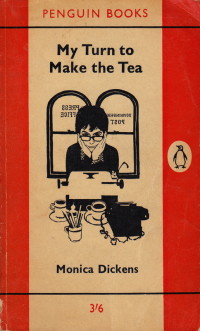
My-Turn-to-Make-the-TeaMy Turn to Make the Tea
by Monica Dickens

I have been looking forward to reading my beautiful if slightly fragile copy of the 1962 Penguin reprint of Dickens’ memoir of her year working for a local newspaper. Though it’s the first printing from this classic orange-and-white edition, it’s too tattered and stained to be worth anything. But I do love the knowledge that this has been read by a series of people over 53 years. That’s pretty cool.

Dickens is funny and open, delighting in revealing the details of her life as a “cub reporter”. This includes life in her rented room, and the relationships between the building’s various tenants, as well as the intricacies of a hokey local newspaper.

“I put away my things and tried not to feel bleak. My first night in that room stretched before me with too many hours, and I found that I was looking forward to going to work tomorrow. At the Munts’, I had often craved solitude, and dreaded hearing the creak of the stair and the whimsical tattoo on my door that meant Mrs Munt had come up for a pow-wow, but up here on the top floor, a stranger to the rest of the house, I felt unwanted and alone.”

Continue reading “Leaving a vacuum in the air where his voice had been”
Kate Gardner Reviews

The essence escapes but its aura remains

July 28, 2015

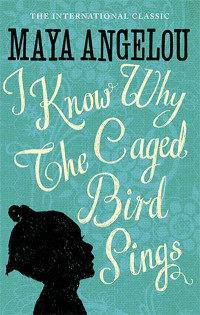
i know why the caged bird singsI Know Why the Caged Bird Sings
by Maya Angelou

Once again, I thought I had read this before and that this would be a re-read, but nope, it was all new to me. I guess that sometimes happens with much-talked-about books. Anyway, now I actually have read it and it is just as amazing as everyone always said it is.

This is the first book in Maya Angelou’s seven volumes of autobiography, covering her childhood in Arkansas and California. Hers was an eventful life, and yet her writing is beautiful enough that the book hardly needs events to make it a great read.

Angelou was sent with her brother to live with their grandmother when she was three, and this is where her story begins. She was very aware of her status as a black girl with a plain face and writes with a tense humour about the white side of town. But she had a comfortably-off family (her Momma ran a successful general store) relative to many others in Stamps, Arkansas – a downtrodden, dirt-ridden place from her descriptions.

“A light shade had been pulled down between the Black community and all things white, but one could see through it enough to develop a fear-admiration-contempt for the white ‘things’…But above all, their wealth that allowed them to waste was the most enviable.”

Continue reading “The essence escapes but its aura remains”

Kate Gardner Reviews

A dam-burst of ideas, memories, impulses and thoughts

January 8, 2015January 8, 2015

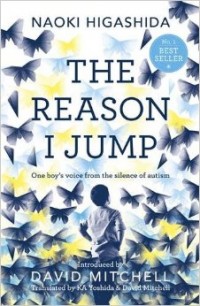
The Reason I JumpThe Reason I Jump: One boy’s voice from the silence of autism
by Naoki Higashida
translated from Japanese by K A Yoshida and David Mitchell

This was one of those random finds that make a great bookshop great. Not that it’s the best book ever, but it’s genuinely interesting and different and, despite being fairly new and translated by one of my favourite authors (plus his wife), I hadn’t heard of it. But it was on display in the non-fiction shelves and Mitchell’s name jumped out at me.

This is somewhere between a memoir and a factual study of autism. Higashida is autistic and at the time of writing was just 13 years old. He struggled with vocal communication, behaviour problems and even written communication, but had worked with his mother and a teacher to create an alphabet-grid system whereby he pointed at words or letters to be understood. (He did also learn to type on a computer and started a blog, so this book isn’t entirely miraculous.) With this book he found a way to explain his experience of autism that was fresh and new to parents and other adults who have regular contact with autistic children. It’s written in the form of questions and answers, with a few very short stories dropped in. There’s some lovely sections about how important nature is to Higashida, partly because it places no demands on him.

“Why do people with autism often cup their ears? Is it when there’s a lot of noise?

…The problem here is that you don’t understand how these noises affect us. It’s not quite that the noises grate on our nerves. It’s more to do with a fear that if we keep listening, we’ll lose all sense of where we are. At times like these, it feels as if the ground is shaking and the landscape around us starts coming to get us, and it’s absolutely terrifying. So cupping our ears is a measure we take to protect ourselves, and get back our grip on where we are.”

For many readers, Higashida’s words were a true breakthrough in their understanding of their own autistic child, and the book was a minor hit in his native Japan. One of those readers was Yoshida, and she immediately started to translate the book so that she could share it, initially with her husband and friends in Ireland, and then, once Mitchell had done some polishing and written an introduction, they published it to reach a much wider audience. There has apparently been some controversy about how much Mitchell polished, with some readers saying this doesn’t sound like a child’s writing. I must say I wholly disagree. Higashida sounds if anything surprisingly typical for his age – presumptive, repetitive and a little self-obsessed, thinking he’s learned to see the wider world but not really anywhere close to that yet.

I don’t mean to sound unkind. This is a very interesting and readable book about a condition that is incredibly difficult to understand. While nothing Higashida has to say was totally revelatory for me and he presumes to speak for all children with autism as if his own experience is universal, I’m really glad I have read it and can definitely see how valuable it could be to anyone who deals with autism. But let’s face it, Mitchell’s introduction is the best bit.

“Imagine a daily life in which your faculty of speech is taken away. Explaining you’re hungry or tired is now as beyond your powers as a chat with a friend… Now imagine that after you lose your ability to communicate, the editor-in-residence who orders your thoughts walks out without notice. The chances are that you never knew this mind-editor existed but, now that he or she has gone, you realize too late how they allowed your mind to function for all these years. A dam-burst of ideas, memories, impulses and thoughts is cascading over you, unstoppably.”

First published in Japanese in 2007.
This translation published 2013 by Sceptre.

Source: The Melton Bookshop.

Kate Gardner Reviews

Silence sits immense upon my soul

October 12, 2013 2 Comments

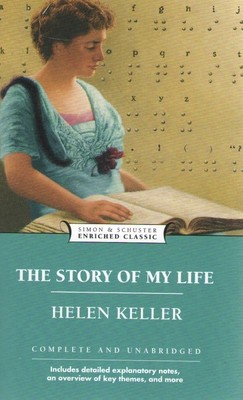
The Story of My Life

The Story of My Life
by Helen Keller

I had of course heard of Helen Keller and, knowing that she became a highly respected feminist, socialist and equal rights activist, I thought the story of her life might be pretty interesting. However, this book was written when she was in her early 20s, still studying at university, so really it’s all about her being deafblind. And that could still have been good, but, well, I found it odd.

That’s not to say it’s badly written, or even bad. For those not familiar with her, Helen Keller was the first deafblind person to receive a bachelor of arts degree, back in 1904. The fact that she was educated at all was pretty unusual for the time, and when she showed intellectual promise she became a bit of a sensation, which I guess is why she was able to publish an autobiography when she was still so young.

“When I try to classify my earliest impressions, I find that fact and fancy look alike across the years that link the past with the present. The woman paints the child’s experiences in her own fantasy.”

It’s certainly interesting to read a first-hand account of her early education – being introduced to the concept of words and language is already something I find fascinating, but how do you bring that concept to someone who can neither see the objects nor hear the words?

“Children who hear acquire language without any particular effort; the words that fall from others’ lips they catch on the wing, as it were, delightedly, while the little deaf child must trap them by a slow and often painful process. But whatever the process, the result is wonderful.”

The answer is largely via touch. Keller lost her sight and hearing aged 19 months and didn’t begin her education until she was 7. In-between she had formed her own understanding of the world through touch and an improvised sign language and remembers happily playing with the cook’s daughter and her own little sister. But once her family employed Anne Sullivan, a partially blind woman who had attended a special school for the blind, as her governess, she finally discovered language.

“There is nothing more beautiful, I think, than the evanescent fleeting images and sentiments presented by a language one is just becoming familiar with – ideas that flit across the mental sky, shaped and tinted by capricious fancy.”

It does suffer from being written by someone so young. It’s a bit naïve and quite defensive – I get the impression negative things had been written about her in the press and one of the aims of this book was to redress those points, which is understandable but doesn’t make for great writing. She also generalises quite a lot, not acknowledging that her situation is unusual not just because of her disability but equally because of the help she received.

It may seem like an odd reaction, but it bothered me that Keller didn’t seem aware of her advantages in life – clearly her family had money to invest in her education and her little bit of fame helped her too. Admittedly, the final chapter is basically one long acknowledgements section, but really many of those names and anecdotes should have been integrated into the main story, rather than it appearing that she got everywhere she did under her own steam. I know it’s not her fault that she is so often dependent on others, but I found it very odd to read, for example, the sentence “I enjoy a spin on my tandem bicycle” with absolutely no mention of the fact that someone else would always have to cycle it with her.

It is weird now how she was considered such a sensation purely for her disability, and perhaps I am a little hard on her because the tone is so very much in the vein of ‘look how much I’ve achieved’, which I find grating. Knowing that she later used her education, fame and experience to help others softens me toward her, but she isn’t yet that person when writing this. I am also a little put off by the religious overtones and language, which are partly of course a product of her time, and possibly even the nature of the books available to her in Braille.

The book is genuinely interesting when she discusses how she interacts with the world and how she learned to communicate – I would have liked more detail about that. In the early chapters you might be forgiven for not being sure what her disability is, as she often describes sights and sounds. It is quite a long way through the book when she acknowledges that “so many of my impressions come to me through the medium of others’ eyes and ears”. I loved the descriptions of her conversing with others by placing a hand on theirs as they sign words letter by letter using ASL. Or of her reading lips using her fingers. It is so hard to imagine and she manages to at least open the door to her world a crack.

“Silence sits immense upon my soul. Then comes hope with a smile and whispers, ‘There is joy in self-forgetfulness.’ So I try to make the light in others’ eyes my sun, the music in others’ ears my symphony, the smile on others’ lips my happiness.”

First published 1903.

Source: Project Gutenberg.

Challenges: This counts towards the Rory Gilmore Reading Challenge.

Kate Gardner Reviews

Non-fiction in fiction’s guise

September 1, 2011March 11, 2012 1 Comment

War is Boring
story by David Axe, artwork by Matt Bors

I am starting to acquire a collection of this “graphic novel style journalism” and I’m really liking it thus far. If anyone has any recommendations for more titles, let me know!

That said, this is not my favourite of the bunch. It’s a slim volume by war correspondent Axe and flits quickly through Chad, Iraq, Lebanon, East Timor, Afghanistan and Somalia, with really only a few short scenes in each place. Which is the point of the book but still not what I was expecting. I suppose I was hoping for a little more background behind each war; in fact I say “more” but in some cases we learn no more than “it’s a war zone”.

But I’m being unfair. Axe’s actual journalism about all these places was published elsewhere. This is not that. This book is about the effect of war on him, on his way of seeing the world. Or perhaps it’s not about war itself but solely about him and the type of person he is. You see, from the start his maxim is “War is boring, peace is much worse” and despite coming perilously close to bullets, explosions, rockets and deadly knives, this view of things doesn’t change.

While he calls himself a war junkie, Axe doesn’t seem to get a thrill from war, it’s just that a direct attempt on his life is the only thing that makes him feel alive. I can’t really understand that but then I’ve never experienced it; I suspect my whole world view would change.

I do empathise with Axe’s aim, which is to bring world conflicts and the people affected by them to wider attention. He genuinely cares and is deeply upset by what he sees when he travels to these places. His website, warisboring.com is part webcomic, part blog from the warzones that he continues to travel to and, with all the space of the internet, it seems to get deeper into the minutiae of each conflict visited, or even just Axe’s experience of each. There are photographs of soldiers in action and straight journalistic accounts alongside the panels of the comic and this combination works better, for me, than the comic alone.

As with previous examples of this genre, the artwork is excellent – detailed and illuminating without showing a lot of graphic violence. And the depiction of Axe himself is self-deprecating and self-aware and more likeable than not. Maybe he has since struck a better balance in life, but the book ends with a frighteningly bleak statement about the awfulness of humanity and the senselessness of violence that made me want to tell him to go see some beautiful things in-between wars – but then, I’m an optimist.

First published August 2010 by Penguin Books.

Kate Gardner Reviews

Not that Herzog one again

November 18, 2010March 11, 2012 1 Comment

It’s Only a Movie
by Mark Kermode

I bought this book at an author event for the Bath Literature Festival just before I launched this website. I thought about writing up the talk and book signing but writer’s block prevented me and I figured I’d just combine it with the book review I’d surely be writing in the following few weeks. And then the book sat around for 8 months before I read it. So all I can really remember about the event was that I had a great evening, Kermode was good fun, smug and self-deprecating at the same time, and I failed to think of anything to say to or ask him when I got my book signed. Hey ho.

This book, and indeed the talk about it, are really just like extended versions of listening to Kermode on the radio, which is something that I have enjoyed doing for about 16 years. He has a genuine deep-rooted love of and enthusiasm for film but he doesn’t come across as snobbish or exclusive in any way. I have always preferred his reviews to anyone else’s, even if I don’t agree with him any more or less often than other critics, and this book helped me to see why.

Firstly, he’s immensely knowledgeable on the subject. He has a PhD and is a visiting lecturer in film studies and all he has ever really wanted to do is review films. He genuinely enjoys watching as many films as he can and still finds time to watch his favourites over and over (and over). His favourite films aren’t highbrow inaccessible fare but the rather more approachable The Exorcist, Mary Poppins and Local Hero but he can argue intelligently and cogently why they are great films.

He’s also a good storyteller. He recognises good anecdotes and knows how to tell ’em well. He opens the book with the admission/warning that he has a bad memory and is prone to exaggeration, so this is the story of his life as seen through his own viewpoint, or rather camera angle. He uses the analogy of this being the film of his life (complete with who would play all leading roles), which is a fitting, if slightly cheesy, way of looking at it.

Some things I learned that I hadn’t previously realised (though perhaps if I was paying more attention over the years I’d have figured this out) – Kermode is an ardent feminist and formerly a bit of a political radical (a “red-flag-waving Bolshie bore” in his own words), a vegetarian (or “near-vegetarian”, according to Wikipedia) who keeps chickens as pets and he has an appalling lack of geographical knowledge (he once flew to Moscow to get to a film set in the Ukraine, failing to realise that Odessa is significantly closer to London than Moscow). Really the only one that’s a surprise and yet clearly affects his response to films is the feminism and I’m not sure why this surprised me. I certainly don’t disapprove; it’s good to see a high-profile, reasonable man talking feminism rather than it being a fight between extreme and less-extreme women.

This isn’t a very personal autobiography, it lives up to its title in that respect. While his wife and children get occasional mentions, this really is the story of Kermode’s love affair with film and his resultant career. Which is what he’s good at talking about, so fair enough. It’s structured thematically, with an almost chronological order, and really my only problem with it is that it starts and ends with that Werner Herzog incident, the one I watched on The Culture Show and read about in the paper and listened to Kermode talk about in various interviews since. Yes, it was interesting, shocking even, at the time, but it’s not the only interesting event in Kermode’s life and I do wish he’d stop banging on about it.

Published 2010 by Random House

Kate Gardner Reviews

Loser comedy

March 23, 2010March 11, 2012 1 Comment

How to Lose Friends and Alienate People
by Toby Young

This infamous “memoir” is funny and entertaining but not brilliantly written. Young repeats himself endlessly and uses too many quotes from philosophers and sociologists in an attempt to make himself sound intelligent. I’m sure he is, but that isn’t the way to convey it. He also rails on quite a bit about his slightly famous titled father, which gets tedious.

What this book does provide, and this is probably the basis for its success, is a satisfyingly glib insight into the more glamorous side of the media. He drops many a household name, giving away all sorts of details you can only assume no-one agreed to in advance. As a journalist who readily admits that he wasn’t suitable for the job he was given at Vanity Fair, Young’s viewpoint and experiences are accessible and even likeable, despite the title.

Apparently, if you want to know which friends he actually lost by writing this, you have to read the sequel, The Sound of No Hands Clapping, but I am not at all tempted. Young has a lot of fans, and maybe their ardour and hype had raised my expectations unnaturally high but, though I have no problem with the “loser” premise, I just didn’t think was very good.

Published 2002 by Abacus
ISBN: 978-0-3491-1485-9

Kate Gardner Reviews

Light on the heavy

March 7, 2010March 11, 2012 1 Comment

Petite Anglaise
by Catherine Sanderson

Having been a fan of the blog for years it’s not a huge surprise that I loved this book. It was the first blog I ever read and opened up a whole new world to me. Now the book has filled in many of the blanks that were necessarily kept out of the blog at the time.

I will add that, had I not read the blog, I very much doubt I would have been attracted to this book. I am not a fan of chick lit with all those pink covers and hapless heroines. That was a phase I went through as a teenager and even then I knew that the books were rubbish. This book is being marketed as chick lit and it does have some things in common with that genre – loveable heroine, an emphasis on the romances in her life, an easy-to-read style, approachable sense of humour. However, Petite Anglaise also deals with some serious, painful, life-altering events (and I don’t mean getting married) and a quick scan through the comments on Amazon proves that lovers of chick-lit are not the right market. Not to mention that it’s very well written.

For those who don’t know the background, Catherine Sanderson started the blog Petite Anglaise in 2004, documenting life as an Englishwoman living in Paris with her French partner and their baby daughter. As her relationship began to fall apart the writing became both more serious and more enticing, laced as it was with intense emotion. She eventually left her partner for a man she met through her blog and the story became one of the effort to be a good parent to her toddler while in the passionate throes of a new relationship. In 2006, Catherine was dumped and fired in a short space of time. Her employer cited her blog as the reason for firing her. Having taken great care to keep her real name, line of work and indeed any detail about that side of her life out of the blog, Catherine took her former employer to court claiming unfair dismissal and won.

Obviously much more has happened to Catherine since that day, but this is where the book ends and it is a suitable full stop. She is now a full-time writer and in 2009 announced that she was no longer going to blog, except for updates about her books. Her writing was always so good that you felt this was where she should end up and I look forward to reading more of her output.

Published 2009 by Penguin
ISBN: 978-0-1410-3119-4

Kate Gardner Reviews

Posts pagination

1 2

Archives

RSS Nose in a book

  • Book review: Interstellar Megachef by Lavanya Lakshminarayan
  • May 2026 reading round-up
  • Book review: Passing by Nella Larsen

Me on the internets

  • @kate_in_a_book@mas.to (Mastodon)
  • Flickr/noseinabook
  • Instagram/kate_in_a_book
  • StoryGraph/kate_in_a_book

Categories

  • Blog
  • Reviews
  • Uncategorized
Proudly powered by WordPress | Theme: Dream by vsFish.